




- The Reality of Hiring Magento Developers in the USA in 2026
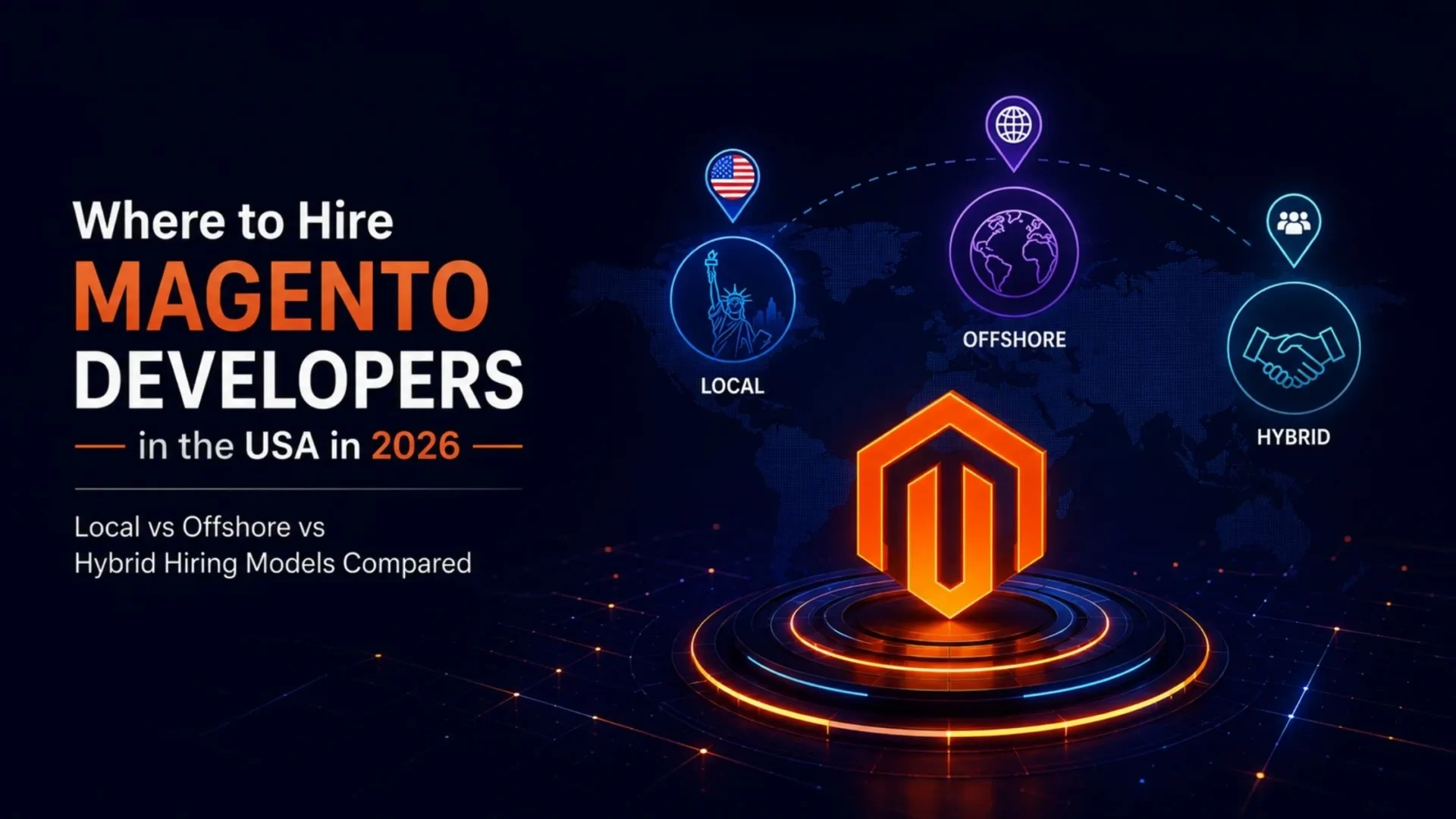
- Three Ways to Hire Magento Developers in the USA
- Model 1: Local US-Based Magento Developers
- Model 2: Offshore Magento Development Teams
- Model 3: Hybrid US + Offshore Hiring
- Cost Comparison: What You Actually Pay
- When Local US Hiring Is the Right Choice
- When Offshore Magento Hiring Is the Right Choice
- Why Most US Buyers Now Choose Hybrid Hiring
- What to Look For When Hiring a Magento Developer
- Red Flags to Avoid When Hiring Magento Developers
- Common Mistakes US Buyers Make When Hiring Magento Developers
- How to Decide: A 5-Question Framework
- Final Thoughts
- Frequently Asked Questions
- 1. How much does it cost to hire a Magento developer in the USA in 2026?
- 2. Is it better to hire a local Magento developer or go offshore?
- 3. How long does it take to hire a Magento developer in the United States?
- 4. Do I need an Adobe Commerce certified developer for my project?
- 5. What are the risks of hiring offshore Magento developers?
- 6. What should I check before hiring a Magento developer?
Hiring a Magento developer in the United States these days is not as straightforward as it used to be.
In 2026, most e-commerce businesses aren’t struggling because they can’t find developers. They’re struggling because the choices feel messy. Expensive local talent, fast offshore teams, hybrid setups that sound great but raise questions. And meanwhile, your launch deadline is creeping closer.
So the real question isn’t where to find a developer. It’s which hiring model actually works for your situation?
This guide breaks it down honestly, costs, timelines, trade-offs, the things people don’t always say out loud. If you’re planning to find Magento development services in the USA, this will help you decide with clarity, not assumptions.
Table of Contents
- The Reality of Hiring Magento Developers in the USA in 2026
- Three Ways to Hire Magento Developers in the USA
- Cost Comparison: What You Actually Pay
- When Local US Hiring Is the Right Choice
- When Offshore Magento Hiring Is the Right Choice
- Why Most US Buyers Now Choose Hybrid Hiring
- What to Look For When Hiring a Magento Developer
- Red Flags to Avoid When Hiring Magento Developers
- Common Mistakes US Buyers Make When Hiring Magento Developers
- How to Decide: A 5-Question Framework
- Final Thoughts
- Frequently Asked Questions
The Reality of Hiring Magento Developers in the USA in 2026
Let’s start with what’s actually happening in the market. Magento (or Adobe Commerce, as it’s now positioned) sits in a different category compared to platforms like Shopify. It’s more powerful, more flexible and yeah, significantly more complex. That complexity translates directly into talent scarcity.
There simply aren’t enough experienced Magento developers in the US. Especially senior ones. Most companies looking to hire Magento developers in the United States run into a few common realities:
- Hiring timelines stretch easily between 60 to 120 days for senior roles.
- Certified Adobe Commerce developers are concentrated in a small number of agencies
- Hourly rates are high and constantly rising
- Internal teams often burn time waiting for the “perfect” hire
And here’s the part that’s often underestimated – the cost of waiting. A delayed Magento launch doesn’t just push timelines. It affects revenue cycles, seasonal campaigns, and sometimes even internal morale. Teams end up juggling workarounds, patching things, doing just enough to keep things running.
Eventually, most US e-commerce businesses land on a mix of local and offshore resources anyway. Not always by design, sometimes just by necessity. Which is why understanding your hiring options early can save you, honestly, months of frustration.
Three Ways to Hire Magento Developers in the USA
Broadly, there are three paths companies take. None of them is universally “better”. It really depends on your project, your budget, and how much hands-on oversight you want.
Model 1: Local US-Based Magento Developers
This means direct full-time hires or working with a US-based agency. You get same-time-zone communication, easier onsite collaboration, and direct accountability. There’s no ambiguity about who you’re talking to.
The catch is cost and speed. Hourly rates for experienced local talent typically run $90–$200+ per hour, and as mentioned, hiring a senior person can take two to four months. This model tends to make the most sense for enterprise builds where onsite presence or strict compliance requirements are non-negotiable.
Model 2: Offshore Magento Development Teams
Offshore teams, usually based in India, Eastern Europe, or Southeast Asia, cost a fraction of local rates, around $25–$60 per hour. You can also get a developer or small team onboarded in one to four weeks, much faster than local hiring.
This fits cost-sensitive projects, long retainers, and maintenance work with a clear scope. It just needs a bit more structure on your end.
Model 3: Hybrid US + Offshore Hiring
This is where you get a US-based project lead, account manager, or solution architect overseeing an offshore delivery team that handles the actual development, QA, and support work. Blended rates usually land around $50–$100 per hour.
Honestly, this has become the default choice for most US Magento buyers in 2026, and not because it’s the trendy option, but because it solves the core tension between cost and communication that pure local or pure offshore engagements tend to struggle with. You’re not paying full US rates for every hour of work, but you’re also not left guessing what’s happening on the other side of the world.
Cost Comparison: What You Actually Pay
Numbers help more than adjectives here, so let’s lay it out plainly.
| Factor | Local US Hiring | Offshore Hiring | Hybrid Model |
|---|---|---|---|
| Hourly rate range | $90–$200+ | $25–$60 | $50–$100 (blended) |
| Senior developer monthly cost | $15,000–$32,000 | $4,000–$9,500 | $8,000–$16,000 |
| Hiring timeline | 60–120 days | 1–4 weeks | 2–6 weeks |
| Time zone overlap | Full | Limited (2–5 hrs typical) | Full via US lead |
| Communication ease | Highest | Requires structure | High via US lead |
| Certification availability | Limited | High in India/Eastern Europe | High |
| Project oversight | Direct | Requires protocols | Built-in via US lead |
| Best for | Onsite-required enterprise builds | Cost-sensitive, long-term work | Most mid-market and enterprise projects |
| Annual cost (1 senior dev) | $180,000–$385,000 | $48,000–$114,000 | $96,000–$192,000 |
The gap between local and offshore annual costs is enormous. We’re talking a difference of well over $200,000 in some cases for a single senior developer. But cost isn’t the only variable that matters.
For projects running longer than about three months, the hybrid model tends to deliver the best total cost of ownership. You keep a US point of contact who understands your business context and can flag issues early, while the bulk of development happens at offshore rates.
Pure offshore engagements, on the other hand, work fine for clearly scoped projects run by buyers who already know how to manage remote teams.
If you want a deeper breakdown of how Magento project pricing actually works, our Magento development cost page goes into more detail.
When Local US Hiring Is the Right Choice
Local hiring isn’t outdated, and it’s not the wrong call for everyone. There are real situations where it’s genuinely the better option.
- Your project requires deep onsite collaboration, in-person workshops, or whiteboard sessions.
- Compliance requirements mandate US-based development teams (healthcare, government, defense-adjacent ecommerce often fall here)
- You’re building a small internal team and want full-time employees on payroll, not contractors.
- Your budget comfortably supports premium US rates, and you wish for direct, same-time-zone communication.
- The project is short and complex enough that it’s better to be solved in person, not over Slack
- You already have a US Magento agency relationship that’s delivered well in the past.
None of these are vague preferences. They’re operational realities that should weigh into the decision.
When Offshore Magento Hiring Is the Right Choice
On the flip side, offshore hiring is the right call more often than people assume, especially once you understand the benefits of offshore team setups versus pure onshore arrangements.
- Cost predictability and budget efficiency matter as much as outcomes. You need the math to work, not just the result
- You already have an internal project manager who knows how to run structured remote engagements
- Your project is long-running (three months or more), where offshore economics really compound in your favor
- You need access to Adobe Commerce certified developers, who are genuinely less in the US than in India or Eastern Europe
- You want to scale a dedicated team fast, without the overhead of a full hiring process
- You’re running ongoing maintenance, support, or migration work rather than a one-time sprint
This isn’t a sales pitch for offshore. It’s just where it tends to make sense, and where it doesn’t.
Why Most US Buyers Now Choose Hybrid Hiring
Talk to enough US e-commerce teams and you’ll hear the same complaint about pure offshore hiring: not bad work, just communication risk. Delays. Misunderstandings.
Hybrid fixes that with one simple move. A US-based lead sits between you and the offshore team. That person owns the relationship, turns your priorities into technical tasks, and is reachable during your normal working hours.
Time zones overlap more than people expect, too. A typical India-based team works around 4 PM–12 AM IST, which lines up with roughly 6:30 AM–2:30 PM EST. That’s real working hours together, not just a weekly check-in call.
A US lead joins daily standups, owns sprint planning, and handles escalations directly. No chasing answers across a 12-hour gap. Over a long engagement, this also tends to cost less than constantly renegotiating local contractor rates.
This setup shows up most on Magento 2 replatforms, ongoing feature work for growing DTC brands, and multi-month maintenance retainers, work where steady delivery matters more than a fast start.
What to Look For When Hiring a Magento Developer
The evaluation criteria remain roughly the same, regardless of which model you choose:
- Adobe Commerce certifications, and proof they’re actually real (not just listed on a resume)
- A documented Magento 2 / Adobe Commerce project portfolio, not generic “ecommerce experience”
- References from at least three previous US clients, ideally ones you can actually call
- Clear communication protocols and a defined escalation path when something goes wrong
- Time zone overlap during your core working hours, however that’s structured
- Pricing transparency – not “contact us for a quote” with no further detail
- Documented quality assurance and code review standards.
- English communication fluency across the people you’ll actually be talking to
- Low developer turnover; ask directly how long their team members typically stay
- Familiarity with US e-commerce compliance: PCI DSS, ADA/WCAG accessibility standards, and state-level privacy laws
It’s worth saying, the wrong Magento developer doesn’t just deliver bad code. They cost you launch dates, traffic, and conversion revenue that compound for months afterward. This is rarely a decision worth rushing.
Red Flags to Avoid When Hiring Magento Developers
A few warning signs come up again and again across hiring mistakes we’ve seen US buyers make:
- Hourly rates that seem too good to be true; often a sign of junior talent, unvetted freelancers, or undisclosed subcontracting
- Vague or unverifiable certifications that can’t be checked against Adobe’s own records
- Reluctance to provide US client references, or references that all happen to be unreachable
- Heavy account management layers with no direct access to the actual developers doing the work
- Pre-built templates marketed as fully custom Magento builds
- No documented testing or QA process beyond “we tested it before launch”
- Missing handover or knowledge transfer protocols if the engagement ends
- Pressure tactics during the sales process, urgency that doesn’t match the actual project timeline
- Contracts that skip IP ownership clauses or NDAs entirely
- High developer turnover mid-engagement, where you keep onboarding new people to the same project
None of these automatically disqualify a vendor on their own. But two or three together is usually worth pausing on.
Common Mistakes US Buyers Make When Hiring Magento Developers
Some mistakes show up so often they’re almost predictable at this point:
- Choosing the cheapest option without evaluating actual delivery capability
- Hiring a single developer when the project really needs a small team (frontend, backend, QA)
- Underestimating the project management overhead that comes with offshore-only setups
- Assuming “certified” automatically means “senior”; they’re related, but not the same thing
- Skipping reference checks because the portfolio looked good enough on its own
- Not defining scope, milestones, and acceptance criteria clearly before work starts
- Treating Magento and Adobe Commerce development as interchangeable with general PHP skills
- Forgetting to budget for ongoing maintenance after launch
Most of these aren’t expensive to fix early. They get expensive once you’ve already signed a six-month contract.
How to Decide: A 5-Question Framework
If you’re still comparing the options, look for these five questions honestly:
- What’s your actual project budget and timeline? Be specific. Unclear budgets lead to vague hiring decisions.
- Does the work genuinely require onsite presence or compliance-driven US-based teams? If yes, that narrows things toward local hiring quickly.
- How mature is your internal project management capability? If you don’t have someone who can run a structured remote engagement, hybrid is probably the safer bet over pure offshore.
- Is this a one-time build or an ongoing engagement? Longer engagements tend to favor offshore or hybrid economics.
- Do you need Adobe Commerce certified developers, and how fast? If certification availability matters and timing is tight, offshore or hybrid will get you there faster than a local-only search.
Most companies land on hybrid once they work through these honestly, not because it’s the “safe” answer, but because it tends to match the realistic budget and timeline most mid-market projects actually have.
That said, if both questions two and four clearly indicate a local focus, that’s also a perfectly valid conclusion.
Final Thoughts
Hiring a Magento developer in the USA in 2026 isn’t really a question of local versus offshore anymore. It’s a question of which model, local, offshore, or hybrid, fits your project’s complexity, budget, and timeline. For most US e-commerce brands today, hybrid has become the default because it keeps communication quality and accountability intact while still delivering the cost predictability that pure US hiring just can’t match.
The right choice always starts the same way: define your project clearly enough that you can actually evaluate hiring options on merit, not assumption.
If you’re weighing how to hire a Magento developer for your US-based business, Elsner’s hybrid model pairs US-based account leads with certified Adobe Commerce developers. You can explore our hire dedicated Magento developer services or talk to our team about what fits your specific project.
Ready to Hire the Right Magento Team?
Elsner’s hybrid model pairs US-based account leads with certified Adobe Commerce developers. Let’s scope what fits your project, budget, and timeline.
Frequently Asked Questions
1. How much does it cost to hire a Magento developer in the USA in 2026?
It depends on the model. US developers usually charge $90–$200+ per hour, offshore teams cost $25–$60, and hybrid models fall somewhere in between.
2. Is it better to hire a local Magento developer or go offshore?
There’s no single right answer. Local works better for close collaboration, offshore is more cost-effective, and hybrid gives you a balance of both.
3. How long does it take to hire a Magento developer in the United States?
Local hiring can take 2-4 months. Offshore teams can start in a few weeks, and hybrid setups usually take around 2-6 weeks.
4. Do I need an Adobe Commerce certified developer for my project?
Not always. Certifications help, but real experience and problem-solving skills matter more for most projects.
5. What are the risks of hiring offshore Magento developers?
Mainly communication and coordination issues. With proper processes or a hybrid model, these risks can be managed well.
6. What should I check before hiring a Magento developer?
Look for real Magento experience, past client work, clear communication, and transparent pricing. Don’t rely on claims alone.