



- What Codex and Claude Code actually are (and why the distinction matters for businesses)
- Codex vs Claude Code: the head-to-head breakdown
- Agent behavior and task execution
- Pricing and usage limits at team scale
- GitHub integration: the enterprise differentiator
- Terminal UX and configuration depth
- Security, compliance, and enterprise controls
- Where each tool genuinely pulls ahead
- The part most comparisons skip: what this decision costs beyond the subscription
- Benchmarks: what the numbers actually show
- Codex vs Claude Code: the features that matter most in 2026
- When neither tool is the answer: the case for AI development expertise
- The enterprise pilot playbook: how to evaluate both before committing
- What changes once your team is running an AI coding agent at scale
- Evaluating AI coding agents for your engineering team?
- Frequently asked questions
- What is the main difference between Codex and Claude Code?
- Is Codex or Claude Code better for enterprise teams?
- How does Codex vs Claude Code pricing compare at scale?
- Can Codex and Claude Code be used together?
- Is Codex open source?
- How does Claude Code’s MCP ecosystem work?
- What should enterprise teams watch out for when adopting AI coding agents?
The debate around Codex vs Claude Code has moved well past Reddit threads and developer Twitter. Engineering leaders at growth-stage companies and enterprise teams are now asking their AI strategy consultants the same question: which one do we actually invest in, and what does that decision mean for our workflows, budget, and team over the next 12 months?
This isn’t the comparison you’ll find written by a solo developer choosing a personal subscription. This is built for teams making an organizational commitment, where the wrong choice means retraining, switching costs, and frustrated engineers. The stakes are different, and so is the analysis.
Here’s what we’ll cover: how each tool actually works under the hood, what the pricing looks like at team scale, how they handle enterprise concerns like security and GitHub integration, where each one genuinely pulls ahead, and when a business should bring in an AI development partner rather than letting teams figure it out independently.
Quick Answer
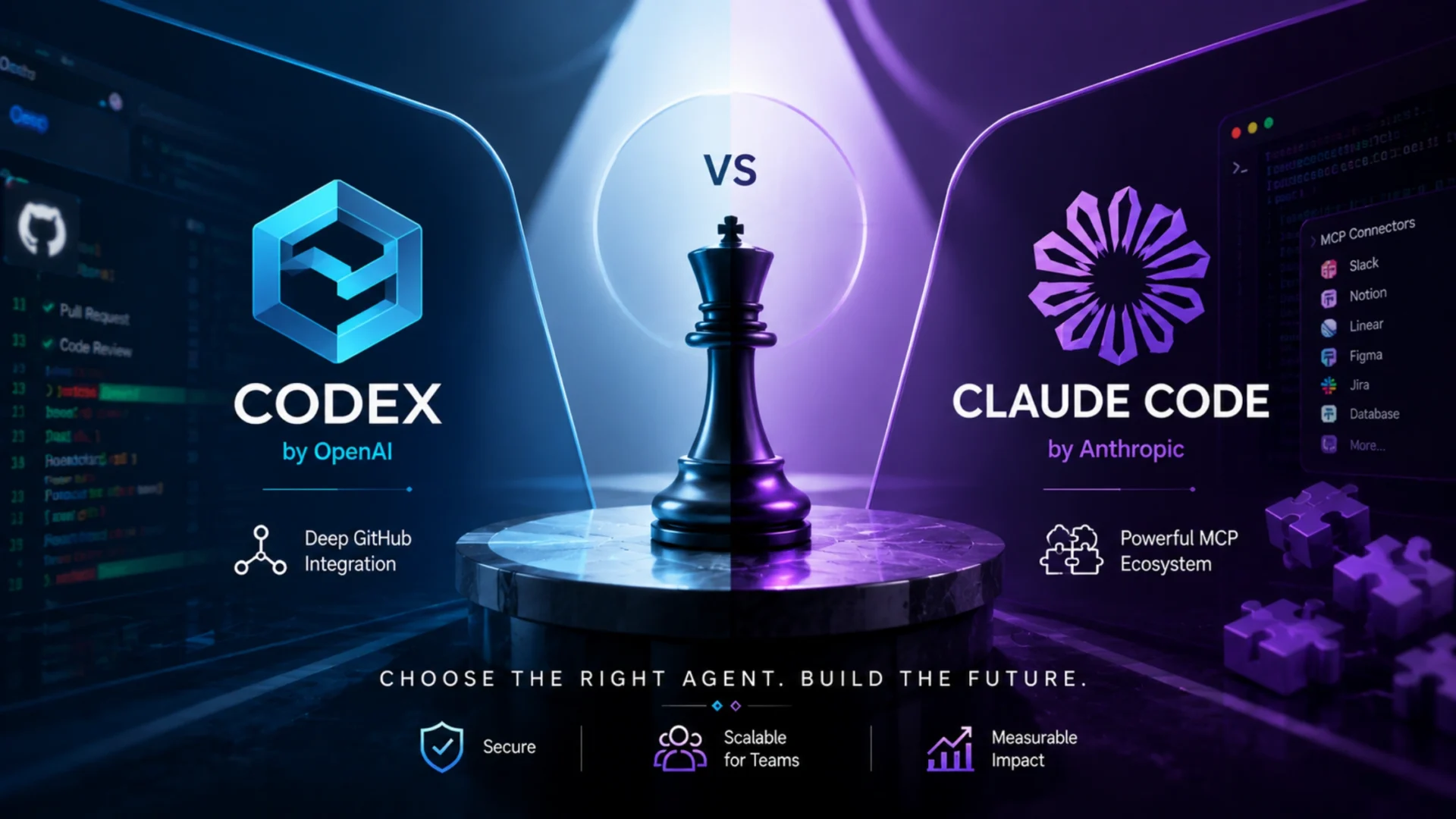
Codex vs Claude Code is not a clean winner-takes-all decision for enterprise teams. OpenAI Codex leads on pricing flexibility, GitHub integration, and model choice controls. Claude Code leads on terminal UX, configuration depth, and MCP connector ecosystem. The right call depends on where your team spends most of its time: in GitHub workflows and background automation, or in deep interactive coding sessions with custom toolchains. Most teams will benefit from piloting both before committing at scale.
What Codex and Claude Code actually are (and why the distinction matters for businesses)
Before comparing them, it’s worth being precise about what these tools are, because marketing language has made both sound like magic assistants when the reality is more structured.
Both are what the industry calls AI coding harnesses. Think of the underlying model, whether that’s GPT-5 Codex from OpenAI or Claude Sonnet/Opus from Anthropic, as the brain. The harness is everything wrapped around it: the file system access, the permission model, the workflow layer, the terminal interface, the memory between tasks, and the way it interacts with your actual codebase. That harness is where the real differences live.
OpenAI Codex launched as a CLI tool and has expanded into a desktop app, a VS Code extension, a web interface, a Slack integration, and a GitHub app that works in the background. It runs on the GPT-5 Codex model family, which OpenAI continues to update actively. As of mid-2026, the current model is GPT-5.3-Codex with real-time steering support mid-task.
Claude Code started as a terminal-first CLI tool with a strong configuration system. It now has a desktop app, a VS Code extension, a web IDE for remote control, parallel session support, and a feature called Cowork that extends it beyond coding tasks. It runs on Claude Sonnet and Opus models, and supports the Model Context Protocol, which is a growing ecosystem of one-click connectors to external services.
For enterprise teams, this matters because neither tool is just a chatbot. You’re choosing an agent infrastructure that your engineers will live inside for hours every day. The depth of that infrastructure, not the raw model intelligence, is usually what makes or breaks adoption.
Codex vs Claude Code: the head-to-head breakdown
Let’s move through the dimensions that actually affect a team’s decision, rather than the ones that sound impressive in product demos.
Agent behavior and task execution
Honestly, both tools have converged more than the product teams would probably like to admit. The core agent behavior, handling multi-step tasks, writing and editing files, running terminal commands, tracking a to-do list across a session, is similar enough that engineers switching between them won’t need a major mental model shift.
The observable differences are subtle but consistent. Codex tends to reason longer before acting. It spends more tokens thinking through a problem before it starts writing output. Claude Code reasons faster and moves to output sooner, which can feel snappier for quick edits but occasionally means it starts down a path before fully thinking through the consequences. Neither approach is universally better. It depends on the task type.
Codex also offers explicit reasoning controls: low, medium, high, and minimal. For enterprise teams running many small tasks at speed, the ability to dial down reasoning overhead on routine work and dial it up for complex refactors is genuinely useful. Claude Code gives you model selection between Sonnet and Opus, but less granularity within a model.
For enterprise teams: If your engineers are doing mixed-complexity work throughout the day, Codex’s reasoning granularity is a practical advantage. If your team is doing deep, complex sessions where configuration and custom hooks matter more than speed, Claude Code’s system is more mature.
Pricing and usage limits at team scale
This is where the Codex vs Claude Code conversation gets real for finance and procurement teams. On paper, the pricing tiers look similar. Both have a roughly twenty-dollar individual tier, a mid-tier around a hundred dollars, and a higher two-hundred-dollar option. In practice, the experience at each tier is meaningfully different.
Claude’s seventeen-dollar plan hits limits faster than most active developers expect. Even the hundred-dollar plan catches heavy users on context-heavy sessions. The number one complaint from engineering teams trialing Claude Code at scale is running into credit ceilings mid-session, which is a real productivity disruption.
Codex Pro at the hundred-dollar tier seems to handle heavy usage more generously in practice. Part of this is model efficiency: GPT-5 Codex runs at roughly half the token cost of Claude Sonnet per equivalent output, according to current API pricing comparisons. That efficiency gap means Codex stretches further at each plan tier.
| Plan tier | Codex experience | Claude Code experience | Enterprise verdict |
|---|---|---|---|
| ~$20/month | Comfortable for moderate use; most developers won’t hit ceilings daily | Limits hit quickly during active sessions; frustrating for full-day use | Codex edge |
| ~$100/month | Generous; heavy users rarely report hitting limits at this tier | Better, but power users still encounter ceilings on Opus-heavy workflows | Codex edge |
| ~$200/month | Pro tier; open-source SDK allows further customization for enterprise | Max tier; strong for teams needing deep configuration and MCP connectors | Depends on use case |
| API / Enterprise | Available; Codex SDK enables custom agent builds on top of the model | Available; Claude API supports custom tooling and internal integrations | Tie; both require custom implementation |
One thing worth noting: both plans also include the parent chat product. Codex seats come with ChatGPT access, including image and video generation. Claude Code seats come with Claude.ai, which has stronger MCP integrations. For teams that want a full AI suite bundled with their coding tool, this bundled value matters when calculating per-seat ROI.
GitHub integration: the enterprise differentiator
This is the section most enterprise teams should read twice. GitHub integration isn’t a feature, it’s a workflow multiplier. And the two tools are not close here.
Codex’s GitHub app is the real story. Install it, enable auto code review on a repo, and it runs in the background continuously. It finds legitimate bugs inline, lets reviewers ask it to fix issues directly in the PR thread, and supports @Codex mentions on any GitHub issue, not just during code review. A developer spots a bug, tags @Codex in the issue, and the fix arrives without anyone switching tools. The PR loop from discovery to merge becomes genuinely tighter.
What makes it stick for engineering teams is consistency. The Codex CLI, the GitHub app, and the web interface all run on the same model and respect the same Agents.md configuration file. Prompts that work in the terminal work from GitHub. That consistency isn’t something you’d notice until you miss it.
Claude Code’s GitHub integration is functional but has drawn mixed reviews. Code reviews tend to be verbose without surfacing the most actionable issues. Commenting workflows aren’t as fluid. That said, Anthropic has shipped improvements in 2026, and the gap has narrowed from where it was at initial launch.
The enterprise bottom line on GitHub
If your team’s development velocity lives inside GitHub, Codex is the stronger choice right now. The background review loop, issue-to-fix workflow, and @Codex mention system solve real engineering bottlenecks that go beyond “AI helps me write code faster.”
Terminal UX and configuration depth
Flip it around, and Claude Code takes the lead. The terminal experience is noticeably more polished. Permission management is more granular. Slash commands, custom hooks, sub-agents, and the ability to configure exactly what Claude can and can’t do in a session all make it the better tool for teams that want deep control over agent behavior.
Claude.md files give teams fine-grained control over how the agent behaves on a per-project basis. The MCP connector ecosystem is growing fast and already includes one-click connections to services like Slack, Notion, Google Drive, and dozens of other tools engineers use daily. This is valuable for teams building internal tooling or workflows that touch many systems.
One thing that has frustrated some enterprise adopters: Claude Code doesn’t support the Agents.md standard that Codex, Cursor, and several other tools use. If your team runs multiple AI tools and wants one shared instruction file, Claude Code requires a separate Claude.md. That’s a minor friction point but worth knowing before rollout.
Security, compliance, and enterprise controls
Neither tool has published a comprehensive enterprise security whitepaper that covers every concern a compliance team will raise. That gap is real, and it’s something procurement will flag. What we do know:
Codex is open source at the CLI level, which means security teams can audit what the agent is doing and build internal guardrails. The open-source nature is an advantage for organizations with strict requirements around third-party tooling.
Claude Code’s permission system is more configurable out of the box, which helps teams that want to define exactly what files and commands the agent can touch without writing their own wrapper. Anthropic’s reputation for safety-first model behavior also carries weight in regulated industries.
For teams in healthcare, finance, or government contexts, the honest answer is: both tools need evaluation against your specific compliance framework. Neither is a plug-and-play enterprise solution without some custom governance work. That’s a gap where working with an AI strategy consulting partner pays off, because the integration layer, not the tool itself, is usually where compliance issues surface.
Where each tool genuinely pulls ahead
Cut through the comparison tables and the answer simplifies into use-case buckets.
Choose Codex when…
- Your team’s development workflow is deeply tied to GitHub
- You want background PR review running automatically across repos
- Cost efficiency at scale matters, especially at the $20 tier
- You want reasoning granularity controls for mixed-complexity workloads
- You’re building custom agent tooling and want open-source access to the CLI
- Your team uses ChatGPT and wants a bundled suite
- You use Agents.md across multiple AI tools and want consistency
Choose Claude Code when…
- Your engineers do deep, configuration-heavy interactive coding sessions
- You need granular permission controls over what the agent can access
- You want MCP connectors to tie the agent into other internal tools
- Custom hooks and slash commands matter for standardized team workflows
- You’re already in the Anthropic/Claude ecosystem for other work
- You want sub-agent support for parallel task execution
- Terminal UX polish and maturity is a priority for your team
The part most comparisons skip: what this decision costs beyond the subscription
Subscription cost is the easy number to compare. The harder costs rarely show up in vendor demos. Enterprise teams should think through all of these before committing.
Onboarding and ramp time
Both tools have a learning curve, but it’s a different shape. Codex is faster to get value from for teams already in GitHub workflows. Claude Code’s full power requires engineers to invest time in Claude.md configuration, hook setup, and learning the slash command system. That’s time worth spending, but budget for it.
Integration work with existing toolchains
Neither tool plugs into a complex enterprise stack without some integration work. Internal auth systems, private repos, proprietary APIs, and compliance logging all require configuration. The open-source Codex CLI makes this more customizable. Claude Code’s MCP ecosystem offers more pre-built connectors. The right choice depends on whether you need custom-built or pre-built.
Model volatility risk
Both Anthropic and OpenAI update models frequently. In March 2026, Anthropic’s engineering blog publicly acknowledged a performance reduction in Claude Code that users had flagged on Reddit and Hacker News, later attributed to latency optimization efforts. OpenAI ships new Codex model versions regularly, meaning behavior can shift between updates. Teams building critical workflows on top of either tool should version their instruction files and run regression checks when models update.
Switching costs
If your team invests six months in Claude.md configuration and custom hooks, switching to Codex isn’t free. Same the other way around. Choose thoughtfully, because the deeper you go into either tool’s configuration layer, the more investment you’re locking in. This isn’t a reason to avoid depth. It’s a reason to pilot seriously before standardizing.
Benchmarks: what the numbers actually show
Benchmark data for AI coding tools is noisy, and anyone presenting a single number as the verdict is oversimplifying. That said, the available data does tell a consistent story.
On SWE-bench Pro, which tests software engineering task completion across real-world coding challenges, Codex and Claude Code land in a similar range as of mid-2026. Neither has a dominant lead on that benchmark.
On Terminal-Bench 2.0, which specifically tests terminal-style task performance, Codex shows a more noticeable lead. That benchmark matters more if your team’s workflow is command-line heavy.
User sentiment data from Builder.io’s production usage showed that users rated GPT-5 Codex roughly 40 percent higher on average than Claude Sonnet in their internal testing. That’s a significant number but also one data point from a company with a specific workflow. Different team environments produce different results.
The honest read on benchmarks: Run your own. Pick three representative tasks your team does every week, run both tools on them with identical prompts, and measure time-to-acceptable-output and error rate. Internal benchmarks beat published ones because they reflect your actual codebase, not a standardized test set.
Codex vs Claude Code: the features that matter most in 2026
A clean side-by-side for teams doing a formal evaluation.
| Feature | Codex | Claude Code |
|---|---|---|
| GitHub PR review (auto) | Strong; inline comments, @Codex mentions, background review | Functional; verbose, less actionable in practice |
| Terminal UX quality | Good | Excellent; more mature and polished |
| Custom configuration depth | Good; open-source CLI, Agents.md support | Excellent; hooks, slash commands, sub-agents, Claude.md |
| External tool connectors | Slack, GitHub, VS Code; growing | MCP ecosystem; 1-click connectors to 50+ services |
| Reasoning control | Low/medium/high/minimal settings | Model selection (Sonnet vs Opus) only |
| Cost efficiency at scale | Stronger; GPT-5 Codex runs at ~half Claude Sonnet API cost | Higher per-token cost; Opus-heavy workflows add up |
| Open source availability | Yes; CLI is open source on GitHub | No |
| Image input support | Yes; screenshots, wireframes, diagrams | Yes |
| Parallel sessions | Yes; multi-agent v2 support | Yes; desktop app parallel sessions |
| Permission persistence between sessions | Good; repo-aware defaults | Partial; settings don’t fully persist in all workflows yet |
When neither tool is the answer: the case for AI development expertise
Here’s the thing most comparison articles won’t say: for a significant portion of enterprise use cases, neither Codex nor Claude Code is the primary solution. They’re productivity tools for engineers. They don’t design your AI architecture. They don’t build the data pipelines your models depend on. They don’t handle deployment, monitoring, governance, or the integration layer between your AI tooling and your business systems.
If your organization is trying to ship AI-powered features, automate complex internal workflows, or build agents that actually do useful work in production, the conversation needs to go deeper than which coding assistant your developers use day to day.
What typically gets underestimated is the infrastructure underneath. Clean data pipelines. Model deployment and versioning. Proper orchestration for multi-agent workflows. Security controls that satisfy compliance teams. Those layers don’t come with a Codex or Claude Code subscription. They require intentional design and experienced AI agent development work.
Teams that get the most out of tools like Codex and Claude Code are usually the ones that already have a solid AI foundation. Good data engineering practices. Clear model governance. A deployment infrastructure that doesn’t rely on one person who knows how everything fits together. Without that foundation, even the best coding agent produces output that’s harder to ship safely.
That’s also where data engineering and MLOps expertise becomes relevant. Getting those layers right before you scale AI tooling adoption is the difference between a team that ships consistently and one that spends half its time debugging why the AI output doesn’t match what production actually needs.
The enterprise pilot playbook: how to evaluate both before committing
Don’t let a vendor demo or a blog post make this decision. Run a structured pilot. Here’s the approach that gives you real signal without a six-month commitment.
A four-week evaluation framework
Week 1: Baseline your current workflow. Document where engineers spend time today. Code review, debugging, writing boilerplate, documentation. Pick three tasks that represent your typical week. These become your benchmark tasks.
Week 2: Run Codex on those three tasks. Measure time-to-acceptable-output, number of corrections needed, and engineer satisfaction on a simple 1-5 scale. Also test the GitHub integration on one real PR.
Week 3: Run Claude Code on the same tasks. Same metrics, same engineers. Give the team a day to configure Claude.md before starting. The setup time is part of the real-world cost, so include it.
Week 4: Review the numbers and the qualitative feedback. Time-to-output and error rate tell part of the story. Engineer preference often tells a different one. If your team genuinely wants to use one tool over the other after two weeks, that preference matters for adoption, and adoption is where ROI actually comes from.
The rollout decision: Standardize on the tool that won on your benchmark tasks, not the one with the best marketing. And consider whether your workflow actually benefits from standardizing at all. Some enterprise teams run Codex for their GitHub-heavy backend teams and Claude Code for their internal tooling teams. That’s not fence-sitting. That’s matching the right tool to the right job.
What changes once your team is running an AI coding agent at scale
This is the section teams rarely think through before rollout. The productivity gains are real. So are the organizational shifts that come with them.
Code review changes. When an agent writes the first draft of a PR, reviewers shift from reading every line to verifying intent and catching the errors the agent made confidently. That’s a different skill. Teams that don’t adapt their review culture end up with higher code volume and no proportional increase in review quality.
Onboarding accelerates, but differently than expected. New engineers get productive on unfamiliar codebases faster because the agent can explain context. But they also build less intuition about why the code works the way it does. Intentional onboarding practices become more important, not less.
Technical debt can accumulate faster. AI-generated code is syntactically clean and often logically correct. It’s also sometimes architecturally lazy: it solves the immediate problem in a way that adds complexity five iterations later. Engineering leads who don’t maintain architecture review as a discipline will notice the debt accumulating after about six months.
The teams that handle this best treat the AI agent as a capable junior engineer, useful, fast, needs supervision on architecture decisions. That framing sets the right expectations for both what to delegate and what to keep human.
Evaluating AI coding agents for your engineering team?
Elsner’s AI development team helps enterprises evaluate, integrate, and scale AI tooling the right way, with the infrastructure, governance, and workflows your team actually needs underneath.
Frequently asked questions
What is the main difference between Codex and Claude Code?
Codex is OpenAI’s AI coding agent built on the GPT-5 Codex model family, with strong GitHub integration and an open-source CLI. Claude Code is Anthropic’s AI coding agent built on Claude Sonnet and Opus models, with a more mature terminal UX, deeper configuration options, and a growing MCP connector ecosystem. Both are harnesses around underlying AI models, not the models themselves.
Is Codex or Claude Code better for enterprise teams?
It depends on your primary workflow. Teams whose development loop is centered on GitHub will generally get more value from Codex, particularly its background PR review and @Codex mention system. Teams doing deep interactive coding sessions with custom toolchains and complex permission requirements will typically find Claude Code’s configuration depth more valuable. Running a structured four-week pilot on your actual tasks is the most reliable way to decide.
How does Codex vs Claude Code pricing compare at scale?
On paper the plan tiers look similar, but in practice Codex tends to be more cost-efficient at scale. GPT-5 Codex runs at roughly half the token cost of Claude Sonnet at the API level, meaning budgets stretch further. Heavy users on Claude’s lower tiers frequently hit context ceilings. At the $100 and $200 tiers, both tools become more comfortable, but Codex Pro still receives fewer complaints about running out of credits from power users.
Can Codex and Claude Code be used together?
Yes, and some enterprise teams do exactly this. A common setup uses Codex for GitHub-integrated workflows and background PR review, while Claude Code handles deep interactive sessions where configuration depth and MCP connectors add value. The main friction is that Claude Code uses Claude.md rather than the Agents.md standard that Codex supports, so instruction files aren’t directly portable between the two tools.
Is Codex open source?
Yes. The Codex CLI is open source and available on GitHub. This gives enterprise security teams the ability to audit the agent’s behavior, build internal wrappers, and customize the tool in ways that closed systems don’t allow. Claude Code’s CLI is not open source, though its configuration system gives teams significant control over what the agent can access.
How does Claude Code’s MCP ecosystem work?
MCP stands for Model Context Protocol, an open standard for connecting AI models to external tools and data sources. Claude Code supports MCP natively, which means teams can connect it to services like Slack, Notion, Google Drive, and dozens of other tools through one-click integrations. This lets the coding agent pull context from or push actions to external systems without manual copy-pasting. Codex doesn’t currently have an equivalent pre-built connector ecosystem of the same breadth.
What should enterprise teams watch out for when adopting AI coding agents?
Four things matter most: code review culture (AI-generated code changes what reviewers need to check for), architectural discipline (agents produce clean code that can still accumulate technical debt), model volatility (both providers update models frequently, which can shift behavior), and the infrastructure underneath (neither tool replaces the need for proper data pipelines, deployment systems, and governance). Teams that treat AI coding agents as a productivity layer on top of a solid engineering foundation get far better results than teams that deploy them into an undisciplined environment.