




- What Is Magento Programming?
- Core Areas of Magento Programming
- Magento Programming vs Magento Development
- Why Magento Programming Matters for eCommerce
- What Programming Languages Does Magento Use?
- PHP (Primary Backend Language)
- MySQL / MariaDB (Database Layer)
- XML (Configuration and Layout)
- JavaScript (Frontend and Admin)
- HTML, CSS, and LESS (Theme Layer)
- GraphQL and REST APIs
- Magento Architecture: How Magento Programming Works Under the Hood
- Modular Structure
- MVC Pattern (Model-View-Controller)
- Dependency Injection (DI)
- Plugins, Observers, and Preferences
- Service Contracts and Repositories
- Custom Module Development in Magento Programming
- Module Directory Structure
- Registration and Configuration
- Building Controllers and Routes
- Models and Database Programming
- Frontend Output with Blocks and Templates
- Advanced Magento Programming Techniques for Scale
- Custom Modules Over Stacked Extensions
- API-First and Headless Architecture
- Database Optimization Techniques
- Layered Caching Strategy
- Asynchronous Processing with Message Queues
- Magento Programming for Performance and Conversion
- Core Web Vitals Optimization
- Custom Checkout Programming
- Image Optimization and Lazy Loading
- JavaScript Bundling and Minification
- Is Your Magento Store Losing Speed as It Grows?
- Magento Programming for Enterprise Scale
- Multi-Store Architecture
- Cloud Hosting Optimization
- Load Balancing and Auto Scaling
- Microservices and Composable Commerce
- Magento Security Programming Best Practices
- Secure Coding Standards
- Role-Based Access Control
- API Security
- PCI Compliance and Payment Security
- Patch Management
- Common Magento Programming Mistakes to Avoid
- Modifying Core Files
- Stacking Extensions Endlessly
- Ignoring Dependency Injection
- Theme Customization Without Discipline
- Skipping Code Reviews and Audits
- Expert Tip: Audit Before You Optimize
- Wondering Which of These Mistakes Are Slowing Your Store?
- When to Hire a Magento Programmer
- Performance Marketing Can’t Outrun
- Operations Slowing Down Internally
- Integration Complexity Outgrowing Native Options
- International or B2B Expansion
- Peak Event Performance Failing
- Future Trends in Magento Programming
- AI-Driven Personalization
- Headless Commerce Becoming Standard
- Progressive Web Apps (PWAs)
- GraphQL-First Development
- Voice and Conversational Commerce
- Why Expert Magento Programming Matters for Long-Term Success
- Long-Term ROI Over Short-Term Cost
- Scalability That Doesn’t Need Rescuing
- Technical Support That Knows the Codebase
- Build a Magento Store That Actually Scales
- Let’s Build Your Magento Edge
- Frequently Asked Questions About Magento Programming
Magento programming is the code-level work that powers every Magento and Adobe Commerce store, from small catalogs to enterprise platforms processing billions in revenue. At its core, Magento programming combines PHP, MySQL, JavaScript, and XML to build modules, customize themes, integrate APIs, and optimize performance on the world’s most flexible eCommerce platform.
If you run a Magento store and growth is starting to expose cracks, the issue almost always traces back to how the platform is programmed underneath. Default installations handle average traffic well. Push past 10,000 SKUs or experience real traffic spikes, and surface-level setup starts to break. That’s where proper Magento programming separates stores that scale from stores that stall.
This guide covers what Magento programming actually is, the languages and architecture behind it, how custom development works in Magento 2 and Adobe Commerce, advanced techniques used by enterprise teams, and when it makes sense to hire a Magento programmer versus building in-house. Whether you’re a developer learning the platform or a business owner deciding where to invest, this should give you the full picture.
What Is Magento Programming?
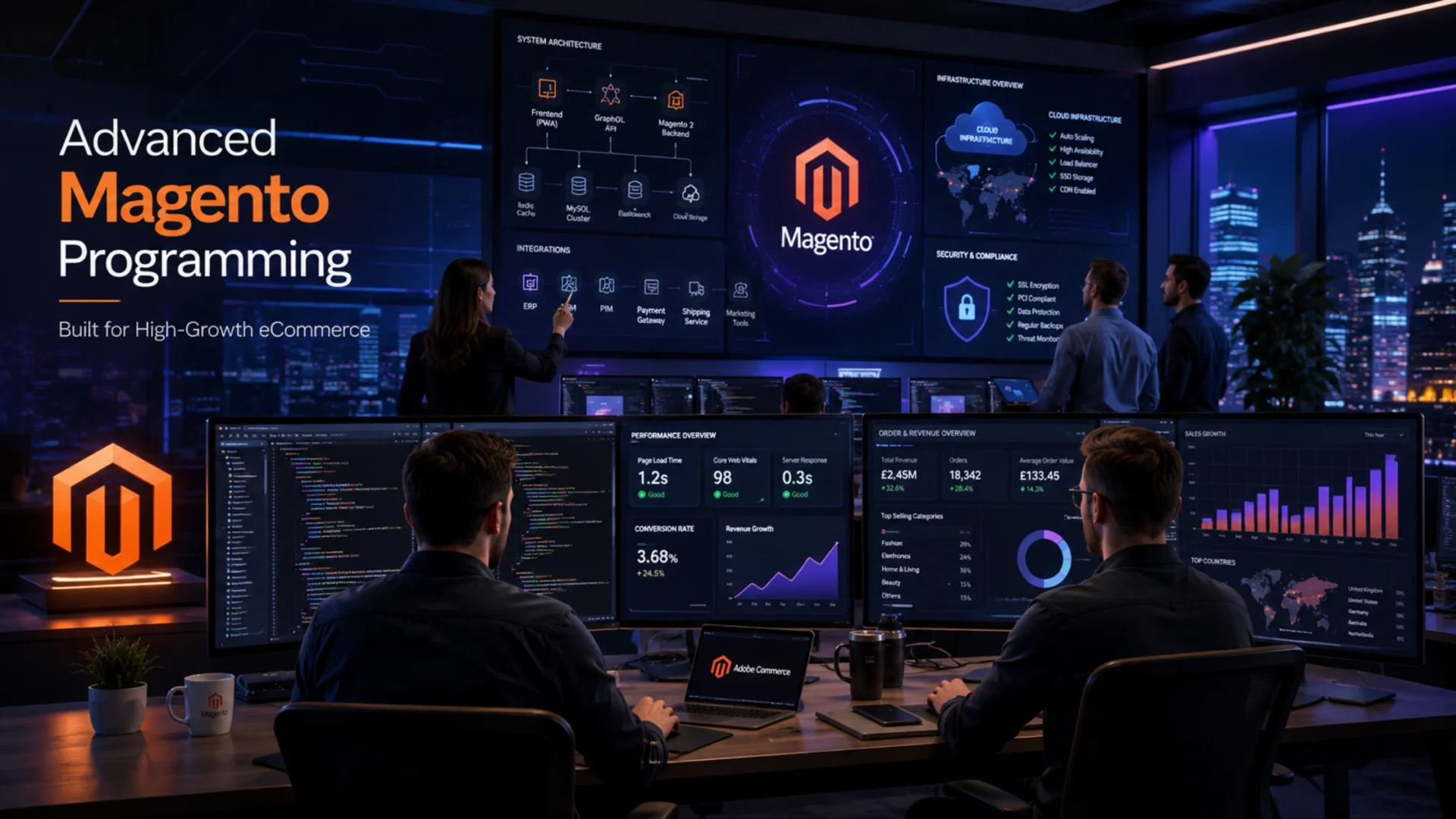
Magento programming is the development discipline of building, customizing, and optimizing stores on the Magento eCommerce platform (now known as Adobe Commerce). It covers everything from writing custom modules and themes to integrating third-party APIs, optimizing databases, and configuring the underlying server architecture.
Unlike basic Magento setup, which involves installation and configuration, Magento programming works at the code level. A Magento programmer writes PHP classes, builds XML configuration files, creates database schemas, develops JavaScript components, and architects the systems that make a store actually run at scale.
Core Areas of Magento Programming
Magento programming spans several distinct areas: custom module development for new features, theme programming for storefront design, API development for integrations with ERP/CRM/PIM systems, database programming for performance and reporting, and infrastructure programming for caching, queues, and scaling. Each area uses different tools but follows the same underlying Magento architecture.
Magento Programming vs Magento Development
The terms are often used interchangeably, but there’s a useful distinction. Magento development is the broader work of building and launching a store, which includes configuration, theming, basic extensions, and deployment. Magento programming refers specifically to the code-level work: writing custom PHP, building modules from scratch, optimizing queries, and architecting how the platform behaves. Most growing stores need both.
Why Magento Programming Matters for eCommerce
Magento is open source and infinitely customizable, which is both its strength and its complexity. Off-the-shelf extensions can only take a store so far. Real competitive advantage, faster checkout, smarter personalization, deeper integrations, comes from custom programming. Stores that invest in proper Magento programming consistently outperform those relying purely on plug-and-play setups.
What Programming Languages Does Magento Use?
Magento is built on a modern PHP stack with several supporting technologies. Understanding these languages is essential for anyone serious about Magento programming.
PHP (Primary Backend Language)
Magento 2 is built on PHP 8.x, using object-oriented programming, dependency injection, and design patterns from the Zend Framework and Symfony components. Every Magento module, controller, model, and helper is written in PHP. A strong Magento programmer needs solid PHP fundamentals before anything else.
MySQL / MariaDB (Database Layer)
Magento uses MySQL or MariaDB to store products, customers, orders, and configuration. Advanced Magento programming often involves writing custom queries, creating indexes, and optimizing the EAV (Entity-Attribute-Value) model that powers Magento’s flexible product catalog.
XML (Configuration and Layout)
Magento uses XML extensively for module configuration, layout definitions, dependency injection, and admin menus. Files like module.xml, di.xml, routes.xml, and layout XML control how the platform behaves. Reading and writing Magento XML is a non-negotiable skill.
JavaScript (Frontend and Admin)
Magento 2 uses RequireJS and Knockout.js on the frontend for dynamic components, particularly in checkout and the admin panel. Modern headless Magento setups also use React or Vue for the storefront, communicating with Magento through GraphQL APIs.
HTML, CSS, and LESS (Theme Layer)
Magento themes use PHTML templates (PHP-HTML hybrid), with styling in LESS (compiled to CSS). The Luma theme is the default reference, while many modern stores migrate to Hyva, a lighter alternative built for performance.
GraphQL and REST APIs
Modern Magento programming relies heavily on APIs for integrations and headless commerce. Magento 2 ships with both REST and GraphQL APIs out of the box, and custom programming often involves extending these to support specific business workflows.
Magento Architecture: How Magento Programming Works Under the Hood
To program effectively in Magento, you need to understand its architecture. Magento 2 follows a modular, layered architecture that separates concerns cleanly, which is both why it’s powerful and why it can feel complex at first.
Modular Structure
Everything in Magento is a module. Even core functionality like the catalog, checkout, and customer accounts is implemented as modules that can be extended, overridden, or disabled. This modular approach is what makes Magento programming so flexible. You add new functionality by creating a new module rather than modifying core files.
MVC Pattern (Model-View-Controller)
Magento follows an MVC pattern. Models handle data and business logic, views render the output (PHTML files), and controllers handle the request flow. Understanding how these three layers interact is fundamental to any serious Magento programming work.
Dependency Injection (DI)
Magento 2 uses dependency injection heavily, configured through di.xml files. Instead of instantiating classes directly, you define dependencies in constructors and let Magento’s object manager handle the wiring. This makes code more testable and easier to extend.
Plugins, Observers, and Preferences
Magento offers three main ways to modify behavior without touching core code. Plugins (interceptors) wrap around existing methods to add logic before, after, or around them. Observers listen for events dispatched throughout the codebase. Preferences override entire classes. Knowing when to use each is a core Magento programming skill.
Service Contracts and Repositories
Magento encourages programming against service contracts (PHP interfaces) rather than concrete implementations. Repositories handle data access in a standardized way. This pattern makes upgrades smoother and code more maintainable.
Custom Module Development in Magento Programming
Custom module development is the heart of advanced Magento programming. Every meaningful customization beyond configuration typically lives in a custom module. Here’s the basic anatomy.
Module Directory Structure
A Magento 2 module lives in app/code/Vendor/ModuleName/ and follows a strict directory convention. Key folders include etc/ for configuration XML, Block/ for view logic, Controller/ for request handling, Model/ for business logic, view/ for templates and layouts, and Setup/ for installation scripts.
Registration and Configuration
Every module needs a registration.php file that tells Magento it exists, and a module.xml file in etc/ that defines its name, version, and dependencies on other modules. Without these two files, Magento won’t load the module at all.
Building Controllers and Routes
Custom controllers handle requests to specific URLs. You define a route in routes.xml, then create a controller class that extends \Magento\Framework\App\Action\Action. The controller’s execute() method runs when the URL is hit, and it typically returns a page result, JSON response, or redirect.
Models and Database Programming
For modules that store data, you create database tables using db_schema.xml (Magento 2.3+) or InstallSchema scripts (older versions). Models extend AbstractModel and use resource models for database operations. Repositories provide a clean API for retrieving and saving data.
Frontend Output with Blocks and Templates
Blocks handle the view logic, preparing data for templates. Templates (.phtml files) handle the HTML output. Layout XML files connect blocks to specific pages and define where they appear. This separation keeps presentation logic clean and reusable.
Advanced Magento Programming Techniques for Scale
Once you’re comfortable with module basics, the next level of Magento programming is about scaling, performance, and architecture. These are the techniques enterprise stores actually use.
Custom Modules Over Stacked Extensions
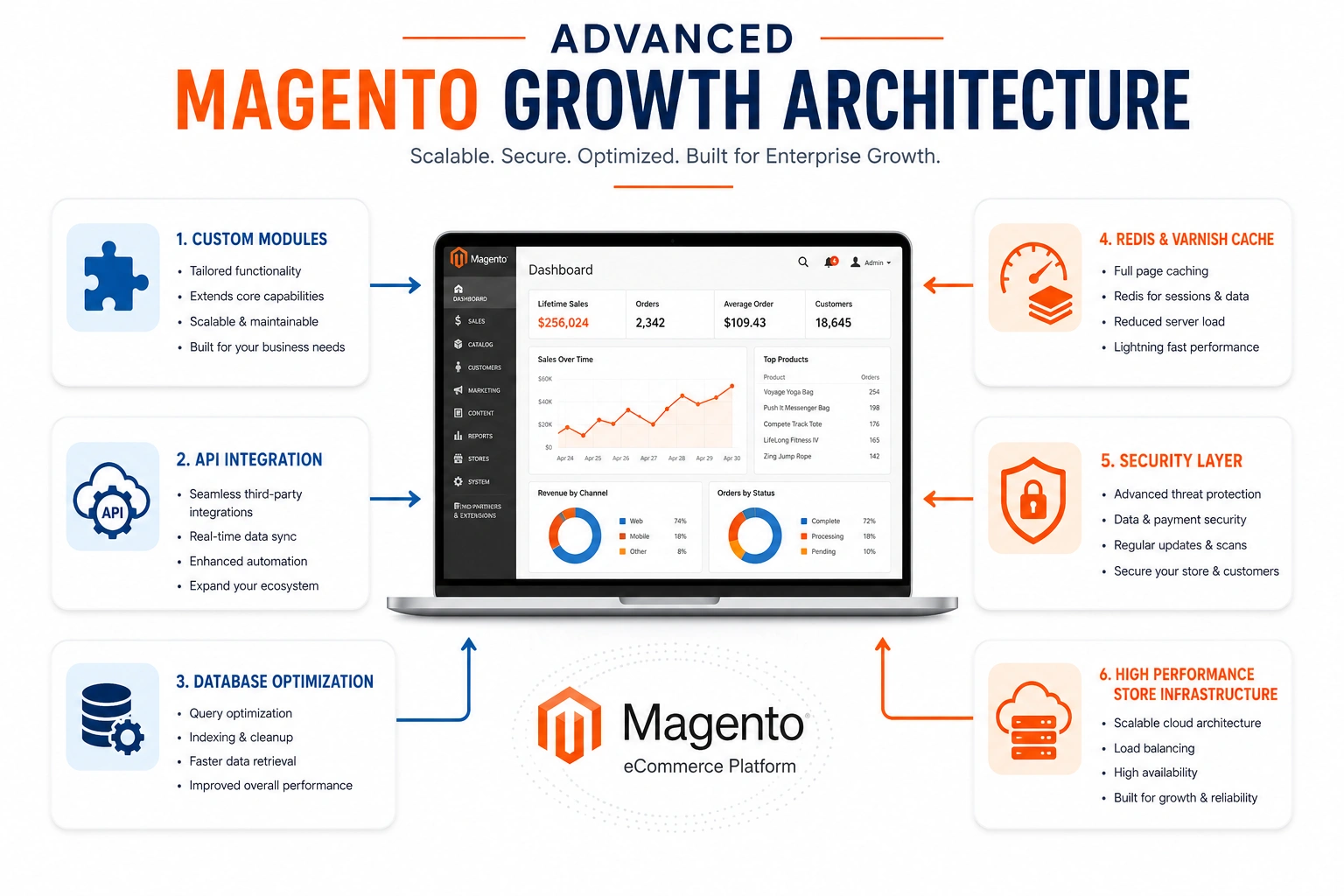
Stores that scale stop adding extensions and start writing custom modules. An extension built for thousands of stores carries overhead nobody needs. A custom module does only what your store requires, nothing else. It loads faster, breaks less, and doesn’t conflict with the rest of your code. Most enterprise Magento stores have custom modules handling 60 to 70 percent of their differentiated functionality.
API-First and Headless Architecture
Modern Magento programming treats the storefront as one surface among many. ERP, CRM, mobile app, marketplace integrations, PWA front-ends, all communicate through clean APIs. The benefit is huge. You can swap the storefront, plug in new channels, or rebuild mobile without touching the order engine. Headless Magento setups depend entirely on this approach.
Database Optimization Techniques
This is the unglamorous one that matters most. Index tuning, query optimization, cleaning out bloated log and quote tables, adding read replicas for reporting, tweaking MySQL configs for actual workload. Done right, you can cut admin response times by 70 percent without changing a single line of business logic.
Layered Caching Strategy
Layered caching separates fast Magento stores from slow ones. Varnish for full-page HTML caching, Redis for sessions and backend cache, CDN for static assets and increasingly for cached pages too. Tuning cache lifetimes, knowing when to bust and when to extend. Most stores get this 60 percent right. Getting it 95 percent right shaves seconds off page load.
Asynchronous Processing with Message Queues
Order placement shouldn’t wait on email sending. Indexing shouldn’t lock the admin. Bulk imports shouldn’t slow customer browsing. Magento’s message queues (using RabbitMQ) handle this in the background. High-volume stores rely on async processing to keep storefronts responsive.
For brands moving toward enterprise architecture, our Adobe Commerce development team maps programming decisions to long-term business goals before any code gets written.
Magento Programming for Performance and Conversion
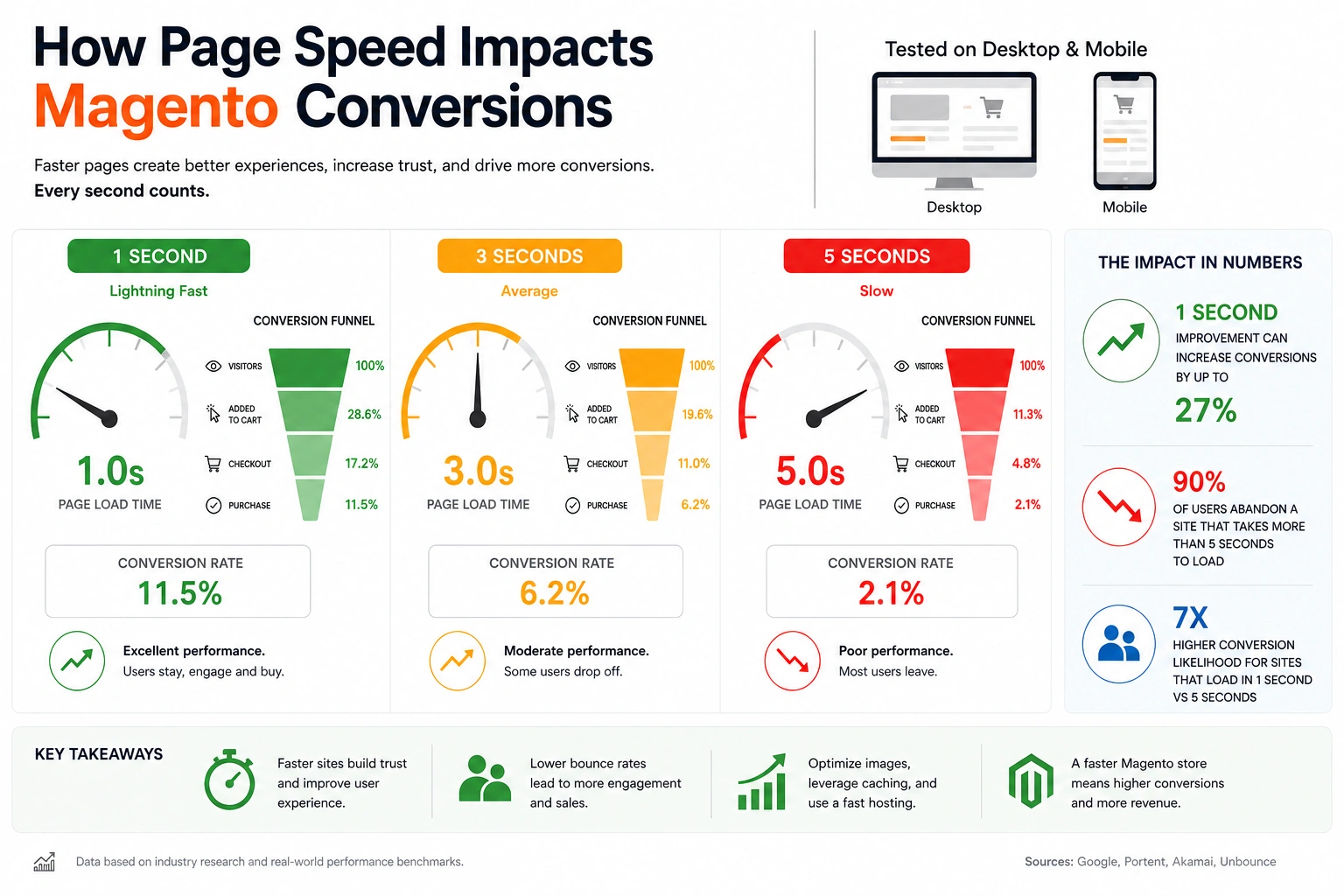
Performance is a revenue metric, not a technical one. Every 100ms of delay measurably costs conversions. Core Web Vitals affect organic rankings. Mobile users abandon faster than ever. Checkout speed decides whether a cart turns into an order. Smart Magento programming addresses all of these directly.
Core Web Vitals Optimization
Largest Contentful Paint, Cumulative Layout Shift, Interaction to Next Paint. Google treats these as ranking signals, and they track real user experience. For Magento specifically, image optimization, JavaScript handling, and reducing render-blocking resources are usually the biggest wins.
Custom Checkout Programming
Checkout customization is one of the highest-leverage Magento programming areas. Removing unused steps, lazy loading payment options, eliminating third-party scripts from the checkout flow. Stores investing here typically see 8 to 15 percent conversion lift. Our piece on Magento 2 checkout strategies covers the operational side in depth.
Image Optimization and Lazy Loading
Lazy load images below the fold. Serve WebP with proper sizes per device. Use srcset for responsive images. Most Magento stores leave 30 to 50 percent of potential speed on the table just by missing these basics.
JavaScript Bundling and Minification
Magento 2’s built-in JavaScript bundling helps, but advanced setups go further. Code splitting, deferring non-critical scripts, removing unused modules from the bundle, using modern build tools where appropriate. The result is faster Time to Interactive across every page.
| Optimization Technique | Business Impact |
|---|---|
| Redis Caching | Faster page loads and lower server costs |
| CDN Integration | Better global performance and smoother peaks |
| Lazy Loading | Improved mobile UX and lower bounce rates |
| Custom Checkout Programming | Higher conversions and fewer abandoned carts |
| Varnish Full Page Cache | Sub-second page loads under heavy traffic |
Is Your Magento Store Losing Speed as It Grows?
Get a free performance snapshot from our Magento experts. We’ll show you exactly where your store is leaking speed and conversions.
Magento Programming for Enterprise Scale
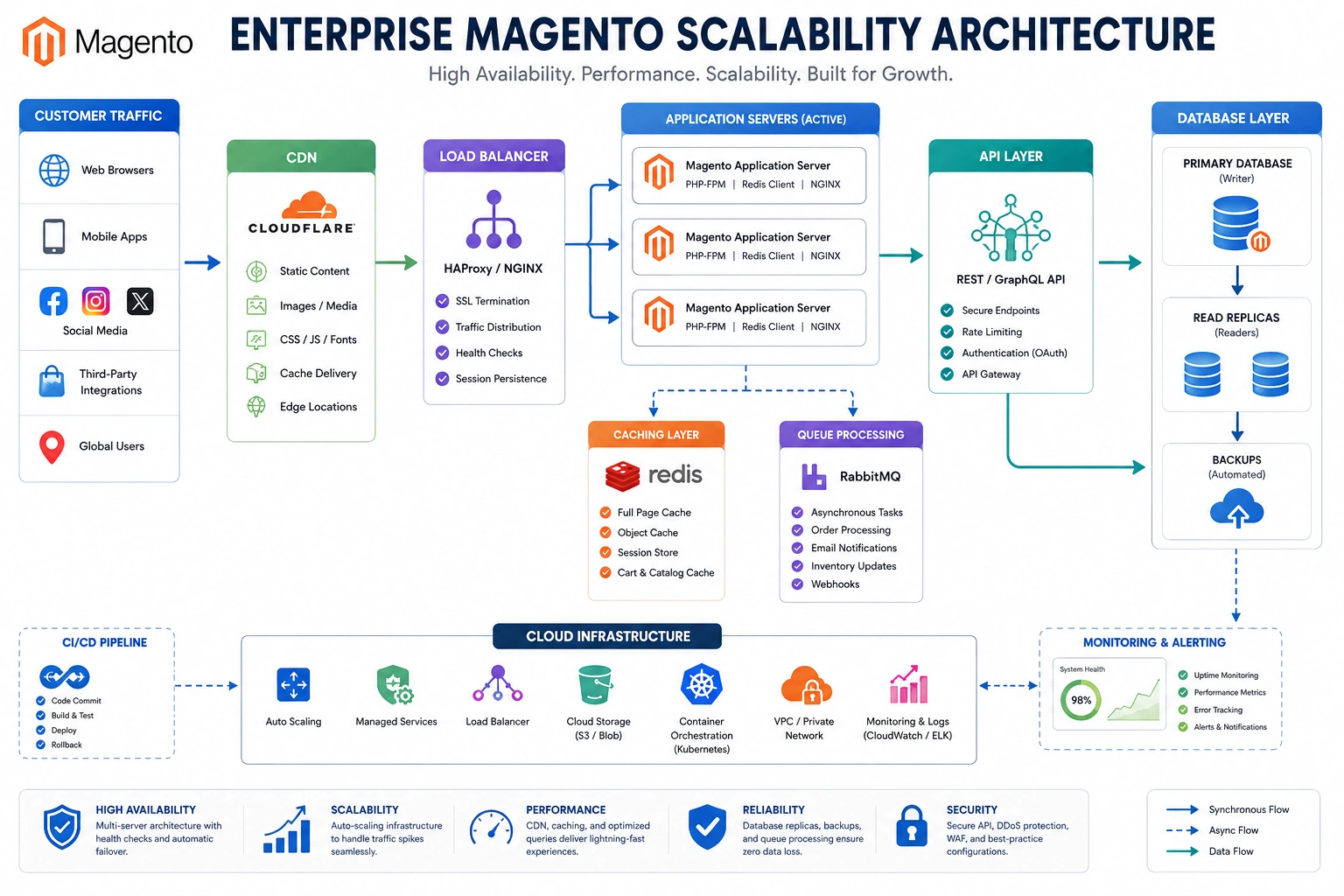
At a certain point scalability stops being about optimization and starts being about architecture. Enterprise Magento programming thinks structurally about how the platform handles growth.
Multi-Store Architecture
Running multiple brands, regions, or B2B channels from one Magento install sounds clean. In practice it’s complicated. Shared customers but separate catalogs, different tax rules per region, currency handling, email templates per brand. Done well, multi-store cuts operational overhead massively. Done poorly, it creates an administrative nightmare.
Cloud Hosting Optimization
Magento on AWS, Azure, or Adobe Commerce Cloud isn’t automatic performance. Instance sizing, database tier, cache layer, CDN configuration. All of it needs tuning to actual traffic patterns. Stores that get this right run leaner and faster.
Load Balancing and Auto Scaling
A single server, no matter how large, eventually hits limits. Load balancing across multiple instances spreads work and provides redundancy. Modern setups also use auto-scaling, where new instances spin up automatically when traffic surges, then spin down when it drops. Useful for brands with spiky demand.
Microservices and Composable Commerce
The biggest enterprise Magento stores have moved past the monolith. Headless front-ends in React or Vue, Magento serving as the commerce engine through APIs, search on Algolia or Elasticsearch, personalization on dedicated services. Each piece scales independently. More complex to build but far more flexible at scale. B2B brands selling internationally usually benefit most, which is why we cover this in our Magento B2B ecommerce guide.
These architectures aren’t right for every store. For brands crossing serious revenue thresholds and operating across regions, they’re often necessary. Our Magento enterprise development team builds these setups for clients who’ve outgrown the standard playbook.
Magento Security Programming Best Practices
Security in Magento programming isn’t optional. Payment data exposure, customer database leaks, and card skimmers running undetected for months can sink a brand. Strong security programming is non-negotiable.
Secure Coding Standards
Input validation, output escaping, prepared statements for every database query, avoiding direct filesystem access without strict checks. These should be baked into every Magento programmer’s workflow. Most Magento vulnerabilities come from custom code that bypassed standards, not from Magento core itself.
Role-Based Access Control
Not every admin user needs full access. Content editors don’t need payment settings. Marketers don’t need customer data exports. Granular role permissions limit damage if an admin account gets compromised, and audit logs close the loop.
API Security
APIs are the new attack surface. Rate limiting, properly configured OAuth, token rotation, IP whitelisting where appropriate. Stores running headless setups especially need this nailed down. An unprotected API endpoint is an open door.
PCI Compliance and Payment Security
Payment data should never touch your servers if you can help it. Tokenization through the gateway keeps you out of PCI scope for card data. Frame the checkout properly, use 3D Secure where it makes sense. Compliance isn’t optional, and the penalties for breaches are brutal.
Patch Management
Magento releases security patches regularly. Most breaches happen on stores running patches that came out six months ago. A monthly patch review cycle, tested in staging, prevents most of this. Outdated Magento versions are the single biggest security risk most stores carry.
Common Magento Programming Mistakes to Avoid
The same patterns show up across hundreds of code audits. Knowing what to avoid is half the battle in good Magento programming.
Modifying Core Files
The cardinal sin of Magento programming. Editing files in vendor/magento/ directly might work today, but it breaks on every upgrade. Always use plugins, observers, or preferences in custom modules to modify behavior. Never touch core.
Stacking Extensions Endlessly
Most stores accumulate 30 to 50 extensions over the years. Each one was needed at some point, but many rewrite core methods or duplicate logic. The result is checkout bugs nobody can track down and admin pages that take 15 seconds to load.
Ignoring Dependency Injection
Some developers still instantiate classes directly or use ObjectManager::getInstance() in their code. This is an anti-pattern in Magento 2. Always inject dependencies through constructors. Code that ignores DI is harder to test, harder to extend, and breaks Magento’s architectural conventions.
Theme Customization Without Discipline
Modifying core theme files instead of using proper overrides. Inline styles everywhere. Custom CSS bloating with every release. Themes that started clean become unmaintainable in two years. Hyva theme migration solves this, but only if underlying code discipline improves.
Skipping Code Reviews and Audits
Custom code accumulates over time. Quality drifts. Old developers leave and take context with them. Without periodic audits, technical debt compounds quietly until something visible breaks. Quarterly code reviews catch issues while they’re cheap to fix.
Expert Tip: Audit Before You Optimize
Before throwing money at new features or speed work, run a thorough audit. Performance audit, security audit, code quality audit, extension audit. Most stores find that fixing what’s already there delivers more impact than adding anything new.
Wondering Which of These Mistakes Are Slowing Your Store?
Our Magento engineers run a no-obligation audit covering performance, code quality, extensions, and security. You get a clear report on what’s holding the store back and what’s worth fixing first.
When to Hire a Magento Programmer
Not every store needs deep custom programming. Some signs are clear though. When you see these, it’s usually time to bring in an expert.
Performance Marketing Can’t Outrun
You’re spending more on ads to compensate for falling conversion rates. Page speed scores keep declining despite optimization. Bounce rates climb every quarter. At some point the platform is the bottleneck, not the marketing.
Operations Slowing Down Internally
Admin pages taking 10+ seconds to load. Order processing lagging. Catalog updates locking the system. When internal users complain about the platform, customers are usually noticing similar issues on the front end.
Integration Complexity Outgrowing Native Options
ERP, CRM, PIM, OMS, marketing automation, custom reporting. As the tech stack grows, simple connectors stop being enough. Custom Magento programming becomes the only way to make it all work cleanly.
International or B2B Expansion
Going multi-region or adding B2B brings complexity native Magento handles but doesn’t optimize for. Tax compliance per region, customer-specific catalogs, quote workflows, account hierarchies. These need real programming work.
Peak Event Performance Failing
Black Friday meltdowns, flash sales that crash, product launches that overwhelm the site. If you’re losing peak-day revenue to infrastructure or code that can’t handle the load, that’s the signal to invest in serious Magento programming work.
| Business Scenario | Standard Magento Setup | Custom Magento Programming |
|---|---|---|
| Traffic Spikes During Sales | Frequent crashes, slow checkout, lost revenue during peak hours | Auto-scaling infrastructure, load balanced, handles 10x normal traffic smoothly |
| Catalog Size (50,000+ SKUs) | Slow category pages, lagging filters, weak search results | Optimized indexing, Elasticsearch integration, sub-second filtering |
| ERP, CRM, PIM Integrations | Generic connectors, manual workarounds, data sync delays | API-first architecture, real-time sync, clean middleware |
| Checkout Performance | Default flow, 4+ second load, higher cart abandonment | Custom checkout, sub-2-second load, 8 to 15 percent conversion lift |
| International Expansion | Limited tax, currency, and language handling out of the box | Multi-store architecture built for regional rules, currencies, and brands |
| Long-Term Maintenance Cost | Compounding technical debt, growing bug list, replatforming risk | Clean codebase, predictable maintenance, scalable for 5+ years |
For brands wondering about Magento development cost, the conversation should start with what current bottlenecks are actually costing, not just what new work would cost.
Future Trends in Magento Programming
The platform isn’t standing still. Adobe Commerce keeps evolving, and Magento programming patterns are shifting alongside it.
AI-Driven Personalization
Personalized product recommendations, dynamic search results, customer-specific pricing. AI handles patterns at scale that no manual configuration can match. Modern Magento programming increasingly involves integrating AI services through APIs rather than building everything from scratch. We’ve written more on AI-driven Magento development for stores moving in this direction.
Headless Commerce Becoming Standard
Headless Magento was experimental five years ago. Now it’s standard for enterprise stores. PWA storefronts, React-based front ends, composable architectures where Magento is the commerce engine and the storefront is independent. Expect this to become the default for stores doing serious volume.
Progressive Web Apps (PWAs)
PWAs offer near-native experience without App Store overhead. Push notifications, offline browsing, home screen install. For many brands, a well-built PWA delivers more value than a separate native app at a fraction of the cost.
GraphQL-First Development
Magento 2’s GraphQL implementation keeps maturing. New schemas, better mutations, more efficient queries. Modern Magento programming uses GraphQL as the default API layer for storefronts and integrations, not REST.
Voice and Conversational Commerce
Voice search through Alexa and Google Assistant, WhatsApp commerce, chatbots that handle orders. Programming for these channels is increasingly part of advanced Magento work, not a separate project.
Why Expert Magento Programming Matters for Long-Term Success
Magento is powerful but unforgiving. Expert programming isn’t a luxury at this point. It’s the difference between a store that scales and one that struggles.
Long-Term ROI Over Short-Term Cost
Cheap development gets expensive fast. Bug fixes pile up, performance issues compound, replatforming becomes the only option. Expert Magento programming costs more upfront and far less over five years. The math favors quality almost every time.
Scalability That Doesn’t Need Rescuing
Stores built right grow without crisis. Traffic doubles and the platform handles it. New regions launch without architecture rewrites. New integrations slot in cleanly. That’s what proper Magento programming buys.
Technical Support That Knows the Codebase
Generic agencies handle basic Magento work. Expert teams know the specific architecture, the integrations, the historical decisions. When something breaks during a sale event, that context is the difference between a 30-minute fix and 8 hours of downtime. Our Magento support plan covers stores that need ongoing expert attention.
Build a Magento Store That Actually Scales
Magento programming at the advanced level isn’t about technical showmanship. It’s about building a foundation that supports actual business goals. Stores that scale gracefully share common traits: clean architecture, disciplined custom development, smart caching, strong security, and performance treated as a revenue lever rather than a technical detail.
Get the programming right, and the platform stops being the limit. Get it wrong, and every quarter brings new fires.
If your store is growing and you’re starting to feel Magento pushing back, the bottleneck usually isn’t traffic or marketing. It’s the technical foundation underneath. Considering a deeper Magento programming review? Reach out to Elsner’s Magento team for an architecture and performance audit.
Let’s Build Your Magento Edge
Whether you need a full architecture review, custom Magento programming, or expert ongoing support, our team is ready when you are. Most engagements start with a 30-minute strategy call.
Frequently Asked Questions About Magento Programming
What is Magento programming?
Magento programming is the development work that powers a Magento or Adobe Commerce store. It includes custom module development, theme customization, API integrations, performance optimization, and security implementation. Where standard configuration handles common needs, programming creates the differentiated functionality and architecture that growing stores require.
What programming language does Magento use?
Magento is built primarily on PHP (version 8.x in Magento 2.4+), using Symfony and Zend Framework components. It also uses MySQL or MariaDB for the database, JavaScript (RequireJS and Knockout.js) plus HTML/CSS for the frontend, and XML for configuration. Modern Magento programming often involves Node.js for build tools and React or Vue for headless front ends.
Is Magento programming difficult to learn?
Magento has a steeper learning curve than most PHP frameworks because of its modular architecture, dependency injection system, and conventions. A developer with strong PHP and OOP fundamentals can write basic Magento modules within a few weeks, but mastering advanced topics like performance tuning, custom checkout, and headless architecture typically takes one to two years of hands-on work.
Why is custom Magento programming important for growing stores?
Standard Magento installations work well at small to mid scale. As traffic, catalog size, and operational complexity grow, the default architecture starts hitting limits. Custom programming removes those limits through optimized code, custom modules, smarter caching, and tailored integrations that off-the-shelf extensions cannot deliver.
How does Magento programming improve website performance?
Through smarter caching layers (Varnish, Redis), database optimization, custom code that runs lighter than generic extensions, asset minification, and infrastructure tuning. The combined effect typically cuts page load times by 40 to 70 percent compared to unoptimized stores, which directly affects conversions and search rankings.
What are the biggest Magento scalability challenges?
The most common ones are database performance under load, extension conflicts that compound over time, inadequate caching for traffic spikes, checkout slowdowns, and infrastructure that wasn’t sized for actual peak demand. Each can usually be solved with proper Magento programming and architectural work.
Is Magento suitable for enterprise eCommerce?
Yes, particularly Adobe Commerce (the enterprise edition), which is designed for enterprise scale. Many of the largest eCommerce brands run on Magento, including stores processing billions in annual revenue. The platform handles enterprise complexity well when programmed properly.
How often should Magento stores be optimized?
Routine performance reviews quarterly. Full code and security audits annually at minimum. Patch updates monthly. Continuous monitoring of Core Web Vitals and server performance. Stores that wait until something breaks usually spend 3 to 5 times more fixing the issue than they would have spent on regular maintenance.
What’s the difference between Magento Open Source and Adobe Commerce?
Magento Open Source is the free community edition with core eCommerce functionality. Adobe Commerce (formerly Magento Commerce) is the paid enterprise edition that adds B2B features, advanced marketing tools, page builder, business intelligence, and dedicated support. Both share the same underlying programming model, so most Magento programming skills transfer between them.
What is the difference between Magento development and Magento programming?
Magento development is the broader category, covering everything from store setup and theme installation to integrations and launch. Magento programming refers specifically to the code-level work, including custom modules, performance optimization, and architectural decisions. Most growing stores need both, but programming is where competitive advantage gets built.