
 Zoho
Solutions
Zoho
Solutions
 Ecommerce
Development
Ecommerce
Development
 Web
Development
Web
Development
 AI
Solutions
AI
Solutions





- Google Kills FAQ Rich Results: The Timeline and What to Do
- What Google Removed and When
- What This Means for Your Structured Data
- Immediate Action Checklist
- Search Console Is Getting AI Performance Reports
- What the New Reports Show
- AI Blocking Controls Now Available
- Why This Changes SEO Reporting
- Google’s AI Search Spam Policy: The Rule Most SEOs Are Missing
- What Google Actually Said
- The llms.txt Situation, Clarified
- Universal Cart and What It Means for Ecommerce SEO
- What Universal Cart Is
- The SEO Implication
- What to Do Right Now
- The Pattern Underneath All Three Updates
- Two Search Surfaces Now. Are You Visible on Both?
- Frequently Asked Questions
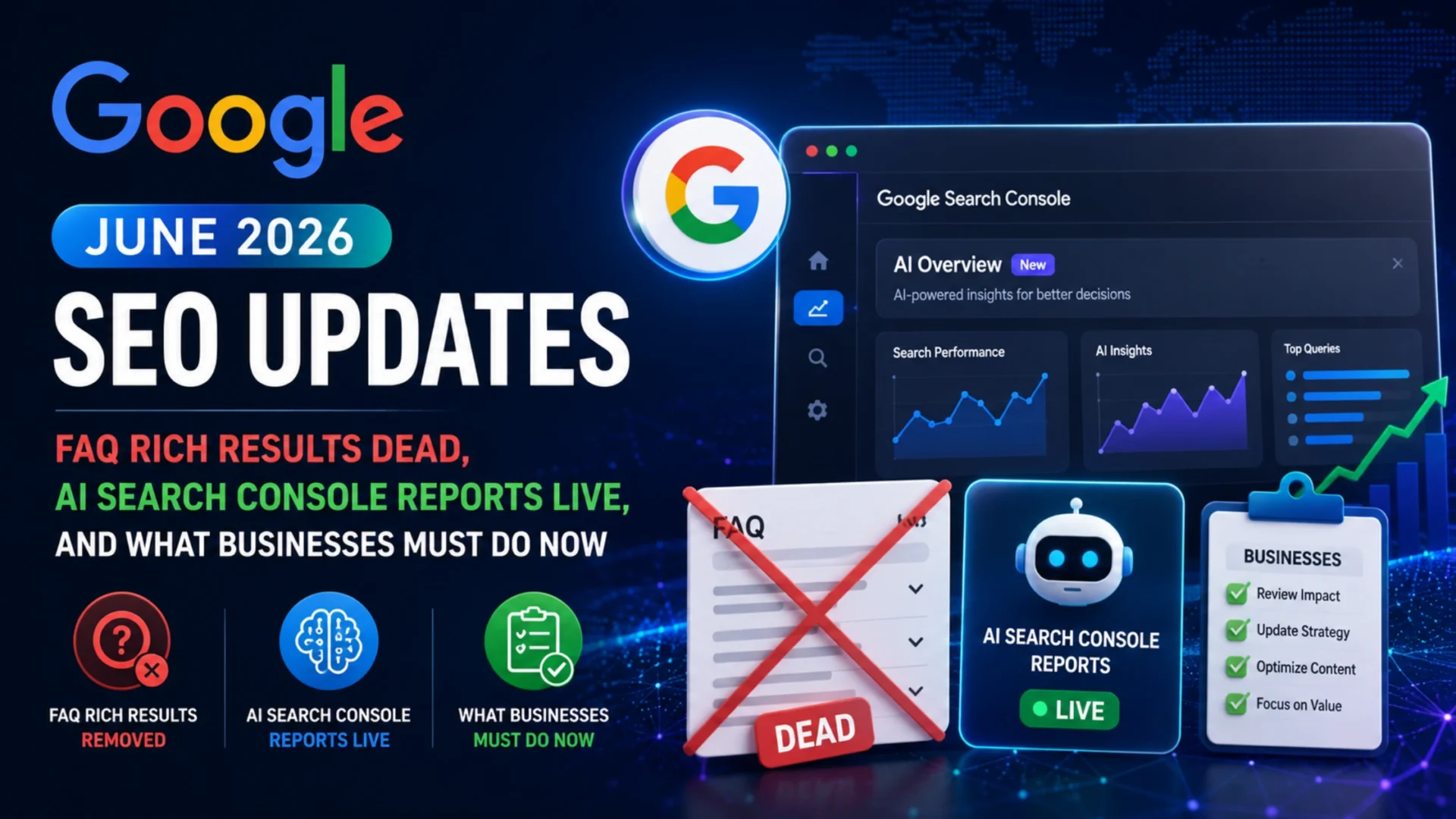
FAQ rich results are gone. Search Console is rolling out a dedicated AI performance section. Google has confirmed that manipulating citations in AI search now counts as spam. And underneath all of it, a new shopping feature is rewiring how ecommerce stores get discovered.
These aren’t predictions. They’re confirmed announcements with dates attached. Here’s what each one means, and the exact steps to take before the reporting you rely on starts disappearing.
Google Kills FAQ Rich Results: The Timeline and What to Do
The most-used schema feature of the last decade is gone, and Google said almost nothing on its way out.
What Google Removed and When
FAQ rich results, the expandable question-and-answer rows that stretched a listing down the page, stopped appearing in Google Search on May 7, 2026. The removal is universal. It even covers the government and health domains that kept the feature after the 2023 restrictions narrowed it for everyone else.
No blog post. No explanation. The feature simply stopped showing, and the reporting around it is being dismantled in phases.
What This Means for Your Structured Data
The instinct is to rip the schema out. That’s the wrong move.
Google confirmed it continues using FAQPage schema to understand page content, even though the visual result is gone.
Pages with FAQPage schema are reportedly 3.2 times more likely to appear in AI Overviews. Schema added purely for SERP real estate is dead. Schema that signals content meaning is very much alive.
This is the real takeaway. The display feature retired, but the underlying signal didn’t. Where you used to chase the rich result, you now chase the citation inside AI answers, which is the discipline of answer engine optimization rather than classic display markup.
Immediate Action Checklist
✓Export historical FAQ rich result data from Search Console now.
✓Update dashboards, client reports, and automated tools that pulled FAQ rich result data.
✓If your QA used Rich Results Test to validate FAQ schema, fix that process before June.
✓Replace FAQ CTR tracking with AI Overview citation tracking as the new KPI.
✓Update Search Console API integrations ahead of the August 2026 cutoff.
Search Console Is Getting AI Performance Reports
If FAQ reporting is leaving, something more useful is arriving to take its place.
What the New Reports Show
Google is adding a dedicated AI performance section to Search Console. It shows how your pages perform specifically inside AI Overviews and AI Mode, kept separate from traditional organic data. The rollout is gradual, so it may not be live in your account yet. When it lands, you’ll finally see whether your AI visibility matches your ranking visibility, which until now has been mostly guesswork.
AI Blocking Controls Now Available
Site owners can now control whether their content appears in AI search features, a change reported to have arrived partly under regulatory pressure in the United Kingdom. You can block content from AI-generated results while keeping it in traditional search. That’s different from a blanket robots.txt rule, since it targets the surface rather than the whole crawl.
Why This Changes SEO Reporting
Impressions, clicks, and CTR no longer tell the full story. A page can rank well in traditional search and have zero presence in AI Overviews. Both numbers matter, and they move independently.
Teams now need two dashboards, not one. Traditional search on one side, AI search on the other. AI citation share is becoming a distinct KPI from keyword rank, and the reporting tools are finally catching up to that reality. For a fuller view of where AI search reporting is heading, the direction has been clear for a while. The tooling just made it official.
Google’s AI Search Spam Policy: The Rule Most SEOs Are Missing
This one slipped past a lot of teams, and it carries real penalty risk.
What Google Actually Said
Google confirmed that its spam policies now apply to AI search features. Buying or manipulating citations in AI Mode and AI Overviews is treated as spam. Inauthentic brand mentions in AI results fall under the same framework as inauthentic backlinks.
“A manipulated AI citation now carries the same risk as a bought backlink.”
Read it as a direct warning to anyone experimenting with paid AI citation placements or so-called GEO shortcuts. The loophole some teams were quietly testing is now closed, and the downside is no longer theoretical.
The llms.txt Situation, Clarified
Google sent mixed signals. One team said it isn’t required. Another added it to Lighthouse Agentic audits. The practical reality is that developer tools like Cursor and GitHub Copilot actively read llms.txt when it’s present, and brands cited in AI Overviews earn roughly 35 percent more clicks than non-cited competitors, per Seer Interactive. The file takes under 30 minutes, carries zero downside, and then you move on to higher-impact content and schema work.
Universal Cart and What It Means for Ecommerce SEO
The final shift is the one online stores can least afford to ignore.
What Universal Cart Is
Universal Cart is Google’s AI-powered, cross-merchant shopping hub. Buyers add products from multiple brands into one cart inside Search, the Gemini app, YouTube, and Gmail, without ever leaving Google. It launched in this market with eight brand partners, and more will be added as the program scales.
The SEO Implication
Product feed accuracy is now a discovery signal, not just a paid-ads requirement. Brands without clean, complete Google Merchant Center data risk being invisible inside Universal Cart. Product schema covering name, price, availability, reviews, and images has to be current and correct. The old wall between SEO, shopping feeds, and paid media is gone. They’re one connected workflow now, and ecommerce SEO has to account for feed quality as a ranking input.
What to Do Right Now
✓Audit Google Merchant Center feeds for completeness and accuracy.
✓Make sure every product page carries complete, current schema markup.
✓Monitor which competitors are surfacing in Universal Cart results.
✓Treat feed optimization as a core SEO task, not just an ads task.
The Pattern Underneath All Three Updates
Step back and the stories rhyme. Google is splitting traditional search performance from AI search performance, and retiring the tactics built for the old model.
|
BEING RETIRED
|
REPLACING IT
|
The businesses gaining ground right now treat AI search visibility as a parallel track they manage today, not a problem they’ll get to next year. That single mindset shift is what separates the sites holding their numbers from the ones quietly bleeding traffic they can’t yet see.
None of these updates are scheduled for later. They’re live and shaping performance as you read this. FAQ reporting is already disappearing. AI performance data is already rolling out. The spam rules already apply. The teams that fix their reporting, structured data, and product feeds this quarter will keep their visibility intact. The ones waiting are already losing ground, and the reporting that would have shown them is the exact reporting being retired.
Two Search Surfaces Now. Are You Visible on Both?
From protecting your structured data to building AI search presence and cleaning product feeds for Universal Cart, our team works across SEO, generative engine optimization, and ecommerce development so you stay visible on traditional search and AI search alike.
Frequently Asked Questions
Are FAQ rich results gone in 2026?
Yes. FAQ rich results stopped appearing in Google Search on May 7, 2026, across all site types, including government and health domains. Search Console reporting and Rich Results Test support are being removed through June, and API support ends in August 2026.
Should I remove FAQPage schema from my pages?
No. Google confirmed it still uses FAQPage schema to understand page content, and pages with it are reportedly 3.2 times more likely to appear in AI Overviews. The visual result is gone, but the content signal remains valuable.
What are Google Search Console AI performance reports?
They are a new, dedicated section in Search Console that shows how pages perform inside AI Overviews and AI Mode, separate from traditional organic data. The rollout is gradual, so the reports may not yet be live in every account.
Can I stop my content from appearing in Google AI Overviews?
Site owners now have surface-specific controls to block content from AI-generated results while keeping it in traditional search. This is different from robots.txt, which controls crawling rather than which search surface displays the content.
Is manipulating AI citations against Google’s policies?
Yes. Google confirmed its spam policies now apply to AI search features. Buying or manipulating citations in AI Mode and AI Overviews is treated as spam, under the same framework used for inauthentic backlinks.
What is Google Universal Cart and why does it matter for SEO?
Universal Cart is an AI-powered, cross-merchant shopping hub across Search, Gemini, YouTube, and Gmail, letting shoppers buy from multiple brands in one cart. It makes clean Google Merchant Center feeds and accurate product schema essential for ecommerce visibility.