





- Why SEO Works Differently for Architecture Firms
- The 6-Pillar Architecture SEO Framework
- Not Sure Which Pillar to Fix First?
- Pillar 1: Keyword Strategy for Architecture Firms
- Understand intent before you pick a single keyword
- The four keyword types worth your attention
- Build a keyword map by service and location
- Pillar 2: On-Page SEO for Architecture Websites
- One service, one page
- Title tags, meta descriptions, and headers
- Write project descriptions that work twice
- Pillar 3: Portfolio and Visual SEO
- Treat project pages as landing pages, not a gallery
- Video SEO most firms leave on the table
- Structured data for images
- Pillar 4: Technical SEO for Image-Heavy Sites
- Speed for sites that live on big images
- Mobile first, genuinely
- Schema markup that earns better listings
- Crawlability basics
- Pillar 5: Local SEO for Architectural Firms
- Google Business Profile, beyond the basics
- Reviews are local ranking fuel
- NAP consistency and the right directories
- Location pages for multi-market firms
- Pillar 6: Authority Building and Link Acquisition
- Quality over quantity, always
- Architecture-specific link tactics
- Create content worth linking to
- Internal linking ties it together
- SEO for Architects in the AI Search Era
- How architects get cited in AI answers
- Measuring What Actually Matters
- Tracking the Numbers but Not Seeing Growth?
- Common SEO Mistakes Architecture Firms Make
- The Architecture SEO Checklist
- Bringing the Six Pillars Together
- Want Your Firm Found When Clients Search?
- Frequently Asked Questions
- How long does SEO take for architecture firms?
- What SEO keywords should architects target?
- Is local SEO or national SEO better for architects?
- How much does SEO cost for an architecture firm?
- Should an architecture firm hire an SEO agency or do it in-house?
- What makes a good architecture firm website for SEO?
- Why are project photos so important for architecture SEO?
- Does my architecture firm need to blog for SEO?
- How do architects show up in AI Overviews and ChatGPT?
A homeowner three blocks from your studio is typing “residential architect near me” into Google right now. In the next ten seconds they will scan a map pack, click two or three firms, and form an opinion before they have read a single word about your design philosophy. That moment is the real competition. Not the awards on your wall, not the projects in your book, but whether your firm shows up at all when the search happens.
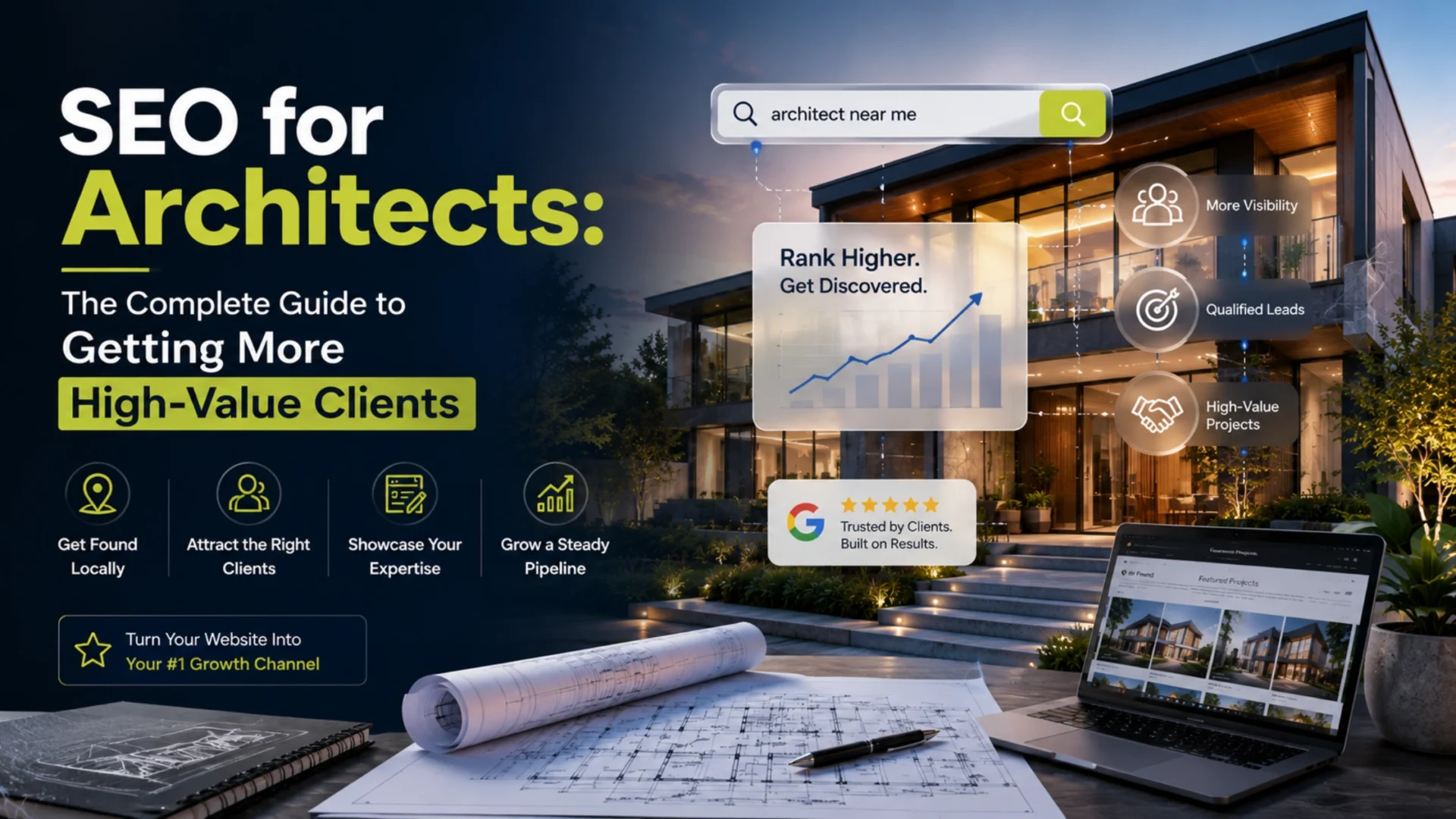
Most architecture firm websites are beautiful and almost invisible. Stunning photography, thoughtful copy, and almost no organic traffic, because the site was built to impress visitors who already know the name rather than to be found by the ones who don’t. This guide to Architect SEO Services fixes that. It walks through a complete, practical SEO system built specifically for architects and architecture firms, organized around six pillars you can work through one at a time.
Quick answer: what is SEO for architects?
SEO for architects is the practice of optimizing an architecture firm’s website and online presence so it ranks in Google search and Maps for the services and locations clients actually search. It combines keyword strategy, on-page optimization, portfolio and visual SEO, technical health, local SEO through Google Business Profile, and authority building, with the goal of turning organic search into a steady source of qualified project inquiries.
Why SEO Works Differently for Architecture Firms
Architecture is one of the highest-consideration purchases a person or business ever makes. Nobody hires an architect impulsively. A custom home, a commercial fit-out, a multi-family development, these are decisions worth hundreds of thousands or millions, and clients research them the way they research a surgeon. That changes everything about how SEO should work for you.
Think about how a client actually finds and chooses an architect. It moves through four stages, and search shows up in every one of them.
- Awareness. They search broad terms like “do I need an architect to build a house” or “cost to hire an architect.” They aren’t ready to call. They’re learning.
- Research. They dig into portfolios, study project types, and start picturing their own job. This is where your visual work either sells or sits unseen.
- Shortlist. They compare a handful of firms, read reviews, and check the map pack. Local trust signals decide who survives this cut.
- Contact. They reach out to two or three. If you weren’t visible in the first three stages, you’re not in this one.
Here’s the part most firms get wrong. They treat SEO as a top-of-funnel traffic game, when for architecture it’s really a trust-building exercise that happens across the whole journey. Word of mouth still matters, of course. But referrals increasingly check you online before they call, and if your digital presence contradicts the recommendation, the referral cools. Search visibility isn’t replacing your reputation. It’s confirming it at the exact moment someone is deciding.
Takeaway: Map your SEO to all four buying stages, not just the top. A firm that only chases “architect near me” wins clicks but loses the clients who spent three weeks reading and comparing before they reached out.
The 6-Pillar Architecture SEO Framework
SEO advice tends to arrive as a scattered list of tactics, which is why most firms try a few, see nothing, and quit. A framework keeps the work coherent. Everything below sits inside six pillars, and they’re sequenced so each one builds on the last. Get the foundation right before you chase links.
PILLAR 01
Keyword Strategy
Find the searches that lead to projects, not just traffic.
PILLAR 02
On-Page Optimization
Structure pages so search engines and clients understand them.
PILLAR 03
Portfolio and Visual SEO
Turn project pages and images into discovery engines.
PILLAR 04
Technical SEO
Keep an image-heavy site fast, crawlable, and mobile-ready.
PILLAR 05
Local SEO
Own the map pack in every market you serve.
PILLAR 06
Authority and Links
Earn the trust signals that move you up the rankings.
Work them in order if you’re starting from scratch. If your site already ranks for some terms, use the framework as an audit and find the weakest pillar first. That’s almost always where the fastest gains hide.
Not Sure Which Pillar to Fix First?
An audit pinpoints exactly where your firm is losing rankings, so you start with the work that moves the needle fastest instead of guessing. We map all six pillars against your current site.
Pillar 1: Keyword Strategy for Architecture Firms
Most keyword advice tells you to find high-volume terms. For architects that’s a trap. “Modern architecture” gets searched constantly and converts almost nobody, because the intent behind it is curiosity, not hiring. The skill isn’t finding popular words. It’s matching words to where the searcher is in their journey.
Understand intent before you pick a single keyword
Two nearly identical phrases can sit at opposite ends of the funnel. Search “residential architecture” and Google shows you image galleries and design inspiration, informational intent. Search “residential architect Denver” and Google shows firms, maps, and service pages, commercial intent. The first attracts students and browsers. The second attracts people ready to spend. Build your pages around the second kind, and let blog content handle the first.
The four keyword types worth your attention
Architecture keywords fall into four buckets, and a healthy strategy uses all four rather than betting everything on one.
Service keywords
Commercial architect, sustainable building design, healthcare architecture firm. These describe what you do and carry strong buying intent.
Location keywords
Architect in Austin, architecture firm near me, Seattle commercial architect. The highest-converting category for most firms, because architecture is a local-trust business.
Specialty keywords
Adaptive reuse architect, mixed-use development architect, green building consultant. Lower volume, far less competition, and they pull in clients who need exactly what you specialize in.
Problem-based keywords
How much does an architect cost, do I need an architect for a renovation, architect vs designer. Top-of-funnel, but they catch clients early and build trust before competitors even appear.
Specialty keywords are the most underused of the four. A firm fighting for “architect Chicago” against fifty competitors might rank first for “healthcare architect Chicago” within months, and that narrower term often brings better-fit, higher-budget projects. Niche down where you can.
Build a keyword map by service and location
Once you have your terms, assign each one to a single page so you don’t compete against yourself. A simple grid keeps it organized.
Free tools like Google Keyword Planner and Google Search Console will get most firms started. Paid platforms such as Ahrefs or Semrush add competitor visibility if budget allows, though they’re not essential on day one. Start with the map, then refine.
Pillar 2: On-Page SEO for Architecture Websites
On-page SEO is where your keyword strategy meets the actual website. It’s the least glamorous pillar and one of the most reliable, because you control every variable. No algorithm guesswork, just clean structure done well.
One service, one page
The single most common mistake architecture firms make is cramming residential, commercial, interior, and renovation services onto one “Services” page. Google can’t tell what that page is about, so it ranks for nothing. Give each core service its own dedicated page with its own target keyword, its own examples, and its own call to action. A clear page structure also makes the site easier to navigate, which is exactly why thoughtful custom web design and SEO architecture tend to go hand in hand from the start.
Title tags, meta descriptions, and headers
Your title tag is the headline that appears in search results, and it carries real ranking weight. Lead with the keyword and keep it natural. “Residential Architect in Portland | [Firm Name]” beats a vague “Welcome to Our Studio” every time. Meta descriptions don’t directly affect rankings, but they influence whether people click, so write them like an invitation rather than a summary. Headers (H1, H2, H3) should outline the page logically, with your primary keyword in the H1 and supporting terms in the H2s.
Write project descriptions that work twice
Architects describe their work beautifully and abstractly. “A meditation on light and volume” reads well but ranks for nothing. The fix isn’t to strip the poetry, it’s to add the specifics underneath it. Mention the project type, the location, the materials, the square footage, the challenge solved. “A 4,200 square foot adaptive reuse project converting a 1920s warehouse in Brooklyn into mixed-use lofts” tells both a client and Google exactly what they’re looking at. Keep the artistry. Just ground it in searchable detail.
Quick tip: Read any project page aloud. If you can’t tell what type of building it is and where it’s located within the first two sentences, neither can a search engine.
Pillar 3: Portfolio and Visual SEO
This is the pillar nearly every generic SEO guide ignores, and it’s the one with the most upside for architects specifically. Your portfolio isn’t just proof of skill. Handled correctly, every project page becomes its own ranking asset, and every image becomes a doorway from Google Images and AI-generated results.
Treat project pages as landing pages, not a gallery
A dedicated page for “Lakeside Modern Residence” can rank for “modern lakefront home architect” plus the project’s city, a phrase your competitors probably aren’t targeting at all. Give each significant project a real page with a descriptive title, a few hundred words of genuine context, the challenge and solution, and the location. Twenty well-written project pages can quietly out-rank a single thin services page across dozens of long-tail searches.
Video SEO most firms leave on the table
Architecture is inherently visual, which makes video a natural fit and a wide-open opportunity. Walkthroughs, 3D renders, and time-lapse build footage perform well on YouTube, the second-largest search engine, and embedding those videos on your project pages increases the time visitors spend there. Longer dwell time is a quality signal Google notices. Optimize video titles and descriptions with the same keywords you’d target on the page, and the same content does double duty across two platforms. Strong, repurposable assets like this are exactly where a deliberate approach to content marketing pays off for firms that publish consistently.
Structured data for images
ImageObject schema helps search engines understand and surface your project photography in image results and rich listings. For an image-led profession, that visibility is a direct line to discovery traffic, people who find you through a photograph of a space that looks like the one they’re imagining. It’s a small technical step with an outsized payoff for architects.
Worth doing: Rename every image file before upload. “modern-kitchen-renovation-austin.webp” works far harder than “DSC_4471.jpg,” and it costs you nothing but a minute per photo.
Pillar 4: Technical SEO for Image-Heavy Sites
Architecture websites have a built-in technical problem: they’re gorgeous and they’re heavy. High-resolution photography is the whole point, and it’s also the thing most likely to drag your site speed into the ground. Technical SEO is how you keep the beauty without paying for it in rankings.
Speed for sites that live on big images
Google’s Core Web Vitals measure how fast and stable your pages feel to real visitors, and image-heavy sites routinely fail them without intervention. Three fixes handle most of the damage: convert images to the WebP format for smaller files at the same visual quality, enable lazy loading so images load only as someone scrolls to them, and serve photos through a content delivery network so they load quickly regardless of where the visitor is. Free tools like Google PageSpeed Insights and GTmetrix will show you exactly where the slowdowns are. If you want the full breakdown of what these metrics mean and how to move them, this guide to improving Core Web Vitals scores is a useful next read.
Mobile first, genuinely
Google indexes the mobile version of your site, not the desktop one. For architects this matters more than usual, because clients often browse portfolios on their phones during a commute or a lunch break. A portfolio that’s stunning on a 27-inch monitor and unusable on a phone is failing the audience Google actually scores. Test every key page on a real device, not just a shrunken browser window.
Schema markup that earns better listings
Beyond image schema, two structured data types belong on every architecture site. LocalBusiness schema tells Google your name, address, phone, and service area, which feeds directly into local rankings. ProfessionalService schema reinforces what kind of business you are. Together they make you eligible for richer, more prominent search listings. The full vocabulary lives at Schema.org if you or your developer want the technical reference.
Crawlability basics
An XML sitemap helps Google find all your pages, and a clean robots.txt keeps it out of the ones that don’t matter. If you run separate location pages, canonical tags prevent Google from treating similar pages as duplicates and splitting your ranking power. None of this is glamorous. All of it quietly decides whether your other five pillars get seen.
Pillar 5: Local SEO for Architectural Firms
For most architecture firms, local SEO is the pillar with the highest return per hour of effort. Clients hire architects they can meet, and Google knows it, which is why the map pack sits above the regular results for nearly every location-based search. Owning that space is often worth more than any amount of national content.
Google Business Profile, beyond the basics
Almost every firm claims their profile and then abandons it. That’s the opportunity. Choose the most accurate primary category (Architect, Architecture Firm) and add relevant secondary ones. Write a service description that uses your real keywords naturally. Then commit to the part nobody does: photos. Upload office shots, team shots, and labeled project photography on a regular schedule, because profiles with fresh, plentiful images consistently outperform stale ones. Use the Q&A feature to answer common questions before clients ask, and post updates when you finish a project or win an award. The official Google Business Profile help center covers the setup mechanics in detail.
Reviews are local ranking fuel
Reviews influence both where you rank locally and whether anyone clicks once they find you. Ask every satisfied client, and ask at the right moment, usually right after a project milestone they’re excited about. Make it easy with a direct link. Respond to every review, positive or negative, in a professional, specific voice, because prospective clients read those responses as closely as the reviews themselves. A steady trickle of new reviews matters more than a one-time burst, so build the ask into your project closeout process rather than treating it as an afterthought.
NAP consistency and the right directories
Your name, address, and phone number (NAP) need to be identical everywhere they appear online. Inconsistencies confuse Google and dilute local trust. Beyond the usual business directories, architects have industry-specific platforms worth claiming: Houzz, Archinect, and ArchDaily among them. Houzz in particular doubles as a lead source and a strong directory signal for the profession.
Location pages for multi-market firms
If you serve several cities, dedicated location pages can capture searches in each one, but only if each page is genuinely unique. Thin, copy-paste pages with the city name swapped out get penalized, not rewarded. Write real local context for each: relevant projects, area-specific considerations, local building styles. Fewer strong pages always beat many weak ones. The fundamentals here run deeper than one section can hold, which is why dedicated local SEO services exist for businesses serious about multi-market visibility.
Pillar 6: Authority Building and Link Acquisition
Links are votes of confidence from other websites, and Google still weighs them heavily. For architecture firms the good news is that your work is naturally link-worthy. The challenge is doing the outreach, which is exactly the part most firms never get around to.
Quality over quantity, always
One link from a respected architecture publication outweighs fifty from random low-quality directories. Cheap bulk links don’t just waste money, they can actively hurt you under Google’s spam systems. Chase relevance and reputation, not volume.
Architecture-specific link tactics
Your profession opens doors others don’t have. Getting a project featured in editorial outlets like ArchDaily, Dezeen, or Houzz earns authoritative links and exposure at once. Guest articles on home design, construction, and real estate blogs put you in front of adjacent audiences. Local sponsorships and community involvement generate legitimate local links. And press releases for award wins or landmark project completions can get picked up by regional and trade press. None of these are quick, but they compound.
Create content worth linking to
The most durable way to earn links is to publish things people genuinely want to reference. Annual design trend reports, curated project showcases by style or region, and data-driven pieces like cost guides or permit process breakdowns all attract links organically because they’re useful. A well-researched “what a custom home actually costs in [your region]” guide can pull links and traffic for years.
Internal linking ties it together
Don’t overlook the links you fully control. Connecting blog posts to relevant service pages, and service pages to related projects, helps Google understand how your content relates and spreads ranking power across the site. Use descriptive anchor text rather than “click here,” and link with intent. The strategy behind grouping related content is laid out well in this breakdown of how topic clusters strengthen SEO, and the same logic applies cleanly to an architecture site.
SEO for Architects in the AI Search Era
Search isn’t just ten blue links anymore. A growing share of clients get their first answer from Google’s AI Overviews, or by asking ChatGPT, Perplexity, or Gemini outright: “who are the best residential architects in Austin?” If your firm isn’t structured to be cited in those answers, you’re missing from a channel that barely existed two years ago. The reassuring part is that most of what earns AI visibility overlaps with the SEO you’re already doing. A few additions tilt the odds in your favor.
How architects get cited in AI answers
AI systems don’t rank pages so much as assemble answers from sources they trust. Five things make your firm one of those sources.
- Answer cleanly and early. These engines pull short, self-contained answers. The quick definitions and direct FAQ responses already in your content are exactly the format they extract.
- Strengthen your entity. AI engines link your firm name to your specialties, location, and projects. Consistent details across your site, your Business Profile, and directories make you a recognizable entity instead of a vague string of text.
- Build author and firm authority. Named architects with real credentials and bylines are easier for these systems to trust and attribute. A faceless site is harder to cite.
- Structure your content. Clear lists, tables, and schema give machines clean data to read. That’s the same structured-data work from Pillar 4, paying off a second time.
- Get mentioned elsewhere. AI answers lean on what reputable third-party sites say about you. The publication features and citations from Pillar 6 feed directly into this.
These signals sit at the heart of answer engine optimization, the practice of structuring content so AI systems can quote it accurately rather than skip it or get it wrong. For a profession where clients increasingly ask an assistant before they open a browser, that’s no longer optional.
Fastest AI-search win: a complete, consistent entity footprint. Identical firm name, address, specialties, and service area across your website, Google Business Profile, and the directories that matter. AI engines reward firms they can identify without guessing.
Measuring What Actually Matters
SEO without measurement is decoration. The trick is tracking the metrics that connect to revenue, not the vanity numbers that feel good and mean little. A firm can triple its traffic and gain zero clients if that traffic is all students researching design history.
The KPIs worth watching closely are narrower than most dashboards suggest: organic traffic landing specifically on service and location pages, rankings for your target service-plus-city terms, contact form submissions attributed to organic search, and calls or direction requests from your Google Business Profile. Those four map directly to new business. Review them monthly for direction and run a deeper strategy review each quarter. Resist the urge to change everything every week, since SEO rewards patience and punishes thrash.
Tracking the Numbers but Not Seeing Growth?
Knowing your KPIs is one thing. Moving them is another. We turn organic traffic and Business Profile activity into a steady stream of qualified project inquiries for architecture firms.
Common SEO Mistakes Architecture Firms Make
Most firms don’t fail at SEO because it’s hard. They fail because they repeat a handful of avoidable mistakes. Here are the ones that cost the most.
- One page for every service. The fastest way to rank for nothing. Split them.
- Abandoning Google Business Profile after setup. A claimed-and-forgotten profile loses to an active one every time.
- Unoptimized project photos. The single biggest missed opportunity for a visual profession. Name them, compress them, add alt text.
- Chasing pretty traffic that never converts. Ranking for “famous modern buildings” feels great and books zero projects.
- Letting the site go silent for months. Freshness is a signal. A dormant site drifts down.
- No internal links between content and services. Orphaned blog posts help nobody, including you.
If you only fix three of these, make it the service pages, the Business Profile, and the project photos. Those three carry most of the weight for a typical firm, and they’re entirely within your control.
The Architecture SEO Checklist
If the six pillars feel like a lot at once, work this list top to bottom. It’s roughly the order that delivers results fastest for a firm starting from a low base.
FOUNDATION
✓ Claim and fully complete your Google Business Profile
✓ Build a dedicated page for each core service, not one combined page
✓ Make your name, address, and phone identical everywhere online
✓ Add LocalBusiness and ProfessionalService schema
VISIBILITY
✓ Rename, compress (WebP), and add alt text to every project image
✓ Give significant projects their own optimized portfolio pages
✓ Map target keywords to pages so they don’t compete with each other
✓ Fix Core Web Vitals with lazy loading and a CDN for heavy imagery
GROWTH
✓ Build a steady review habit into your project closeout process
✓ Pursue features in architecture publications and local press
✓ Link blog content to relevant service and project pages
✓ Structure answers and entities so AI search engines can cite you
Bringing the Six Pillars Together
SEO for architects rewards firms that treat it as an extension of their craft rather than a separate marketing chore. The same care that goes into a building, structure first, then detail, then the finishing work that makes it sing, applies cleanly to a search strategy. Get the keyword foundation right, structure your pages cleanly, let your portfolio and visuals do the heavy lifting, keep the technical side healthy, dominate your local market, and earn authority through work worth referencing. Do the six pillars in sequence and the rankings follow, not overnight, but steadily and durably. The firms that show up when a client searches are rarely the most talented ones. They’re the ones who decided to be findable.
Want Your Firm Found When Clients Search?
From keyword strategy and portfolio optimization to local SEO and technical health, the right partner turns your beautiful, quiet website into a steady source of qualified project inquiries. Let’s audit where you stand today and map the pillars that will move your firm up the rankings.
Frequently Asked Questions
How long does SEO take for architecture firms?
Most architecture firms see early local SEO movement within three to six months, with meaningful organic results building over six to twelve. Local rankings through Google Business Profile tend to respond faster than competitive service-plus-city terms. Timelines depend on your starting point, competition in your market, and how consistently the work gets done.
What SEO keywords should architects target?
Focus on four types: service keywords (commercial architect, sustainable design), location keywords (architect in [city], architecture firm near me), specialty keywords (healthcare architect, adaptive reuse), and problem-based keywords (cost to hire an architect, do I need an architect). Location and specialty terms usually convert best because they signal real buying intent.
Is local SEO or national SEO better for architects?
For most firms, local SEO delivers a far higher return. Clients hire architects they can meet, so ranking in the map pack for your service area matters more than national visibility. National SEO becomes worthwhile mainly for firms with a strong specialty niche or multiple offices across several markets.
How much does SEO cost for an architecture firm?
It varies widely with scope and competition, so any single number would mislead. The real cost includes time or fees for content, technical work, local optimization, and ongoing maintenance. The most useful question isn’t the monthly figure but the return: a single won project often covers a year of SEO investment many times over.
Should an architecture firm hire an SEO agency or do it in-house?
It depends on capacity. The local SEO basics, claiming and maintaining a Google Business Profile, gathering reviews, naming images, are very doable in-house. The technical work, content strategy, and link building are where firms usually benefit from a partner, simply because they’re specialized and time-consuming. Many firms run a hybrid: handle the basics internally and outsource the rest.
What makes a good architecture firm website for SEO?
A strong site combines dedicated pages for each service, optimized and well-described project pages, fast load times even with heavy imagery, mobile-friendly design, proper schema markup, and a complete Google Business Profile. Beauty alone isn’t enough. The site has to be structured so search engines can understand it and clients can find it.
Why are project photos so important for architecture SEO?
Architecture is a visual profession, and images are a major discovery channel through Google Images and increasingly through AI-generated results. Optimized photos with descriptive file names, alt text, and ImageObject schema can drive significant traffic from people searching visually for the kind of space you design. It’s the highest-upside step most firms skip.
Does my architecture firm need to blog for SEO?
Blogging isn’t mandatory, but useful content helps you capture top-of-funnel searches and earn links. Pieces like regional cost guides, design trend reports, and answers to common client questions build authority and bring in clients earlier in their journey. Quality and consistency matter more than frequency, a few strong articles beat a pile of thin ones.
How do architects show up in AI Overviews and ChatGPT?
AI search engines cite sources they can identify and trust. To get included, answer common questions clearly and early, keep a consistent firm name, address, and specialty across your site and directories, use named authors with real credentials, structure content with schema and clean formatting, and earn mentions on reputable third-party sites. Much of this overlaps with strong local and on-page SEO, with extra weight on entity clarity and authority.