



- What White Label Magento Development Actually Means
- When Agencies Should Consider White Label Magento Partnerships
- How White Label Magento Engagements Are Structured
- What to Look For in a White Label Magento Partner
- Red Flags Agencies Should Watch For
- How White Label Magento Pricing Actually Works
- How to Onboard a White Label Magento Partner Without Disrupting Client Relationships
- Common Mistakes Agencies Make
- Why Adobe Commerce Certifications Matter
- A Simple Framework to Evaluate Any Partner
- Looking for a Reliable White Label Magento Partner?
- Conclusion
Agencies winning Magento projects rarely have the problem they expect. The pitch goes well. The client signs. Everyone’s excited, and then the reality kicks in.
Now you’re staring at a complex Adobe Commerce build, timelines are tight, expectations are high, and the team that’s supposed to deliver it doesn’t fully exist yet.
Hiring senior Magento developers? That’s not a quick fix. It takes months. Certifications take even longer. And while all that is happening, the client isn’t waiting. They expect movement. Progress. Confidence.
This is exactly where white-label Magento development services shifts from a backup plan to something strategic. When done in a right way, it lets agencies sell, scope, and deliver enterprise-level Magento work without the pressure to build an in-house team from scratch.
Not just that. It creates room to scale, test new markets, and take on bigger opportunities without hesitation.
So, how does it actually work in practice? And more importantly, how do you get it right? Let’s break it down.
What White Label Magento Development Actually Means
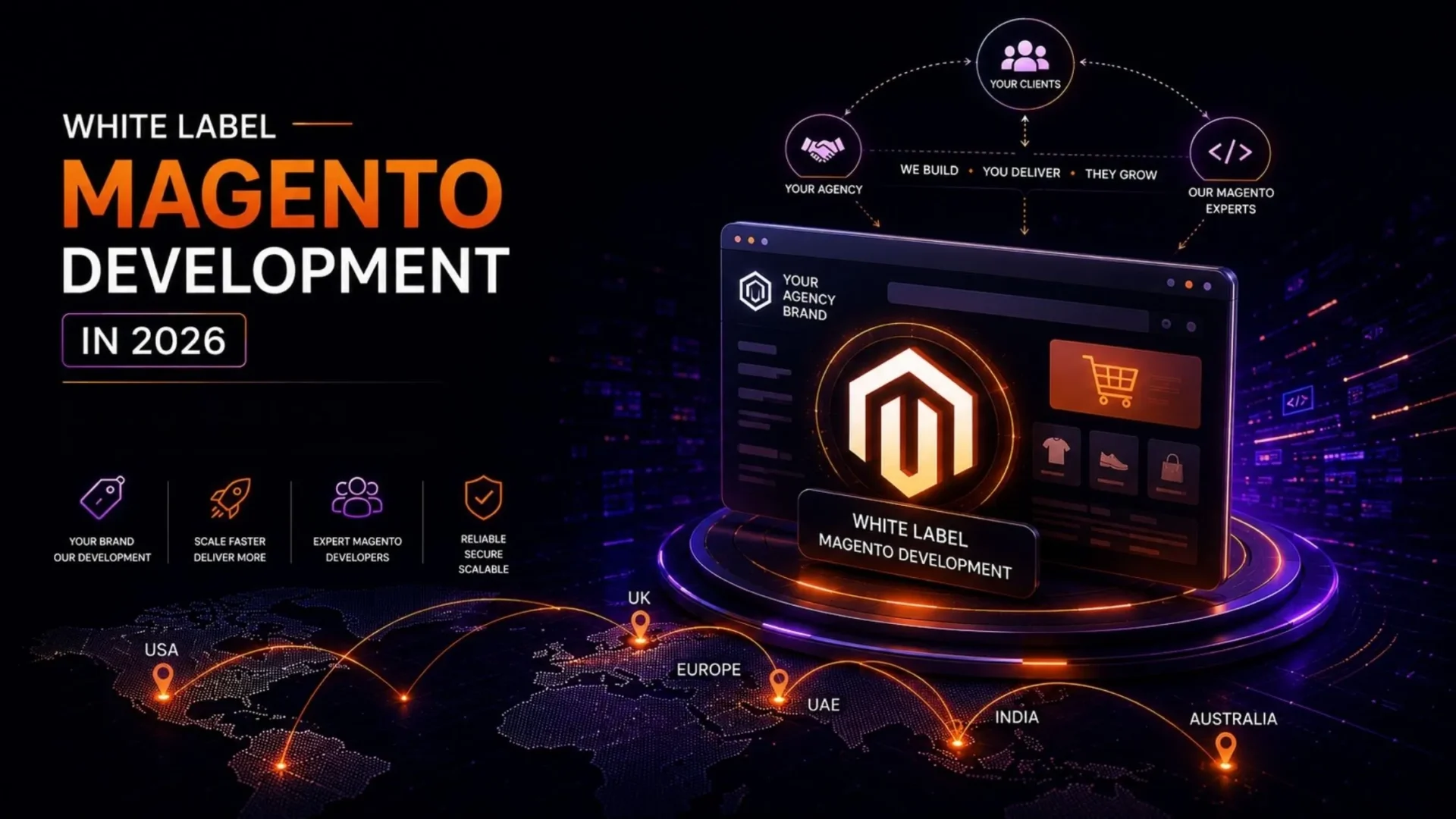
Actually, white-label Magento development is pretty simple. You partner with a Magento development team that works behind the scenes while you stay front-facing with your client. Everything delivered: code, communication, documentation. It appears as if it came directly from your agency.
But here’s where most people get it slightly wrong. White label is not outsourcing in the generic sense. It’s not hiring freelancers from a marketplace. It’s structured. Controlled. Intentional. The partner operates within your processes, aligns with your communication style, and respects your client relationships as if they were their own.
Operationally, that means:
- Work is delivered under your branding
- Communication flows through your team
- Documentation reflects your standards
- The partner remains invisible to your client
There are typically two ways this plays out. Some agencies go for dedicated resources — developers who work almost like an extension of their internal team. Others prefer project-based engagement, where work is scoped, quoted, and delivered per project.
And in 2026, the demand for the second model is growing fast.
Magento talent is harder to find. Adobe Commerce projects are getting more complex. Certifications are a must for enterprise deals. So instead of overloading internal teams or rushing bad hires, agencies are choosing partnerships that help them stay flexible.
Also note that white label is not cheap labor. If that’s the expectation, it usually ends badly. What you’re really investing in is capability, reliability, and delivery confidence.
When Agencies Should Consider White Label Magento Partnerships
Not every agency needs a white label partner. And honestly, forcing it when it’s not the right fit can create more friction than value. But in the right situations, it becomes almost a growth lever. Let’s look at where it actually makes sense.
Agencies Without Deep In-House Magento Expertise
Agencies that consistently win Magento projects but don’t have deep in-house expertise — that’s an obvious one. Instead of turning down opportunities or overpromising internally, a white label setup fills that gap almost immediately.
The Overflow Scenario
You already have a dev team. They’re good. But during peak cycles, things start slipping. Deadlines tighten. Quality risks creep in. Having a white label partner in place gives you breathing room without overhiring.
Expanding Into Adobe Commerce
Maybe you’ve been focused on Shopify or WordPress, and now enterprise clients are asking for Adobe Commerce development. Building that capability internally from scratch? That’s a long runway. A white label partner lets you enter that space faster, without betting everything up front.
Maintenance and Support Retainers
Ongoing Magento retainers can quietly eat up internal bandwidth. Small fixes, updates, performance tweaks. They add up. Offloading that to a trusted partner keeps your core team focused on higher-value work.
But there are also situations where this doesn’t work as well.
If your projects are extremely small and one time, the structure of a white label partnership might feel heavy. If founders want to stay deeply involved in every technical conversation, that can create friction. If the agency’s positioning is purely based on lowest-cost delivery, then honestly, a proper white label partnership may not align with that model.
It’s not about forcing the fit. It’s about recognizing when it naturally solves a real operational challenge.
How White Label Magento Engagements Are Structured
This is where things get practical. Because not all partnerships look the same. Choosing the right structure matters more than most agencies expect.
|
1
|
Dedicated Resource ModelThis is the closest thing to having an in-house developer, without actually hiring one. You get one or more Magento developers assigned exclusively to your agency. They work on your projects, follow your processes, and integrate into your workflow. It’s usually a monthly retainer setup. Predictable cost. Consistent output. Best suited for agencies with steady Magento work. Communication typically runs through your agency project managers. The developer doesn’t directly interact with your client, but they’re aligned enough to feel like part of your team. It takes a bit longer to onboard. But once it’s running, it’s smooth. |
|
2
|
Project-Based EngagementThis one is more straightforward. You bring a project. It gets scoped, estimated, and delivered within a defined timeline. No long-term commitment. No monthly retainer. It works well for agencies with occasional Magento needs. Maybe a Magento 2 migration, a custom module, or a one-time enterprise build. Faster to start. More transactional in nature. But also, less continuity. |
|
3
|
Hybrid ModelThis is somewhere in between. You have a small dedicated team handling ongoing work, and then you scale up with additional resources when needed. This is often where growing agencies land eventually. It balances flexibility with stability. |
Here’s a quick comparison:
Most successful partnerships don’t stay in one model forever. They often start with a project. Build trust. Then gradually shift into dedicated or hybrid setups.
What to Look For in a White Label Magento Partner
This is where things get serious. Because the wrong partner doesn’t just affect delivery. It affects your reputation. And fixing that takes time.
- Certifications — If the partner doesn’t have Adobe Commerce certified developers, that’s already a signal. Enterprise Magento projects demand a certain level of expertise, and certifications are part of that baseline.
- Portfolio depth — Not just screenshots. Real projects. Real complexity. You want to see Magento 2 builds, integrations, and performance optimization work. Not just theme customization.
- NDA and confidentiality frameworks — A proper white-label partner should be comfortable signing strict agreements that protect your client relationships and intellectual property.
- Project management transparency — Whether it’s Jira, Asana, or ClickUp, you should be able to see what’s happening without tracking updates. Not micromanaging, just clarity. There’s a difference.
- Communication — How do they report progress? What tools do they use? How often do they update? You don’t want surprises halfway through a project. Also, ask for references. Not generic testimonials, but actual agency partnerships.
- Quality assurance — Ask about testing processes. Code reviews. Deployment protocols.
- Reliability — Team stability, time zone overlap, and English communication. These things sound small, but they directly impact day-to-day collaboration.
One thing worth repeating. The wrong partner doesn’t just deliver bad code. They damage client trust in ways that take years to repair.
Red Flags Agencies Should Watch For
Some warning signs are obvious. Some are not.
Extremely Low Rates
It looks attractive at first. But it usually signals junior talent, poor QA, or hidden costs that show up later.
Hesitation Around NDAs
If a partner isn’t comfortable signing strong confidentiality agreements, that’s a problem.
Vague Answers About Experience or Certifications
Vague answers about experience or certifications? Also concerning.
Poor Communication Patterns
Slow responses. Poor clarity. Inconsistent updates. These are early indicators of bigger issues down the line.
High Developer Turnover
If your assigned developer keeps changing, continuity breaks. Context gets lost. Timelines slip.
No Structured QA Process or Real Portfolio
Partners who don’t have structured QA processes, or worse, no real portfolio, are a risk. It’s not always obvious upfront, but these things tend to surface quickly once work begins.
How White Label Magento Pricing Actually Works
Let’s talk numbers, realistically. Hourly pricing varies by region. US and UK developers sit at the higher end. Eastern Europe falls somewhere in the middle. India is generally more cost-efficient, but the range still depends heavily on experience and certifications.
Dedicated Developer Retainers
Monthly retainers can range quite a bit depending on seniority. Junior resources are cheaper, but often need more oversight. Senior certified developers cost more — but they reduce risk significantly.
Project-Based Pricing
Project-based pricing depends on scope, custom integrations, third-party APIs, or multi-store setups. All of these increase complexity and Magento development cost.
Hidden Factors to Account For
Project management overhead. QA. Deployment support. Post-launch maintenance. These aren’t always included in initial quotes, so it’s important to clarify upfront. And yes. The cheapest option almost always becomes the most expensive. Rework, delays, client dissatisfaction — it adds up. From an ROI perspective, a strong white-label partnership often saves agencies more in hiring, training, and certification costs than they spend on the partnership itself.
How to Onboard a White Label Magento Partner Without Disrupting Client Relationships
This part is often underestimated. Onboarding isn’t just about starting work. It’s about maintaining continuity.
|
1
|
Set Up Communication ChannelsSet up branded email IDs. Define how updates will be shared. Decide which tool will be used: Jira, ClickUp, or Asana. Whatever fits your workflow. |
|
2
|
Define Roles ClearlyWho owns the client relationship? Who handles technical decisions? Ambiguity here leads to confusion later. |
|
3
|
Maintain Shared DocumentationShared access to specs, timelines, and technical notes ensures that everyone stays aligned, even if team members change. |
|
4
|
Set Expectations EarlyResponse times. Reporting frequency. Escalation paths. And one important detail — when clients ask deep technical questions, your partner should support you with answers. But you should remain the voice delivering them. That’s what keeps the white label structure intact. |
Common Mistakes Agencies Make
A lot of partnerships don’t fail because of capability. They fail because of the setup.
- Choosing based on price alone — One of the most common mistakes.
- Skipping discovery — Rushing into a contract without fully understanding how the partner works creates friction later.
- Not defining communication protocols — Not defining protocols upfront leads to misalignment. Letting the partner directly communicate with clients without structure can break the white-label boundary.
- Assuming all Magento developers are the same — They’re not. Certifications, experience, and specialization make a huge difference.
- Treating the partnership as purely transactional — The best outcomes come when both sides invest in the long-term relationship.
Why Adobe Commerce Certifications Matter
Certifications are not just badges. They represent authentic expertise.
Adobe offers different certification levels: Associate Developer, Professional Developer, and Solution Specialist. Each level reflects a deeper understanding of the platform.
Delivery Quality
Certified developers are more likely to follow best practices, avoid common pitfalls, and handle complex scenarios with the depth that enterprise Magento projects demand.
Credibility
When pitching enterprise clients, having certified expertise behind the scenes strengthens your position. Uncertified teams may seem cheaper. But they often lead to higher costs later through inefficiencies and errors. Always verify certifications. Don’t just take claims at face value.
A Simple Framework to Evaluate Any Partner
If you’re evaluating a white label Magento partner, these five questions usually tell you everything you need to know.
|
1
|
Do they have verified Adobe Commerce certifications? |
|
2
|
Can they provide references from at least three agency partnerships? |
|
3
|
Is their engagement model flexible as and when your agency grows? |
|
4
|
Do they have a clear communication and a QA process? |
|
5
|
Are their pricing and contract terms transparent from the beginning? |
If most answers are strong, you’re probably looking at a good fit. If not, it’s worth pausing before moving forward.
Looking for a Reliable White Label Magento Partner?
Elsner has delivered 650+ Magento and Adobe Commerce projects since 2004. Adobe-certified developers, structured white-label engagements, and full confidentiality. Let’s explore what the right partnership could look like for your agency.
Conclusion
White-label Magento development isn’t a “Plan B” anymore. Nowadays, it’s one of the most strategic capabilities an agency can build. When rightly done, it helps you win bigger projects, serve enterprise clients, and scale without carrying the full load of in-house hiring.
However, when done poorly, it can damage trust in ways that are hard to recover from. The difference usually comes down to one thing: choosing a partner who treats your goodwill as their own.
If you’re exploring Magento development companies or looking to strengthen your Magento delivery capability, working with an experienced partner like Elsner Technologies can be a practical starting point. No pressure, just clarity on what a structured partnership could look like for your agency.