



- What is Answer Engine Optimization (AEO)?
- Why AEO is the Future of Search for Marketers
- AEO vs SEO: Key Differences Marketers Must Understand
- How Answer Engines Work
- Core Answer Engine Optimization Strategies for 2026
- AEO Content Strategy: How to Structure Content for AI Visibility
- AEO for AI Platforms (ChatGPT, AI Search, Voice Assistants)
- Industry-Specific AEO Strategies for Marketers
- Common AEO Mistakes Marketers Should Avoid
- Tools and Technologies for Answer Engine Optimization
- How to Measure AEO Success
- Future Trends in Answer Engine Optimization (2026 and Beyond)
- Ready to Make Your Content the Answer?
- Conclusion
Search doesn’t quite look like it used to. You type a query, and instead of ten blue links, you get a straight answer. Clean. Summarised. Almost final. No scrolling, no comparing ten tabs.
That shift right there is why answer engine optimization strategies are no longer optional.
And honestly, many marketers still treat this like “SEO with a new name.” It’s not. Not really.
Let’s have a look at it.
What is Answer Engine Optimization (AEO)?
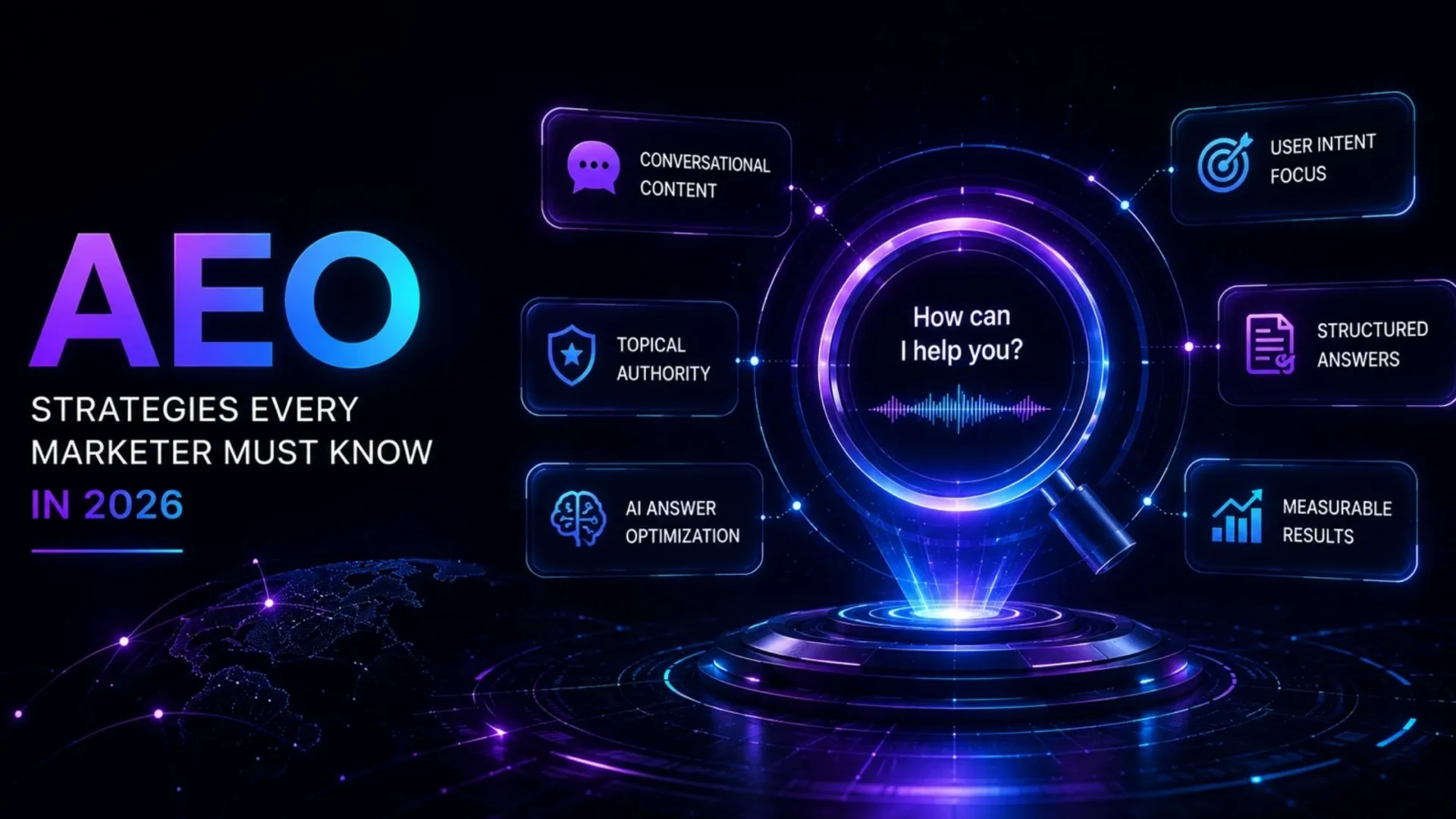
Answer Engine Optimization (AEO) is the process of structuring and optimising your content. This is done so that AI-driven platforms like chat-based search, voice assistants, and AI summaries can directly extract and present your content as the answer.
Not just rank it, but use it. That’s the difference. Traditional SEO focused on visibility. AEO focuses on selection.
Your content isn’t competing for clicks anymore. It’s competing to become the answer itself. And this shift has been building for a while.
Voice search, featured snippets, AI overviews, and now tools like ChatGPT and AI-powered search engines have made it very real.
Why AEO is the Future of Search for Marketers
Let’s be honest. Users don’t want options. They want clarity.
That’s why zero-click searches have exploded. People ask, they get an answer. They move on. No website visit. No browsing journey. From a marketer’s perspective, this feels uncomfortable at first. But here’s the thing.
If your content becomes the source of that answer, your brand still wins. Maybe even more. Because now you’re not just visible, you’re trusted.
Some quick shifts are happening right now:
- AI-generated summaries are replacing traditional SERPs
- Search intent is becoming conversational, not keyword-driven
- Authority is being judged at a topic level, not just a page level
This is where the AI answer engine optimization strategy comes into play. It’s not about stuffing keywords anymore. It’s about structuring meaning.
AEO vs SEO: Key Differences Marketers Must Understand
There’s still overlap, yes. But the intent behind both is drifting apart.
This is where most marketers slip. They optimise content for ranking, but forget to make it answer-ready.
That gap? That’s where AEO wins.
How Answer Engines Work
This part matters more than people think.
AI-driven search engines don’t “read” content the way humans do. They process patterns, context, and relationships, using technologies like Natural Language Processing (NLP). It helps them understand the meaning, intent, and context behind words.
In simple terms:
|
1
|
They scan structured and unstructured data |
|
2
|
They use NLP to interpret language, context, and query intent |
|
3
|
They identify the intent behind a query |
|
4
|
They extract the most relevant, concise answer |
|
5
|
They prioritise clarity over cleverness |
Which means, if your content is buried in long paragraphs without structure, it might never get picked. Even if it’s good.
Structured data, clear headings, and concise answers. These aren’t just best practices anymore. They’re entry points.
Core Answer Engine Optimization Strategies for 2026
Let’s now get into the part that is actually important.
|
1
|
Optimise for Direct Answers and Featured SnippetsStart answering questions early. Not after 500 words. Give a clear, 2 to 3-line answer right below the heading. Then expand if needed. Think of it like this: If an AI had to extract just one paragraph from your page. Would it make sense on its own? If not, fix that. |
|
2
|
Focus on Intent-Based Content CreationKeyword-first thinking is fading. Intent-first thinking is what works now. Instead of targeting “best CRM tools,” go deeper. You can use “What is the best CRM for small businesses in India”? Think of it like:
Content that matches intent gets picked more often. |
|
3
|
Use Structured Data and Schema MarkupSchema helps machines understand your content faster. FAQ schema, how-to schema, product schema. They all increase your chances of being used in answer engines. It’s not flashy work. But it works. |
|
4
|
Build Topical Authority and Content ClustersOne blog won’t make you authoritative. A cluster will. Create interconnected content around a topic. Link them logically. Keep updating them. Over time, AI starts recognising your site as a reliable source for that topic. This is one of the most underrated top answer engine optimization strategies right now. |
|
5
|
Optimise for Conversational QueriesSearch queries are becoming more human. It’s shifting to voice and AI search. Your content should reflect a natural tone and language. Add FAQs. Write like someone is actually asking you something. |
|
6
|
Improve Content Readability and ClarityIf your content is hard to scan, it won’t get picked. It should have short paragraphs, clear subheadings and a logical flow. And yes, sometimes even slightly imperfect writing feels more natural, which, ironically, helps. |
AEO Content Strategy: How to Structure Content for AI Visibility
Structure is everything in AEO. Here’s what works:
- Clear H2 and H3 hierarchy for headings
- Direct answers under each section
- FAQ blocks for common queries
- Summaries, wherever needed
- Tables for comparisons
Basically, a clear content marketing strategy to make your content easy to break apart and reuse. Because that’s exactly what AI systems do.
AEO for AI Platforms (ChatGPT, AI Search, Voice Assistants)
Different platforms, same principle. They all pull from structured, relevant, and trustworthy content. But there are slight nuances:
Chat-Based Platforms
Chat-based platforms prefer conversational clarity
Voice Search
Voice search prefers short, precise answers
AI Search Engines
AI search engines prefer structured depth
So your content needs to balance all three. That’s where answer engine optimization strategies for ChatGPT and AI platforms become critical.
Industry-Specific AEO Strategies for Marketers
AEO isn’t one-size-fits-all. It’s much more
B2B Marketing
Focus on depth and clarity. Decision-makers want precise answers, backed by expertise. So, case-based content works well here.
Content Marketing
Structure your blogs for extraction. You have to think modular. Each section should be independent and stand on its own.
Local and Service-Based Businesses
Optimise for location-based queries. Include clear service descriptions, FAQs, and structured local data. Maybe you can even use the lingo followed in that particular region. These answer engine optimization strategies for brands can directly impact lead generation.
Common AEO Mistakes Marketers Should Avoid
This is where things quietly go wrong.
- Over-optimizing content with keywords
- Ignoring user intent completely
- Writing long, unstructured blocks of text
- Not updating content regularly
- Treating AEO as just another SEO tactic
AEO requires a shift in thinking. Not just execution.
Tools and Technologies for Answer Engine Optimization
You don’t need dozens of tools, just the right ones.
- Schema generators for structured data
- AI content optimization tools
- Analytics platforms to track engagement and visibility
The goal is simple. Understand what’s getting picked, and why.
How to Measure AEO Success
Traditional metrics won’t tell the full story anymore. Instead, look at:
|
1
|
Visibility in AI-generated answers |
|
2
|
Featured snippet appearances |
|
3
|
Organic traffic trends |
|
4
|
Engagement signals like time on page |
If your content is being used as the answer, you’ll start seeing indirect gains.
Future Trends in Answer Engine Optimization (2026 and Beyond)
This is just the beginning. We’re moving toward:
Fully AI-first search ecosystems
AI systems will dominate search by generating answers instead of listing websites. It will make traditional rankings less important.
Personalized answers based on user behavior
AI will customise responses based on past searches, preferences, location, and behavior. No two users may see the exact same answer.
Even stronger reliance on structured data
Structured data will become essential. Not optional. AI depends on clearly defined content formats to understand and extract accurate answers.
Faster, more conversational search experiences
Search will feel more like a real-time conversation. Users will ask follow-up questions and get instant, context-aware responses.
Ready to Make Your Content the Answer?
Elsner’s AEO specialists help brands structure content for AI-driven search, featured snippets, and voice assistants — so your business gets selected, not just ranked. Get a free strategy consultation today.
Conclusion
Search hasn’t disappeared. It’s just evolved. From links to answers. From keywords to intent. From ranking to selection. And if you’re not optimising for that shift, you’re slowly becoming invisible in places where it matters most.
Now might be the right time to rethink your content strategy. If you’re looking to optimise your content with AI-driven search and actually make it work in real scenarios, it helps to have the right direction with technical experts. Because AEO isn’t just a trend. It’s where search is heading.