





- What Is a Virtual Art Gallery, Really?
- How Does Visitor Behavior Actually Change Online?
- Technologies Behind Online Art Gallery Platforms
- Web-Based (WebGL) — The Default Starting Point
- AR — The Strongest Sales Tool in the Stack
- VR — Right Tool, Wrong Starting Point for Most
- The Recommendation Most Developers Skip
- Benefits of Virtual Art Galleries
- The Challenges Worth Knowing Before You Start
- What Is The Cost Of Virtual Art Gallery Development?
- Mistakes That Kill Virtual Gallery Projects
- Choosing the Right Development Partner
- Closing Thoughts
- Transform Your Art Gallery Into a Digital Experience
- FAQ
- What is a virtual art gallery?
- How does AR work in art galleries?
- What does building a virtual gallery cost?
- Do you need VR for a virtual art gallery?
- How do virtual galleries increase art sales?
- What technology powers virtual art galleries?
Search for “virtual art gallery,” and you’ll find the same article recycled a hundred times. Digital is the future. Immersive experiences are rising or art is going online. Great. But none of them tell you how it actually works or what it costs. You won’t know why so many virtual gallery projects quietly fail six months after launch.
Moving a gallery online isn’t uploading images to a prettier website. It’s rebuilding how people discover, explore, and buy art in an environment where they can’t touch anything. Online art gallery visitors can’t feel the scale. They will close the tab the moment navigation feels clunky.
This guide covers the real mechanics: technology stack, implementation decisions, cost ranges, and the mistakes that kill ROI before the virtual art gallery even finds its audience.
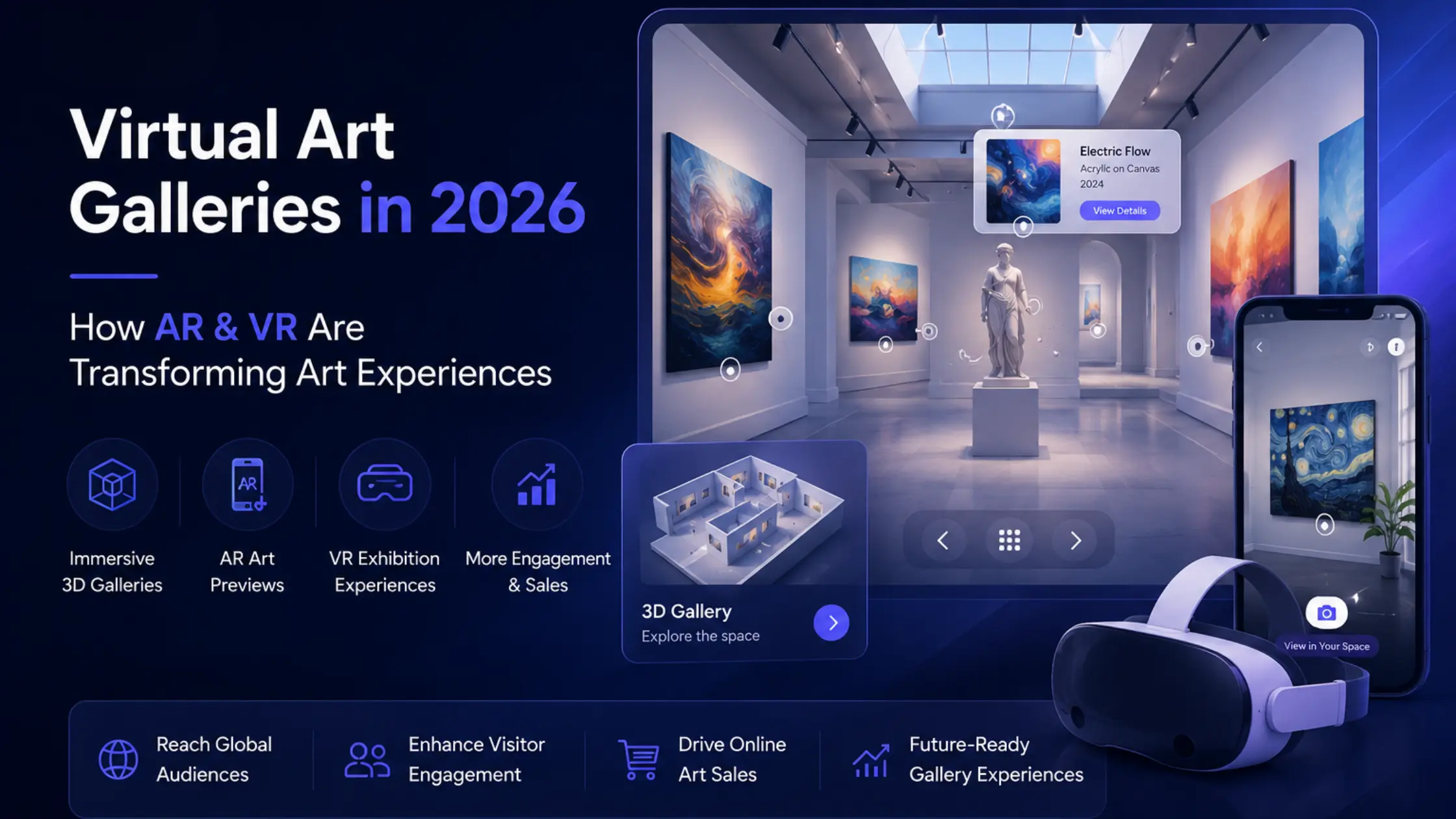
What Is a Virtual Art Gallery, Really?
The term gets stretched to cover three very different things. Mixing them up is expensive.
|
1
|
Web-Based 3D Virtual GalleryThe most practical and scalable format for an immersive art experience online. Visitors explore a 3D environment directly in their browser. No headset, app download, or friction. They are built on WebGL. 3D virtual gallery tours simulate physical gallery spaces with navigable rooms, wall-mounted works, and interactive elements. Any device with a browser can access it. |
|
2
|
VR Art Gallery ExperienceRequires a headset like Meta Quest, HTC Vive, and similar. Fully immersive, spatially convincing, and genuinely impressive. Also expensive to build. Gallery experience is limited to the slice of your audience that actually owns a headset. VR art gallery experience is best reserved for premium exhibitions and institutional projects. Not as a starting point. |
|
3
|
AR Art ExperienceThis one runs on a smartphone camera. Point your phone at a wall and see the painting hanging there, at actual scale, in your actual room. No headset. No download in most cases. And for driving online art sales, AR in museums and galleries is arguably the most commercially useful of the three. |
The immersive art experience online format you choose determines your cost, your audience size, and your ROI timeline.
How Does Visitor Behavior Actually Change Online?
People don’t behave the same way in a virtual gallery as they do in a physical one. The entire journey compresses. So, if your online art gallery platform is designed like a digital replica of a physical space rather than its own thing, you’ll lose people fast.
The digital transformation for art galleries that matters most: passive viewing becomes active exploration. A physical visitor walks through and looks. An online visitor clicks, zooms, reads embedded narratives, and previews art in their living room via AR. If the experience holds, they buy. That compressed journey from discovery to transaction is where virtual galleries earn their keep.
AR VR in art galleries shift behavior from passive viewing → interactive exploration
Technologies Behind Online Art Gallery Platforms
Most articles list technologies without explaining when to use which one. Here’s the breakdown that will help you decide how to create a virtual art gallery.
Web-Based (WebGL) — The Default Starting Point
WebGL renders 3D environments directly in a browser using the device’s GPU. Frameworks like Three.js and Babylon.js power most of what you’d recognize as a 3D virtual gallery tour today. No app. No plugin. Just a link.
The accessibility advantage is real: anyone, anywhere, on any browser. The challenge is performance. Complex 3D scenes with uncompressed textures load slowly, particularly on mobile. Asset optimization (compressed textures, progressive loading, CDN delivery) is necessary.
It’s the difference between a gallery that holds visitors and one they abandon after eight seconds.
AR — The Strongest Sales Tool in the Stack
AR in museums and galleries works by reading the physical environment through a camera and overlaying digital content in real time. For art, that means a buyer can see a specific painting on their actual wall, at actual scale, before committing to a purchase.
This isn’t a novelty. IKEA built its entire pre-purchase strategy around this principle. For galleries, it directly addresses the biggest friction in online art sales: the buyer’s uncertainty about scale, color accuracy, and spatial fit. AR reduces that hesitation.
Delivery options include:
- Native apps (ARKit on iOS, ARCore on Android)
- WebAR, which runs in the browser without any download.
VR — Right Tool, Wrong Starting Point for Most
VR delivers an unmatched level of immersion. It also requires hardware that most of your audience doesn’t own, costs significantly more to build, and narrows your reach before you’ve established it.
For ticketed virtual exhibitions, high-end collector events, or cultural institutions with specific institutional mandates, VR makes sense. For a gallery owner looking to expand digital sales and reach new buyers? Not a good starting point.
The Recommendation Most Developers Skip
Start with WebGL + AR. Not VR.
A well-executed web-based 3D gallery with AR previews (metaverse art gallery) for your key works delivers most of the commercial value at a fraction of the cost.
Build the revenue-generating foundation first. Add VR when you have an audience that wants it and a budget that justifies it.
Benefits of Virtual Art Galleries
These are the outcomes worth building toward.
Global Reach, Without the Overhead
A physical gallery in Chicago serves Chicago. A virtual gallery serves Chicago, London, and Seoul simultaneously. For galleries with work that appeals to international collectors, removing geography as a barrier changes the entire addressable market.
24/7 Sales Without 24/7 Staff
Your gallery doesn’t close. A collector in Singapore browsing at midnight can explore your full collection, read the artist’s background, and complete a purchase without anyone being online. That’s passive revenue. It’s one of the most underused advantages of going digital.
Longer Sessions Through Storytelling
Physical galleries are limited by tired feet and short attention spans. Virtual galleries can hold attention longer. But only when they’re built around content, not just images. Embedded artist interviews, audio guides, layered exhibition narratives turn a viewer into someone genuinely invested. And investment drives purchases.
AR Closes the Sale
The conversion problem in online art sales isn’t price. It’s uncertainty. Buyers can’t judge scale from a flat JPEG. AR lets them place the work in their own space before deciding. Galleries using AR consistently see better conversion on online listings than those relying on photography alone.
Data You Can Actually Use
Physical galleries are largely blind to visitor behavior. Virtual galleries aren’t. With analytics properly set up, you can track:
- Which artworks get the most views and interactions
- Where visitors drop off in the navigation
- Geographic breakdown of your audience
- Paths from artwork view to purchase inquiry
- Device and browser data for experience optimization
This isn’t just interesting. It informs curation decisions, marketing spend, and every future exhibition.
The Challenges Worth Knowing Before You Start
High Initial Cost and Scope Creep
The cost of developing a virtual art gallery is real. The bigger risk isn’t the initial quote. It’s scope is expanding mid-project without a corresponding budget conversation.
Fix: Start with a tightly scoped MVP. A web-based 3D gallery with AR previews for your top ten works is a real, launchable product. Expand from something that’s live and performing.
Bad UX Kills Traffic Before It Starts
Many virtual galleries are technically complete and experientially broken. Confusing navigation, no clear entry point or tiny interactive targets. These mistakes make visitors leave. Fast.
Fix: Prioritize UX in the brief, not as an afterthought. Run real user tests before launch. Simple and intuitive outperforms visually complex every time.
Mobile Compatibility Isn’t Optional
More than 60% of web traffic is mobile. A virtual gallery that breaks on a phone isn’t reaching most of its potential audience.
Fix: Build mobile-responsive from the start. Test across devices and screen sizes before anything goes live.
Load Speed Kills Sessions
Large 3D environments with unoptimized textures load slowly. Visitors abandon slow virtual galleries the same way they abandon slow websites immediately.
Fix: CDN infrastructure, compressed assets, and progressive loading aren’t performance luxuries. They’re prerequisites.
What Is The Cost Of Virtual Art Gallery Development?
Three factors move these numbers significantly:
- 3D complexity — Custom-modeled environments cost more than template-based builds. Photorealistic rendering via Unreal Engine sits at a different price point than standard WebGL.
- Integrations — Connecting your gallery to an e-commerce platform, CRM, NFT marketplace, or existing CMS adds time and cost. Plan for this upfront, not mid-build. It is the future of art galleries digital.
- Scale — A gallery hosting 25 artworks has entirely different infrastructure needs than a museum digitizing 2,000 works.
The most expensive mistake isn’t starting too small. It’s building the wrong thing for the wrong audience with no monetization path.
Mistakes That Kill Virtual Gallery Projects
Overbuilding VR Before You Have a Digital Audience
A $60,000 VR experience is a bad investment if your audience doesn’t own headsets and hasn’t engaged with your existing digital presence. It’s the premium tier before the foundation exists.
Fix: Build the web-based gallery. Prove engagement. Then consider VR for the audience that’s already there.
Treating Mobile as Secondary
Mobile visitors don’t get a worse version. They leave.
Fix: Mobile-first or mobile-equal. No exceptions.
Replicating Physical Navigation in a Digital Space
An open floor plan that works in a physical gallery creates a disorienting maze online. Visitors don’t know where to go and they don’t wait to figure it out.
Fix: Design navigation for digital behavior. Guided tours, clear room labels, obvious controls. Design for the first-time visitor who has never used a virtual gallery before.
Building a Gallery With No Story
A 3D room with images on the walls isn’t a gallery experience. It’s a storage room with better lighting.
Fix: Every work needs context. Artist biography, exhibition essay, process video, audio guide — storytelling is what converts a browser into a buyer.
Launching Without SEO
Virtual gallery platforms typically render in JavaScript. Without server-side rendering, structured data, and proper metadata, search engines can’t index the content. An invisible gallery doesn’t get traffic.
Fix: Technical SEO has to be part of the build, not bolted on afterward. Your development partner needs to understand both.
Choosing the Right Development Partner
Not every agency can pull this off. Most can build websites. Fewer can build immersive, performant, commercially viable virtual gallery experiences. Here’s what to look for:
- Live examples of immersive builds — WebGL galleries, AR implementations, VR work. If the portfolio is all static sites, keep looking.
- Relevant sector experience — Gallery and cultural institution projects are different from retail ecommerce. Ask specifically.
- UX-led process — A good partner starts with user research and information architecture, not immediately with code.
- Scalability planning — Your gallery will grow. The platform should accommodate more work, more visitors, and new features without a full rebuild.
- SEO and performance baked in — Not optional. Not extra. Core to every deliverable.
- Post-launch support — Virtual gallery transformation isn’t a one-time project. It needs ongoing iteration based on real visitor data.
Closing Thoughts
Virtual art galleries aren’t a trend that’ll plateau and fade. They’re a structural change in how audiences find and experience art, and that shift is accelerating, not stabilizing.
The galleries that get this right won’t be the ones that spent the most or adopted the most advanced technology. They’ll be the ones who understood their audience, chose the right format, and built something that actually works for the people using it.
Start with the foundation. Prove it performs. Then build from there.
Transform Your Art Gallery Into a Digital Experience
Elsner helps art galleries and cultural institutions build scalable, immersive digital experiences. If you’re planning digital transformation for art galleries, the conversation starts with strategy and technology selection, not a proposal.
FAQ
What is a virtual art gallery?
It’s a digital environment, usually browser-based or headset-based. Here, visitors can explore and purchase artwork without visiting a physical location. Modern virtual galleries use 3D rendering, AR, and interactive content to replicate and often improve on the physical gallery experience.
How does AR work in art galleries?
AR uses a smartphone or tablet camera to overlay digital artwork onto a real physical space in real time. In practice, a buyer points their phone at a wall and sees how a specific painting would look there before purchasing.
What does building a virtual gallery cost?
Basic web-based 3D galleries run $5,000–$15,000. Advanced immersive platforms with AR and ecommerce integration land between $15,000–$40,000. Full VR experiences start at $40,000 and can exceed $100,000 depending on complexity. Final cost depends on 3D scope, integrations, and how many works you’re hosting.
Do you need VR for a virtual art gallery?
No. Most galleries shouldn’t start with VR. A WebGL-based 3D gallery with AR art previews delivers strong commercial results at a fraction of the cost. VR becomes relevant once you have an established digital audience and a use case that justifies the investment.
How do virtual galleries increase art sales?
They remove geographic barriers, enable 24/7 browsing and purchasing, and use AR to eliminate the uncertainty that stalls online art buying. They also generate behavioral data that you can actually act on.
What technology powers virtual art galleries?
The core stack: WebGL for browser-based 3D rendering, ARKit/ARCore or WebAR for augmented reality, Unity or Unreal Engine for VR builds, 3D scanning for digitizing physical spaces, and CDN infrastructure for fast global delivery.