




- What Is Website Copywriting and Why Does It Matter?
- How Website Copy Builds or Breaks Trust
- Why Messaging Influences Buying Decisions
- The SEO and Conversion Connection
- Bad Copy vs Good Copy in One Example
- Why Most Website Copy Fails to Convert Visitors
- Generic Messaging That Could Belong to Anyone
- Weak Headlines That Don’t Earn the Scroll
- Writing About the Brand Instead of the Customer
- CTAs That Confuse Instead of Convert
- Keyword Stuffing and Robotic SEO Copy
- Website Copywriting Secrets Used by High Converting Brands
- Customer Focused Messaging From the First Word
- Headlines That Grab Attention Without Being Clever
- Benefit Driven Copy That Sells the Outcome
- Strategic CTA Placement Throughout the Page
- Trust Building Copy That Removes Doubt
- Search Intent Optimization Built Into the Copy
- The Psychology Behind High Converting Website Copy
- Emotional Triggers That Drive Action
- Trust Psychology and Risk Reduction
- Scarcity and Time Sensitivity Done Well
- Cognitive Load and the Cost of Confusion
- Anticipating and Addressing Objections Directly
- Is Your Website Copy Working as Hard as It Should?
- SEO Website Copywriting Best Practices in 2026
- Search Intent Optimization Above Everything Else
- Semantic Keywords and Topical Depth
- EEAT Signals That Build Authority
- Mobile First Formatting
- Readability and User Experience Built Into the Copy
- Featured Snippet and AI Overview Optimization
- Common Website Copywriting Mistakes That Hurt Conversions
- Walls of Text That Nobody Reads
- Messaging That Tries to Sound Smart
- Confusing or Competing CTAs
- Over Optimized SEO Copy
- Expert Insight: The Five Second Test
- Spotting These Mistakes on Your Own Site?
- Advanced Website Copywriting Tips for Better Conversions
- Storytelling That Makes the Brand Relatable
- Power Words That Earn Their Place
- Scannable Formatting That Respects Reader Time
- Microcopy Optimization in the Small Details
- Personalization Strategies Worth Implementing
- When Businesses Should Invest in Professional Website Copywriting Services
- Traffic Is Strong but Conversions Are Flat
- Bounce Rates Are High Across Key Pages
- Brand Messaging Feels Inconsistent
- Engagement Metrics Are Slipping
- Make Your Website Earn Every Visit
- Turn Your Website Into a Conversion Machine
- Frequently Asked Questions
Most websites don’t have a traffic problem. They have a copy problem.
Brands spend thousands on SEO, paid ads, and design refreshes, then send all that traffic to homepages and landing pages that read like brochures. Visitors land, scroll for six seconds, and leave. The funnel looks broken. The real issue sits on the page itself.
Website copywriting is the quiet force that decides whether visitors stay, trust the brand, and eventually buy. Strong copy turns a cold visitor into a warm lead. Weak copy turns even qualified traffic into bounce rate statistics. Honestly, it’s one of the highest leverage investments a business can make, and most companies underinvest in it badly, including their broader content marketing services strategy.
This guide breaks down what actually works in modern website copywriting. Not generic tips. Real conversion psychology, SEO alignment, and the structural decisions that separate websites doing serious revenue from those quietly losing visitors every day. If your site has traffic but conversions feel flat, this is usually where the leak lives.
What Is Website Copywriting and Why Does It Matter?
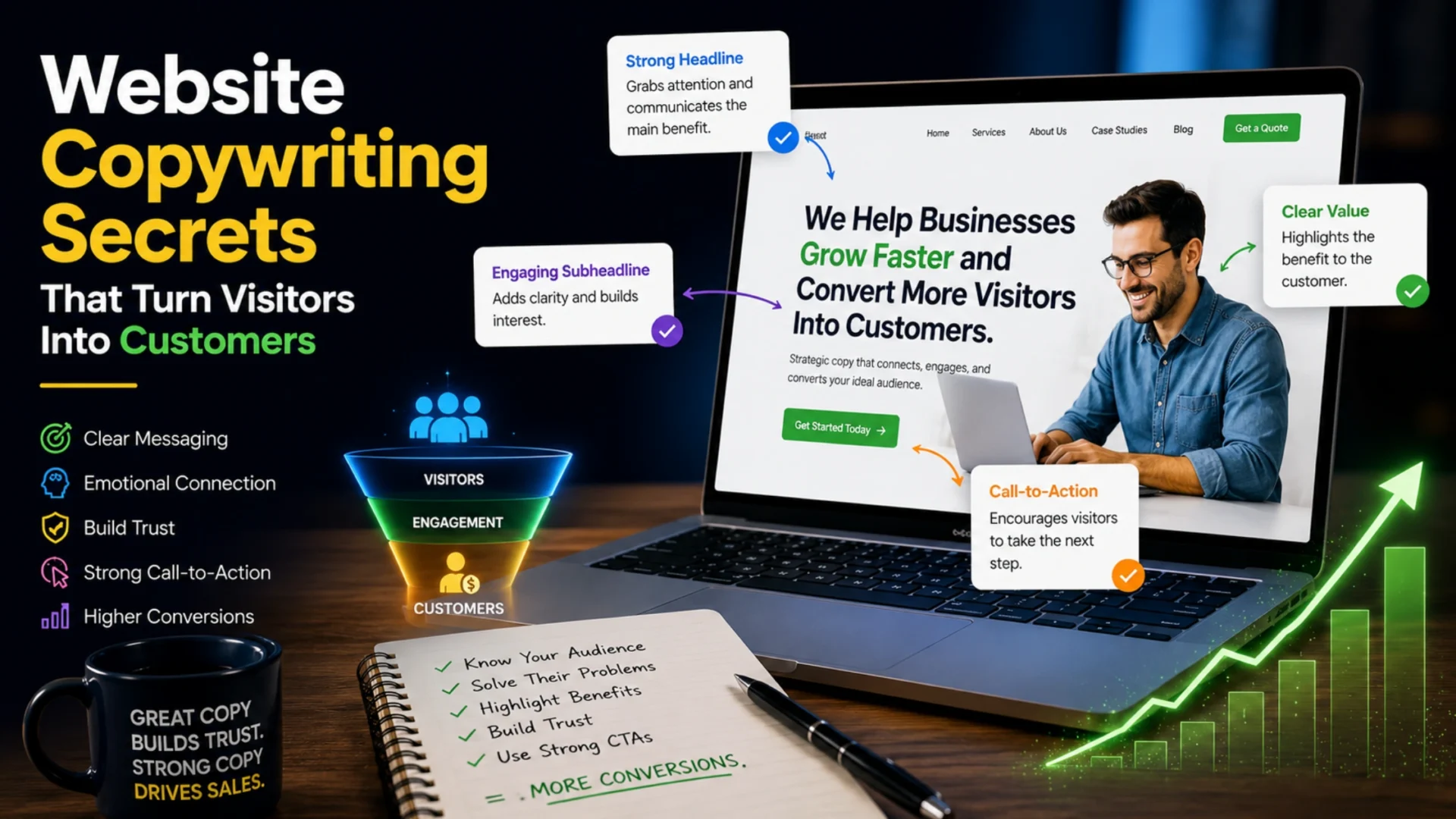
Website copywriting is the strategic writing that drives action on a website. Headlines. Subheadings. Hero sections. Product descriptions. CTAs. About pages. Every word that exists to move a visitor closer to a decision.
People often confuse it with content writing. They’re different jobs entirely. Content writing builds awareness through blogs, guides, and educational material. Copywriting converts. One brings people in. The other turns them into customers.
How Website Copy Builds or Breaks Trust
Visitors judge credibility in seconds. The first headline. The clarity of the value proposition. Whether the page sounds confident or generic. All of it signals whether this brand is worth their attention. Copy that sounds like every other competitor instantly puts you in the commodity bucket. Copy that speaks directly to the visitor’s situation pulls them in.
Why Messaging Influences Buying Decisions
Most B2B and ecommerce buyers compare three to five options before deciding. Your copy is often the deciding factor between you and the next tab. Clear messaging that addresses the specific problem wins. Vague claims about being “innovative” or “trusted” lose every time. Buyers want to feel understood, not impressed.
The SEO and Conversion Connection
Google measures dwell time, scroll depth, and pogo sticking as ranking signals. Pages with weak copy lose on all three. Strong copy keeps people reading, which keeps them on the page, which tells Google the result satisfied the searcher. SEO and conversion writing aren’t separate disciplines anymore. They’re the same job.
Bad Copy vs Good Copy in One Example
Bad: “We provide innovative solutions that empower businesses to achieve their goals.”
Good: “Cut your invoicing time from 6 hours to 20 minutes. Built for accounting teams managing 200 plus clients.”
One sounds like a brochure nobody asked for. The other tells the visitor exactly what they get, who it’s for, and why it matters. That’s the entire game.
If you’re rethinking how your site communicates with visitors, our content marketing services team approaches copy as a conversion asset, not just words on a page.
Why Most Website Copy Fails to Convert Visitors
The patterns repeat across thousands of audits. Most websites lose conversions for the same handful of reasons. Fixing any one of them moves the needle. Fixing all of them transforms results.
Generic Messaging That Could Belong to Anyone
If you swap your logo with a competitor’s logo and the homepage still makes sense, the copy isn’t doing its job. Generic value statements about quality, innovation, and customer focus tell visitors nothing. Specificity wins. Numbers, names, scenarios, outcomes. Vague positioning is the fastest way to blend into the noise.
Weak Headlines That Don’t Earn the Scroll
Eight out of ten visitors read the headline. Two out of ten read past it. That’s the math. A weak headline kills everything underneath it. Most websites use clever wordplay or vague taglines where they should be making a clear promise. The headline isn’t where you get creative. It’s where you get specific.
Writing About the Brand Instead of the Customer
Count the times “we” appears on your homepage. Then count the times “you” appears. Most underperforming websites are heavily weighted toward the brand. Visitors don’t care about your founding story in the first scroll. They care whether you can solve their problem. Flip the ratio and conversions usually follow.
CTAs That Confuse Instead of Convert
Submit. Learn More. Click Here. These CTAs are everywhere, and they’re costing real money. Strong CTAs tell the visitor exactly what happens next and why it’s worth doing. “Get my free audit.” “See pricing in 60 seconds.” “Book a 15 minute strategy call.” Specific beats clever, every time.
Keyword Stuffing and Robotic SEO Copy
Old SEO playbooks pushed exact match keywords into every other sentence. That approach now actively hurts rankings and destroys readability. Modern SEO rewards copy that sounds human, covers a topic completely, and matches search intent. If your page reads like it was written for crawlers, both visitors and Google will treat it that way.
Website Copywriting Secrets Used by High Converting Brands
The brands quietly winning online aren’t doing anything magical. They’re applying a small set of principles consistently. These are the patterns that show up across high performing SaaS sites, ecommerce stores, and service businesses.
Customer Focused Messaging From the First Word
High converting copy starts with the customer’s reality, not the company’s offering. Their frustration. Their goal. Their cost of doing nothing. Then it bridges to what you offer as the answer. This isn’t about flattery. It’s about proving you understand them before asking for their attention.
Headlines That Grab Attention Without Being Clever
The best headlines pass the “so what” test. They make a clear, specific promise that the rest of the page delivers on. Numbers help. Outcomes help more. Try this formula: who it’s for, what they get, how it’s different. “Operations software for logistics teams shipping 500 plus orders a day, with carrier rules built in.” Boring? Maybe. Effective? Hugely.
Benefit Driven Copy That Sells the Outcome
Features tell. Benefits sell. A feature is “real time inventory sync across channels.” The benefit is “stop overselling and refunding angry customers.” Both belong on the page, but the benefit goes first. Visitors don’t buy software. They buy the outcome the software produces.
Strategic CTA Placement Throughout the Page
One CTA buried at the bottom of a long page isn’t enough. Place CTAs at natural decision points. After the hero. After social proof. After the features section. After pricing. Visitors decide at different points. Meet them where their interest peaks. Just don’t overload the page with the same CTA repeated five times. Variety in framing helps.
Trust Building Copy That Removes Doubt
Testimonials. Case study snippets. Recognizable client logos. Specific metrics. Guarantees. Compliance badges. Every element that signals “you can trust this brand” reduces friction. Most websites underuse trust signals or place them where nobody looks. Move them next to the CTA. Watch what happens.
Search Intent Optimization Built Into the Copy
Every page should match a clear search intent. A pricing page targets evaluation intent. A category page targets commercial intent. A blog targets informational intent. The copy needs to deliver what the searcher came for, fast. Misaligned intent kills both rankings and conversions at the same time.
| Copywriting Element | Conversion Benefit |
|---|---|
| Clear, Specific Headlines | Improves engagement and earns the scroll |
| Benefit Focused Body Copy | Increases conversions by selling outcomes |
| Social Proof Near CTAs | Builds trust and removes purchase hesitation |
| Strong, Action Driven CTAs | Reduces friction and clarifies the next step |
| Customer Centric Language | Builds connection and improves dwell time |
The Psychology Behind High Converting Website Copy
Great copy isn’t writing. It’s applied psychology. Every word choice taps into how people actually decide. Understanding the mental shortcuts visitors use makes the difference between copy that converts and copy that just exists.
Emotional Triggers That Drive Action
People justify with logic but decide with emotion. Frustration with a current solution. Relief at finding something better. Excitement about a future state. Fear of falling behind competitors. Copy that names these emotions specifically creates a stronger pull than copy that stays purely rational. The goal isn’t manipulation. It’s resonance.
Trust Psychology and Risk Reduction
Every purchase carries perceived risk. Wasted money. Wasted time. Looking bad to the team. Strong copy actively reduces that risk through guarantees, free trials, money back terms, transparent pricing, and credible proof. The brand that makes the decision feel safest usually wins, even against technically better competitors.
Scarcity and Time Sensitivity Done Well
Fake countdown timers and “only 2 left” tricks destroy trust. Real scarcity works. Limited spots in a coaching program. Beta access for the first 100 sign ups. Pricing that genuinely changes at quarter end. When urgency is honest, it accelerates decisions. When it’s manufactured, sophisticated buyers see through it immediately.
Cognitive Load and the Cost of Confusion
Confused visitors don’t convert. They leave. Every extra sentence, jargon term, or unclear navigation step adds cognitive load. The brands that win obsess about reducing it. Short sentences. Clear hierarchy. Simple language even for complex products. If a visitor has to think hard to understand what you do, you’ve already lost most of them.
Anticipating and Addressing Objections Directly
Every visitor has objections. Too expensive. Will it actually work for my situation. How hard is it to switch. Smart copy answers these before the visitor leaves to find answers elsewhere. FAQ sections. Comparison content. “Is this right for me” qualifiers. Objection handling is where mid funnel conversions live.
Is Your Website Copy Working as Hard as It Should?
Get a free messaging review from our team. We’ll look at your homepage, key landing pages, and CTAs and show you exactly where conversions are leaking.
SEO Website Copywriting Best Practices in 2026
Search engine optimization has shifted dramatically. Old playbooks built around keyword density and exact match phrases now actively hurt rankings. Modern SEO copywriting blends search intent, semantic depth, and genuine usefulness. Here’s what actually works today.
Search Intent Optimization Above Everything Else
Before writing a single word, understand what the searcher actually wants. Informational. Navigational. Commercial. Transactional. The copy needs to match that intent fast. Pages that satisfy intent rank. Pages that try to force a different intent fail, regardless of how well written they are.
Semantic Keywords and Topical Depth
Google now understands topics, not just keywords. Covering related concepts, questions, and entities signals that the page is genuinely useful. A page about website copywriting should naturally include conversion rate, headlines, CTAs, user experience, and search intent. Stuffing the same phrase 20 times accomplishes nothing.
EEAT Signals That Build Authority
Experience, Expertise, Authoritativeness, Trustworthiness. Google evaluates all four. Real author credentials. Specific examples. Verifiable claims. Clear contact information. Linked sources. Pages that demonstrate these signals consistently rank above pages that don’t, especially in competitive spaces.
Mobile First Formatting
Most traffic is mobile. Most copy is still written and reviewed on desktop. The mismatch creates problems. Long paragraphs become walls of text on a phone. Wide tables get cut off. Subheadings get lost. Write for the phone first. Test on the phone. If it works there, it works everywhere.
Readability and User Experience Built Into the Copy
Short sentences. Short paragraphs. Clear subheadings every few hundred words. Bullet points where they help. White space that lets the eye breathe. None of this is decorative. All of it directly affects how long visitors stay, which directly affects rankings.
Featured Snippet and AI Overview Optimization
Google’s AI Overviews and featured snippets pull from pages that answer questions directly and clearly. A 40 word definition. A short numbered list. A clean comparison. Structuring copy with snippet ready answers earns visibility in spots that didn’t exist five years ago. This is increasingly where rankings live.
Modern SEO is user focused, not keyword focused. The brands ranking consistently in 2026 are writing for humans first and letting search engines reward that choice. Our piece on the future of SEO across LLMs, GEO, and AEO covers where the discipline is heading.
Common Website Copywriting Mistakes That Hurt Conversions
Most conversion problems come down to a small list of recurring mistakes. They show up across industries, page types, and budgets. Fixing them is straightforward once they’re named.
Walls of Text That Nobody Reads
Long paragraphs scare visitors away. Two or three sentence paragraphs feel approachable. The information density can be identical. The perception is completely different.
Messaging That Tries to Sound Smart
Industry jargon and complex vocabulary make writers feel credible. They make readers feel stupid. Plain language wins for almost every audience, including technical buyers. Smart people appreciate clarity, not complexity.
Confusing or Competing CTAs
Three different CTAs on one page asking for three different actions create paralysis. Pick the primary action you want. Make it the loudest one. Secondary actions can exist but should never compete visually.
Over Optimized SEO Copy
Pages built to rank but not to read. Awkward sentences forcing keywords. Repetitive phrases. Robotic flow. Visitors feel it instantly and leave. So does Google’s quality scoring. Write for humans, optimize lightly, and ranking follows.
Expert Insight: The Five Second Test
Show your homepage to someone for five seconds, then close it. Ask them what your company does, who it’s for, and why they should care. If they can’t answer all three, the copy needs work. This single test reveals more about messaging clarity than any analytics dashboard ever will.
Spotting These Mistakes on Your Own Site?
Our copy and CRO specialists run a structured website audit covering messaging clarity, CTA placement, trust signals, and conversion friction points. You’ll know exactly what to fix first.
Advanced Website Copywriting Tips for Better Conversions
Once the basics are solid, these advanced techniques separate good websites from great ones. Most brands skip directly to these without fixing fundamentals first. That order doesn’t work. Get the foundation right, then layer these on.
Storytelling That Makes the Brand Relatable
Stories stick. Stats slide off. A short founder story or customer journey woven into the copy creates emotional connection that pure features can’t match. Keep it tight. Two or three sentences in the right spot beats a 500 word about page.
Power Words That Earn Their Place
Words like proven, guaranteed, instant, simple, and effortless drive action when used carefully. Used everywhere, they lose meaning. Sprinkle them where they matter most. Headlines. CTAs. Subheads. Not in every sentence.
Scannable Formatting That Respects Reader Time
Most visitors scan before they read. Subheadings should tell the story on their own. Bullets should hold the key points. Bolded phrases should anchor scanning eyes. If a visitor only reads the formatting, they should still understand the page.
Microcopy Optimization in the Small Details
Button labels. Form field hints. Error messages. Tooltip text. These small pieces of copy shape the entire user experience. “Send” vs “Get My Free Audit.” “Field required” vs “We need this to send your report.” Small changes, big impact.
Personalization Strategies Worth Implementing
Industry specific landing pages. Role specific messaging. Returning visitor variants. Dynamic copy based on referral source. The technology is now accessible for most businesses, not just enterprise. Even simple personalization moves conversion rates measurably. Our take on conversion rate optimization covers the technical and strategic side of getting this right.
When Businesses Should Invest in Professional Website Copywriting Services
Not every business needs professional copywriting immediately. But some signs make it obvious. When you see these, it’s usually time.
Traffic Is Strong but Conversions Are Flat
You’re spending on SEO and ads. Traffic is climbing. Conversions aren’t. That gap is almost always a messaging problem, not a traffic problem. More visitors won’t fix a page that doesn’t convert. Better copy will.
Bounce Rates Are High Across Key Pages
Homepage bouncing above 65 percent. Landing pages losing visitors in under 15 seconds. These are signals that the first impression isn’t working. Often the design is fine. The copy is what’s pushing people away.
Brand Messaging Feels Inconsistent
Different pages sound like different companies. The homepage promises one thing, the product pages another, the about page a third. Visitors notice. Professional copywriting builds a cohesive brand voice that runs through every page.
Engagement Metrics Are Slipping
Time on page dropping. Scroll depth shrinking. Repeat visits declining. These metrics tell you the content isn’t holding interest. Fresh, strategic copywriting is often the single highest leverage fix.
Make Your Website Earn Every Visit
Traffic is expensive. Conversions are where the math actually works. Website copywriting is the bridge between the two, and most brands underinvest in it relative to the impact it has. Better copy doesn’t just lift conversion rates. It improves SEO performance, builds trust faster, and makes every dollar spent on traffic or affordable SEO services work harder.
The good news is the principles are learnable. The patterns repeat. The fixes aren’t mysterious. What separates websites that convert from websites that don’t is usually a willingness to write for the customer, not the brand, and to measure what’s actually working.
If your website is bringing in traffic but the conversions don’t match, the messaging is probably where the leak lives. That’s almost always fixable with a focused effort.
Turn Your Website Into a Conversion Machine
Our content and CRO team rebuilds website copy around clarity, customer psychology, and modern SEO. Most clients see meaningful conversion lift within the first 60 days.
Frequently Asked Questions
What is website copywriting?
Website copywriting is the strategic writing that drives action on a website. It includes headlines, hero sections, product descriptions, CTAs, and every other piece of copy designed to move visitors closer to a buying decision. Unlike content writing, which focuses on education and awareness, copywriting focuses directly on conversion.
How does website copywriting improve conversions?
Strong website copy reduces visitor confusion, builds trust quickly, addresses objections, and makes the next action obvious. Each of those elements lifts conversion rates measurably. Brands that invest in professional copy typically see 20 to 40 percent improvements in conversion within a few months of rewrites.
Why is SEO website copywriting important?
SEO copywriting balances search visibility with conversion. It helps the page rank for relevant queries while still persuading visitors to act. Without SEO, even great copy stays invisible. Without strong conversion focus, even ranking pages fail to generate revenue. Both have to work together.
What makes website copy high converting?
Clear, customer focused messaging. Specific headlines that promise outcomes. Benefit driven body copy. Trust signals near decision points. Strong action driven CTAs. Readable formatting. All of these working together produce pages that convert consistently better than industry averages.
What is the difference between copywriting and content writing?
Content writing builds awareness, educates audiences, and supports SEO through blogs, guides, and articles. Copywriting drives action through pages and elements built to convert. Both matter. They serve different stages of the customer journey and require different skill sets.
How often should website copy be updated?
Core pages benefit from a strategic review every 12 to 18 months. Landing pages and high traffic pages should be tested and refined quarterly. Anytime the offering, audience, or market changes meaningfully, the copy should be revisited. Stale copy quietly costs conversions year over year.