




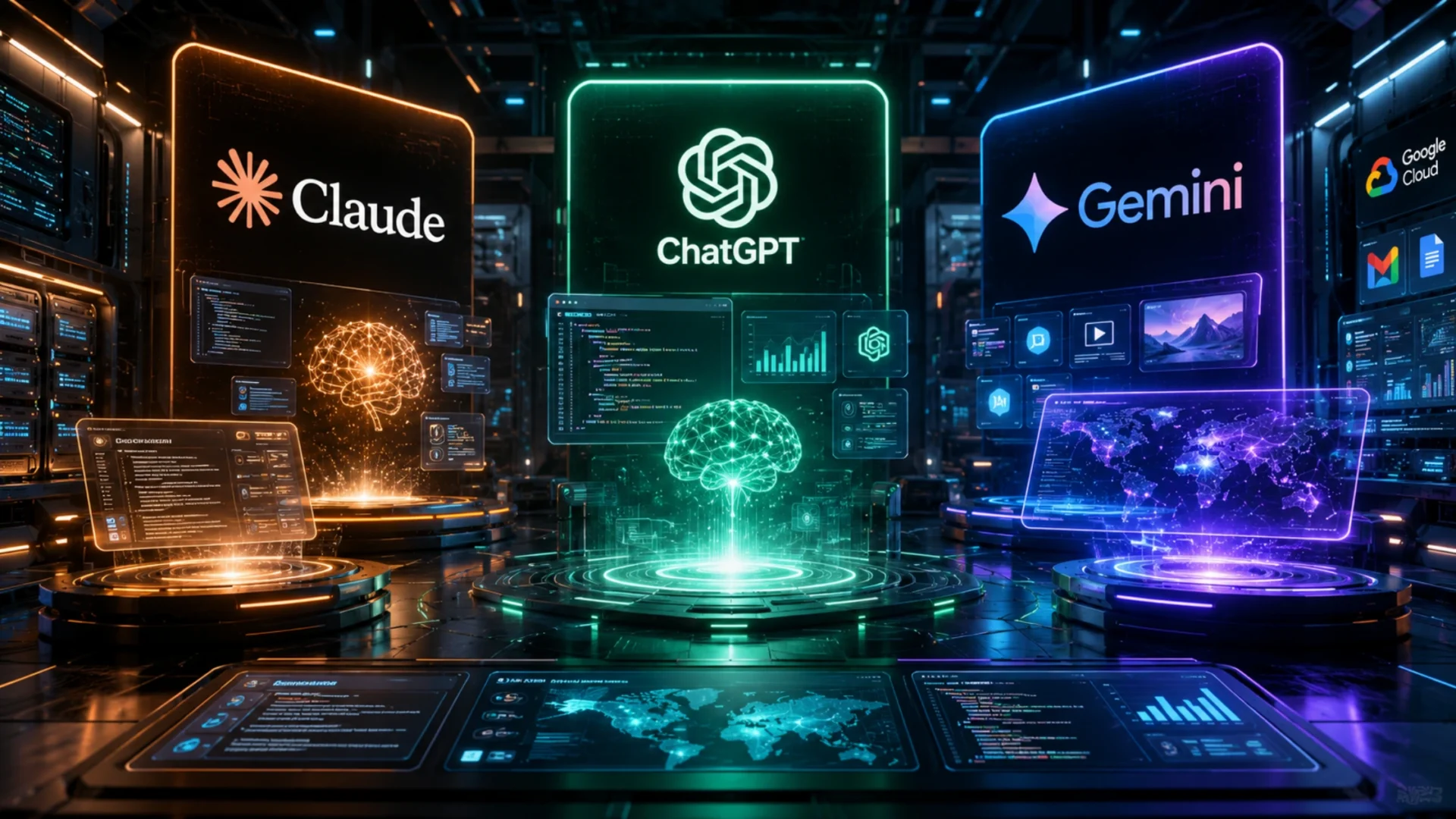
- What Are Claude, ChatGPT, and Gemini?
- What Is Claude AI?
- What Is ChatGPT?
- What Is Gemini?
- Claude vs ChatGPT vs Gemini at a Glance
- Feature-by-Feature Comparison
- 1. User Interface and Ease of Use
- 2. Writing and Content Creation Quality
- 3. Coding and Development Performance
- 4. Research and Accuracy
- 5. Context Window and Memory
- 6. Multimodal Capabilities
- 7. Integrations and Ecosystem Support
- Claude vs ChatGPT for Coding: The Developer Breakdown
- Claude vs ChatGPT vs Gemini for Content Writing
- Which AI Is Better for Research and Productivity
- Claude Pro vs ChatGPT Plus vs Gemini Advanced: Pricing Comparison
- Real-World Use Cases: Which AI Wins for Each User Type
- Best AI for Developers
- Best AI for SEO Teams
- Best AI for Businesses
- Best AI for Students
- Best AI for Content Creators
- Best AI for Research Work
- Pros and Cons: Honest Assessment
- Which AI Should You Choose?
- Choose Claude if:
- Choose ChatGPT if:
- Choose Gemini if:
- Use multiple tools if:
- The Future of AI Assistants
- Agentic AI Becomes Standard
- Context Windows Keep Growing
- Model Quality Gaps Narrow, Ecosystem Depth Widens
- Enterprise AI Adoption Accelerates
- Final Verdict
- Frequently Asked Questions
Every week, millions of people search for the same question: which AI is actually better? The honest answer is that Claude, ChatGPT, and Gemini are all genuinely capable, but they are built on different philosophies, optimized for different tasks, and priced for different users.
This guide cuts through the noise with real comparisons across coding, writing, research, pricing, and productivity so you can make a confident decision fast.
What Are Claude, ChatGPT, and Gemini?
What Is Claude AI?
Claude is built by Anthropic, a San Francisco AI safety company founded in 2021. Anthropic designed Claude around Constitutional AI, which uses explicit values to guide model behavior and reduce harmful outputs.
Claude’s flagship models in 2026 are Claude Opus 4.6 and Claude Sonnet 4.6. Opus handles complex reasoning and high-stakes professional tasks, while Sonnet delivers most of that quality at faster speed and lower cost. Claude is widely regarded as the strongest AI for writing quality and coding precision, producing output that reads naturally, follows complex instructions accurately, and handles large documents without losing context.
What Is ChatGPT?
ChatGPT is built by OpenAI and remains the most recognized AI assistant in the world. Its advantage is handling almost everything at a high level while offering the widest range of built-in tools. GPT-5.4 is the current flagship, and the o-series reasoning models handle multi-step logic and complex planning. The interface includes native image generation through DALL-E, voice mode, web search, and a code interpreter that executes Python.
OpenAI reports that 92% of Fortune 500 companies use ChatGPT in some capacity, giving it a mature ecosystem of third-party integrations that neither Claude nor Gemini has fully matched.
What Is Gemini?
Gemini is Google’s AI platform developed by Google DeepMind, with Gemini 3.1 Pro as the current flagship. Where Gemini stands apart is native integration with tools hundreds of millions already use: Gmail, Google Docs, Sheets, Slides, and Google Search. Gemini 3.1 Pro supports up to one million tokens as standard input and is the most capable platform for multimodal tasks involving video and audio. For teams already in Google Workspace, Gemini feels less like a separate tool and more like a smarter version of software they already use.
Claude vs ChatGPT vs Gemini at a Glance
| Feature | Claude | ChatGPT | Gemini |
|---|---|---|---|
| Developer | Anthropic | OpenAI | Google DeepMind |
| Flagship Model (2026) | Opus 4.6 / Sonnet 4.6 | GPT-5.4 | Gemini 3.1 Pro |
| Best For | Writing, coding, long docs | General use, creative work, image gen | Google ecosystem, video, massive context |
| Context Window | 200K standard (1M Opus) | 128K | 1M standard |
| Image Generation | No | Yes (DALL-E) | Yes (Imagen) |
| Video Understanding | No | Limited | Yes (native) |
| Free Plan | Yes (daily limits) | Yes (with ads) | Yes |
| Paid Plan | Claude Pro at $20/month | ChatGPT Plus at $20/month | Google AI Pro at $19.99/month |
| Premium Tier | Claude Max at $100 or $200/month | ChatGPT Pro at $200/month | Google AI Ultra at $249.99/month |
| Coding Strength | Excellent (powers Cursor, Claude Code) | Very Strong | Good |
| Google Workspace Integration | Limited (via MCP) | Limited | Native |
| Voice Mode | Basic | Advanced | Yes |
| Web Search | Yes | Yes | Yes (deep Google integration) |
Feature-by-Feature Comparison
1. User Interface and Ease of Use
ChatGPT’s interface is the most feature-rich, with tool toggles for web search, image generation, and code interpreter visible in the chat window. It is intuitive for beginners but can feel cluttered for specific workflows. Claude’s interface is cleaner and more focused, working well for writing and document tasks. The Projects feature retains context about your work across multiple sessions. Gemini feels most natural for Google Workspace users, with deep embedding in Docs and Gmail that reduces friction between apps.
Winner for ease of use: ChatGPT for general users, Gemini for Google Workspace teams, Claude for focused professional work.
2. Writing and Content Creation Quality
Claude has built the strongest reputation for writing. It produces prose that reads naturally, varies sentence structure, and maintains consistent tone across long-form content. Writers consistently report that Claude’s output requires less editing and sounds the least like AI-generated text. ChatGPT is capable and fast but its longer documents can drift in tone. Gemini produces solid writing, especially inside Google Docs, but tends toward wordiness over flowing prose.
Winner for writing quality: Claude, with ChatGPT competitive for creative and short-form work. For SEO-focused content strategies, the right AI choice can meaningfully impact content performance.
3. Coding and Development Performance
Claude Opus 4.6 scores 74% or better on SWE-bench, one of the most challenging real-world software engineering benchmarks, and powers Cursor, Windsurf, and Claude Code. ChatGPT with GPT-5.4 scores around 74.9% on SWE-bench and its Code Interpreter can execute Python, useful for data analysis. Gemini 3.1 Pro benchmarks at around 63.8% on SWE-bench and wins on processing large codebases due to its massive context window.
Winner for coding: Claude for complex logic, debugging, and production code. ChatGPT for quick solutions across broad frameworks. Gemini for large codebases and Google Cloud development. Building custom AI/ML solutions on top of these models requires understanding their individual strengths.
4. Research and Accuracy
Gemini has an edge in research requiring current information due to its deep Google Search integration. ChatGPT’s o-series reasoning models are strong for structured analysis and scientific reasoning. Claude excels at synthesizing information from documents you provide and reasoning through complex multi-part questions, though its real-time web access is less connected to live data than Google’s.
Winner for research: Gemini for current events. Claude for document analysis. ChatGPT for structured analytical reasoning. Pairing AI research capabilities with GEO (Generative Engine Optimization) strategies can significantly improve content discoverability.
5. Context Window and Memory
Claude’s standard context window is 200,000 tokens, with Opus 4.6 supporting up to one million tokens in research mode. Gemini’s standard context window is one million tokens, the largest available, though quality can vary at extreme lengths. ChatGPT supports up to 128,000 tokens, sufficient for most tasks but limited for very large documents. On memory across sessions, all three have improved: ChatGPT retains over 10,000 facts, Claude Projects stores full business context, and Gemini launched memory import in early 2026.
Winner for context: Gemini for raw length. Claude for consistent quality at long context lengths. ChatGPT for cross-session memory sophistication.
6. Multimodal Capabilities
ChatGPT handles text, images, audio, and code in a single interface with advanced voice mode and tightly integrated DALL-E image generation. Gemini is natively multimodal at a deeper level, processing images, video, and audio, and Veo 3 video generation is one of the most capable video AI tools available. Claude handles images and document analysis well but does not have native video or audio processing.
Winner for multimodal: Gemini for video and audio. ChatGPT for the broadest all-in-one toolset. Claude for document and image analysis.
7. Integrations and Ecosystem Support
ChatGPT has the most mature third-party integration ecosystem, with Custom GPTs and the Operator product for autonomous web actions. Gemini’s integration with Google Workspace is unmatched, enabling drafting directly inside Docs, summarizing Gmail threads, and building Sheets formulas without switching apps. Claude’s Model Context Protocol (MCP) has expanded significantly in 2025 and 2026, connecting to Google Drive, GitHub, Slack, and custom data sources. Businesses looking to implement AI-powered chatbots and automation tools should factor in each platform’s integration depth before committing.
Winner for integrations: ChatGPT for third-party app breadth. Gemini for Google Workspace teams. Claude for API-driven professional workflows.
Claude vs ChatGPT for Coding: The Developer Breakdown
Code quality and debugging.
Claude consistently produces cleaner code with better type safety, more accurate edge case handling, and more reliable refactoring across large files. In head-to-head tests on identical prompts, Claude gives more thorough explanations and catches logic errors that ChatGPT misses.
Breadth of knowledge. ChatGPT has an advantage in framework breadth. For obscure libraries or older codebases, ChatGPT’s wider training data often means it has seen more examples.
Long codebase handling. With a 200K context window, Claude handles multi-file refactoring and large codebase review more reliably than ChatGPT. This is a major practical advantage for senior developers on complex projects.
Agentic coding. Claude Code, Anthropic’s command-line agentic coding tool, is now a professional standard for developers who want AI to take multi-step autonomous coding actions. ChatGPT’s Codex product is competitive but Claude Code has broader adoption among working engineers.
API pricing for developers. Claude Sonnet 4.6 costs $3 per million input tokens and $15 per million output tokens. GPT-5.4 costs $2.50 per million input tokens and $15 per million output tokens. Claude Opus 4.6 at $15/$75 is the premium option for the highest-stakes tasks.
| Criteria | Claude | ChatGPT |
|---|---|---|
| Code Quality | Excellent | Very Good |
| Debugging Accuracy | Excellent | Good |
| Framework Knowledge | Deep | Broader |
| Long Codebase Handling | Excellent (200K context) | Good (128K context) |
| Agentic Coding | Claude Code (standard tool) | Codex (competitive) |
| Speed | Moderate | Fast |
| API Cost (Sonnet vs GPT-5.4) | $3/$15 per 1M tokens | $2.50/$15 per 1M tokens |
Claude vs ChatGPT vs Gemini for Content Writing
Human-sounding output.
Claude produces the most natural-sounding prose, varying sentence length, avoiding clichéd AI phrases, and maintaining consistent voice. If AI detection and readability are priorities, Claude is the clear leader. Pairing this with a strong performance marketing strategy can amplify the reach of high-quality AI-assisted content.
SEO writing. All three can write SEO-optimized content with the right prompting. ChatGPT has an edge for generating high volume content quickly. Claude produces higher quality individual pieces that require less editing. Gemini integrates directly into Google Docs, streamlining the workflow from draft to publication.
Long-form blog posts. Claude handles 3,000 to 5,000-word pieces with better structural integrity. It maintains the thread of an argument across a long piece without the tonal drift that can appear in ChatGPT’s longer outputs.
Ad copy and short-form. ChatGPT’s creative writing strength and faster iteration make it better suited for ad copy and social media posts where volume and variety matter more than precision.
Email writing. All three perform well. Claude excels at matching a specific tone and brand voice. ChatGPT generates variants quickly. Gemini’s Gmail integration makes it the most practical choice if email is your primary workspace.
Which AI Is Better for Research and Productivity
Gemini is the best option for research requiring current information, thanks to its deep Google Search integration. For journalists, market researchers, and anyone tracking fast-moving topics, Gemini’s search-native experience is a genuine advantage.
Claude is the best option for research involving large documents you already have. Feeding Claude a lengthy report, legal brief, or research paper and asking it to synthesize findings produces more accurate and thorough results than the other two.
ChatGPT sits in the middle and handles both reasonably well. The o-series reasoning models are particularly strong for structured analytical tasks: comparing options, building frameworks, and walking through complex multi-step problems.
For productivity and automation, ChatGPT’s broader integration ecosystem gives it an edge for third-party tools. Gemini is the productivity winner for Google-native teams. Claude’s Projects and MCP connections serve professionals who need persistent context and custom data source access. Organizations exploring conversational AI and chatbot development will find the productivity capabilities of each platform directly relevant to their deployment decisions.
Claude Pro vs ChatGPT Plus vs Gemini Advanced: Pricing Comparison
| Plan | Monthly Price | Key Features | Best For |
|---|---|---|---|
| Claude Pro | $20/month ($17/month annual) | Sonnet 4.6, priority access, extended context, Claude Code included | Writers, researchers, developers |
| Claude Max 5x | $100/month | 5x usage of Pro, Opus 4.6 access | Power users, daily heavy usage |
| Claude Max 20x | $200/month | 20x usage of Pro, Opus 4.6 access | Enterprises, maximum throughput |
| ChatGPT Plus | $20/month | GPT-5.4, DALL-E, voice mode, web search, code interpreter | General users, creative work, image generation |
| ChatGPT Pro | $200/month | Unlimited advanced reasoning models | AI researchers, power users |
| Google AI Pro | $19.99/month | Gemini 3.1 Pro, 1M context, 5TB storage, Workspace integration | Google ecosystem teams |
| Google AI Ultra | $249.99/month | Highest model access, Veo 3 video generation, full Google suite | Video creators, enterprise multimodal |
All three services have converged on the same $20 per month standard tier. The free tiers have also improved meaningfully: ChatGPT gives free users access to GPT-5.3 with ads as of February 2026, and Claude’s free tier provides genuine access to Sonnet 4.6 with daily limits.
Note that Google retired the “Gemini Advanced” brand in early 2026, renaming it Google AI Pro. Google also quietly doubled Google AI Pro’s cloud storage from 2TB to 5TB in April 2026 at no additional cost, making it the only subscription that includes substantial cloud storage alongside AI access.
The premium tiers at $100 to $200 per month make financial sense only for professionals who consistently hit daily usage limits on standard plans.
Real-World Use Cases: Which AI Wins for Each User Type
Best AI for Developers
Claude is the professional developer’s choice in 2026. It powers Cursor and Windsurf, the two most widely adopted AI code editors, and Claude Code has become the standard for agentic coding workflows. For developers who need broader framework coverage or fast prototyping, ChatGPT is a strong secondary tool. Many professional developers use both, reaching for Claude on complex problems and ChatGPT for rapid iteration.
Best AI for SEO Teams
All three generate SEO content well when prompted correctly. If your team works in Google Docs and uses Google Search Console, Gemini’s native integration keeps everything connected. Claude produces higher quality individual pieces that rank well because they read naturally and follow complex briefs accurately. ChatGPT is the fastest for generating large content volumes with structural consistency. Businesses that combine AI content creation with professional SEO services see the strongest results.
Best AI for Businesses
For businesses, the choice comes down to existing infrastructure. Companies in Google Workspace get immediate value from Gemini. Businesses evaluating Claude or ChatGPT independently should consider Claude for document-heavy workflows and ChatGPT for customer-facing automation. Companies investing in performance marketing can use AI tools to accelerate content production and campaign iteration across all three platforms.
Best AI for Students
The free tiers of all three platforms are genuinely useful for students in 2026. Gemini is free for students at many universities through Google Workspace for Education. Claude’s free tier excels for essay writing, research synthesis, and understanding complex texts. ChatGPT’s free tier gives access to GPT-5.3, covering most student needs for coding, writing, and learning.
Best AI for Content Creators
Content creators benefit most from Claude for long-form writing quality and ChatGPT for creative variety and image generation. Gemini is the practical choice for creators whose workflow centers on YouTube or who use Docs and Sheets for production planning. The practical multi-tool workflow for serious content creators: Claude for high-quality drafts, ChatGPT for creative brainstorming and image assets, and Gemini for research and Google-integrated publishing.
Best AI for Research Work
Gemini leads for research requiring real-time web data. Claude leads for research involving large existing documents. ChatGPT’s o-series reasoning models are the best choice for structured analytical reasoning. For academic research, many researchers also supplement with Perplexity for source-cited answers. Businesses leveraging AI for market research can pair these tools with GEO services to ensure their content surfaces in AI-driven search results.
Pros and Cons: Honest Assessment
| Claude | ChatGPT | Gemini | |
|---|---|---|---|
| Strengths | Writing quality, coding precision, instruction-following, long document analysis | Versatility, tool breadth, image generation, creative writing, voice mode | Google Workspace integration, context length, video/audio multimodal, real-time search |
| Weaknesses | No native image/video gen, fewer built-in tools, Opus access requires Max plan | Consistency on long complex tasks, shorter context than Gemini, pricing for top models | Less consistent reasoning on complex logic, variable quality at extreme context lengths |
| Free Tier Value | Good (daily limits on Sonnet 4.6) | Good (GPT-5.3 with ads) | Good (strong for Workspace users) |
| Paid Tier Value | Excellent for writing and coding professionals | Excellent for all-around users | Excellent for Google ecosystem users |
| API Quality | Best for complex reasoning, clean output | Strong, broad capability | Competitive pricing, strong for high-volume |
Which AI Should You Choose?
Choose Claude if:
- Your work involves writing, editing, or analyzing long documents
- You are a developer who wants the best coding assistant available
- You need AI that reliably follows complex multi-part instructions
- You work with large documents and need 200K or more context
- You want output that does not need heavy editing to sound human
Choose ChatGPT if:
- You want one tool that does everything reasonably well
- You need image generation alongside text
- You use voice mode for dictation or conversational AI
- You want access to custom GPTs and a wide plugin ecosystem
- You are building customer-facing AI products with broad integration needs
Choose Gemini if:
- Your team lives in Google Workspace and that will not change
- You work with video, audio, or very large documents regularly
- You need real-time web research integrated into your AI workflow
- You code in Python, use Google Cloud, or build for Android
- You want the best storage-to-cost ratio in an AI subscription
Use multiple tools if:
- You are a professional who uses AI for diverse tasks daily
- The quality differences between tools matter to your work
- You have hit the limits of what one tool can do well
The most effective AI professionals in 2026 develop judgment about which platform to reach for first. Claude for deep writing and coding, ChatGPT for creative work and broad task coverage, Gemini for Google-integrated research and multimodal tasks. Used strategically, three tools at $20 each is a reasonable monthly investment for anyone whose work is meaningfully accelerated by AI.
The Future of AI Assistants
The three platforms are converging faster than most people expected. In 2026, the gap in raw capability has narrowed considerably, and a meaningful jump from one provider typically triggers competitive responses within months.
Agentic AI Becomes Standard
All three platforms are racing to build autonomous multi-step capability. Claude Code, ChatGPT’s Operator product, and Gemini’s agent integrations are early versions of what will become table-stakes by late 2026. The question shifts from “can this AI answer my question” to “can this AI take actions for me across multiple tools.”
Context Windows Keep Growing
Gemini demonstrated that one million tokens at standard quality is achievable. Anthropic’s research releases already show one million token capability for Claude Opus 4.6. The constraint on what you can ask AI to process is loosening quickly.
Model Quality Gaps Narrow, Ecosystem Depth Widens
The flagship models from Anthropic, OpenAI, and Google are genuinely competitive on most benchmarks. Differentiation is increasingly about integrations, memory systems, tooling, and workflow fit rather than raw intelligence. For businesses, this means choosing an AI platform is now as much an infrastructure decision as a capability one.
Enterprise AI Adoption Accelerates
The EU AI Act, enforced in 2026, and emerging US regulatory frameworks are pushing enterprises to formalize which AI systems they use and why. Enterprise AI Pro plans with compliance certifications are becoming decision factors alongside raw capability.
Claude Opus 5, GPT-5.5, and Gemini 4.0 are expected in Q3 2026. The practical advice: stay informed, test the new releases, and be willing to update your tool preferences when the evidence warrants it.
Final Verdict
There is no single best AI assistant in 2026. Claude, ChatGPT, and Gemini are all genuinely excellent tools with clearly different strengths.
Claude is the best choice if writing quality and coding precision are your primary needs. ChatGPT is the best all-around tool for users who need a wide feature set and the broadest integration ecosystem. Gemini is the best choice for anyone whose work centers on Google Workspace, very large documents or video, or real-time web research.
Test the free tiers before paying. All three have improved dramatically and most users will identify a clear preference within a week of real use.
Frequently Asked Questions
Is Claude better than ChatGPT?
Claude is better than ChatGPT for writing quality, complex coding tasks, and processing long documents. ChatGPT is better for creative variety, image generation, voice mode, and broad tool integrations. Neither is universally better. They excel in different areas.
Which AI is best for coding?
Claude is the leading choice for professional coding in 2026. It powers Cursor and Claude Code, produces cleaner code with better reasoning, and handles large codebases reliably. ChatGPT is a strong alternative for quick code generation across broad frameworks.
Is Gemini more accurate than ChatGPT?
Gemini scores higher on some reasoning benchmarks (94.3% GPQA vs. 92.8% for GPT-5.4), but accuracy varies significantly by task type. For real-time information, Gemini is more accurate due to Google Search integration. For complex logical reasoning, ChatGPT’s o-series models are strong. Claude leads for document-based accuracy.
Which AI tool is best for content writing?
Claude produces the most natural-sounding long-form content and requires less editing. For SEO content at scale, ChatGPT’s speed and consistency are advantages. Gemini’s Google Docs integration makes it practical for teams whose publishing workflow is Google-native.
Which AI assistant offers the best free plan?
All three free plans are meaningfully useful in 2026. Gemini’s free tier is particularly strong for Google Workspace users. ChatGPT’s free tier now includes GPT-5.3 with ads. Claude’s free tier includes Sonnet 4.6 with daily limits. Try all three before paying.
Is Claude safer than ChatGPT?
Both Anthropic and OpenAI invest heavily in safety research. Anthropic’s Constitutional AI approach makes Claude’s values explicit and auditable. OpenAI has its own safety alignment research team. Gemini follows Google AI Principles. No platform is categorically “safer,” but Anthropic’s explicit focus on safety as a core product philosophy is a meaningful differentiator for organizations where that matters.
Which AI tool is best for businesses?
The best AI for businesses depends on your existing infrastructure. Google Workspace teams benefit most from Gemini’s native integration. Development-heavy organizations should consider Claude for code quality. Businesses needing broad automation and the widest tool ecosystem should start with ChatGPT.
Claude vs ChatGPT vs Gemini: which is best?
If forced to pick one for most users: Claude Opus 4.6 gives the highest floor across the most professional use cases. But the most effective approach is to use Claude for writing and coding, ChatGPT for creative work and broad coverage, and Gemini for Google-integrated workflows and research. The $60 per month for all three is a reasonable investment for professionals who use AI seriously every day.