- What Is AI-Powered Conversion Optimization?
- Why Shopify Stores Need AI for Better Conversions?
- Key AI-Powered Conversion Optimization Strategies for Shopify
- 1. AI-Driven Product Recommendations
- 2. Personalized User Journeys
- 3. Smart Search and Navigation
- 4. AI-Powered Chatbots and Customer Support
- 5. Predictive Analytics for Customer Behavior
- 6. Dynamic Pricing and Offers
- AI Tools That Improve Shopify Conversion Rates
- Improving UX and Checkout Conversions Using AI
- One-Click Checkout Optimization
- AI-Based Cart Abandonment Recovery
- Smart Payment and Shipping Suggestions
- Role of AI Personalization in Boosting Shopify Sales
- Measuring Success: How to Track AI Conversion Performance
- When Should You Implement AI Conversion Optimization?
- Signs Your Shopify Store Needs Optimization
- Why Choose Elsner for Shopify Conversion Optimization?
- Want to Increase Your Shopify Conversion Rate with AI?
- Conclusion
- Frequently Asked Questions (FAQs)
- 1. What is AI-powered conversion optimization for Shopify?
- 2. How does AI help increase Shopify conversion rates?
- 3. Are AI tools expensive for Shopify stores?
- 4. Can small Shopify stores use AI optimization?
- 5. What metrics should be tracked for conversion optimization?
- 6. Is AI safe for Ecommerce data?
- 7. How long does it take to see results from AI CRO?
- 8. Do I need a developer to set up AI tools on Shopify?
- 9. What is the biggest conversion mistake Shopify stores make?
- 10. How does Elsner approach Shopify AI conversion optimization?
You are running ads. The traffic is coming in. Your product pages look solid. But the sales – they just are not there. That disconnect is one of the most common – and most draining – situations a Shopify store owner faces.
Here is something worth sitting with. According to the Baymard Institute, the average cart abandonment rate across Ecommerce is close to 70%. In plain terms – out of every 10 people who add something to their cart, about 7 walk away without buying. So no, traffic is not your problem. Getting people to actually purchase – that is where the real work is.
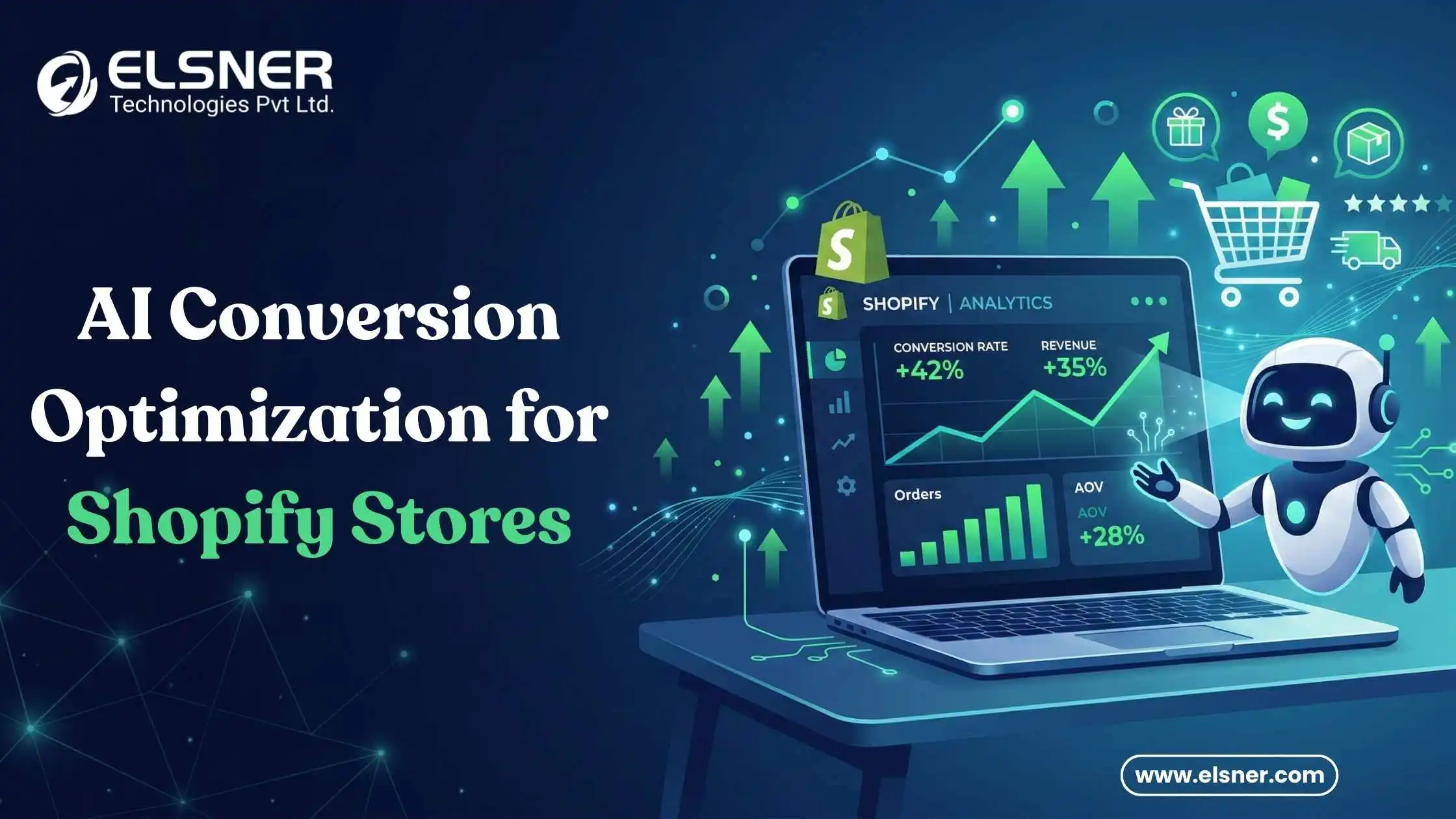
This is where AI-powered conversion optimization enters the picture. It pulls you away from guessing and puts real customer data to work for you. It spots patterns in behavior that no human team would realistically catch at speed. On top of that, it adjusts your store experience in real time – not after a two-week testing cycle. The result is a store that keeps selling for you even when your team is offline.
This guide covers every strategy worth knowing – from AI Ecommerce optimization and smart personalization, to predictive analytics, checkout recovery, and more. Many brands implement these strategies with the help of professional Shopify development services to ensure proper setup and measurable conversion improvements.
What Is AI-Powered Conversion Optimization?
Start simple. Shopify conversion optimization is about improving how many of your store visitors actually complete a purchase. Traditional CRO relied on manual testing – one change at a time, wait weeks for data, then decide. It worked, to a degree. The problem was the speed. By the time you had results, the market had already moved.
AI-driven CRO flips that. Instead of slow iteration, AI tools process live behavioral signals – scroll depth, click patterns, device type, purchase history, time of day – all at once. From there, the system makes micro-adjustments to your store in real time. No waiting. No manual implementation after every test. The kind of speed and scale that no human team can match on their own.
What makes AI especially worth it is the learning curve. The more traffic flows through your store, the smarter the system gets. That compounding effect means what works in week one keeps improving through month three, month six, and beyond.
|
Feature |
Traditional CRO |
AI-Driven CRO |
|
Speed of Insights |
Weeks to months |
Real-time |
|
Personalization Level |
Broad segments |
Individual-level |
|
Testing Method |
Manual A/B |
Automated multivariate |
|
Scalability |
Team-dependent |
Scales on its own |
|
Data Processing |
Sampled datasets |
Full behavioral stream |
Why Shopify Stores Need AI for Better Conversions?
Shopify alone powers over 1.75 million businesses globally. That number tells you everything about how competitive the Ecommerce space has become. A clean design and a competitive price point are no longer enough. Customers expect experiences that feel like they were built specifically for them – not a generic store page that looks the same for everyone who visits.
Customer behavior has shifted fast too. Mobile shoppers want pages that load in under two seconds. Implementing proper Shopify speed optimization helps improve load time, user experience, and overall conversion rates. They compare products across multiple tabs before making a decision. They abandon carts and the second friction appears. With all of this in play, Shopify performance optimization is not optional anymore. It is a survival requirement.
AI handles this by keeping you one step ahead of your shoppers. It identifies who is ready to buy right now versus who needs more time. It catches hesitation before it becomes an exit. On top of that, it protects your margins by not throwing discounts at customers who were already going to convert without one.
Key AI-Powered Conversion Optimization Strategies for Shopify
1. AI-Driven Product Recommendations
This is one of the biggest levers in AI Ecommerce optimization. Forget the static “Customers also bought” blocks that show the same products to everyone. AI recommendation systems study each visitor individually – browsing history, what they clicked, what similar buyers purchased, how long they spent on each page. From there, every shopper sees a set of suggestions that feels like it was picked for them specifically.
McKinsey research links Amazon’s recommendation engine to roughly 35% of its total revenue. Shopify stores can access the same logic through AI-powered apps that connect directly to your product catalog and update automatically – no manual curation needed. Proper integration and configuration by experienced Shopify experts ensures these recommendation systems deliver maximum impact.
2. Personalized User Journeys
A first-time visitor and a repeat customer are two completely different people in terms of what they need from your store. AI segments your traffic in real time and shows each group a different version of the experience. That could mean a different homepage banner, a different featured collection, or a different offer popup. All of it happens without your team doing any manual work after the initial setup.
3. Smart Search and Navigation
Poor search functionality quietly kills conversions. If a shopper types “navy blue sneakers” and your store surfaces unrelated results, they leave – often for good. AI-powered search understands natural language. It corrects typos automatically, catches synonyms, and ranks results based on what similar shoppers clicked and actually bought. Improving this one area of Shopify store optimization can lift conversions in a way that surprises most store owners.
4. AI-Powered Chatbots and Customer Support
A shopper sitting on your product page at midnight cannot reach your support team. An AI chatbot can be there instead. These tools handle questions about sizing, shipping timelines, and return policies instantly and accurately. Beyond answering questions, the better platforms are trained to guide hesitant shoppers toward a decision by addressing objections before those objections turn into exits.
5. Predictive Analytics for Customer Behavior
Predictive analytics tools use historical behavioral data to forecast what is about to happen. Modern Shopify AI and automation features help store owners analyze behavior, automate actions, and improve conversion rates more efficiently. Which customers are close to churning? Who is showing strong purchase intent right now? Which products are likely to spike in demand this weekend? With these answers, you can adjust your marketing spend, inventory, and offers around facts rather than assumptions.
6. Dynamic Pricing and Offers
Fixed pricing for everyone is a missed opportunity. AI-powered dynamic pricing adjusts your offers based on demand signals, customer segments, competitor pricing, and stock levels. This does not mean undercutting everyone on price. It means a first-time visitor might see a small incentive to nudge them over the line, while a loyal returning buyer sees your full-price product – because the data says they will buy anyway.
AI Tools That Improve Shopify Conversion Rates
There are several categories of tools that directly support Shopify conversion rate optimization. Each one targets a different part of the customer journey. Knowing what each category does helps you pick the right starting point for your store.
|
Tool Category |
What It Does |
Where It Helps Most |
|
Heatmap & Session Recording |
Shows how users scroll, click, and move through your pages |
Homepage, product pages, checkout |
|
AI A/B Testing Platforms |
Runs multivariate tests and picks winners automatically |
Landing pages, CTAs, banners |
|
Customer Behavior Analytics |
Tracks paths, drop-off points, and engagement signals |
Funnel analysis, UX decisions |
|
AI Chatbots |
Handles live support and guides hesitant shoppers |
Product pages, cart, checkout |
|
Predictive Personalization |
Delivers tailored content and offers to individual visitors |
Homepage, email, remarketing |
When you are evaluating platforms, look for ones that integrate natively with Shopify and offer real-time reporting. Most serious tools offer a free trial. That way, you can verify the impact on your own store before committing to a monthly plan.
Improving UX and Checkout Conversions Using AI
Checkout is where purchases are won or lost. Improving your Shopify checkout performance can significantly reduce abandonment and increase completed purchases. It is also seen that most shoppers abandon checkout simply because the process felt too long or complicated. AI cuts that friction down significantly – and it does so without requiring a full redesign of your store.
One-Click Checkout Optimization
AI tools pre-fill checkout fields based on a returning shopper’s past purchase data. They surface preferred payment methods at the top of the page. That way, checking out feels quick and effortless rather than like a form the shopper has to slog through.
AI-Based Cart Abandonment Recovery
When a shopper leaves without completing their purchase, AI triggers a personalized follow-up – email, SMS, or push notification – at the exact send time that behavioral data says works best for that person. The message is specific to what they left behind. The offer, if there is one, is calculated to convert without over-discounting unnecessarily.
Smart Payment and Shipping Suggestions
AI reads a customer’s location and order history to surface the most relevant payment options upfront – buy now, pay later, preferred card type, local payment methods. It also highlights the fastest shipping option available to that specific customer. Showing someone their best choices before they have to search for them removes a real point of hesitation right at the finish line.
Role of AI Personalization in Boosting Shopify Sales
Personalization is the core of what makes AI-powered Shopify store optimization work. When a shopper feels like your store gets them, they stay longer, explore more, and spend more. McKinsey research puts that return at 5 to 8 times the ROI on marketing spend. That is not a marginal improvement – that is a fundamental shift in how efficiently your store operates.
Here is how AI personalization shows up across the channels your customers actually use:
- Personalized Content: Homepage banners, hero images, and featured collections change based on who is browsing. No single static layout for every visitor.
- Product Suggestions: AI surfaces items that match each visitor’s taste profile and real-time intent. That way, recommendations feel chosen – not generated.
- Email and Remarketing Automation: Welcome flows, browse abandonment sequences, and win-back campaigns run automatically and are personalized at scale. No manual sends required.
- Customer Segmentation: AI groups shoppers by actual behavior patterns – not just age or location. Likewise, your marketing budget reaches people who are genuinely likely to respond rather than broad audiences with low intent.
Measuring Success: How to Track AI Conversion Performance
You cannot improve what you are not watching. Once AI tools are live on your Shopify store, tracking the right numbers is what separates meaningful progress from activity that just feels productive.
|
KPI |
What It Measures |
Benchmark to Aim For |
|
Conversion Rate |
% of visitors who complete a purchase |
2 to 4% is the Ecommerce average |
|
Bounce Rate |
% who leave after viewing just one page |
Below 40% for a healthy store |
|
Average Order Value (AOV) |
Average revenue per transaction |
Track week-over-week upward trend |
|
Cart Abandonment Rate |
% who add to cart but do not finish buying |
Below 65% is a solid target |
|
Customer Lifetime Value (CLV) |
Total revenue from one customer over time |
Rising trend signals store health |
|
Return on Ad Spend (ROAS) |
Revenue per dollar of ad budget spent |
3x minimum is the standard goal |
AI analytics platforms surface these numbers automatically in real-time dashboards. Not only that, but they flag anomalies too – unexpected drops in conversion or sudden spikes in abandonment. Your team can respond fast rather than discovering a problem weeks after the damage is done.
When Should You Implement AI Conversion Optimization?
Timing matters – and the right answer depends on where your store is right now.
Signs Your Shopify Store Needs Optimization
- Your conversion rate sits consistently below 1.5% despite decent traffic coming in
- You are spending on paid ads but the sales growth does not match that spend
- Cart abandonment is over 70% with no automated recovery system running
- Customers are not returning after their first purchase
- Your mobile conversion rate is noticeably lower than your desktop numbers
On store size – even stores with 1,000 monthly visitors start seeing real impact from AI personalization and smart recommendations. Stores with 10,000 or more monthly sessions typically see the sharpest returns. That is because AI learns from volume. The more data it has, the faster and better it performs.
On cost – most AI CRO tools start between $50 and $150 per month. For a store doing $50,000 in monthly revenue, even a 0.5% lift in conversion rate means roughly $250 in additional monthly revenue from the same traffic. In most cases, the math turns positive before the first quarter is over.
Why Choose Elsner for Shopify Conversion Optimization?
Elsner is a full-service IT company with 19+ years of experience and a track record that spans 9,500+ projects delivered to 6,200+ global clients. As a dedicated Shopify development company, Elsner brings a team of 250+ developers who are focused on one thing: results that show up in your revenue numbers.
What separates Elsner from the typical Shopify development services provider is the approach. The team does not just build stores and hand them over. They study how your specific customers behave, find exactly where conversions are breaking down, and build targeted solutions to close those gaps. Every recommendation is backed by data. Every build is measured against real outcomes.
Elsner’s Shopify conversion rate optimization services cover the full picture – AI tool integration, custom development, UX audits, checkout flow improvements, and ongoing performance monitoring. Whether you are an early-stage startup or a growing D2C brand, Elsner builds solutions that grow alongside your business. The foundation of the company rests on honesty, precision, and treating your growth as a shared goal – not just a project to complete.
Want to Increase Your Shopify Conversion Rate with AI?
Our Shopify conversion optimization experts help you identify drop-off points, implement AI-driven personalization, and improve checkout performance to turn more visitors into paying customers.
Conclusion
Getting traffic is one part of the equation. Turning that traffic into consistent, growing revenue is the part that actually builds a business. AI-powered conversion optimization is what bridges those two things. From smarter product recommendations and predictive analytics, to cart recovery and personalized checkout flows – every strategy in this guide points toward the same result: more buyers, better order values, and a store that performs around the clock.
The stores pulling ahead in 2025 are not always the ones with the biggest ad budgets. They are the ones using their customer data well, personalizing every touchpoint, and removing friction before it costs them a sale. That is what AI makes possible – at a price point that works for stores of every size.
Start with one thing if that feels more manageable. Pick AI product recommendations, cart abandonment recovery, or smart search – and measure what it does for your numbers over 30 days. Then build from there. The compounding effect of consistent Ecommerce conversion optimization is real. And Elsner is here to help you get there, step by step through proven conversion rate optimization services designed to improve Shopify store performance.
Frequently Asked Questions (FAQs)
1. What is AI-powered conversion optimization for Shopify?
It is the process of using AI to study visitor behavior and automatically improve the parts of your store that drive purchases. That covers product recommendations, smart search, checkout flow, email automation, and more. The goal is simple – get more of your existing traffic to actually buy, without relying on slow manual testing to get there.
2. How does AI help increase Shopify conversion rates?
AI processes live behavioral signals to understand what each shopper needs at that exact moment. From there, it adjusts the experience – product suggestions, messaging, offers, checkout layout – to match that intent. Knowing how to increase Shopify conversion rate using AI comes down to matching the right tool to the right friction point in your funnel. Fewer drop-offs follow naturally.
3. Are AI tools expensive for Shopify stores?
Most AI tools for Shopify conversion optimization start between $29 and $150 per month. Many platforms offer free trials. For a store doing $50,000 in monthly revenue, a 0.5% lift in conversion rate adds around $250 monthly from the same traffic. In most cases, the tool pays for itself well within the first billing cycle.
4. Can small Shopify stores use AI optimization?
Absolutely. Many AI tools are built for stores at early growth stages. Even at 500 to 1,000 monthly visitors, tools like AI chatbots, smart search, and email automation deliver real, measurable value. Starting early also means the system builds its behavioral learning base sooner. That way, by the time your traffic grows, the AI is already performing at a higher level.
5. What metrics should be tracked for conversion optimization?
The essential ones are conversion rate, bounce rate, average order value (AOV), cart abandonment rate, and customer lifetime value (CLV). Beyond these, return on ad spend (ROAS) and time-on-page help you understand whether your store is engaging visitors before they reach checkout. Together, these numbers show you exactly where your funnel is strong and where it is leaking.
6. Is AI safe for Ecommerce data?
Reputable AI platforms are built with data security built in and comply with regulations like GDPR and CCPA. That said, always review a platform’s privacy policy before connecting it to your store. Elsner helps clients evaluate and implement tools that meet recognized industry security standards – so you are not navigating that alone.
7. How long does it take to see results from AI CRO?
Most stores begin seeing measurable improvements within 30 to 60 days of implementing Shopify AI personalization strategies. Tools like chatbots and cart recovery emails show the fastest results because they act on active shoppers right away. Predictive analytics and full personalization layers take a bit longer – they need enough behavioral data to perform at their best. The early weeks require some patience. After that, the returns tend to compound in a way that manual CRO simply cannot match.
8. Do I need a developer to set up AI tools on Shopify?
Many tools install directly from the Shopify App Store with no coding needed. That said, more advanced integrations – custom recommendation engines, personalized checkout experiences, or bespoke AI systems – do require development expertise. Elsner specializes in exactly that kind of custom Shopify performance optimization work, from initial audit right through to live deployment and performance monitoring.
9. What is the biggest conversion mistake Shopify stores make?
Spending heavily on ad traffic while the conversion experience itself is broken. Pouring budget into a store with a slow checkout, confusing navigation, or irrelevant product suggestions is expensive and avoidable. Fix the leaks first. That way, every dollar you spend on acquisition actually has a chance of becoming a sale.
10. How does Elsner approach Shopify AI conversion optimization?
Elsner starts with a full audit of your store’s performance data – finding exactly where drop-offs happen and which customer segments are underperforming. From there, the team builds the right AI-powered Shopify store optimization strategy for your specific goals. Every decision is data-driven. Every build is tied directly to measurable conversion outcomes – not just technical completion.