




- What is agentic AI, really
- AI agents vs chatbots: what’s actually different
- Why 2026 is the turning point for AI agent adoption
- Real business use cases for AI agents
- Back office and operations automation
- Customer support agents
- Sales and marketing agents
- Cybersecurity agents
- Supply chain and logistics coordination
- Multi-agent systems: when one agent isn’t enough
- What goes into building an AI agent
- Not sure which workflow is the right first agent project?
- AI agent governance and risk
- How much does AI agent development cost
- How to choose an AI agent development company
- Frequently Asked Questions
- What is the difference between agentic AI and a chatbot?
- What business problems do AI agents actually solve?
- How long does it take to build and deploy an AI agent?
- Is agentic AI safe for enterprise use?
- Do small and mid-sized businesses need AI agents, or is this only for large enterprises?
- What should a business have in place before starting an AI agent project?
- The bottom line
- Ready to build an AI agent that actually works in production?
Ask five people what “agentic AI” means and you will likely get five different answers. That confusion is costing businesses real time and real budget right now, even as adoption keeps climbing in the background. Gartner predicts that 40 percent of enterprise apps will include task specific AI agents by 2026, up from less than 5 percent just two years ago. McKinsey has reported that 62 percent of companies have already tested or implemented AI agents through at least one channel. Those numbers point to something real. This has moved past the hype phase and into budget lines and production systems.
As a founder, CTO, or operations leader, you have probably heard “agentic AI” everywhere this year, not always with a clear sense of what it actually is or how it differs from the chatbot already installed on your website. This guide walks through what agentic AI really means, how it differs from a standard AI assistant, where businesses are already using it successfully, what it takes to build one properly, and what it costs. Elsner’s own AI agent development work follows the same underlying principle covered here: start with a narrow, well understood problem, then build outward from there.
Let’s get one thing out of the way first. There has been a ton of breathless talk online suggesting every business needs ten agents running by next quarter or risks getting left behind. That is not realistic, and it is not the point of this piece. The companies actually benefiting from agentic AI are using it as a specific tool for a specific workflow problem, not as a wholesale replacement for how they operate. Keep that lens on while you read the rest of this.
Quick Answer
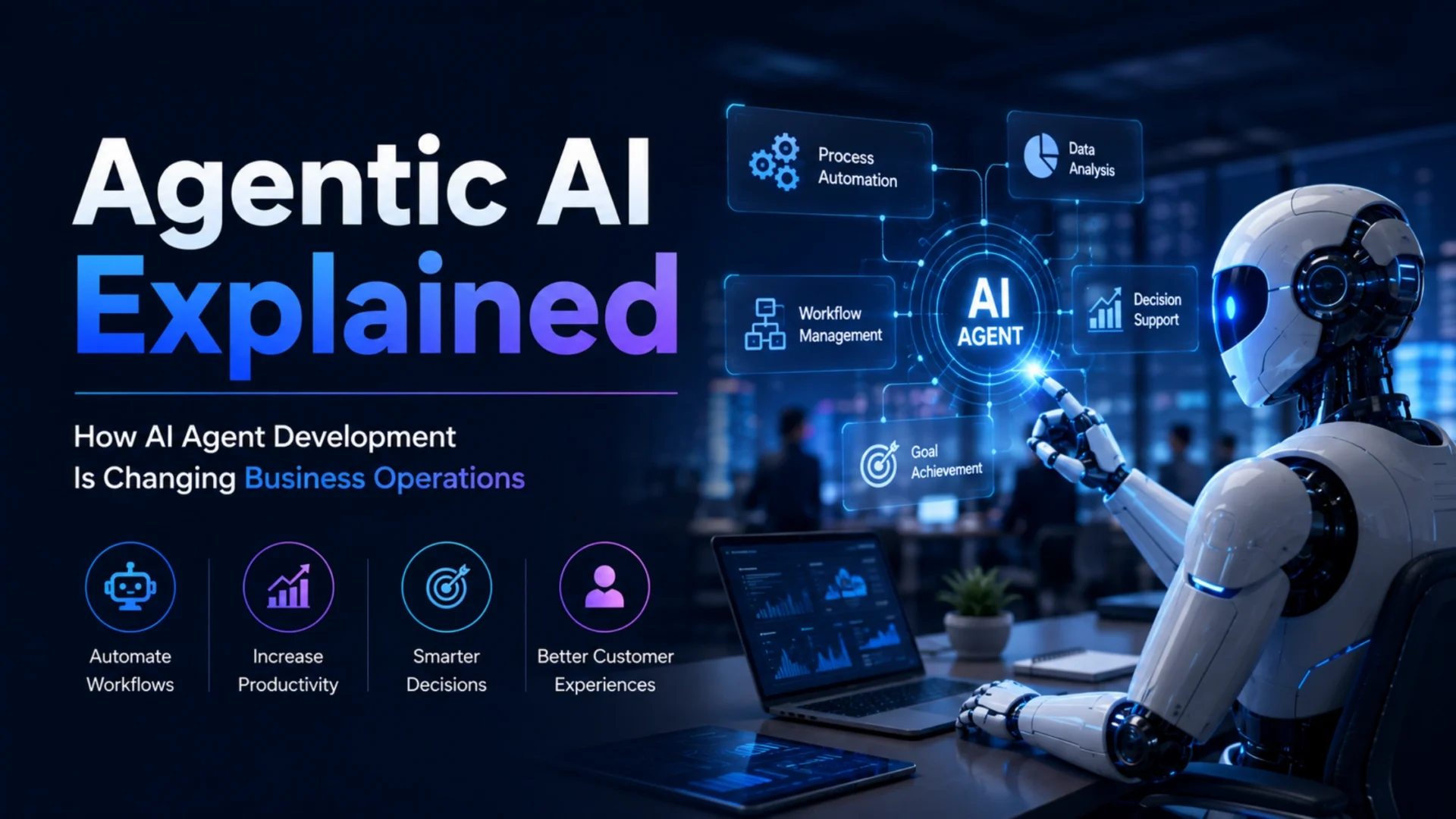
Agentic AI refers to systems that can plan, reason, use tools, and complete multi-step tasks with limited human oversight, rather than simply responding to a single prompt and stopping. A chatbot answers a question and waits. An agent pursues a goal, calls on real business systems to get there, and keeps enough memory of the process to know where it is in a multi-step task. Gartner expects 40 percent of enterprise applications to carry task specific AI agents by the end of 2026, and MIT Sloan Management Review and Boston Consulting Group found agentic AI reached 35 percent enterprise adoption in roughly two years, a far faster curve than any prior wave of enterprise technology.
What is agentic AI, really
Cut past the hype and the definition is fairly simple. Agentic AI describes systems that can plan, reason, use tools, and execute multi-step tasks with limited human oversight. That last part is the whole distinction. A regular AI assistant follows a command and waits for the next one. An agent behaves more like a person working toward a goal, figuring out the steps along the way instead of waiting to be told each one.
You can feel the difference with a simple example. Ask a regular AI tool to draft an email, and it writes an email. You read it, you send it, you move on. Give an agent the goal of re-engaging every lead that has gone cold in the last 30 days, and the agent works out how to do that on its own. It pulls the lead list, checks activity history, writes personalized messages, sends them at reasonable times, and logs the results, all without you typing instructions for each individual step.
That “figuring out the steps” part is the entire shift. It is the difference between a tool you operate and a system you direct.
Most agents built this way also lean on retrieval-augmented generation, usually shortened to RAG. In plain terms, RAG lets an agent pull real time, up to date information from your own data, a CRM, a knowledge base, a product catalog, rather than relying only on what it learned during training. That is why an agent can give a customer an accurate order status instead of a vague, stale-sounding answer. It is reading real data, not guessing from memory. This is the same reasoning behind Elsner’s conversational AI and chatbot development work, where connecting a system to live business data is what separates a genuinely useful assistant from a scripted one.
Here is the part worth being honest about. The word “agentic” has turned into another marketing term, and plenty of products use it without earning it. A real agent needs three things a normal chatbot lacks: a clear objective it is working toward, the ability to call tools or systems to reach that objective, and enough memory to keep track of where it is inside a longer process. Take away any one of those three and what you have is a dressed up chatbot, not an agent.
AI agents vs chatbots: what’s actually different
This is where a lot of buyers get confused, often because vendors blur the line on purpose. Agentwashing is common. Plenty of products marketed as agents are still just chatbots wearing a new label.
The distinction that actually matters: a chatbot responds, an agent acts.
| What you’re comparing | Chatbot | AI Agent |
|---|---|---|
| Autonomy | Waits for the next prompt | Pursues a goal across multiple steps |
| Tool use | Limited or none | Connects to CRM, ERP, internal systems, and APIs |
| Decision making | Follows a script or gives a single response | Makes intermediate decisions to reach an outcome |
| After the response | Conversation ends, human takes over | Agent continues the task, logs results, may trigger the next step |
Why does this matter if you are evaluating vendors? Because “we offer AI agents” means very different things depending on who is saying it. If a vendor cannot explain what happens after the agent responds, what system it touches next, what decision it makes, what it does without you clicking anything, you are likely looking at a chatbot with better branding. Worth asking directly before signing anything.
Here is a quick gut check that tends to cut through vendor pitches fast. Ask what the agent does when a customer’s question falls outside its expected script. A chatbot usually hits a dead end or loops back to “can you rephrase that.” A genuine agent either finds another path to the answer using a different tool, or escalates cleanly to a human with full context attached. That single answer tells you more than most sales decks will. Elsner has covered the ROI side of this distinction in more depth in measuring ROI from conversational AI and chatbots, which is worth a read before evaluating any vendor’s numbers.
Why 2026 is the turning point for AI agent adoption
The adoption curve here is genuinely unusual. Traditional AI adoption climbed to 72 percent over roughly eight years, according to MIT Sloan Management Review and Boston Consulting Group’s 2025 survey. Agentic AI reached 35 percent adoption in about two years, with another 44 percent of organizations planning to deploy it soon. That is a dramatically faster curve than any prior wave of enterprise technology, and it is not slowing down.
Scale is showing up fast too. Salesforce’s 2026 Connectivity Benchmark Report, based on a survey of 1,050 IT leaders, found that the average enterprise now runs 12 AI agents, with that number projected to grow to roughly 20 by 2027. That is not a pilot anymore. That is infrastructure.
Where is this actually happening in production, not just in pilots? Back office automation and customer support currently lead real world adoption. Sales, marketing, cybersecurity, and supply chain use cases are catching up quickly behind them.
Here is the part most vendors will not tell you upfront. Building an agent is not the hard part anymore. Plenty of tools can spin up a working prototype in an afternoon. The hard part, the part that actually determines whether a project succeeds, is getting that agent to run reliably and securely once it is touching real customer data and real business systems. That same Salesforce report found that half of enterprise AI agents currently operate in isolation, disconnected from other systems, which tells you a lot about where most companies are actually stuck. This is the same operational gap covered in Elsner’s broader look at digital transformation strategy, where technology that never gets connected to the rest of the business tends to underdeliver no matter how impressive it looked in the demo.
Real business use cases for AI agents
Theory is fine, but this is the section that matters if you are trying to figure out whether an agent applies to your own business. Here are the places agents are already doing real work, not just appearing in a roadmap slide.
Back office and operations automation
Data entry, reconciliation, and reporting are unglamorous but expensive when done manually. An agent that reconciles invoices against purchase orders, flags mismatches, and drafts the correction request saves a finance team hours every week, without anyone opening a spreadsheet.
Customer support agents
A support agent that pulls live documentation, checks an order status in your ERP, and resolves a multi-step question, such as “where is my order and can I change the delivery address,” without escalating to a human every time. Escalation still happens when it should. That is good design, not a flaw. Elsner’s own WhatsApp chatbot integration work follows this same principle, where the agent handles what it can and hands off cleanly when it cannot.
Sales and marketing agents
Lead qualification, personalized follow up sequences, and campaign automation that adjusts based on engagement data rather than a fixed drip schedule. An agent scoring inbound leads against your ideal customer profile and routing the best ones straight to a rep’s calendar is a common early win.
Cybersecurity agents
Monitoring, threat detection, and automated response. An agent that scans network traffic and system logs in real time, flags anomalies, and initiates a containment step before a human even sees the alert. Speed matters enormously here, and agents close a gap humans physically cannot close alone.
Supply chain and logistics coordination
Coordinating between inventory systems, suppliers, and shipping data to flag delays before they become customer facing problems. This is one of the fastest growing categories, precisely because supply chains involve so many disconnected systems that used to require manual checking. An agent watching shipment data against expected delivery windows can flag a delay and notify the affected customer before they ever open a support ticket, which quietly prevents a much bigger complaint later.
Not every one of these fits every business, and that is fine. Usually a company sees itself clearly in one, maybe two, of these categories. That is the honest starting point for a first agent project, not trying to automate everything at once.
Multi-agent systems: when one agent isn’t enough
Once a business moves past a single agent doing one job, the real challenge shifts. It is no longer “does the agent work.” It is “do the agents work together.”
Think of it like specialized roles on a team rather than one person trying to do everything. One agent handles intake and qualification, another handles fulfillment logistics, another handles support escalations, and they pass context to each other instead of starting from zero every time. Emerging communication standards are starting to let agents built on different platforms talk to one another, though honestly, this part of the ecosystem is still maturing.
Here is the gap worth flagging honestly. Salesforce’s research found that half of enterprise agents currently operate in isolation, with no coordination between them. That means a lot of companies are running a dozen separate automation experiments in parallel rather than one connected system. Multi-agent orchestration is where the actual return on agentic AI shows up, but it requires planning from the start, not bolting connections on after the fact.
Picture the difference as clearly as possible. A support agent that resolves a ticket and then stops is helpful. A support agent that resolves a ticket, updates the customer’s record, flags a trend to the product team when three other customers report the same issue that week, and alerts billing when a refund is due, that is a connected system doing the work of three people using three separate tools. The gap between the two versions has less to do with raw AI capability and everything to do with coordination.
What goes into building an AI agent
Selecting the right model is the less challenging part of the problem. A dependable agent that can actually be used in production needs a few things: detailed guidelines, an understanding of the business environment, memory of previous interactions, connections to other systems, controlled access to tools, and continuous performance checks once it is live.
Data and integration requirements
An agent is only as useful as the data it can reach. That means connecting to a CRM, an ERP, or internal knowledge bases in a way that keeps the data structured and current. This step usually takes longer than the AI development itself, and it is frequently underestimated in early project scoping. Businesses working through data engineering and MLOps before an agent build finds this stage far less painful than tackling it mid-project.
Governance and permissions
Unrestricted agent access is a real risk, not a theoretical one. An agent with write access to a CRM should not carry the same permissions as one that only reads order status. Permissions need to be scoped deliberately, task by task, before an agent ever goes live.
Testing and reliability
A working prototype and a production ready agent are two different things. A prototype handles the happy path. Production means handling edge cases, unexpected inputs, system downtime, and the occasional user who phrases a request in a way nobody anticipated. Budget real time for this stage. It is usually where projects either succeed or quietly fail after launch.
If you are scoping a project, treat the list above as a working checklist. Data readiness, governance boundaries, and a genuine testing plan, before a single agent touches a live customer.
Not sure which workflow is the right first agent project?
Elsner can walk through your current systems and data readiness and give you an honest read on what agent would actually deliver value first, without a ten agent roadmap you don’t need yet.
AI agent governance and risk
As adoption accelerates, governance has become just as important as picking the right use case, not an afterthought bolted on after launch.
The key risk areas worth planning for early
- Data access boundaries: exactly what an agent can see and touch across your systems
- Decision authority limits: what an agent can decide on its own versus what needs human sign-off
- Monitoring and audit trails: so every action an agent takes is traceable after the fact
Businesses that treat governance as an ongoing commitment see faster deployment, not slower. That sounds backward at first, but it makes sense once you see it in practice. There is less re-thinking after deployment. Adding governance to an agent that is already live in production is far more difficult, complicated, and messy than building it in from day one, and this is exactly where a business intelligence layer built alongside the agent, rather than bolted on later, earns its keep.
How much does AI agent development cost
Honest answer: it depends heavily on scope. A single purpose agent handling one workflow is a very different project from a multi-agent system with deep integrations across several business systems.
The main cost drivers worth understanding before you request a quote
- Model and infrastructure costs: vary based on usage volume and the complexity of reasoning required
- Integration complexity: how many systems the agent needs to connect to, and how clean the data already is
- Ongoing monitoring and maintenance: an agent is not a one-time build, it needs oversight as your business changes
- Governance and security work: scales with how much access and decision-making authority the agent has
There is no honest way to give a specific dollar figure without knowing your systems, your data quality, and your use case. Anyone quoting a fixed price before a discovery conversation is usually guessing. A scoped conversation with a development partner is really the only accurate way to estimate what your specific project will cost.
A gut check worth remembering
If a vendor quotes a fixed price before asking a single question about your data or systems, that is usually a red flag, not a bargain. The projects that go sideways later are almost always the ones where scope was guessed at instead of scoped properly, and the price tag that looked attractive in month one becomes the budget overrun everyone argues about in month six.
How to choose an AI agent development company
A few things separate a real production partner from an agency that is simply good at demos.
Look for real production experience, not just proof of concept work. Ask for examples where an agent is actually running with live customer data today, not a controlled internal test. Ask how they handle integration with your existing systems specifically, not a generic answer about seamless integration. And ask what their approach to governance and monitoring looks like from day one, since that is usually where projects either hold up or fall apart six months in.
A few direct questions worth asking any potential partner
- Can you show me an agent you built that has been in production for at least six months?
- What happens when the agent encounters something it was not designed to handle?
- Who owns the governance framework once the project ships, you or us?
- What does your testing process actually cover before launch?
This is also where Elsner’s approach differs from a lot of the field. Our AI agent development team focuses on getting agents from a working prototype into reliable production use, with the integration work, permissions, and monitoring built in from the start rather than added after something breaks.
Not every business is ready to commit to a specific build on day one, and that is a reasonable place to start from. Figuring out where automation actually pays off is its own project, separate from picking a vendor to execute it.
If you are still shaping the broader roadmap before committing to a specific build, our AI strategy and consulting team can help you figure out where an agent actually fits your business first, before a single line of code gets written.
Key takeaways
- Agentic AI describes systems that plan, reason, use tools, and complete multi-step tasks with limited human oversight, not a rebranded chatbot.
- Gartner expects 40 percent of enterprise apps to include task specific AI agents by the end of 2026, and MIT Sloan Management Review and Boston Consulting Group found agentic AI hit 35 percent adoption in about two years, far faster than any prior enterprise technology wave.
- A real agent needs a clear objective, the ability to call tools or systems, and enough memory to track a multi-step process. Missing any one of the three makes it a chatbot with better branding.
- Back office automation and customer support lead real production adoption today, with sales, marketing, cybersecurity, and supply chain use cases catching up quickly.
- Half of enterprise AI agents currently operate in isolation, according to Salesforce’s 2026 Connectivity Benchmark Report, which is exactly why multi-agent coordination needs planning from the start.
- Governance built in from day one, data boundaries, decision limits, and audit trails, makes deployment faster, not slower, and is far cheaper than retrofitting it after launch.
- Cost depends almost entirely on integration complexity and data readiness. Anyone quoting a fixed price before a discovery conversation is guessing.
Frequently Asked Questions
What is the difference between agentic AI and a chatbot?
A chatbot responds to a single prompt and stops. An agent pursues a goal across multiple steps, uses tools, connects to business systems, and makes intermediate decisions without waiting for the next instruction each time.
What business problems do AI agents actually solve?
Repetitive, multi-step work that currently requires a human to check several systems and make small decisions along the way. Back office reconciliation, customer support triage, lead qualification, and supply chain monitoring are common starting points.
How long does it take to build and deploy an AI agent?
It depends on scope. A single purpose agent with clean data access moves faster than a multi-agent system requiring several integrations. A working prototype often comes together quickly. Getting to a reliable, production ready version usually takes longer, since testing and governance work take real time.
Is agentic AI safe for enterprise use?
It can be, when access permissions, decision authority, and monitoring are planned from the start. The risk is not the technology itself, it is giving an agent broad access without clear boundaries. Governance planned early makes agentic AI considerably safer at enterprise scale.
Do small and mid-sized businesses need AI agents, or is this only for large enterprises?
Enterprise adoption is ahead right now, but the underlying use cases, like customer support and lead qualification, apply just as well to smaller businesses. Scope tends to be simpler for smaller teams, which usually means a faster, less expensive path to a working agent.
What should a business have in place before starting an AI agent project?
Clean, accessible data in the systems the agent needs to touch, a clear picture of what decisions the agent is allowed to make on its own, and a specific workflow in mind rather than a vague goal like “automate customer service.”
The bottom line
Agentic AI is not another buzzword to nod along with in a meeting. It is a genuine shift in what software can do on its own, and the adoption curve backs that up. But the businesses actually getting value from it are not the ones chasing ten agents by next quarter. They are the ones picking one well understood workflow, building governance in from the start, and proving the pattern works before scaling it further. That discipline, not the model underneath, is what separates an agent that quietly runs in production for years from one that gets quietly switched off six months after launch. Where internal teams need extra hands to get there, Elsner’s flexible engagement models scale with the project instead of forcing a fixed structure on it.
Ready to build an AI agent that actually works in production?
A lot of agentic AI projects stall somewhere between an impressive demo and a system your team can actually trust with real customers and real data. That gap is exactly where Elsner’s AI agent development practice works. We handle the full path, from scoping the right use case, through integration and governance, to an agent that runs reliably in production, not just a proof of concept that looks good in a meeting.