 Zoho
Solutions
 Ecommerce
Development
 Web
Development
 AI
Solutions




- How Adobe Commerce Pricing Works
- Adobe Commerce Deployment Options and How Each Is Priced
- What the Adobe Commerce License Includes and What Costs Extra
- Included in the License
- Not Included
- What Drives Your Adobe Commerce License Quote
- Adobe Commerce Total Cost of Ownership: Every Cost Line
- A Three-Year TCO Worksheet for Comparing Quotes
- Adobe Commerce vs Magento Open Source: When the License Pays Off
- How to Control Adobe Commerce Costs and Negotiate Your Contract
- FAQs
- How much does Adobe Commerce cost per year?
- Why doesn’t Adobe publish Adobe Commerce pricing?
- Is hosting included in Adobe Commerce pricing?
- What’s the difference between Adobe Commerce on Cloud and Adobe Commerce as a Cloud Service?
- Does Adobe Commerce cost more as my store grows?
- Is Adobe Commerce worth it for a small business?
- Want a Three-Year Cost Plan Before Your Adobe Call?
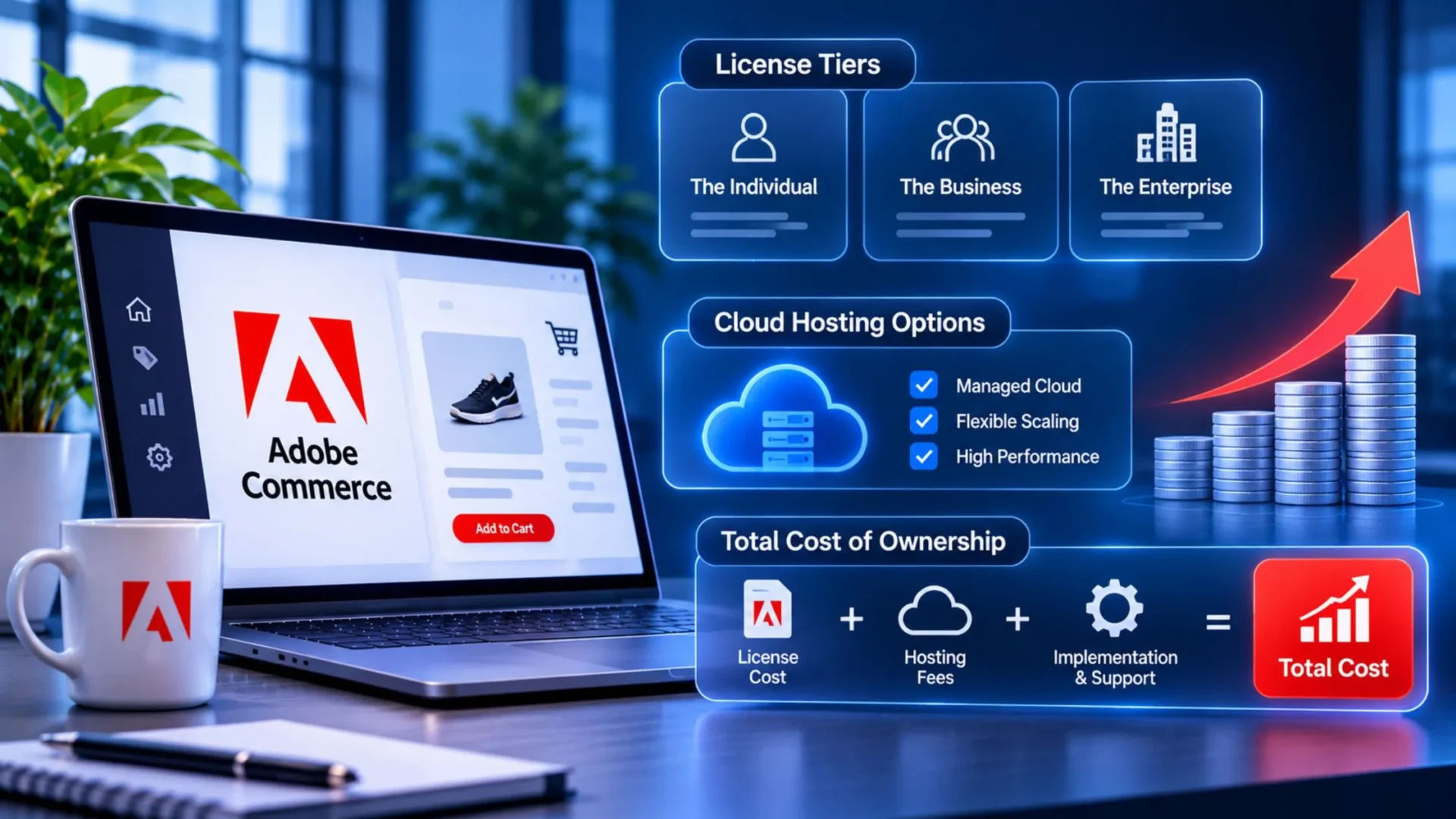
How Adobe Commerce Pricing Works
Adobe Commerce uses a success-based license. Your annual fee rises with the revenue your store processes, so a fast-growing brand can pay more at each renewal.
Adobe’s product descriptions set the price through a “Pricing Level”: your licensed GMV and AOV tiers, or an order limit, written into your sales order. In plain terms:
GMV (Gross Merchandise Value)
The total value of orders your store takes in a year.
AOV (Average Order Value)
The average value per order. Two stores with the same GMV can land in different tiers if one sells fewer, larger orders.
Order Limit
Caps how many orders the contract covers.
Adobe doesn’t publish dollar amounts for these tiers. Partner and agency estimates put entry-level licenses for stores under $1 million in GMV at about $22,000 a year self-hosted and about $40,000 a year on Adobe Commerce on Cloud. Treat these as starting points for negotiation, not quotes.
Contracts usually run one year or several. If your GMV grows past your licensed tier, expect the price to rise at renewal.
Adobe Commerce Deployment Options and How Each Is Priced
Adobe now sells Adobe Commerce in four forms. Adobe introduced the two SaaS options in June 2025 and continues to support the PaaS model. Each option moves a different share of cost from you to Adobe.
Two details change the math. Adobe Commerce as a Cloud Service doesn’t support Luma storefronts, so moving to it means a new storefront on Edge Delivery Services. And on Cloud, customers must stay on supported versions, or Adobe may suspend traffic to their store from June 1, 2027.
For a deeper look at the SaaS option, see our guide to Adobe Commerce as a Cloud Service.
What the Adobe Commerce License Includes and What Costs Extra
The license buys features, support, and (on the cloud options) infrastructure. It doesn’t buy a finished store.
Included in the License
✅ Commerce Features Beyond Open Source
B2B company accounts, shared catalogs, and quotes; content staging and preview; customer segmentation; gift cards, store credit, and returns management.
✅ Adobe Support
Ticket-based support from Adobe, which Magento Open Source doesn’t have.
✅ Cloud Environments
The Adobe Commerce as a Cloud Service base package includes one production and two sandbox environments. On Cloud (PaaS) contracts list your environments and an annual vCPU allowance for production.
Not Included
- Design, theme, and storefront build.
- Third-party extensions and their renewals.
- Integrations with ERP, CRM, PIM, payment, shipping, and tax systems.
- Data migration from your current platform.
- Agency or in-house support after launch.
- Extra capacity, such as more environments, vCPU, or catalog ingestion packs.
- Security and PCI work on your own code and extensions. Adobe runs its cloud options under a shared responsibility model.
On the SaaS option, Adobe also sells a separate Managed Operations package that adds a designated Customer Success Engineer. For a feature-level comparison with the free edition, see Magento Open Source vs Adobe Commerce.
What Drives Your Adobe Commerce License Quote
Six factors move the license number. Know where you stand on each before the first sales call.
|
1
|
GMV TierThe biggest single driver. Bring your actual trailing 12-month GMV and a realistic forecast.
|
|
2
|
AOV and Order VolumeHigh-volume, low-value stores and low-volume B2B stores price differently at the same GMV.
|
|
3
|
Deployment OptionA self-hosted license costs less than on Cloud, but you pay for hosting and DevOps separately.
|
|
4
|
CapacityOn Cloud contracts include a set vCPU allowance and number of environments. SaaS contracts can add catalog ingestion packs.
|
|
5
|
Support LevelManaged Operations or managed services packages cost more than the base license.
|
|
6
|
Contract TermsMulti-year commitments and bundles with other Adobe products can change the price per year.
|
Capacity is the factor teams control most after signing. A well-tuned store uses less compute for the same traffic, which matters when your contract caps vCPU. Our Adobe Commerce speed optimization tips cover the main levers.
Adobe Commerce Total Cost of Ownership: Every Cost Line
Total cost of ownership (TCO) is the license plus everything it takes to build, run, and grow the store. Over three years, the non-license lines often add up to more than the license itself.
Store changes TCO more than almost any other choice. Who builds and supports the store. Our Magento hiring models breakdown indicates that a senior developer costs $15,000 to $32,000 per month to hire locally versus $4,000-$9,500 a month offshore.
A Three-Year TCO Worksheet for Comparing Quotes
Two quotes only compare fairly when they cover the same lines over the same period. Fill in this worksheet for each deployment option you’re considering.
Ask Adobe to quote both the Cloud (PaaS) and SaaS options so you can compare them in the same sheet. A fixed monthly support block keeps years two and three predictable; a Magento support plan works this way.
Adobe Commerce vs Magento Open Source: When the License Pays Off
The license pays for itself when it replaces costs you would incur with Open Source. Weigh it against two figures: the cost of rebuilding the features you need, and the cost of the operations work Adobe is taking off your plate.
For larger stores weighing the enterprise route, our guide to Magento enterprise development covers architecture and scaling choices.
How to Control Adobe Commerce Costs and Negotiate Your Contract
The license is negotiable, and most of the other cost lines are in your control. These steps help on both fronts:
|
1
|
Bring Real NumbersShare actual trailing GMV, order counts, and a realistic forecast. Ask how a mid-term GMV jump is handled.
|
|
2
|
Quote Two OptionsAsk for Cloud (PaaS) and SaaS pricing side by side, and model both in the worksheet above.
|
|
3
|
Read the Capacity TermsConfirm environments, vCPU allowance, and overage rates before you sign.
|
|
4
|
Weigh Multi-Year TermsA longer term can lower the yearly price. Check renewal caps, GMV true-ups, and exit terms first.
|
|
5
|
Start Renewals EarlyBegin talks three to six months before the contract ends, so you have time to compare alternatives.
|
|
6
|
Trim Extensions and Custom CodeUse native Adobe Commerce features where they exist. Every module you remove cuts upgrade and patching work.
|
|
7
|
Plan Upgrades Inside Support WindowsOn Cloud stores face enforced upgrades from June 1, 2027, so a late upgrade becomes a rushed one.
|
A partner who scopes the build before you sign helps you buy the right tier and avoid paying for capacity you won’t use. Elsner’s Adobe Commerce development services cover implementation, migration to the SaaS platform, and long-term support.
FAQs
How much does Adobe Commerce cost per year?
Adobe quotes each license individually. Partner and agency estimates put entry-level licenses for stores under $1 million in GMV at about $22,000 a year self-hosted and about $40,000 a year on Adobe Commerce on Cloud. Total yearly cost runs higher once you add build, support, extensions, and upgrades.
Why doesn’t Adobe publish Adobe Commerce pricing?
The price depends on your GMV and AOV tiers or order limit, your deployment option, the capacity you need, and the support level. Adobe sets these in each sales order, so every contract is negotiated.
Is hosting included in Adobe Commerce pricing?
Hosting is included in Adobe Commerce on Cloud and Adobe Commerce as a Cloud Service. With a self-hosted license, you pay for hosting and server management separately.
What’s the difference between Adobe Commerce on Cloud and Adobe Commerce as a Cloud Service?
Adobe Commerce on Cloud is single-tenant PaaS. You keep full code control but must apply version upgrades. Adobe Commerce as a Cloud Service is multi-tenant SaaS with automatic, versionless updates. You customize it through APIs and App Builder, and it doesn’t support Luma storefronts.
Does Adobe Commerce cost more as my store grows?
Usually, yes. The license is tied to GMV, AOV, or order limits, so strong growth can move you into a higher tier at renewal. Model expected growth into years two and three of your budget.
Is Adobe Commerce worth it for a small business?
Often not, unless you need its B2B, content staging, or segmentation tools from day one. Many smaller stores get better value from Magento Open Source with targeted extensions. Revisit the choice as GMV and requirements grow.
Want a Three-Year Cost Plan Before Your Adobe Call?
Talk to our team about your three-year cost plan before your Adobe call.