





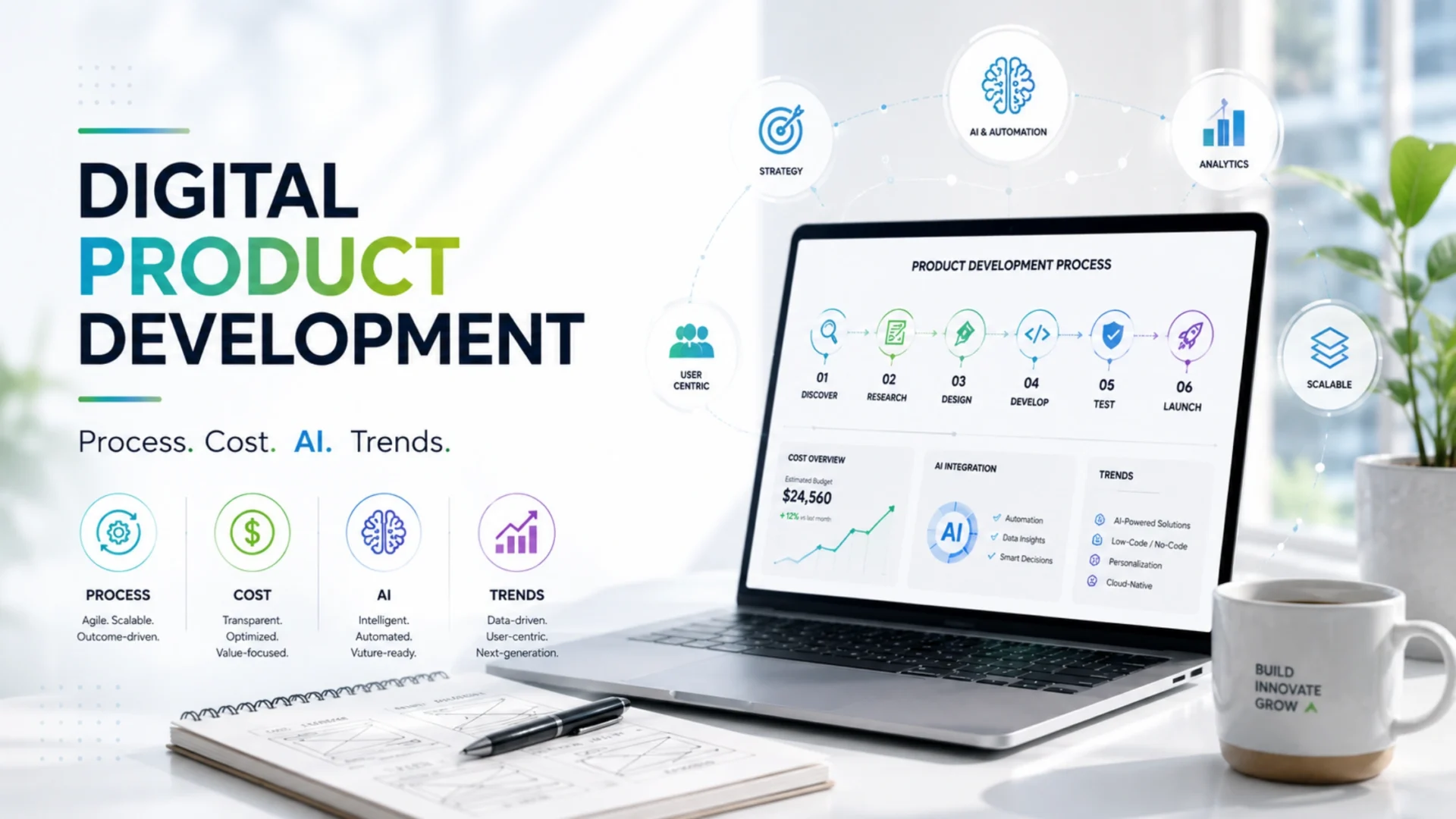
- What is digital product development?
- Why digital product development looks different in 2026
- The digital product development process, phase by phase
- Not sure which phase your product idea actually needs first?
- How much does digital product development cost in 2026?
- Where AI actually helps in digital product development, and where it doesn’t
- Key digital product development trends for 2026
- Common digital product development mistakes to avoid
- How to choose a digital product development partner
- How Elsner approaches digital product development
- The bottom line
- Have a product idea worth validating properly?
- Frequently Asked Questions
- What is digital product development?
- How much does digital product development cost in 2026?
- How is digital product development different from software development?
- How much does AI actually speed up product development?
- Why do most digital products fail?
- What are the main stages of the digital product development process?
- Should a startup build an MVP in-house or outsource it?
- How long does it take to build a digital product?
Most digital products don’t fail because the code was bad. They fail because nobody checked whether the market actually wanted them before the team spent eight months building it. CB Insights has tracked this pattern across hundreds of startup post-mortems, and the newest analysis of 431 VC-backed shutdowns since 2023 still points to the same root cause: 43% of failures trace back to poor product-market fit, not a lack of funding or talent.
That single number changes how digital product development should be approached in 2026. This guide breaks down what the process actually looks like today, what it costs at different scopes, where AI genuinely speeds things up versus where it doesn’t, and the trends worth paying attention to instead of chasing every buzzword that shows up in a LinkedIn post. If you’re a founder scoping an MVP or an enterprise team modernizing a legacy platform, the sections below get specific instead of generic.
Quick Answer
Digital product development is the end-to-end process of turning an idea into a market-ready software product, covering discovery, UX and technical design, build, testing, launch, and continuous iteration after release. In 2026, the process looks different from even two years ago because generative AI now compresses coding and documentation timelines, product teams face tighter scrutiny on unit economics, and the biggest driver of failure remains skipping validation before writing a single line of code.
What is digital product development?
Digital product development is the structured process a business follows to design, build, and launch a software-based product, whether that’s a mobile app, a web platform, a SaaS tool, or an internal system that never touches a public app store. It’s broader than “writing code.” It includes market validation, UX research, technical architecture, iterative building, quality testing, launch planning, and the ongoing cycle of updates that keeps a product relevant after day one.
People often use “digital product development” and “software development” interchangeably, but they aren’t the same thing. Software development is the technical execution: writing, testing, and shipping code. Digital product development sits a level above that. It asks whether the thing being built solves a real problem for a real audience, and it treats coding as one phase inside a much longer strategic process that starts with research and doesn’t really end, since a live product keeps evolving based on how people actually use it.
This distinction matters more than it sounds. A team can execute flawless engineering and still ship a product nobody uses, because the engineering was never the risky part. The risky part was assuming the market need existed in the first place. That’s the gap most competitor explainers on this topic skip over entirely, and it’s exactly where the CB Insights data above becomes relevant to how you should actually plan a build.
A useful way to frame it
Software development answers “can we build this.” Digital product development answers “should we build this, and will anyone care once we do.” If your team is only asking the first question, you’re doing software development with product development branding attached to it.
Why digital product development looks different in 2026
Three things have genuinely changed the calculus this year, and none of them are hype. First, IT budgets are expanding fast. Gartner’s most recent 2026 forecast puts worldwide IT spending at $6.37 trillion, up 14.2% from 2025, with software spending alone growing 15.1% as generative AI features get baked into products companies already own. That’s real budget flowing toward digital initiatives, not a projection years out.
Second, AI coding assistance has moved from novelty to measurable output, though the gains are uneven. Third, and this is the part most guides gloss over, boards and investors are scrutinizing product spend harder than they did two years ago. A product idea that can’t show a clear path to demand validation gets a much colder reception in 2026 than it would have in 2021, when capital was cheap and “move fast” covered a multitude of sins.
Put those two numbers side by side and the picture gets clearer. There’s more money moving into digital product work than ever, and yet the leading cause of failure hasn’t shifted in a decade of data. More budget doesn’t fix a validation problem. It just means the mistakes get more expensive. That’s the real argument for treating discovery and market validation as the highest-leverage phase of the entire process, not a box to tick before the “real work” of building starts.
The digital product development process, phase by phase
Skip a phase here and it usually shows up later as a redesign, a churn spike, or a feature nobody uses. Here’s what each stage actually needs to accomplish, not just what it’s called.
Phase 1: Discovery and market validation
Talk to real prospective users before writing a single spec. Structured interviews, competitor teardown, and a plain answer to “who is this for and what happens if it doesn’t exist” belong here. Given that 43% of failures trace back to this exact gap, this phase deserves more time than most teams give it, not less.
Phase 2: Product strategy and scope definition
Translate research into a roadmap: what ships in the first release, what waits, and what gets cut entirely. A tight, well-argued product strategy at this stage prevents scope creep from quietly doubling the budget three months in.
Phase 3: UX and technical architecture
Wireframes, user flows, and a technical stack decision that accounts for where the product needs to be in eighteen months, not just at launch. Picking the wrong architecture here is cheap to fix on paper and expensive to fix in production.
Phase 4: MVP build
Build the smallest version that tests the core hypothesis, not the smallest version that’s easiest to code. Those two things get confused constantly, and it’s usually the reason an MVP ships without answering the question it was supposed to answer.
Phase 5: Testing and QA
Functional testing, security review, performance testing under real load, and usability testing with actual target users, not just internal stakeholders who already know how the product is supposed to work.
Phase 6: Launch and iteration
Launch is a checkpoint, not a finish line. Set up analytics before day one, define what “working” looks like in numbers, and build the feedback loop that turns real usage data into the next sprint’s priorities.
Worth saying plainly: this cycle rarely runs in a clean straight line. Teams loop back to strategy after early testing surfaces something nobody expected, and that’s healthy, not a sign the process failed. A rigid six-step waterfall applied to a fast-moving market is often worse than a looser cycle that lets teams react to what users actually do. Elsner’s own MVP software development guide walks through how to scope that first build without over-engineering it.
Not sure which phase your product idea actually needs first?
Elsner can run a scoping session that pressure-tests the idea, sizes the build, and flags the risks before a single sprint gets scheduled.
How much does digital product development cost in 2026?
Anyone giving a single flat number for this is guessing. Cost depends on scope, platform count, backend complexity, compliance requirements, and whether the team is US-based, offshore, or a hybrid. That said, industry pricing guides published this year converge on a rough range that’s useful for early budgeting purposes.
| Product scope | Typical range | What drives the cost |
|---|---|---|
| Simple MVP | $15,000 to $50,000 | Single platform, core features only, minimal third-party integrations |
| Standard MVP | $50,000 to $120,000 | User accounts, payments, admin panel, basic analytics, moderate design work |
| Complex MVP or full product | $120,000 to $300,000+ | Multi-platform, custom backend logic, AI features, compliance work such as HIPAA or SOC 2 |
| Enterprise-grade platform | $300,000 and up | Legacy system integration, multi-team coordination, high-availability infrastructure |
These figures move around depending on geography and agency model, so treat them as a planning anchor rather than a quote. What tends to blow past estimates isn’t the initial build, it’s scope creep after launch, undocumented technical debt from cutting corners early, and underestimating QA time. A realistic budget usually sets aside 15 to 20% of the total build cost for post-launch fixes and the first round of iteration, since no first release survives contact with real users unchanged. For a deeper breakdown by feature set, Elsner’s AI development cost guide covers what adding intelligent features specifically adds to a budget.
Where AI actually helps in digital product development, and where it doesn’t
This is the part where most 2026 content gets vague or overhyped. The honest picture, based on McKinsey’s controlled research with its own developer teams, is task-specific. AI tools cut time on code documentation by 45 to 50%, code generation by 35 to 45%, and refactoring by 20 to 30%. On genuinely high-complexity tasks, the ones that require unfamiliar frameworks or deep architectural judgment, the time savings shrink to under 10%.
That gap matters. AI is excellent at compressing the repetitive, well-defined parts of a build. It’s far less reliable on the parts that require judgment about what should exist in the first place, which loops back to the same discovery and strategy work that AI can’t shortcut. McKinsey’s broader research on high-performing engineering organizations found that top-quintile teams see 16 to 30% gains in productivity and time to market, and 31 to 45% gains in software quality, but only when AI gets embedded across the entire development lifecycle instead of handed to individual developers as a standalone tool.
The honest caveat
Simply giving a team AI coding tools rarely moves outcomes on its own. Teams that don’t restructure their workflow around AI, meaning use case selection, review processes, and upskilling, often see minimal gains or even a net slowdown from time spent debugging AI-generated code. That’s a documented finding, not a caveat added for balance.
Beyond coding speed, generative and agentic AI are also reshaping what gets built. Chatbots, recommendation engines, and workflow automation are showing up as default features in products that had no AI component two years ago, largely because the infrastructure to add them has gotten cheaper and faster to integrate. Businesses building a new product today without at least evaluating AI agent capabilities are often leaving an obvious differentiator on the table, though not every product genuinely needs one bolted on just because the trend exists.
Key digital product development trends for 2026
Some of these are genuinely new. Others are older ideas that finally have the tooling to work properly. Here’s what’s actually shaping how products get built this year.
1. Agentic workflows inside the product itself. Beyond using AI to build faster, more products are shipping with autonomous agents as a core feature, handling multistep tasks a user would otherwise do manually. Gartner’s own AI-optimized infrastructure forecasts show inference workloads, the compute that powers these live agent features, already overtaking training spend in 2026.
2. Product teams treating discovery as a formal, budgeted phase. With poor product-market fit still the single largest failure cause, more product organizations are allocating dedicated budget and time to validation instead of squeezing it into a two-day kickoff meeting.
3. AI-native architecture from day one. Rather than bolting AI onto an existing product later, more teams are designing the data pipeline and infrastructure to support AI features from the first sprint, since retrofitting that layer later is consistently more expensive than building it in.
Illustrative scenario
Picture a healthtech startup that built its scheduling MVP without AI in mind, then tried to bolt on an intake assistant eighteen months later. Retrofitting the data model to support it took nearly as long as the original build. A competitor that scoped the AI layer from the start shipped the same feature in a fraction of the time. This is a representative pattern based on common retrofit challenges, not a specific client result.
4. Composability over monolith rebuilds. Instead of ripping out legacy systems entirely, more teams are wrapping modern APIs around existing infrastructure and modernizing piece by piece, which lines up with the broader shift toward product modernization over full rebuilds.
5. Tighter unit economics scrutiny. With Gartner projecting a 15.1% jump in software spending largely driven by GenAI feature costs, finance teams are asking harder questions about what each new feature actually costs to run at scale, not just to build once.
6. Shorter build cycles, longer iteration cycles. AI-assisted coding is shrinking initial build timelines, but the post-launch iteration phase is stretching out, since teams now have more capacity to act on user feedback quickly rather than batching changes into infrequent releases.
7. Privacy and compliance built in earlier. Data-heavy products, particularly in healthcare and fintech, are treating privacy architecture as a phase-one decision instead of a pre-launch checklist item, largely because retrofitting compliance is far more disruptive than most teams expect.
8. Cross-functional product pods replacing siloed handoffs. Design, engineering, and product strategy working in the same pod from day one, rather than passing specs down a chain, is showing up more often as a structural fix for the miscommunication that used to eat weeks of every project.
Common digital product development mistakes to avoid
Skipping validation because the idea “feels obvious.” This is precisely the trap behind that 43% failure statistic. Founders and product leads who are close to a problem often overestimate how universal it actually is. A handful of structured customer conversations before development starts is cheap insurance against a very expensive mistake.
Confusing “minimum viable” with “barely functional.” An MVP should be minimal in feature count, not minimal in quality. A broken login flow or a confusing onboarding sequence will tank early user feedback regardless of how sound the underlying idea is. Elsner’s guide on MVP mistakes that cause startup failure covers this pattern in more depth.
Overestimating what AI tools save on complex work. As the McKinsey data shows, time savings from AI shrink to under 10% on genuinely complex tasks. Budgeting an aggressive timeline assuming AI will compress the hard parts of a build is a common and avoidable planning error.
Treating launch as the finish line. Teams that pour their entire budget into getting to launch, with nothing reserved for the iteration that inevitably follows, tend to freeze the moment real user data starts coming in. Set aside iteration budget before development even starts, not after the first bug report arrives.
Choosing architecture for today’s scope instead of next year’s. A stack that works for 500 users can buckle at 50,000. Not every product needs to plan for hyperscale from day one, but the ones that ignore scale entirely usually pay for it with a costly mid-life rebuild.
How to choose a digital product development partner
Most agency pitch decks look similar. What separates a genuinely capable partner from one that just executes tickets shows up in a handful of specific questions worth asking directly.
- Do they push back on scope, or do they just build whatever’s requested without questioning the assumptions behind it?
- Can they show a case study of a product that shipped and actually stayed live and profitable a year later, not just launched on schedule?
- How do they handle the discovery phase specifically, and is it a real, resourced step or a token kickoff call?
- What’s their honest answer on where AI genuinely speeds up the build versus where it doesn’t, without oversell?
- Who does the actual engineering work: senior architects, or a rotating junior team with light senior oversight?
Be wary of any partner who promises a fixed price and timeline before understanding the product’s core assumptions. That confidence usually means they haven’t scoped the risky parts yet, or they’re planning to pad the estimate to cover unknowns they haven’t surfaced. A good partner asks harder questions in the first meeting than the pitch deck answers.
How Elsner approaches digital product development
Elsner runs digital product development as a full-stack process, not a coding shop that starts once a spec is handed over. That means discovery and market validation, UX and architecture, MVP builds, QA, and the post-launch iteration cycle that most agencies quietly stop supporting the moment a product ships. Our product development services cover this entire lifecycle for founders and enterprise teams alike.
For products that lean on intelligent features, our teams pair that build process with dedicated data engineering and MLOps support, so AI capabilities are architected properly from the start instead of retrofitted after the fact. We also work with organizations already sitting on legacy systems, helping them modernize incrementally rather than absorbing the cost and risk of a full rebuild.
The bottom line
Digital product development in 2026 has more capital behind it, faster tooling supporting it, and the same failure pattern threatening it that’s shown up in the data for over a decade. AI genuinely compresses coding and documentation time, but it doesn’t compress the judgment work of figuring out what’s worth building in the first place. Budgets are growing, expectations are higher, and the teams that treat discovery as seriously as they treat engineering are the ones actually beating that 43% failure statistic instead of becoming another line in next year’s version of it.
Have a product idea worth validating properly?
Elsner scopes, validates, and builds digital products for founders and enterprise teams who want the discovery phase taken as seriously as the engineering. Book a consultation and let’s talk through what your product actually needs first.
Key takeaways
- Digital product development is broader than software development. It includes discovery, strategy, and iteration, not just coding, testing, and shipping.
- 43% of VC-backed startup shutdowns since 2023 trace back to poor product-market fit, according to CB Insights, making discovery the highest-leverage phase of the entire process.
- Worldwide IT spending is projected to hit $6.37 trillion in 2026, up 14.2%, with software spending growing 15.1% largely due to GenAI feature costs, per Gartner.
- AI cuts documentation time by 45 to 50% and code generation by 35 to 45%, but savings drop below 10% on high-complexity tasks, per McKinsey’s controlled research.
- MVP costs typically range from $15,000 for a simple build to $300,000 or more for an enterprise-grade platform, with scope and integrations driving most of the variance.
- Elsner’s product development services cover the full lifecycle from validation through post-launch iteration, not just the build phase.
Frequently Asked Questions
What is digital product development?
Digital product development is the full process of taking a software product from an initial idea through market validation, design, engineering, testing, launch, and ongoing iteration. It’s broader than software development, which is the technical execution stage focused specifically on writing, testing, and shipping code.
How much does digital product development cost in 2026?
A simple MVP typically runs $15,000 to $50,000, a standard MVP with accounts and payments falls between $50,000 and $120,000, and complex or enterprise-grade builds with AI features or compliance requirements often exceed $300,000. Final cost depends heavily on integrations, platform count, and team location.
How is digital product development different from software development?
Software development is a subset of digital product development, focused on coding, testing, and releasing. Digital product development also covers market validation, UX research, and product strategy, ensuring the thing being built is actually worth building before engineering resources get committed to it.
How much does AI actually speed up product development?
According to McKinsey’s controlled research, AI cuts time on code documentation by 45 to 50% and code generation by 35 to 45%. On high-complexity tasks requiring unfamiliar frameworks or architectural judgment, time savings drop to under 10%, so AI compresses the routine work far more than the strategic decisions.
Why do most digital products fail?
CB Insights’ updated 2024 analysis of 431 VC-backed startup shutdowns found that 43% failed due to poor product-market fit, ahead of running out of cash as the underlying cause rather than the symptom. Skipping structured validation before building remains the single biggest predictor of failure.
What are the main stages of the digital product development process?
Most digital products move through discovery and validation, strategy and scope definition, UX and technical architecture, MVP build, testing and QA, and launch followed by continuous iteration. Teams often loop back to earlier phases as user data comes in, so the process is rarely a strict straight line.
Should a startup build an MVP in-house or outsource it?
It depends on internal technical capacity and timeline pressure. Many early-stage teams outsource the initial MVP build to move faster and access senior architecture expertise, then bring development in-house once the product has validated demand and needs a dedicated internal team for long-term ownership.
How long does it take to build a digital product?
A simple MVP can take 8 to 12 weeks from validated scope to launch. Standard products with integrations and multiple user roles typically run 4 to 6 months, while enterprise-grade platforms with compliance requirements or legacy integrations often take 9 months or longer.