




- Why AR Matters for Furniture E-commerce Right Now
- The Business Benefits of AR for Furniture Brands
- Types of AR Furniture E-commerce Solutions
- Shopify vs Magento vs Custom AR Implementations
- Real Implementation Costs of Furniture AR
- Common Challenges Furniture Brands Face with AR
- How to Know if Your Furniture Brand Is Ready for AR
- AR Implementation Checklist
- Conclusion
- Ready to Add AR to Your Furniture E-commerce Store?
- Frequently Asked Questions
- What is AR in furniture e-commerce?
- How much does AR furniture e-commerce implementation cost?
- Does AR reduce furniture return rates?
- Is Shopify good for AR furniture e-commerce?
- What is the difference between WebAR and app-based AR?
- Do small furniture brands need AR technology?
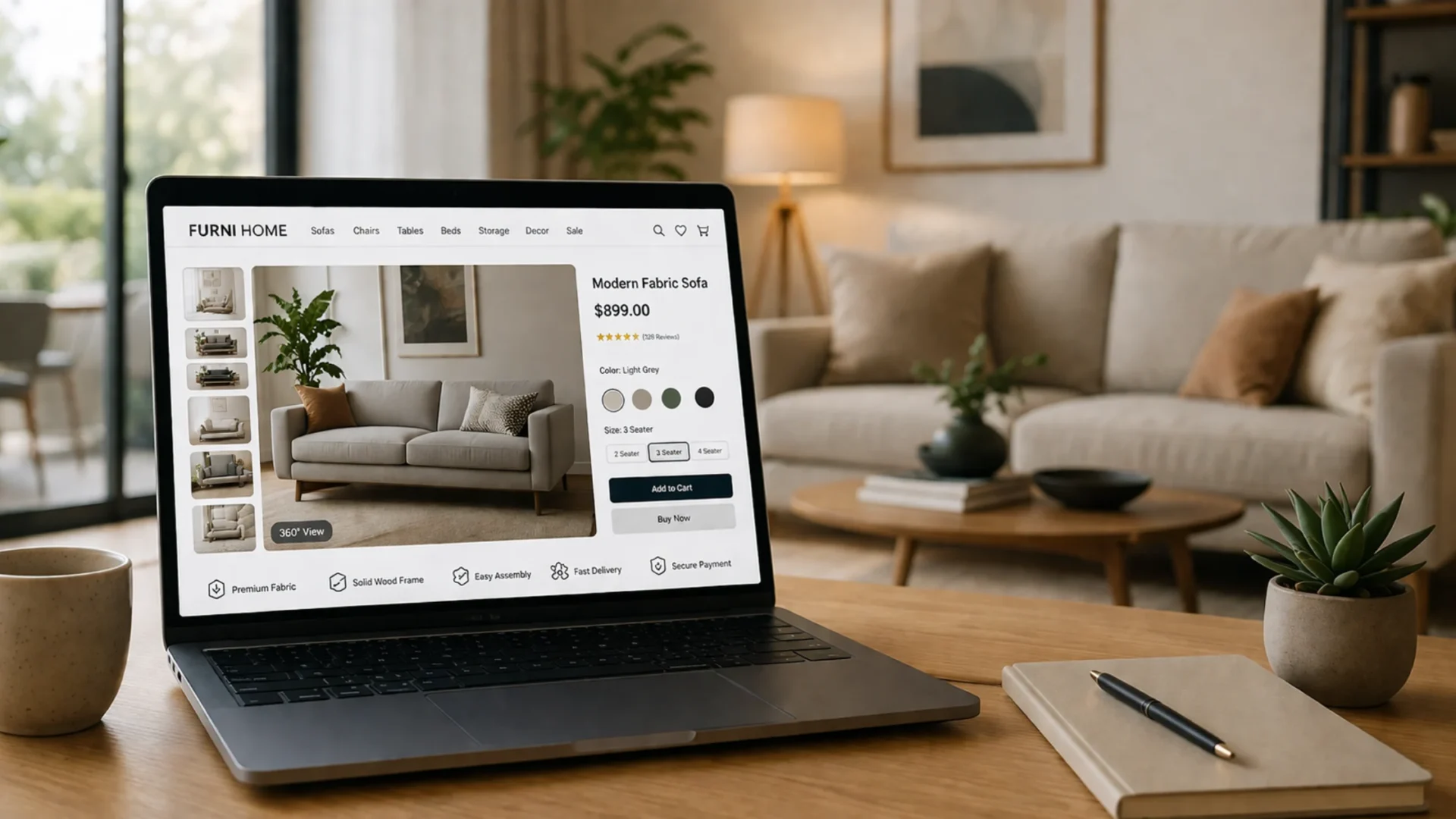
Furniture e-commerce has a challenge that most other categories don’t. Customers cannot actually experience the product when shopping online. They can’t sit on the sofa, touch the fabric, or stand next to a bookshelf to understand its size. And that creates hesitation. It leads to more cart abandonment, lower conversion rates, and a high rate of return that lowers the profit margins.
This is when things started to change.
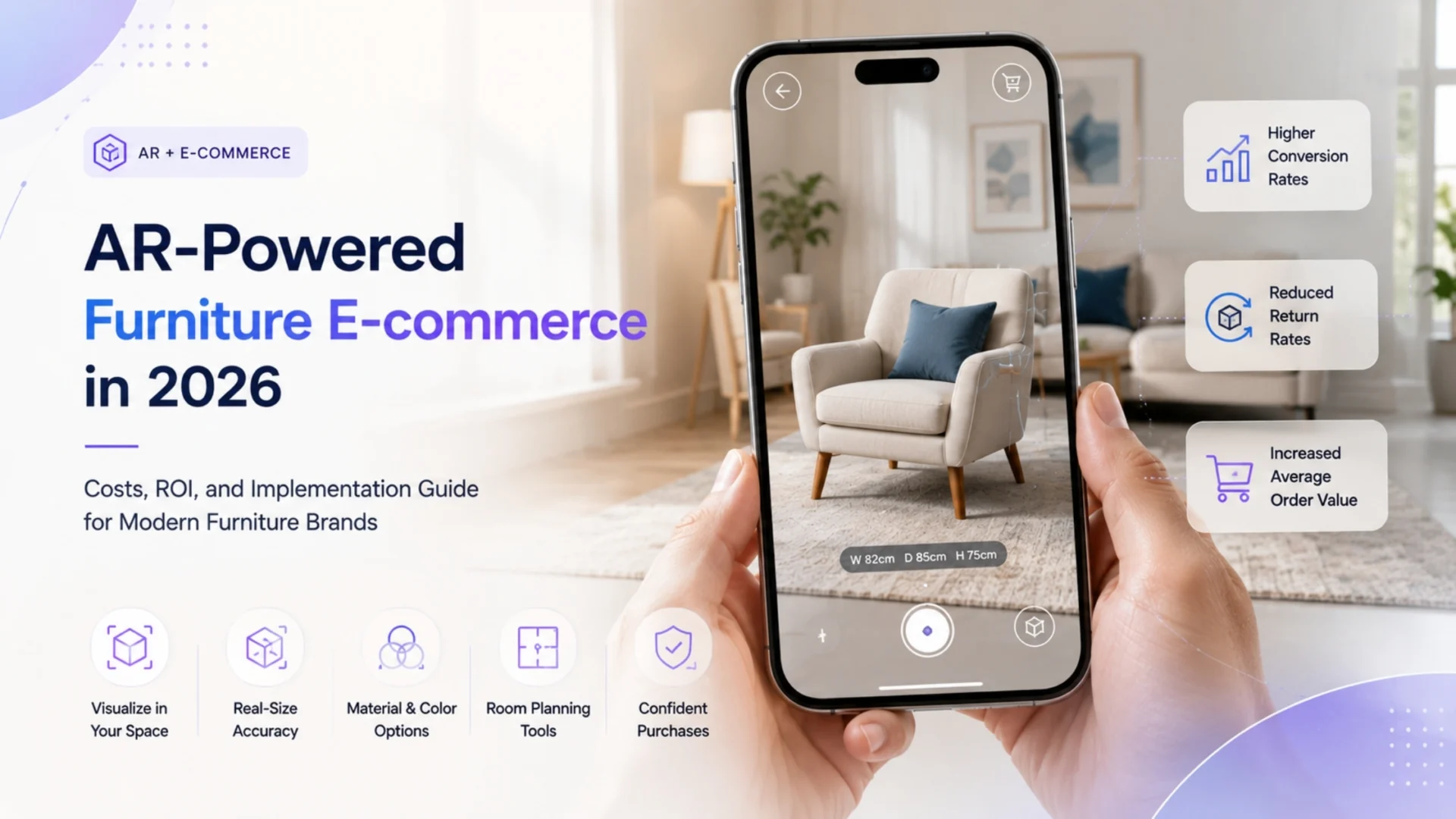
Now, augmented reality is no longer just a cool demo feature. It’s becoming a practical solution to this exact issue. Furniture brands are using AR that lets shoppers place a sofa right inside their living room with their phone. It helps them see how it looks, how it fits, and whether it actually works in their space. Customers feel more confident, make quicker decisions, and returns go down.
In this guide, we’ll break down how AR-powered furniture e-commerce actually works, what it costs to implement, the platforms available, and where it truly delivers ROI, and where it still might not be worth it.
Quick Answer: What is AR in Furniture E-commerce?
AR (augmented reality) in furniture e-commerce lets shoppers use their phone camera to place a true-to-scale 3D model of a product in their room before buying. It removes the biggest hesitation trigger, which is “will this actually fit?”, and directly impacts purchase confidence, return rates, and conversion. Implementation costs typically range from $40,000 to $150,000 in year one, depending on catalog size and whether you go with Shopify, Magento, or a custom build.
Why AR Matters for Furniture E-commerce Right Now
Furniture isn’t an impulse buy. Nobody shops for a dining table like they pick up a t-shirt. People wait, measure their space, check with family, rethink, and still hesitate at checkout. And honestly, that hesitation is where a lot of potential revenue just gets lost.
It mostly comes down to one question: will this actually fit? Product photos can be misleading. Something that looks neat and compact online can end up taking over half the room in real life. That gap between expectation and reality is one of the biggest reasons furniture gets returned. And with large items, returns aren’t just annoying, they’re expensive.
There’s also the showroom problem. Plenty of furniture brands built their reputation on physical stores. And now, foot traffic has been shifting online. A growing share of that traffic is mobile. People are scrolling product pages on their phones in the evening, not walking into a showroom on a Saturday.
Then there’s the expectations shift. Now that shoppers are used to seeing AR-style “view in your room” features from IKEA and Wayfair, it has become a basic expectation rather than a bonus feature.
Worth noting: This does not mean that AR is mandatory for every furniture brand. But for brands struggling with returns, hesitation, and mobile-heavy traffic, it’s solving a real, measurable business problem.
The Business Benefits of AR for Furniture Brands
It’s worth separating the sales pitch from the actual business case. Here’s where AR tends to improve results for furniture sellers specifically.
Honestly, all these benefits are not automatic just because AR is “turned on.” It only helps when the implementation is done well. A clunky AR feature can hurt more than it helps.
Types of AR Furniture E-commerce Solutions
There isn’t one single “AR for furniture” product. There are a few distinct approaches. Choosing the right one depends on your catalog, your budget, and how technical your team is.
|
1
|
WebARWebAR runs directly in a mobile browser without any app required. The customer taps “view in your room,” their camera opens, and the product appears on screen. It’s become the default for most furniture brands because it skips the biggest barrier: getting someone to download an app just to see a couch. Simpler to build, faster to launch, though the visuals aren’t quite as sharp as a native app. |
|
2
|
App-Based ARBrands with dedicated mobile apps can offer a richer, more advanced AR experience. Better tracking, smoother rendering, and more interactive features like swapping materials in real time. The tradeoff is development complexity and the simple fact that most customers won’t download an app just for furniture shopping, unless they’re already loyal repeat buyers. |
|
3
|
3D Product ConfiguratorsInstead of just placing a model, configurators let customers swap fabric, finish, leg style, or color and watch it update live. Great for brands selling customizable furniture. It cuts down a lot of the back-and-forth with sales reps or live chat. |
|
4
|
Room Planning ToolsThese go further than single-product placement, letting customers arrange several pieces in a virtual room. More work to build, but great for brands selling full room sets, or for customers furnishing a whole space at once. |
A valid rule of thumb: The right choice usually comes down to how complex your product line is, how much development capacity you have, and how much value each option would add for your specific customer base. A brand selling simple, single-SKU items rarely needs a full room planner. A brand selling modular, customizable furniture probably needs more than basic WebAR.
Shopify vs Magento vs Custom AR Implementations
This is where a lot of furniture brands get stuck, because the “right” platform really depends on business size and catalog complexity. Here’s a comparison between the three main platforms:
Shopify AR makes sense when you’re a mid-market or growing D2C furniture brand with a moderate catalog size, and you want to get the AR feature live fast. Shopify’s AR apps and 3D model support are reasonably plug-and-play now. If your brand is already on Shopify development services, adding AR is usually faster than starting from scratch elsewhere.
Magento is a better fit when your catalog is larger, your setup is more complex with multi-warehouse inventory, B2B pricing tiers, or lots of product variants, and you need more control over how the AR integrates with the current backend systems. Brands already using Adobe Commerce development actually have more flexibility to build a deeper AR integration without the platform limitations.
Custom development makes sense when the ready-made options just can’t do what you need. Maybe a highly specific room-planning tool, a custom 3D rendering setup, or integration with in-store inventory systems. Custom e-commerce development is the most expensive and slowest path, but the only one that has no platform limits. Most brands don’t start here; they consider this after outgrowing the other two.
Real Implementation Costs of Furniture AR
This is the section most articles skip, probably because it’s the hardest to judge honestly. Costs vary, but “it depends” isn’t a useful answer for someone trying to budget a project. So here are realistic ranges based on current implementation work.
|
1
|
3D Model CreationThis is usually the biggest line item, and it’s billed per product, not per project. Simple furniture pieces typically run somewhere in the $50 to $150 range per model when outsourced at scale. More complex pieces can range $200 to $500 or more per model once you factor in texture variants. A catalog of 200 SKUs at an average of $150 per model is already a $30,000 line item before any platform work begins. |
|
2
|
Platform IntegrationFor Shopify, AR setup usually costs $3,000 to $15,000, depending on how custom the storefront needs to be. Magento/Adobe Commerce runs higher, often $15,000 to $50,000, since the backend work and catalogs are bigger. Fully custom builds start around $50,000 and can go well into six figures. |
|
3
|
Ongoing MaintenanceThis part gets overlooked constantly. Catalogs change. New products are added, some items are discontinued, and seasonal collections are launched. Every new SKU needs a new 3D model. Existing models occasionally need re-optimization as rendering engines and AR frameworks update. |
|
4
|
Hidden Costs to Plan ForPerformance optimization for heavy 3D models. Mobile compatibility testing across older and newer devices, not just flagship phones. CDN and storage costs for hosting 3D assets at scale, which grow as your catalog grows. QA and testing time, since AR bugs including models floating, wrong scale, and texture glitches are genuinely hard to catch without dedicated testing cycles. |
Realistic budget range: A typical mid-market AR project with a moderate catalog, Shopify or Magento, and a reasonable maintenance plan runs $40,000 to $150,000 in year one, plus ongoing costs after. Custom or enterprise builds cost significantly more.
Common Challenges Furniture Brands Face with AR
Implementation rarely goes exactly as planned. So it is always better to know the friction points beforehand.
3D Asset Production Bottlenecks
Photographing or scanning hundreds of SKUs accurately takes far longer than most teams budget for, especially with brands that have large, frequently changing catalogs. This tends to be the very first challenge that slows everything down.
Slow-Loading Models
A silent conversion killer. If the AR feature takes eight seconds to load, most customers won’t wait around for it. They’ll just close it and move on, sometimes with a worse impression than if AR hadn’t been offered at all.
Mobile Performance Limitations
Not every customer has a flagship phone. AR experiences that work beautifully on a new iPhone can just keep buffering on a mid-range Android device. This is still a real constraint, and it needs to be tested before launch.
Inaccurate Scaling
One of the more damaging failure modes, because it actively works against the entire point of AR. If a model renders 10% too small or large, you’re not reducing returns. You’re potentially creating new sizing complaints from customers who trusted the AR view.
Poor User Adoption
This happens more often than vendors like to admit. Plenty of customers still skip the “view in your room” button entirely, especially first-time visitors who don’t trust or understand the feature yet.
Unrealistic ROI Expectations
AR is a meaningful lever, not a silver bullet. Brands that expect it to single-handedly fix conversion problems are usually disappointed, regardless of how well it’s built. Maintaining large catalogs over time is, honestly, the challenge that determines whether an AR program survives past year one or gets quietly abandoned.
Bottom line: None of this means AR isn’t worth doing. It just means going in with realistic expectations is the difference between a program that delivers and one that gets quietly shut down after year one.
How to Know if Your Furniture Brand Is Ready for AR
AR isn’t the right next move for every furniture brand, and that’s worth saying plainly. Here’s how to honestly assess where you stand.
There’s no shame in deciding AR isn’t the right priority yet. Plenty of furniture brands get more immediate ROI from fixing product photography, improving sizing charts, or tightening up their return policy first. You can get back to AR once those fundamentals are solid.
AR Implementation Checklist
Before kicking off an AR project, confirm the basics are in place. Brands that skip this step tend to run into mid-project expenses.
- Product dimensions standardized across the entire catalog
- High-quality product images available for every SKU being modeled
- Mobile optimization tested across all major device ranges
- A 3D model production pipeline planned out, including who owns ongoing updates
- CDN and storage infrastructure configured to handle 3D asset load
- AR scaling validated against real-world measurements, not just visual estimates
- E-commerce platform compatibility confirmed (Shopify, Magento, or custom stack)
- Analytics tracking configured so you can actually measure conversion impact
- Customer testing completed with real users, not just the internal team
- Performance benchmarks validated before full launch, not after
Conclusion
For furniture brands in 2026, AR is no longer just a flashy add-on. It’s becoming a practical tool that boosts purchase confidence, reduces return-related costs, and gives customers an engaging way to shop online.
The brands seeing real results aren’t the ones who jumped on AR first. They’re the ones who matched the right implementation approach to their catalog size, budget, and operational readiness.
If your furniture brand is exploring an AR-powered e-commerce experience, Elsner’s furniture e-commerce development teams can help map out a scalable AR approach built around your actual business goals, not a generic template.
The right measure isn’t what AR costs. It’s what a wrong implementation costs. A well-planned AR rollout matched to your catalog and operational capacity delivers measurable returns. One that’s rushed, under-tested, or over-budgeted relative to catalog size rarely does.
Ready to Add AR to Your Furniture E-commerce Store?
We work with furniture brands to design scalable AR implementations that fit your catalog, your platform, and your actual business goals. No guesswork, no overpromising.
Frequently Asked Questions
What is AR in furniture e-commerce?
AR, or augmented reality, lets furniture shoppers use their phone camera to place an exact version of a product in their room before buying. Instead of guessing from a photo, they can see how a sofa, table, or shelf looks in their own space.
How much does AR furniture e-commerce implementation cost?
It depends on your catalog and platform, but most mid-market brands spend $40,000 to $150,000 in year one. That covers 3D models, platform setup, and testing. Modeling alone runs $50 to $500 per product, and there’s ongoing maintenance after launch too.
Does AR reduce furniture return rates?
Yes, especially returns caused by sizing or “it didn’t fit the room” issues, which are some of the most common reasons furniture comes back. It won’t fix returns caused by fabric feel, color mismatches, or shipping damage. But for size and fit, it works well.
Is Shopify good for AR furniture e-commerce?
Yes, it’s a great choice for mid-market or growing D2C brands that want AR up fast without a lot of complexity. Shopify’s apps handle AR and 3D models pretty well now. Bigger catalogs or more complex backends might eventually need Magento or a custom build instead.
What is the difference between WebAR and app-based AR?
WebAR runs right in a browser with no app download, so it’s easier for first-time shoppers to try. App-based AR looks better and feels more advanced, but customers have to install an app first, and most people won’t do that just to buy one piece of furniture.
Do small furniture brands need AR technology?
Not always. If your catalog is small or your sales volume is low, AR might cost more than it’s worth right now. A lot of smaller furniture brands get better, faster results from fixing product photos, sizing info, and return policies first, then revisiting AR later.