




- What ecommerce merchandising actually means
- Why ecommerce merchandising matters more in 2026
- The main types of ecommerce merchandising
- Ecommerce merchandising strategies that move the numbers
- How merchandising actually works on each platform
- The catalog data foundation most teams skip
- Tools and software, and the build versus buy call
- Common merchandising mistakes that quietly cost sales
- The KPIs that tell you it’s working
- A practical way to roll out better merchandising
- Where ecommerce merchandising is heading
- The bottom line
- Want a store that merchandises itself well?
- Frequently Asked Questions
- What is ecommerce merchandising?
- What does an ecommerce merchandiser do?
- What is the difference between ecommerce merchandising and marketing?
- What are the main types of ecommerce merchandising?
- Which platform is best for ecommerce merchandising?
- How do I start improving merchandising on my store?
- Does ecommerce merchandising work for B2B stores?
A store can carry the right products, price them fairly, and pull in steady traffic, and still watch shoppers leave with empty carts. The usual reaction is to blame the strategy. Most of the time the strategy is fine. What breaks is the layer underneath it, the way products get organized, surfaced, and presented the moment someone lands on a page.
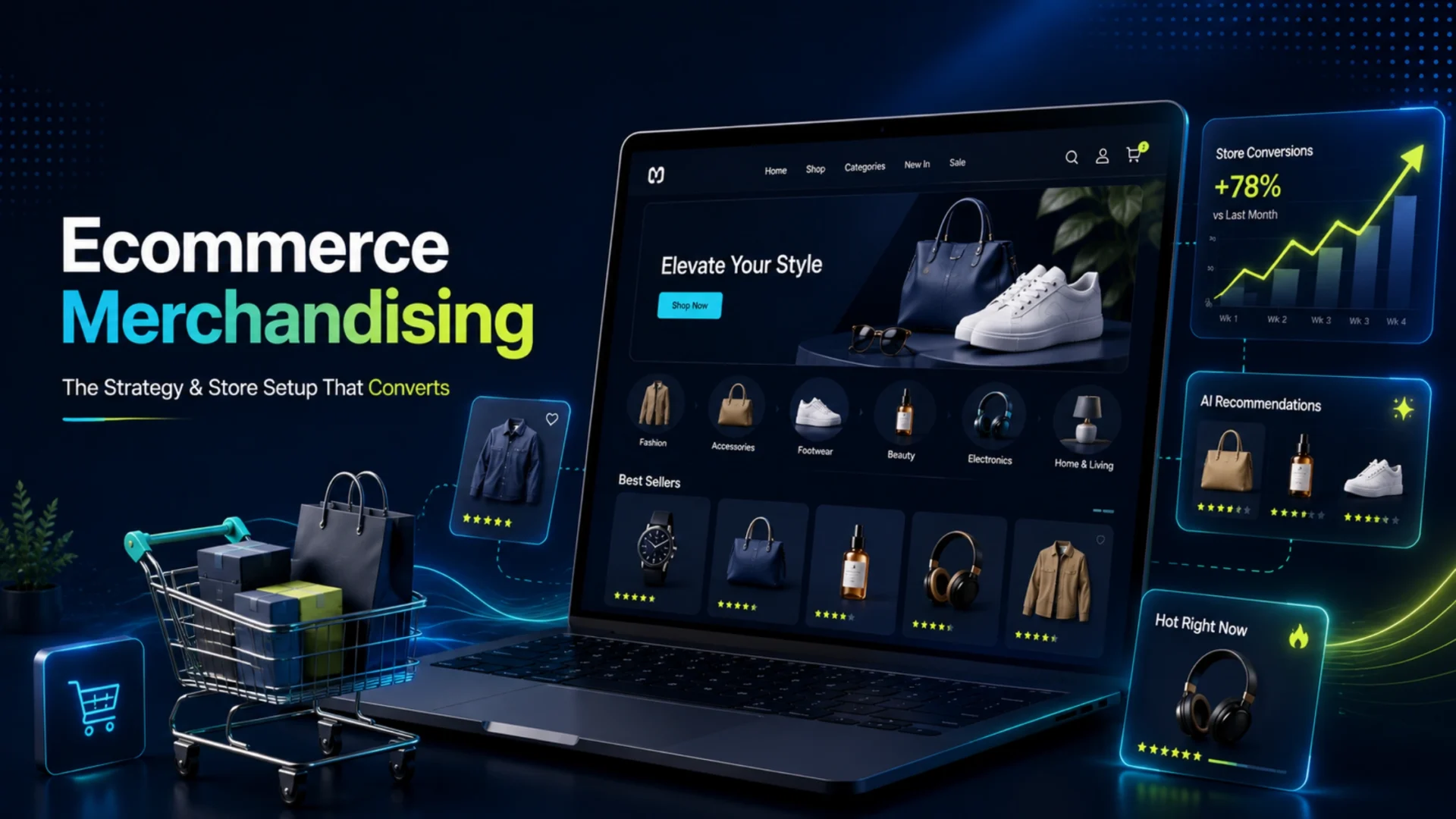
Ecommerce merchandising is that layer. It decides which products a shopper sees first, in what order, and how easy they are to find and trust. Done well, it lifts conversions and average order value without a single extra visitor. Done poorly, it quietly leaks revenue that no ad budget can recover. This guide covers what the practice really involves, the strategies that move numbers, and the part most articles skip entirely: how your platform and catalog setup decide whether any of it can work.
Quick Answer
Ecommerce merchandising is the practice of organizing, presenting, and promoting products in an online store so shoppers find what they want and buy more of it. It spans category structure, search, product pages, recommendations, and personalization, all working together to guide a visitor from landing page to checkout while lifting conversion rate and average order value.
What ecommerce merchandising actually means
Think of a sharp retail store manager. They decide what goes in the window, which items sit at eye level, how the aisles flow, and what greets you near the register. Online merchandising does the same job, except the shelves are category pages, the window is your homepage, and the store manager is a mix of rules, data, and software.
The goal stays simple. Show the right product, to the right shopper, at the right moment, in a way that earns the click and then the purchase. That covers how products are grouped, how they rank inside a collection, what the search bar returns, which items get recommended, and how a product page reassures a hesitant buyer.
People often blur merchandising and marketing, so here’s the clean split. Marketing brings people to the store through ads, email, social, and search. Merchandising takes over once they arrive and shapes what happens next. One fills the room. The other works the room. A brand can run brilliant campaigns and still convert poorly if the on-site experience falls apart, which is exactly where a lot of ad spend quietly dies.
Why ecommerce merchandising matters more in 2026
Shopper patience keeps shrinking, and expectations keep climbing. People compare, abandon, and switch stores in seconds, often on a phone, often mid-task. The store that helps them decide fastest usually wins the sale.
Personalization is now a baseline, not a perk. McKinsey research found that 71% of shoppers expect personalized interactions, and 76% feel frustrated when they don’t get them. That frustration has a price. The same research shows fast-growing companies pull 40% more revenue from personalization than their slower peers. Relevant merchandising is how most stores deliver that personalization in practice.
The cost of getting it wrong is just as measurable. The average cart abandonment rate sits around 70 percent, and better checkout and product experiences can lift conversion on large sites by roughly 35 percent. Read those numbers together and the takeaway is blunt. For most stores, the fastest revenue isn’t hiding in the ad account. It’s sitting in the merchandising layer they already own.
The reframe that helps: traffic problems are loud and expensive to solve. Merchandising problems are quiet and cheap to solve. A store paying to acquire visitors who then can’t find or trust the product is funding two leaks at once. Fix the on-site experience first, and every future click works harder.
The main types of ecommerce merchandising
Merchandising isn’t one task. It’s a handful of connected disciplines, and most stores are strong in one or two while ignoring the rest. Here’s how the pieces break down.
Visual merchandising
How products look on screen. Imagery, video, layout, and a homepage that signals what the store is about within a second. This is the digital storefront window, and weak visuals lose shoppers before a single word is read.
Category and navigation merchandising
The order products appear in on collection pages, plus the filters and menus that help shoppers narrow choices. Sort logic matters here. Best-sellers up front, out-of-stock items demoted, new arrivals surfaced on time.
Search merchandising (searchandising)
Tuning what the search bar returns. Shoppers who search know what they want and convert at a much higher clip. A zero-results page or an irrelevant result here is a sale walking out the door.
Product recommendations
Cross-sell and upsell blocks. The case shown with a phone, the better model shown next to a budget one, the bundle that turns one item into three. Done with care, it reads as helpful, not pushy.
Personalized merchandising
Adapting what each shopper sees based on behavior, history, or segment. A returning customer might see tailored picks, a first-timer sees trending products. This is where data does the heavy lifting.
Promotional merchandising
Banners, badges, seasonal collections, and offers placed where they catch attention without crowding the page. The art is creating urgency that feels real rather than the constant fake sale that shoppers learn to ignore.
Notice how these overlap. A personalized recommendation is also a search and a category decision. Strong stores treat them as one system, not six separate projects, and that coordination is where the real gains show up.
Ecommerce merchandising strategies that move the numbers
Plenty of advice on this topic stays vague. Here are the moves that tend to pay off, with a note on what makes each one actually work.
Sort category pages by performance, not by accident. Default sort order is the most overlooked lever in any store. Rank by conversion rate, margin, and stock level rather than by upload date. Pin proven sellers near the top and push out-of-stock items down. This one change often lifts category conversion with zero design work.
Make the search bar a first-class citizen. Add autocomplete, fix synonyms, and kill zero-results pages with smart fallbacks. Shoppers who search are closer to buying, so a weak search experience punishes your highest-intent visitors. For stores already on Shopify, our breakdown of AI conversion optimization for Shopify walks through how search and recommendations tie into conversion gains.
Use real data for personalization, not guesswork. Browsing history, past purchases, and segment behavior all sharpen what each shopper sees. Start with simple rules, like showing complementary items in a cart, before chasing full machine-learning recommendations. The simple version earns money while you build the sophisticated one.
Curate collections with intent. Themed groupings, like a holiday edit or a starter bundle, do the deciding for shoppers who don’t want to scroll a hundred items. Bundles in particular nudge order value up without feeling like a hard sell.
One honest caveat. None of these strategies survive bad data or a rigid platform. A recommendation engine fed messy product attributes recommends nonsense. Which brings us to the part most guides skip.
How merchandising actually works on each platform
Here’s the uncomfortable truth vendors rarely mention. The merchandising you can run depends heavily on the platform you build on. Some capabilities ship out of the box, some need an app, and some only happen with custom development. Knowing the difference saves real money and prevents a strategy that your store physically can’t execute.
| Platform | Native merchandising | Usually needs an app | Where custom dev helps |
|---|---|---|---|
| Shopify and Shopify Plus | Basic collection sorting, manual product ordering | Advanced search, AI recommendations, automated sorting | Custom logic, Hydrogen storefronts, deep data tie-ins |
| WooCommerce | Core sorting and basic related products | Search, filters, recommendation plugins | Most flexibility, since you own the code outright |
| Adobe Commerce (Magento) | Strong rules, segments, visual merchandiser built in | Specialized search and personalization tools | Complex B2B rules, large catalogs, custom workflows |
| BigCommerce | Solid category and product controls | AI search and recommendation add-ons | Headless builds for full presentation control |
A pattern shows up here. Hosted platforms like Shopify give you speed and a clean starting point, but heavy customization pushes you toward apps or custom work. Open platforms like WooCommerce and Adobe Commerce hand you more control at the cost of more engineering. Neither is better in the abstract. The right fit depends on catalog size, how unusual your rules are, and how much you plan to personalize.
If you’re on the enterprise end with complex rules and a large catalog, Adobe Commerce development tends to carry merchandising natively that other platforms can only reach through stacked apps. For lean, fast-moving brands, a well-built Shopify setup usually gets there with less overhead.
The catalog data foundation most teams skip
Every merchandising tactic above rests on one quiet thing: clean, structured product data. Skip it, and the fancy tools you bought start working against you.
Picture the problem. A filter for “color” only works if every product has a color attribute, spelled consistently. Search only finds “sneakers” if the catalog tags them that way and knows “trainers” means the same thing. A recommendation engine only pairs a charger with the right phone if the relationships are defined in the data. When attributes are missing, inconsistent, or scattered across spreadsheets, none of it holds.
This is why a clean product taxonomy and complete attributes matter more than any single tool. Decide what attributes every product must carry, enforce naming standards, and keep one source of truth rather than five conflicting exports. For stores with large or messy catalogs, a dedicated product information system is often the unlock. Our work on Pimcore development centers on exactly this, giving teams one governed home for product data that every channel can pull from.
The payoff is practical. Once the data is structured, search gets sharper, filters stop returning junk, and recommendations start making sense. Teams that invest here early stop fighting their own catalog and spend that time on actual merchandising instead. It rarely makes the highlight reel, yet it decides whether everything above succeeds.
Tools and software, and the build versus buy call
There’s no single product called an ecommerce merchandising tool. The category spans search and discovery engines, recommendation platforms, personalization software, and the analytics that tell you what’s working. The right mix depends on your platform, catalog, and team size.
The harder question is rarely which tool. It’s whether to buy a ready-made platform or build around your own stack. Both work. The trade-offs decide the fit.
Buy a platform
- Fast to launch, with proven features ready to go.
- The vendor handles updates, security, and uptime.
- Best when your needs are common and time is short.
- Watch for monthly fees that scale with traffic and weak fit for odd rules.
Build around your stack
- Fits unusual catalogs, B2B rules, and existing systems precisely.
- No per-order fees eating margin as you grow.
- Best when your data or logic is genuinely unique.
- Needs real engineering capacity to build and maintain.
A middle path works for most stores. Buy the commodity layers, like a search app or a recommendation engine, then build the thin custom piece that matches your exact catalog and rules. That keeps cost sane while fitting the parts that truly differ. When that custom layer is the right call, a focused ecommerce development effort usually beats forcing a rigid app to do something it was never built for.
Common merchandising mistakes that quietly cost sales
Some errors show up again and again, even on stores run by experienced teams. Knowing what to avoid is half the work.
Out-of-stock products ranking first
Shoppers click, get disappointed, and lose trust in the whole store. Demote or hide unavailable items automatically. This is one of the most damaging and most fixable errors there is.
Treating search as plumbing
Search gets set up once and then ignored for years. Meanwhile it serves your highest-intent shoppers. Zero-results pages and irrelevant matches here cost more than almost any other gap.
Endless fake urgency
When every product screams limited time, shoppers stop believing any of it. Save urgency for moments that are real, and it keeps its power.
Setting it and forgetting it
Merchandising isn’t a one-time setup. Seasons shift, inventory changes, and shopper behavior moves. The stores that win review the data and adjust on a regular cadence.
Spot the thread. Most of these trace back to a store running on autopilot. Merchandising rewards attention, and the stores that pay it pull ahead of the ones that don’t.
The KPIs that tell you it’s working
You can’t improve what you don’t measure, and merchandising has its own set of signals. These are the ones worth watching.
| Metric | What it tells you |
|---|---|
| Conversion rate | Whether your presentation turns visits into orders |
| Average order value | How well cross-sell, upsell, and bundles are landing |
| Search exit and zero-results rate | Where search is failing high-intent shoppers |
| Category and product page views | Which collections pull attention and which fall flat |
| Cart abandonment rate | Friction between interest and a completed purchase |
Track these by segment, not just as a single store average. A change that helps mobile shoppers might hurt desktop, and a blended number hides it. When the figures point at a specific leak, that’s where the next round of work goes. Stores serious about turning these signals into gains often pair merchandising with structured conversion rate optimization, since the two disciplines feed each other.
A practical way to roll out better merchandising
The biggest mistake is trying to fix everything at once. It stalls, the effort sprawls, and nobody can point to a clear win. A narrower path works far better. Pick one thing, prove it, then expand.
The rollout we’d recommend
Fix the data first. Audit your product attributes and taxonomy before touching any tool. Every later step depends on this, and skipping it guarantees disappointing results.
Pick one high-traffic category. Improve its sort order, filters, and presentation. A focused win on a busy page shows value fast and builds the case for more.
Tune search and add smart recommendations. Fix zero-results pages, add autocomplete, and place complementary products where they help. These often deliver the quickest revenue lift.
Layer in personalization. Start with simple segment rules before chasing full machine learning. The basic version earns money while the advanced one gets built.
Measure, then scale. Track conversion, order value, and search performance for a few weeks. When the numbers hold, extend the same pattern to the next category. Not before.
This phased approach has a second benefit. It builds belief inside the team. People who watch one category get measurably better stop treating merchandising as guesswork and start asking for more of it. If capacity is the constraint, a partner who handles both the build and the ongoing ecommerce maintenance can shorten the climb and keep the gains from slipping over time.
Where ecommerce merchandising is heading
A few shifts are worth planning around now rather than reacting to later. None of them are exotic. They’re the fundamentals getting sharper as AI raises the bar.
Automation is taking over the repetitive work. Sorting category pages by live performance, flagging out-of-stock items, and generating product copy at scale are increasingly handled by software, freeing teams for the judgment calls machines still get wrong. The smart move is to automate the busywork and keep humans on strategy.
Discovery is also moving off the traditional store. Shoppers now find products through AI assistants, visual search, and social feeds, sometimes never touching a category page at all. That makes clean, well-structured product data even more valuable, because those systems can only surface what they can clearly read. Stores thinking ahead are pairing merchandising with answer engine optimization so their catalog shows up wherever the buying decision now happens.
The bottom line
Ecommerce merchandising is the difference between a store that lists products and one that sells them. The strategies matter, but they only work on top of clean data and a platform that can actually run them. Get that foundation right, and every other improvement compounds.
Most stores don’t need a bigger ad budget to grow. They need shoppers who land to find, trust, and buy the products already in front of them. That’s a fixable problem, and it usually pays back faster than anything else on the roadmap.
Want a store that merchandises itself well?
Talk to a team that builds merchandising into your store from the ground up, with the catalog structure, search, and recommendation logic your conversion goals depend on.
Frequently Asked Questions
What is ecommerce merchandising?
Ecommerce merchandising is the practice of organizing, presenting, and promoting products in an online store so shoppers find what they want and buy more of it. It covers category structure, search, product pages, recommendations, and personalization, all working together to turn visits into orders and lift average order value.
What does an ecommerce merchandiser do?
An ecommerce merchandiser decides how products are grouped, ranked, and shown across the store. They manage category sort order, tune search results, set up recommendations and promotions, and watch the data to adjust. The role blends creative judgment with analytics, increasingly supported by automation for the repetitive parts.
What is the difference between ecommerce merchandising and marketing?
Marketing brings shoppers to the store through ads, email, social, and search. Merchandising takes over once they arrive and shapes what they see and how easily they buy. One fills the room, the other works the room. Strong stores need both, since great campaigns still convert poorly on a weak on-site experience.
What are the main types of ecommerce merchandising?
The main types are visual merchandising, category and navigation merchandising, search merchandising, product recommendations, personalized merchandising, and promotional merchandising. Most stores are strong in one or two and weak in the rest. The biggest gains come from treating them as one connected system rather than separate tasks.
Which platform is best for ecommerce merchandising?
It depends on catalog size and how unusual your rules are. Shopify suits fast, lean brands. WooCommerce and Adobe Commerce give more control for complex catalogs and B2B rules. BigCommerce sits in between. There’s no single best platform, only the best fit for your specific merchandising needs and engineering capacity.
How do I start improving merchandising on my store?
Start by cleaning your product data and taxonomy, since everything else depends on it. Then pick one high-traffic category, improve its sort order and filters, tune search, and add simple recommendations. Measure the results for a few weeks before scaling the same pattern to other categories. Avoid trying to fix everything at once.
Does ecommerce merchandising work for B2B stores?
Yes, and it often matters more. B2B catalogs are larger and more complex, search usage is higher, and buyers expect account-specific pricing and curated lists. That makes clean data and a platform that supports custom rules, like Adobe Commerce, especially important for B2B merchandising done well.