




There’s something you start noticing slowly. A few orders from Canada. Some traffic from the UK. Then Europe shows up in your analytics. But conversions? Not great.
Customers see prices in USD. Duties surprise them at checkout. Shipping feels unpredictable. As a result, expanding globally no longer feels exciting; it feels messy.
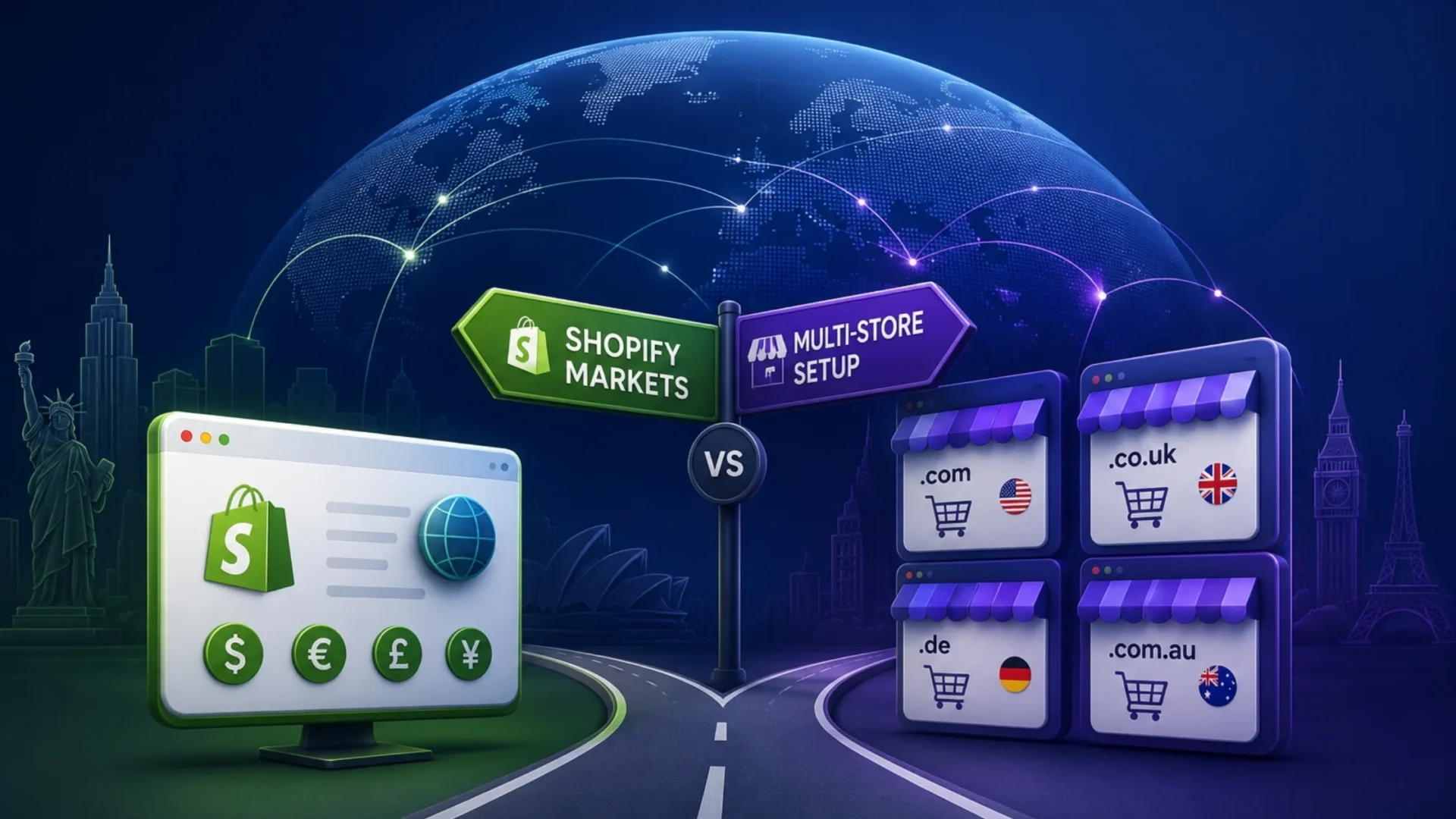
This raises a key question: should you scale internationally with Shopify Markets, or create separate Shopify stores for each region?
There’s no universal answer here. But there is a right answer for your brand, depending on where you are right now.
Let’s break it down, clearly and honestly.
Quick context: Choosing between Shopify Markets and multi-store isn’t just a technical decision. It’s a strategic one that affects your tax compliance, SEO performance, customer experience, and long-term operational costs. This guide covers both sides honestly — from setup complexity to hidden costs to when it makes sense to graduate from one model to the other.
Why International Expansion Matters for US Brands in 2026
The US market is still strong, no doubt. But the e-commerce growth? It’s slowing.
Meanwhile, cross-border ecommerce is picking up pace. According to industry estimates, international orders are growing at a much faster rate than domestic ones.
And here’s the thing. You’re probably already getting international traffic. You just aren’t converting it well. Rising ad costs in the US make this even more important. The Customer Acquisition Cost keeps climbing. Expanding globally is no longer optional; it’s becoming a margin play.
But Shopify international expansion without the right setup? That’s where brands lose money.
What Is Shopify Markets?
Shopify Markets is Shopify’s built-in solution for international selling. It lets you sell across multiple countries from a single store. One backend. One product catalog. One system to manage.
There are two versions:
- Shopify Markets (standard)
- Shopify Markets Pro (paid, with more advanced features)
With Markets, you can:
- Show prices in local currencies
- Adjust domains (subfolders or subdomains)
- Offer localized checkout experiences
- Manage international shipping rules
And with Markets Pro, Shopify steps in as the Merchant of Record, handling duties, taxes, and compliance. Sounds powerful, right? It is. But it’s not perfect.
You still operate within a shared structure. That means limited control when things get complex.
What Is a Shopify Multi-Store Setup?
A multi-store setup means creating separate Shopify stores for each country or region. So instead of one global store, you might have:
- US store
- UK store
- EU store
- Australia store
Each store runs independently. Different pricing. Different products. Different checkout flows. Even different teams if needed. That level of control is unmatched. But it comes with a cost.
More stores = more complexity, more operations, more overhead.
You’re not just scaling revenue. You’re scaling systems.
Shopify Markets vs Multi-Store: Side-by-Side Comparison
Here’s the simple way to look at it. Shopify Markets is about speed and simplicity. Multi-store is about control and depth.
If you’re early in your international journey, Markets feels easier. If you’re scaling globally at a serious level, multi-store starts making more sense.
The Real Cost Difference
At first glance, we know that Shopify Markets is cheaper.
You stay on your existing Shopify or Shopify Plus plan. You may pay a small percentage on international transactions, especially with Markets Pro. But multi-store?
That’s a different story. Each store often requires:
- Separate Shopify Plus license
- Development and design work
- Ongoing maintenance
- Region-specific operations
So while Markets might feel like an upgrade, multi-store feels like building multiple businesses.
Taxes, Duties, and Compliance
This is where things get real. International commerce isn’t just about shipping products. It’s about compliance. VAT in Europe. GST in Australia. IOSS requirements. Import duties.
One mistake here can lead to refunds. Or worse, chargebacks. Shopify Markets Pro simplifies this by acting as the Merchant of Record.
That means Shopify handles:
- Tax calculation
- Duty collection
- Regulatory compliance
A Merchant of Record is essentially the legal seller responsible for the transaction. They take on the risk. In a multi-store setup, that responsibility sits entirely with you.
Which is fine if you have the right infrastructure. But risky if you don’t.
SEO Implications You Can’t Ignore
Your ecommerce strategy changes significantly depending on your approach.
With Shopify Markets:
- You use subfolders or subdomains
- Your domain authority stays consolidated
- Faster to rank in new regions
With multi-store:
- You use country-specific domains (ccTLDs)
- Stronger local signals
- But you start from zero authority
Then there’s hreflang implementation, which tells search engines which version of your site to show. Markets handle this more simply. Multi-store gives you full control, but also full responsibility. So, if speed matters, Markets win. If local SEO dominance matters, multi-store wins.
SEO note: If you’re planning to optimize for international search rankings, the domain structure you choose at the start becomes much harder to change later. Choose strategically.
Customer Experience is Where You Win or Lose
This part is often underestimated. Conversion doesn’t just depend on traffic. It depends on experience. Think about your international customer:
- Do they see prices in their currency?
- Can they pay using local methods?
- Is the language natural, not just translated?
- Are returns easy?
Returns, by the way, are the hidden cost most brands ignore. A poor returns experience kills repeat purchases faster than anything else.
Multi-store setups usually deliver a better localized experience. But markets are catching up fast.
When Shopify Markets Is the Right Choice
If you’re still figuring things out, Markets is often the smarter starting point.
You’ll likely benefit if:
- You’re testing 2 to 4 international markets
- Your team is small, under 50 people
- Your product catalog is consistent across regions
- You want to launch within 4 to 8 weeks
- International revenue is under 30%
It lets you move fast without overcommitting. And that matters more than people think.
When Multi-Store Makes More Sense
Now, if you’re already seeing traction internationally, things change. Multi-store is a better fit when:
- You’re committed to specific countries long-term
- You need different pricing, branding, or product mix
- You have country-specific teams or partners
- Your revenue is above $50M
- Local SEO is a major growth driver
At this stage, control becomes more valuable than speed.
The Hybrid Approach Smart Brands Use
Here’s what most successful brands actually do. They don’t choose one forever. They start with Shopify Markets to test demand. Once a region proves profitable, they graduate it into a dedicated store. This hybrid approach gives you:
- Speed in the beginning
- Control when it matters
It’s not just efficient. It’s strategic.
A Quick Decision Framework
If you’re still unsure, ask yourself:
- How many countries are you targeting this year?
- Is your product identical across regions?
- Do you have a team for international operations?
- What’s your budget for expansion?
- Do you prioritize speed or localization?
If most answers lean toward simplicity → start with Markets.
If they lean toward customization → consider multi-store.
Common Mistakes US Brands Make
Some patterns keep popping up.
- Launching too many markets at once
- Ignoring local payment preferences
- Using English-only content everywhere
- Underestimating return logistics
- Choosing multi-store too early
The most expensive mistake: Choosing the wrong model early, building significant operations around it, then realizing you need to switch. Migration costs — in time, money, and lost orders — are brutal.
How Elsner Helps US Brands Expand on Shopify
Expanding internationally isn’t just a technical decision. It’s strategic.
Elsner offers Shopify development services to design the right expansion path, whether that’s setting up Shopify Markets, building multi-store ecosystems, or creating hybrid models.
We focus on one thing: sustainable growth. That means technical setup, yes. But also SEO optimization, performance tuning, and making sure your choice doesn’t create operational headaches down the line.
If you’re planning your next move, it might be worth talking to a Shopify expert who understands both the technical and business sides of the decision.
Conclusion
There’s no universal winner here. If you’re testing international markets, Shopify Markets is the fastest way to move forward. If you’re building a long-term international presence, multi-store gives you the control you’ll need.
And honestly, most brands don’t stay in one model forever. They evolve. Start simple. Learn fast. Scale smart.
That’s how international expansion actually works in 2026.
Ready to Expand Internationally on Shopify?
Whether you choose Markets, multi-store, or a hybrid approach, getting the setup right from the start saves months of headaches later. Let’s talk about what makes sense for your brand.
Frequently Asked Questions
What is the difference between Shopify Markets and Shopify Markets Pro?
Shopify Markets provides core international selling tools. Markets Pro has added advanced features like automated duties, tax handling, and Merchant of Record services, making compliance easier and taking legal liability off your hands.
Can I use Shopify Markets without Shopify Plus?
Yes, Shopify Markets is available on standard plans. However, some advanced capabilities are available only with Shopify Plus, which is designed for scaling your e-commerce growth at an enterprise level.
How much does Shopify Markets Pro cost?
Pricing varies based on transaction fees and region. It typically includes a percentage fee on international sales. Contact Shopify directly for your specific pricing based on your sales volume and markets.
Does Shopify Markets handle taxes and duties?
Standard Markets offers basic tools. Markets Pro fully handles duties, taxes, and compliance as the Merchant of Record, taking the legal responsibility off your shoulders.
Which is better for SEO?
Markets is better for faster international SEO using subfolders or subdomains, since you inherit your main domain’s authority. Multi-store is better for deep local SEO with country domains (ccTLDs), which gives stronger local signals but requires building authority from scratch in each market.
Can I switch from Markets to multi-store later?
Yes, and many brands do. It’s a common evolution path as international revenue grows. The key is planning for it — having clean data, proper redirects, and a migration strategy so you don’t lose SEO authority or customer data in the transition.