




- Why Features Matter in Furniture Ecommerce Websites?
- Essential Features Every Furniture Ecommerce Website Must Have
- High-Quality Product Images and 360° Views
- Advanced Search and Filtering Options
- Detailed Product Descriptions and Specifications
- AR and 3D Visualization
- Mobile-Optimized Design
- Easy Navigation and Category Structure
- Secure and Flexible Payment Options
- Customer Reviews and Ratings
- Wishlist and Save for Later Feature
- Fast Loading Speed and Performance Optimization
- Advanced Features That Give You a Competitive Edge
- Personalized Product Recommendations
- Live Chat and Customer Support
- AI-Based Search and Suggestions
- Integration with Inventory and CRM Systems
- Features That Directly Improve Conversions
- Common Mistakes to Avoid in Furniture Ecommerce Websites
- Poor Image Quality
- Complicated Navigation
- Lack of Product Information
- Slow Website Speed
- Quick Feature Checklist for Furniture Websites
- When to Upgrade or Redesign Your Furniture Website
- Conclusion
- Planning to Build or Upgrade Your Furniture Ecommerce Website?
- Frequently Asked Questions
- What features are essential for a furniture Ecommerce website?
- Why are visuals so important in furniture websites?
- How does mobile optimization affect furniture Ecommerce sales?
- What advanced features can improve furniture website performance?
- How can I improve conversions on my furniture website?
Online furniture shopping has grown and it is not slowing down. Buyers in the US are skipping the showroom trip entirely. They scroll through sofas at midnight, compare dining tables on their lunch break, and expect to feel as confident buying online as they would in person. That shift is real, and it puts serious pressure on furniture brands to step up their digital game.
Here is the thing — most furniture websites are not built for the way people actually shop today. A slow homepage, a photo that barely shows the product, a checkout that glitches on mobile — any one of these pushes a buyer straight to a competitor. Getting the right furniture Ecommerce website features in place is what separates stores that grow from stores that stall.
At Elsner, we have spent 20+ years helping furniture brands across the US build online stores that perform. This guide covers every feature worth having in 2026 — with honest context on why each one matters to your bottom line.
Why Features Matter in Furniture Ecommerce Websites?
Buying furniture is not like buying a phone case. It is a considered, high-stakes decision. Shoppers are thinking about dimensions, room aesthetics, material durability, and whether something will still look good in five years. That much thought requires a lot of trust — and your website either earns it or loses it.
Picture a physical store. A sales rep walks beside the customer, answers questions, lets them test the cushion, and helps them imagine the piece in their living room. Your website has to do all of that — without the human element. The right furniture website functionality fills that gap. Poor functionality leaves buyers guessing, and guessing leads to exits.
There is also the matter of competition. Furniture Ecommerce in the US is no longer a space where basic is enough. Buyers have options — dozens of them. The websites that win are the ones that make the experience feel natural, confident, and easy. Features are how that happens.
Essential Features Every Furniture Ecommerce Website Must Have
High-Quality Product Images and 360° Views
Scroll through any high-performing furniture website and the first thing you notice is the imagery. Big, clear, well-lit photos that show exactly what the product looks like. That is not a coincidence — it is a deliberate business decision. For any serious online furniture store, image quality is the first filter buyers use to judge whether a brand is worth their time.
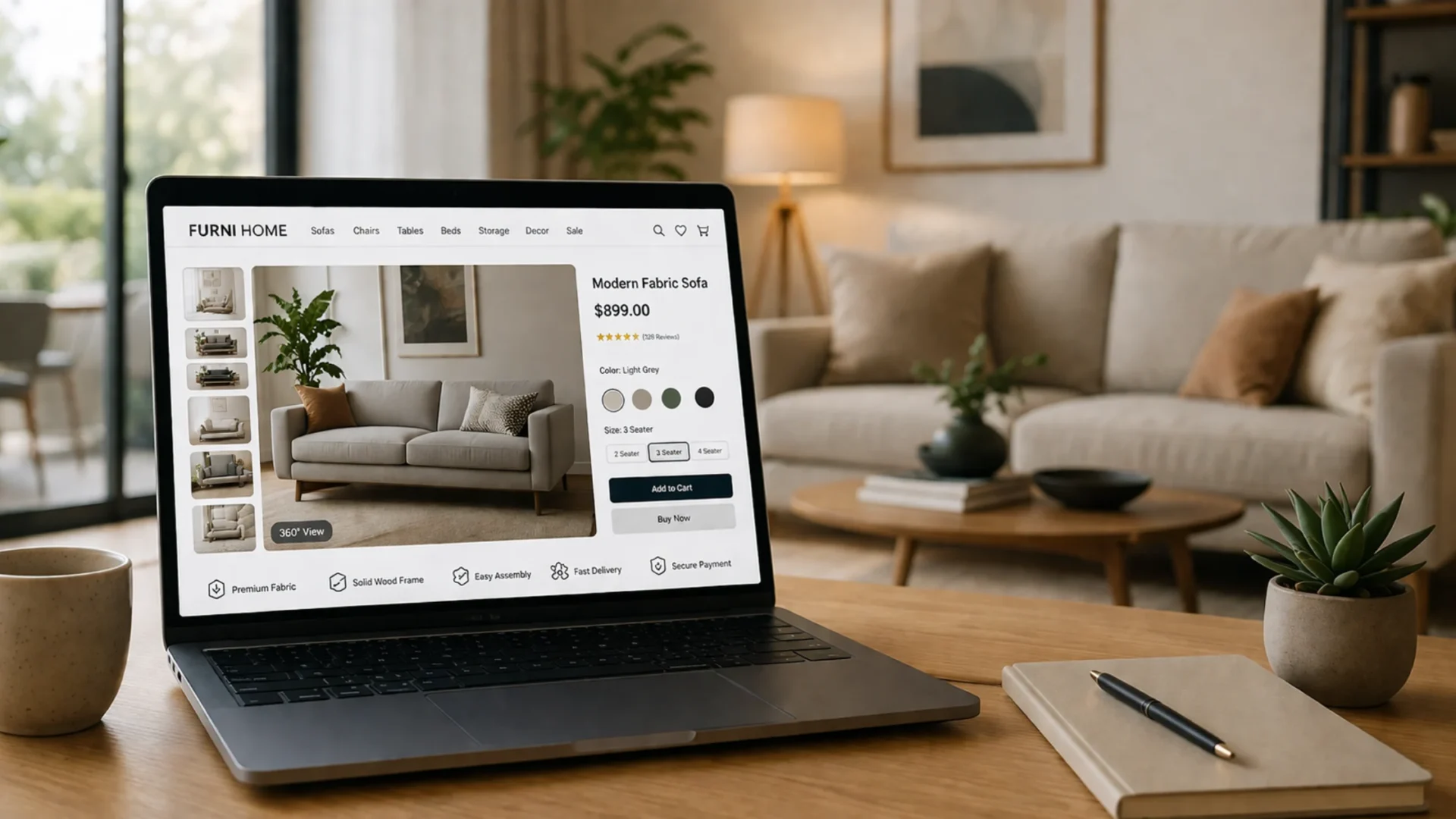
Multiple angles matter. A single front-on shot does not cut it when someone is buying a dining chair. They want to see the backrest detail, the leg finish, the seat depth. A 360-degree spin view lets them rotate the product like it is sitting right in front of them. Add zoom functionality and suddenly a buyer can inspect the fabric weave or wood grain — details that often decide a purchase.
Lifestyle photography takes it further still. Showing a sectional in an actual room, styled with a rug and throw pillows, creates an emotional picture. People buy the vision as much as the product — and lifestyle images hand them that vision on a silver plate. This is exactly where investing in a purpose-built furniture ecommerce website — one designed around how furniture buyers actually think — pays off from day one. The visual experience is not decoration. It is the sales floor.
Advanced Search and Filtering Options
A well-stocked furniture catalog can run into the thousands. Without strong filtering, that depth becomes a liability. Visitors get overwhelmed, cannot find what they are looking for, and leave. Strong furniture website design features always include filters that genuinely narrow things down — not just a price slider and two category tabs.
Think about how your customers actually search. They want to find a “grey velvet sofa under 90 inches wide” or a “solid oak dining table that seats six.” Your filters should match that mental model. Size, material, color, price, room type, style, brand — layered filtering that lets shoppers combine criteria is what keeps them on your site long enough to buy.
The search bar itself needs attention too. Auto-suggestions, typo tolerance, and natural-language processing turn it from a basic tool into a powerful one. This is one of the highest-return items on the Ecommerce features list for furniture — because the faster someone finds what they want, the more likely they are to buy it. For furniture brands running catalogs in the thousands, this level of search intelligence is not optional — it is what keeps high-intent buyers on site long enough to convert.
Detailed Product Descriptions and Specifications
A product page with no dimensions is a dead end. A buyer who wants to know if a sofa fits against a 9-foot wall — and cannot find that answer on your site — is a buyer who will find it somewhere else. Complete, accurate specifications are a basic furniture website requirement that too many brands still overlook.
Beyond the numbers, the written description has a job to do. It is not just filler content — it sells. Good copy communicates feel, durability, and style context in a way that specs alone cannot. Keep it clear and direct. Skip the puffery. Tell the buyer what the product is made of, how it holds up, and who it is made for.
Care instructions, assembly requirements, weight limits, available color variants — every useful detail you add is one less reason for a buyer to hesitate. Think of the product page as your 24-hour salesperson. Write it like one.
AR and 3D Visualization
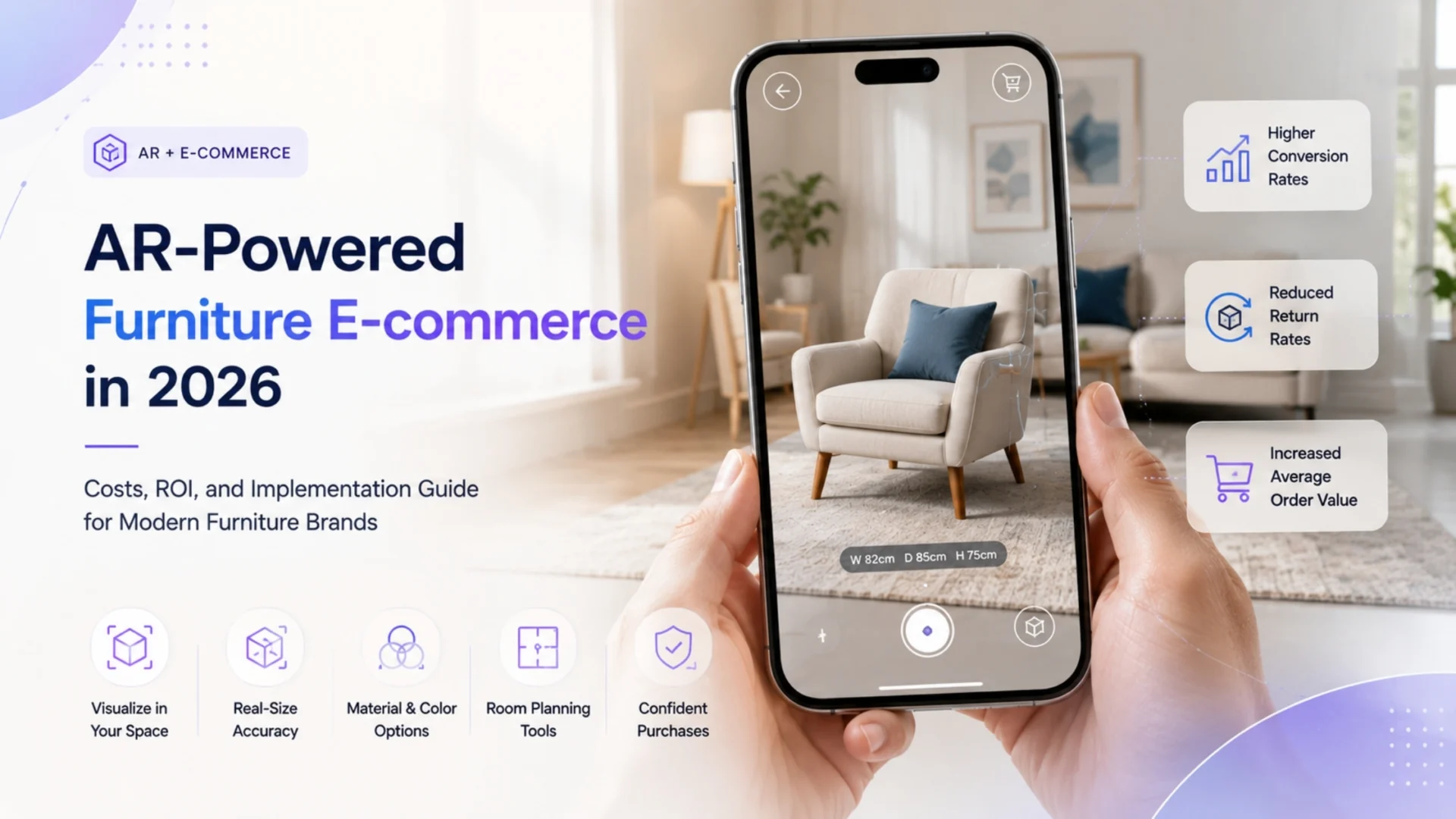
“Will this actually fit in my room?” — that one question holds back more furniture purchases than almost anything else. AR visualization answers it directly. Point a phone camera at the corner of a room and see the sofa placed there, to scale, in real time. That experience removes the biggest psychological barrier in furniture buying.
From an Ecommerce UX furniture standpoint, AR is a game-changer. Brands that have implemented it report lower return rates and higher average order values — and Elsner’s own furniture digital transformation projects back this up with real numbers: conversion rates improving by 40–65% and returns dropping by up to 40% after AR was added. Buyers who use it feel more confident in their decision — and confident buyers complete purchases. What was a premium differentiator two years ago is fast becoming a baseline expectation among US shoppers in 2026.
3D product models serve desktop shoppers the same way. Drag to rotate, zoom in on joints and finishes, resize to scale. Combined with AR for mobile, 3D visualization gives your product pages an experiential depth that standard photography simply cannot match.
Mobile-Optimized Design
More than 60% of Ecommerce traffic in the US comes from mobile. If your furniture website was designed primarily for desktop, you are already behind. A responsive layout is a minimum — but true mobile optimization goes much deeper than that.
Touch targets need to be large enough to tap without frustration. Navigation menus should collapse cleanly without hiding important categories. Product images should load fast on a cellular connection, not just on Wi-Fi. The checkout flow needs to work with one hand, on a 6-inch screen, without requiring the user to pinch and zoom their way through form fields.
Search engines prioritize mobile-friendly pages in rankings. That alone makes mobile optimization a strategic necessity — not just a UX nicety. Getting this right lifts both your organic traffic and your on-site conversion rate at the same time.
Easy Navigation and Category Structure
When someone lands on your furniture website, they should know where everything is within seconds. That clarity comes from deliberate category structure — not from cramming every product type into a single mega-dropdown and hoping for the best. Logical navigation is one of the most underrated furniture website best practices around.
Organize by room first — living room, bedroom, dining, office, outdoor — then break those down into product types. Mega menus show subcategories at a glance without requiring extra clicks. Sticky headers keep navigation accessible as users scroll through long pages. Breadcrumbs tell shoppers exactly where they are, and make it easy to backtrack without hitting the browser back button repeatedly.
Bad navigation is invisible until someone gets frustrated by it. By then, they are already gone. Structure your site the way your customers think — not the way your warehouse organizes stock.
Secure and Flexible Payment Options
A shopper who reaches the checkout has already done the hard work. They browsed, compared, and decided. The last thing you want is for payment friction to kill the sale at the finish line. Offer what people actually use — credit and debit cards, PayPal, Apple Pay, Google Pay, and buy-now-pay-later services like Affirm or Klarna.
BNPL options are particularly relevant in furniture. Average order values are high, and splitting a $1,200 sofa into monthly payments makes a meaningful difference to a buyer on a budget. Offering that flexibility often converts a “maybe next month” into a confirmed order today.
Trust signals matter here too. SSL certificates, recognized payment logos, and security badges all tell the buyer their financial data is protected. A checkout page that looks secure, loads fast, and accepts familiar payment methods will consistently outperform one that does not. Getting this right from the architecture level — not as a bolt-on afterthought — is one of the strongest arguments for working with a dedicated ecommerce development company rather than patching together a generic template.
Customer Reviews and Ratings
No marketing copy is more persuasive than a real customer saying a product is worth buying. A product page with 150 reviews rated 4.6 stars does the selling for you. Buyers trust other buyers — especially strangers who have nothing to gain by leaving a positive review.
Make leaving a review easy. A short post-purchase email with a direct link to the review form gets more responses than a complicated multi-step process. Allow photo uploads — seeing a real sofa in a real apartment is worth more to a prospective buyer than any professional lifestyle shot. Respond to negative reviews calmly and constructively. That response is visible to every future visitor who reads the page.
Reviews also generate keyword-rich content organically. Customers write in natural language about real use cases — and search engines pick that up. A well-reviewed product page ranks better and converts better. That combination makes reviews one of the highest-ROI features on the entire site.
Wishlist and Save for Later Feature
Most people do not buy furniture on their first visit. They browse, save, revisit, compare, and eventually decide. A wishlist feature supports that process by giving them a place to store what caught their eye — without any purchase commitment.
Cross-device access makes this feature even more useful. A buyer who saved a coffee table on their phone during lunch should be able to pull it up on their laptop at home that evening. That continuity keeps your brand present throughout the decision-making window — which, for furniture, can stretch across days or weeks.
Pair the wishlist with a side-by-side compare tool and you give buyers everything they need to settle a debate between two similar products. Dimensions, price, material, and customer ratings — all in one view. That kind of clarity shortens the decision cycle.
Fast Loading Speed and Performance Optimization
A one-second delay in page load time can reduce conversions by 7%. For a furniture store doing real revenue, that number adds up fast. Speed is not a developer detail — it is a business metric, and it belongs on the same priority list as your product photos and checkout flow.
Furniture websites carry a heavy visual load by nature. High-resolution images, 360-degree viewers, and video content all add weight. Managing that weight through image compression, lazy loading, and a content delivery network (CDN) keeps pages snappy without sacrificing visual quality.
Google uses page speed as a ranking factor. Faster sites rank higher in search results, which means more visitors finding you without paid advertising. Think of performance optimization as part of your online furniture store features stack — not an IT afterthought.
Advanced Features That Give You a Competitive Edge
Personalized Product Recommendations
A shopper browsing sectional sofas probably needs a coffee table, an area rug, and maybe a side lamp to go with it. Showing them those options — based on what they are actively looking at — increases the average order value and keeps them engaged on your site longer.
Personalization engines pull from browsing history, purchase patterns, and real-time behavior. Done well, they feel less like upselling and more like helpful curation. Think of it as a knowledgeable store associate who has been watching your browsing session and steps in with genuinely relevant suggestions — rather than pushing whatever is on sale.
Live Chat and Customer Support
Furniture purchases come loaded with questions. Delivery timelines, fabric options, return windows, product compatibility — when these questions go unanswered, buyers hesitate. When they hesitate long enough, they leave. Live chat keeps that from happening by giving people a direct line to answers in real time.
AI-powered chatbots handle routine queries around the clock. For nuanced questions — assembly complexity, custom order lead times — a real agent is far more reassuring. The most effective setup combines both: bots for speed, humans for trust. That mix covers your buyers at every stage of the decision.
AI-Based Search and Suggestions
Standard keyword search falls apart fast. A buyer who types “comfortable chair for a small space” is not going to get useful results from a basic text-match engine. AI-based search understands intent. It handles natural language, accounts for misspellings, and surfaces relevant results even when the search terms are vague or imprecise.
The system learns over time from what users actually click and buy. Each interaction refines the output. For large catalogs with thousands of SKUs, that learning capability is a real competitive advantage — one that compounds the longer it runs.
Integration with Inventory and CRM Systems
Nothing frustrates an online buyer more than completing a purchase and learning — hours later — that the item is out of stock. Real-time inventory integration prevents that. When your website pulls live stock data from your backend, availability is always accurate. No manual updates, no disappointments.
CRM integration brings a different kind of value. It lets you track purchase history, send timely follow-ups, run loyalty programs, and personalize communications based on what a customer has already bought. When your store, inventory, and CRM operate as one connected system rather than three separate tools, the difference shows up directly in repeat purchase rates and customer lifetime value. This is where deep furniture website functionality pays off at a brand level, not just a transactional one.
Features That Directly Improve Conversions
See how each feature connects to a specific business outcome:
Common Mistakes to Avoid in Furniture Ecommerce Websites
Poor Image Quality
A premium sofa photographed on a grey sheet under bad lighting looks like a budget product. Buyers are making visual judgments every second they spend on your site — and low-quality photos fail that judgment instantly. Professional photography is not optional for furniture. It is the single most visible signal of brand quality on the entire site. Inconsistent styling across product images compounds the problem — it makes the catalog feel disjointed and undercuts trust.
Complicated Navigation
When users cannot find a product quickly, they do not try harder — they leave. Overly nested menus, unclear category labels, and missing breadcrumbs are all quiet conversion killers. The fix is to design navigation around how customers think, not how the business internally categorizes its inventory. Test it with real people who have never seen the site. If they hesitate, something needs to change.
Lack of Product Information
A product page that skips dimensions, materials, or care instructions leaves buyers with no way to make a confident decision. Doubt stalls purchases. Every piece of information you add is another objection answered before it ever gets raised. Write for the buyer who is two clicks away from purchasing and just needs one last piece of confirmation. Give it to them.
Slow Website Speed
Speed problems often hide in plain sight — sites that look fine on a fast office connection reveal themselves on a phone with average signal. Uncompressed images and heavy third-party scripts are the usual culprits. Run Google PageSpeed Insights on your site right now. Look at the score honestly. A slow website costs you visitors, conversions, and search rankings — all at once. If speed and performance are already flagging on your current store, pairing a technical fix with a broader ecommerce SEO strategy ensures you recover rankings and traffic simultaneously — not just fix one problem while the other keeps bleeding.
Quick Feature Checklist for Furniture Websites
Run through this before your next build or redesign:
- High-resolution product images from multiple angles
- 360° spin view and zoom functionality
- Lifestyle photography in real room settings
- AR visualization for mobile shoppers
- 3D product models for desktop
- Layered filtering by size, material, color, price, room, and style
- AI-powered search with typo tolerance and intent matching
- Complete product specs — dimensions, materials, weight limits, care instructions
- Mobile-optimized layout and one-handed checkout flow
- Sticky navigation, breadcrumbs, and logical category structure
- Credit/debit, PayPal, Apple Pay, Google Pay, and BNPL options
- SSL certificate and visible trust/security badges
- Customer reviews with photo upload enabled
- Wishlist and cross-device save functionality
- Side-by-side product comparison tool
- Page load speed under 3 seconds — tested on mobile
- Personalized product recommendations on product and cart pages
- Live chat with bot + human fallback
- Real-time inventory sync and CRM integration
When to Upgrade or Redesign Your Furniture Website
Not every furniture brand needs a full rebuild right now. That said, some signals are hard to argue with. An outdated design is one of them. A site that looks like it was built five years ago sends an implicit message to buyers — and it is not a flattering one. First impressions form in milliseconds, and a dated aesthetic can cost you the sale before the visitor ever reaches a product page.
Traffic without conversions is another clear signal. If people are finding your site but not buying, the product is rarely the issue. Nine times out of ten it is the experience — slow speed, confusing layout, or a checkout that does not work on mobile. These problems do not fix themselves over time. They get more expensive to ignore. For a deeper look at what goes into building a site that avoids these traps from the ground up, our furniture website design guide covers platform selection, layout strategy, and conversion-focused design decisions in full detail.
At Elsner, we have run audits on dozens of furniture websites and consistently find the same patterns: fixable issues that are quietly draining revenue. Whether the work is a targeted feature upgrade or a full redesign, our team identifies what is actually holding performance back — and prioritizes fixes that deliver the fastest return. If your site is not performing the way your traffic suggests it should, that conversation is worth having.
Conclusion
A furniture Ecommerce website is not something you build once and forget. It is a living sales asset — one that needs to match where your buyers are and how they shop. The features in this guide are not separate checkboxes. They work as a system. Strong visuals earn trust. Clear navigation reduces effort. Mobile performance expands reach. Speed keeps people around long enough to decide.
The brands that take Ecommerce seriously — the ones that treat their website as a real revenue channel rather than a digital brochure — are the ones pulling ahead. Each improvement compounds. Better product pages drive more conversions. More conversions fund better photography. Better photography improves engagement. The cycle builds on itself.
Elsner has delivered 650+ Magento websites, worked with 6,200+ global clients, and spent 19+ years building Ecommerce solutions across the furniture industry. We know what works, what does not, and where most sites leave money on the table. If you are planning to build or upgrade your furniture Ecommerce website, reach out for a consultation or feature audit. Let us show you exactly what your site needs — and what it does not.
Planning to Build or Upgrade Your Furniture Ecommerce Website?
Get in touch with the Elsner team for a free consultation or site audit today. We identify exactly what your site needs — and what it does not.
Frequently Asked Questions
What features are essential for a furniture Ecommerce website?
The non-negotiables cover a few core areas. From a product standpoint, you need high-quality images, 360-degree views, and complete specifications. From a UX standpoint, advanced filtering, clear navigation, and fast load speed are critical. From a trust standpoint, customer reviews, secure payment options, and a visible return policy all carry weight. Together, these furniture Ecommerce website features form the baseline for a site that converts.
Why are visuals so important in furniture websites?
Furniture buyers cannot touch, sit on, or measure a product through a screen. Visuals are the closest they get to a physical experience. Poor images create uncertainty — and uncertainty stops purchases. High-resolution photos from multiple angles, lifestyle shots in real room settings, and 3D or AR tools all work together to give buyers enough visual information to feel confident. That confidence is what closes the sale.
How does mobile optimization affect furniture Ecommerce sales?
Over 60% of Ecommerce browsing in the US happens on mobile. A site that is not built for phones is losing more than half its potential audience before they ever reach a product page. Mobile optimization means fast load times on cellular connections, touch-friendly navigation, and a checkout flow that works cleanly on a small screen. Get it right and you open your store to a much larger share of buyers — many of whom would never have converted on a poorly adapted desktop layout.
What advanced features can improve furniture website performance?
AR visualization, AI-powered search, personalized product recommendations, and live chat support are among the most impactful. AR solves the biggest emotional barrier in furniture buying — “Will it fit?” AI search handles the way people actually type queries, not how they are supposed to. Personalized recommendations increase order values. Live chat catches buyers who are close to deciding but have one unanswered question. Each of these online furniture store features targets a specific drop-off point in the buyer journey.
How can I improve conversions on my furniture website?
Start with speed and mobile performance — these affect every visitor, at every stage. Then look at your product pages: are the images strong, are the specs complete, and are reviews visible? From there, review your checkout process for friction — unnecessary fields, limited payment options, and unclear trust signals all push buyers away at the final step. A professional audit from Elsner can identify exactly where your site is losing buyers and prioritize the fixes that will move the needle fastest.