- The Real Challenges Holding Tile Businesses Back
- Over-Reliance on Dealer Networks
- Manual Processes at Every Stage
- Export Complexity Without the Right Systems
- Weak or Absent Digital Presence
- Rising Global Competition
- Tile Ecommerce Solutions: Selling Tiles Like a Modern Business
- Why Is an Online Channel Not Optional Anymore?
- B2B and B2C Ecommerce for Tile Manufacturers Are Different Problems
- What a Tile Ecommerce Website Actually Needs?
- What Selling Online Actually Delivers?
- Automation in Tile Manufacturing: How To Modernize Tile Manufacturing Business
- ERP Is the Backbone
- CRM Transforms Dealer Management
- Order and Inventory Automation
- Supply Chain Visibility
- Data That Actually Informs Decisions
- Smart Marketing For Tile Brands: Being Found By The Right Buyers
- SEO Is the Lowest-Cost Long-Term Investment
- PPC for Targeted Lead Generation
- Visual Marketing Is a Natural Fit
- Content Marketing Builds Trust Over Time
- Reaching International Buyers Directly
- Technology Tile Industry Trends 2026 Worth Paying Attention To
- AI demand forecasting is moving from enterprise-only to accessible.
- AR visualization is already deployed by several major tile brands.
- Chatbots for quotation handling address the time zone problem directly.
- Omnichannel integration is where the most forward-thinking businesses are heading.
- Starting The Transformation for the Future of The Tile Industry
- Start with an audit.
- Build the ecommerce platform for specific requirements.
- Integrate ERP and CRM in parallel.
- Then run the marketing.
- Measure what matters.
- What Digital Businesses Actually Gain?
- Ready to Grow Your Tile Business Online?
- Conclusion
- Frequently Asked Questions
- What is the future of the tile industry?
- How can tile manufacturers sell online?
- Is ecommerce suitable for tile exporters?
- How automation improves tile business operations?
- What digital marketing strategies work best for tile companies?
- Can ERP integration for tile manufacturers improve tile business operations?
- What technology trends are impacting the tile industry?
- How can small tile businesses compete online?
The future of the tile industry now depends on search bars, procurement portals, and design software. Buyer behavior has shifted. Architects find products online. Contractors compare suppliers before making a single phone call. Even wholesale buyers do their research digitally before committing to a quotation. The tile businesses that recognize this are adapting.
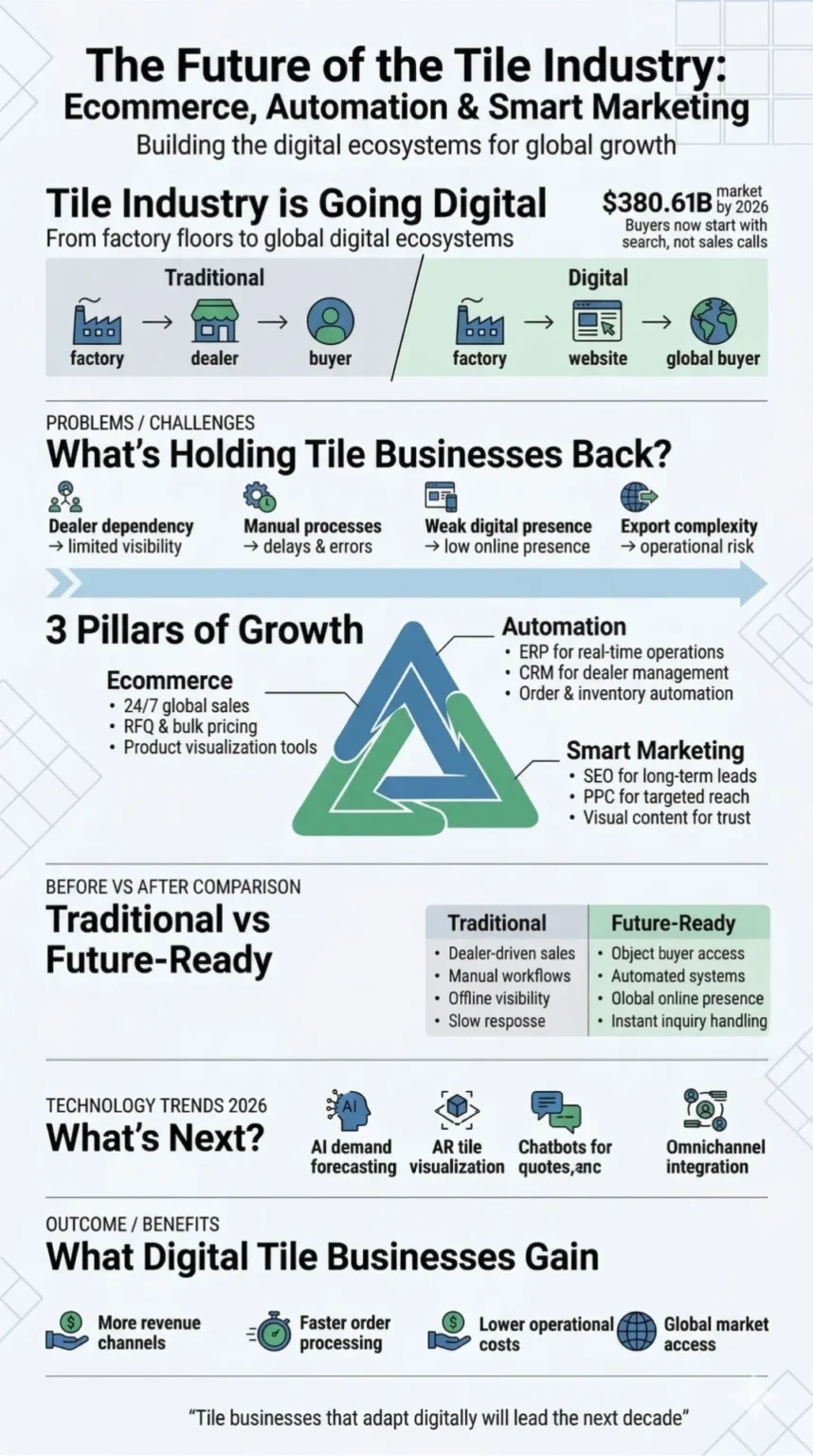
Global demand for ceramic and vitrified tiles isn’t slowing down. The market is projected to reach USD 380.61 billion by 2033. It’s driven by residential construction, commercial development, and steady export volumes. But supply has grown faster than demand in several segments. And that has made competition brutal.
Being a good manufacturer is no longer enough. Buyers now evaluate suppliers on how easy they are to find, how quickly they respond, and how clearly they present their products online. Price matters, but it stopped being the only thing that matters.
Three areas define what separates growing tile businesses from stagnant ones right now: ecommerce, automation, and smart marketing. These pillars are also central to effective digital transformation services. These tile industry trends 2026 are not independent projects. They work together, and this article breaks down exactly how.
The future of the tile industry: 2026 and beyond
The Real Challenges Holding Tile Businesses Back
Most tile manufacturers are not struggling because of their products. The quality is often there. The problem is structural.
Over-Reliance on Dealer Networks
Dealers and distributors built many tile businesses. But over-dependence on them creates a specific set of problems:
- Pricing flexibility disappears when every sale goes through an intermediary
- Market feedback is filtered, delayed, or lost entirely
- Brand equity with the end customer is minimal. So, customers remember the dealer, not the manufacturer
- One underperforming distributor in a key territory can quietly suppress an entire region’s revenue
Direct relationships with buyers are increasingly valuable. Dealer networks alone cannot build them.
Manual Processes at Every Stage
This is where a lot of time and money quietly disappear. Orders confirmed over WhatsApp. Stock levels maintained in spreadsheets. Dispatch updates communicated by phone. At any meaningful scale, manual processes produce:
- Inventory discrepancies that cause fulfilment errors
- Order delays from miscommunication between sales and warehouse teams
- Duplicate entries, missed follow-ups, and reconciliation headaches at month end
The cost is not just operational. Customers notice slow confirmations and inconsistent updates. It affects how they perceive the business.
Export Complexity Without the Right Systems
For tile exporters, every order carries additional layers:
- Currency conversion,
- Customs documentation,
- Port handling,
- Time zone gaps, and
- Multi-country compliance requirements
Managing all of this through informal systems is resource-heavy and fragile. One missed document or a miscommunication with a freight partner can delay a shipment by weeks.
Weak or Absent Digital Presence
Many tile manufacturers have a website. Few have one that does any real work for the business, especially without a solid tile ecommerce SEO strategy. The typical problems:
- No search visibility. Buyers searching for relevant terms simply do not find them
- Product pages with inadequate specifications, low-quality images, or missing technical data
- No way for an international buyer to make a serious inquiry outside of business hours
- Mobile experience that is either broken or barely functional
A buyer in the UAE searching for large-format tiles at 10 pm isn’t calling anyone. They want a catalog, specs, and a working inquiry form — right then. Most manufacturer websites and digital marketing strategies for tile exporters can’t deliver that. So the buyer moves on, usually straight to a competitor.
Rising Global Competition
Indian and Chinese manufacturers compete on price. European producers own the premium end. Mid-sized manufacturers sit uncomfortably in between and that’s where the pressure is hardest.
The problem isn’t just competition. Buyers today research online before they ever reach out. Without strong digital visibility and a clear value proposition, mid-sized players simply don’t show up where it counts.
Tile Ecommerce Solutions: Selling Tiles Like a Modern Business
Why Is an Online Channel Not Optional Anymore?
An ecommerce platform does not replace a sales team. It extends one when built with the right ecommerce development services. A well-built B2B portal means a buyer in Texas can browse a full catalog, check bulk pricing, and submit an RFQ on a Sunday afternoon, without anyone at the office being available.
That is market access without proportional headcount. For exporters, it is often the most cost-effective lead generation channel available.
B2B and B2C Ecommerce for Tile Manufacturers Are Different Problems
Wholesale buyers need account-based ordering, bulk pricing tiers, credit term visibility, and proper technical documentation. They are not browsing impulsively. The purchase cycle is longer and more deliberate.
Retail consumers behave differently. They respond to room visualization tools, curated photography, project calculators, and a clean checkout experience. Both can be served from the same platform. But they need distinct experiences.
Forcing retail buyers through a B2B workflow, or B2B buyers through a consumer checkout, damages conversions on both sides.
What a Tile Ecommerce Website Actually Needs?
Generic ecommerce templates fall short for tiles. The product catalog alone requires careful architecture. Buyers filter by size, finish, material, application area, and technical spec. If that filtering is clunky or incomplete, they leave.
Beyond filtering, tile ecommerce solutions need:
- High-resolution imagery with surface texture detail
- 3D room visualization so buyers can preview tiles in context
- Bulk pricing tiers and quantity-based discount structures for B2B buyers
- Multi-currency and multi-language support for international markets
- An RFQ system for custom project requirements
- Sample request functionality with integrated logistics
- Real-time inventory sync with ERP systems
What Selling Online Actually Delivers?
The practical benefits of ecommerce for tile manufacturers are measurable. Wider reach without equivalent cost increases. Lead generation with buyer data captured at the point of inquiry. Product performance analytics that show which SKUs attract attention and which do not. Reduced dependency on intermediaries improves margins over time.
Automation in Tile Manufacturing: How To Modernize Tile Manufacturing Business
ERP Is the Backbone
Without an ERP system, growth creates chaos, especially without the right tile industry digital solutions. Production teams do not know what raw materials are available. Warehouse managers are working from yesterday’s numbers. Finance waits on manual reports to understand where margins actually stand.
ERP integration fixes this. Inventory, production, procurement, and financial data live in one system, updated in real time. For manufacturers managing large SKU catalogs across multiple facilities, this is not a nice-to-have. It is foundational.
CRM Transforms Dealer Management
A distributor relationship managed entirely in someone’s head is a liability. When that salesperson leaves, the knowledge walks out with them.
CRM systems give businesses a structured record of every commercial relationship: quotation history, order patterns, credit terms, communication logs, and follow-up schedules. Scaling a dealer network across multiple regions without CRM is genuinely difficult. With it, it becomes manageable.
Order and Inventory Automation
Automation in tile manufacturing handles the routine without human intervention. Low stock triggers reorder processes before shortages hit. Order confirmations go out automatically. Customers get status updates without someone having to remember to send them.
The cumulative effect on operational cost and error rates is significant. Less firefighting. Faster processing. Fewer customers chasing missing orders.
Supply Chain Visibility
For exporters, supply chain blind spots are expensive. A delayed shipment that could have been caught early becomes a missed delivery window and a damaged client relationship. Vendor tracking, logistics integration, and automated alerts let procurement teams act on problems before they escalate.
Data That Actually Informs Decisions
Real-time dashboards change how businesses operate. Sales performance, inventory levels, production output available now, not at month end. Teams that previously waited for weekly reports are making decisions the same day they spot an issue.
Smart Marketing For Tile Brands: Being Found By The Right Buyers
SEO Is the Lowest-Cost Long-Term Investment
When a contractor in the US searches “vitrified tile manufacturer India” or a developer in the UAE searches “large format porcelain tiles bulk supplier,” the businesses at the top of results capture the majority of that traffic. The ones on page three get almost nothing.
Effective SEO services for tile businesses involve:
- technical website optimization,
- product page content built around how buyers actually search, and
- consistent content that answers the buyer questions.
SEO in digital marketing for tile industry compounds over time. Paid advertising stops the moment the budget does. SEO does not.
PPC for Targeted Lead Generation
Pay-per-click campaigns on Google and paid social on LinkedIn let tile businesses reach specific buyer profiles in specific geographies. Architects in Scandinavia. Contractors working on commercial builds in the Gulf. Interior designers in the UK are looking for premium stone-effect tiles.
Every click, inquiry, and conversion is trackable. The budget concentrates on what works. For exporters testing new markets, targeted PPC is far cheaper than attending a trade show and hoping the right people walk by.
Visual Marketing Is a Natural Fit
Tiles are a visual product. Instagram and Pinterest are built for visual products. This alignment is obvious, but many tile brands still do not use it well.
A photo of an installed project says more than any spec sheet. Manufacturing content builds credibility. Done consistently, a curated feed becomes a portfolio that architects and designers actually refer to when shortlisting suppliers.
Content Marketing Builds Trust Over Time
Case studies, project showcases, and technical guides attract buyers at the research stage and are a key part of content marketing strategies. before they have committed to any supplier. A well-documented commercial flooring project with high-resolution images and client feedback does more for a premium brand position than a product brochure ever could.
This content also feeds SEO. It attracts links from design publications, trade directories, and architecture blogs. Both outcomes matter in digital marketing strategies for tile exporters.
Reaching International Buyers Directly
Trade shows are expensive and time-bound. Export agents take commission. digital marketing for tile industry runs continuously.
A structured international lead generation program combines export-relevant SEO, localized landing pages for key markets, LinkedIn outreach to procurement professionals, and presence on B2B trade platforms. The goal is qualified inquiries from buyers in the US, Europe, and the Middle East — not just volume.
Technology Tile Industry Trends 2026 Worth Paying Attention To
AI demand forecasting is moving from enterprise-only to accessible.
Manufacturers using AI-based forecasting report more accurate production planning and lower inventory carrying costs. The models improve as they accumulate more data.
AR visualization is already deployed by several major tile brands.
Buyers point a phone at their bathroom floor and see a tile laid out before ordering a sample. Adoption is accelerating on the retail side and beginning to move into the B2B specification market.
Chatbots for quotation handling address the time zone problem directly.
A buyer in Canada should not have to wait until business hours in India to get a basic spec answer or pricing range. A well-configured chatbot handles initial qualification, captures requirements, and routes serious inquiries to the right person.
Omnichannel integration is where the most forward-thinking businesses are heading.
Direct website, B2B portal, dealer network, trade platforms, and inside sales are all connected. A buyer who starts on a trade platform, requests a sample through the website, and places an order through a distributor should experience a coherent journey, not a fragmented one.
Starting The Transformation for the Future of The Tile Industry
The most common mistake is trying to do everything at once. A phased smart marketing for tile brands works better.
Start with an audit.
Where are the manual bottlenecks? Where are the leads being lost? What does the current digital presence look like from a buyer’s perspective? This baseline shapes every decision that follows.
Build the ecommerce platform for specific requirements.
Tile product catalogs have complexity that generic platforms do not handle well. The investment in proper architecture pays off at every stage after launch.
Integrate ERP and CRM in parallel.
The value of ecommerce multiplies when it connects to operational systems. Orders flowing into ERP automatically. Customer data flowing into CRM without manual entry. This is where efficiency gains compound.
Then run the marketing.
SEO from day one — it takes time to build. Paid campaigns when the platform is ready to convert traffic. Content consistently, not in bursts.
Measure what matters.
Lead volume, conversion rates, average order value, order processing time, customer acquisition cost. Review monthly, adjust quarterly.
What Digital Businesses Actually Gain?
Companies that complete structured digital transformation consistently report the same outcome. Here are the benefits of ecommerce for tile industry:
- New revenue channels that run independently of the dealer network
- Lower-order processing costs through automation
- Faster fulfilment and fewer errors
- Better customer experience because information flows without friction
- Access to markets previously unreachable without agents or physical presence
None of this requires a complete overhaul overnight. Digital growth for tile exporters, distributors and manufacturers requires a clear plan and consistent execution.
Ready to Grow Your Tile Business Online?
From ecommerce development to SEO and automation, we help tile manufacturers build scalable digital systems that drive real growth and global reach.
Conclusion
The tile businesses that lead in five years won’t necessarily be the ones with the biggest factories. They’ll be the ones that show up when buyers search, sell efficiently online, and run clean operations behind the scenes.
Ecommerce, automation, and digital marketing don’t work well in isolation. A strong platform with weak operations breaks down at fulfillment. Solid operations with no marketing sit idle. And marketing without a functional platform wastes every lead it brings in.
Scaling a tile business sustainably takes more than production capacity and product quality. It takes the ability to reach the right buyers, serve them well, and build systems that hold up as volume grows.
Frequently Asked Questions
What is the future of the tile industry?
The industry is moving toward digital sales, automated operations, and data-driven decision-making. Manufacturers and exporters that invest in ecommerce platforms, operational systems, and digital marketing will have a structural advantage over those still relying on offline processes.
How can tile manufacturers sell online?
By building B2B or B2C ecommerce platforms designed for tile-specific requirements:
- advanced product filtering,
- technical specs,
- RFQ systems,
- bulk pricing tiers, and
- ERP integration.
Generic ecommerce solutions rarely meet the complexity of tile product catalogs.
Is ecommerce suitable for tile exporters?
It is one of the most effective tools available to exporters. A well-optimized platform generates qualified leads from international buyers around the clock, without the cost of trade shows or agent commissions. Multi-currency and multi-language support are non-negotiable for export-focused sites.
How automation improves tile business operations?
It eliminates manual processes that create errors, slow operations, and limit scale. ERP integration connects production, inventory, and finance. CRM structures commercial relationships. Order automation reduces processing time and human error. Together, they lower costs and improve reliability.
What digital marketing strategies work best for tile companies?
SEO for long-term organic visibility, PPC for targeted lead generation, social media for visual brand building, and content marketing for authority. For exporters, international campaigns and online lead generation for tile companies targeting buyers in the US, Europe, and the Middle East are particularly worth the investment.
Can ERP integration for tile manufacturers improve tile business operations?
Significantly. ERP integration for tile manufacturers consolidates data across inventory, production, warehouse, and finance into one real-time system. For manufacturers managing complex SKU catalogs and multiple facilities, it eliminates the information delays that cause stock errors, production overruns, and delayed fulfillment.
What technology trends are impacting the tile industry?
AI demand forecasting, AR visualization tools, chatbots for quotation handling, and omnichannel sales integration are the most relevant right now. These are no longer experimental — several tile manufacturers have already deployed them with measurable results.
How can small tile businesses compete online?
By being specific. A small manufacturer that dominates search results for a particular tile type, finish, or export market will outperform a larger competitor trying to be everything to everyone. Focused SEO, targeted PPC, consistent visual marketing on the right platforms and online lead generation for tile companies can generate real commercial traction without enterprise-level budgets.