- What Is Shopify?
- Core features
- Shopify Enterprise Pricing Comparison (2026)
- Basic
- Grow (mid-tier)
- Advanced
- Shopify Plus (Enterprise)
- Where standard Shopify isn’t enough?
- What Is Shopify Plus?
- Shopify Plus Features: What Shopify Plus actually add?
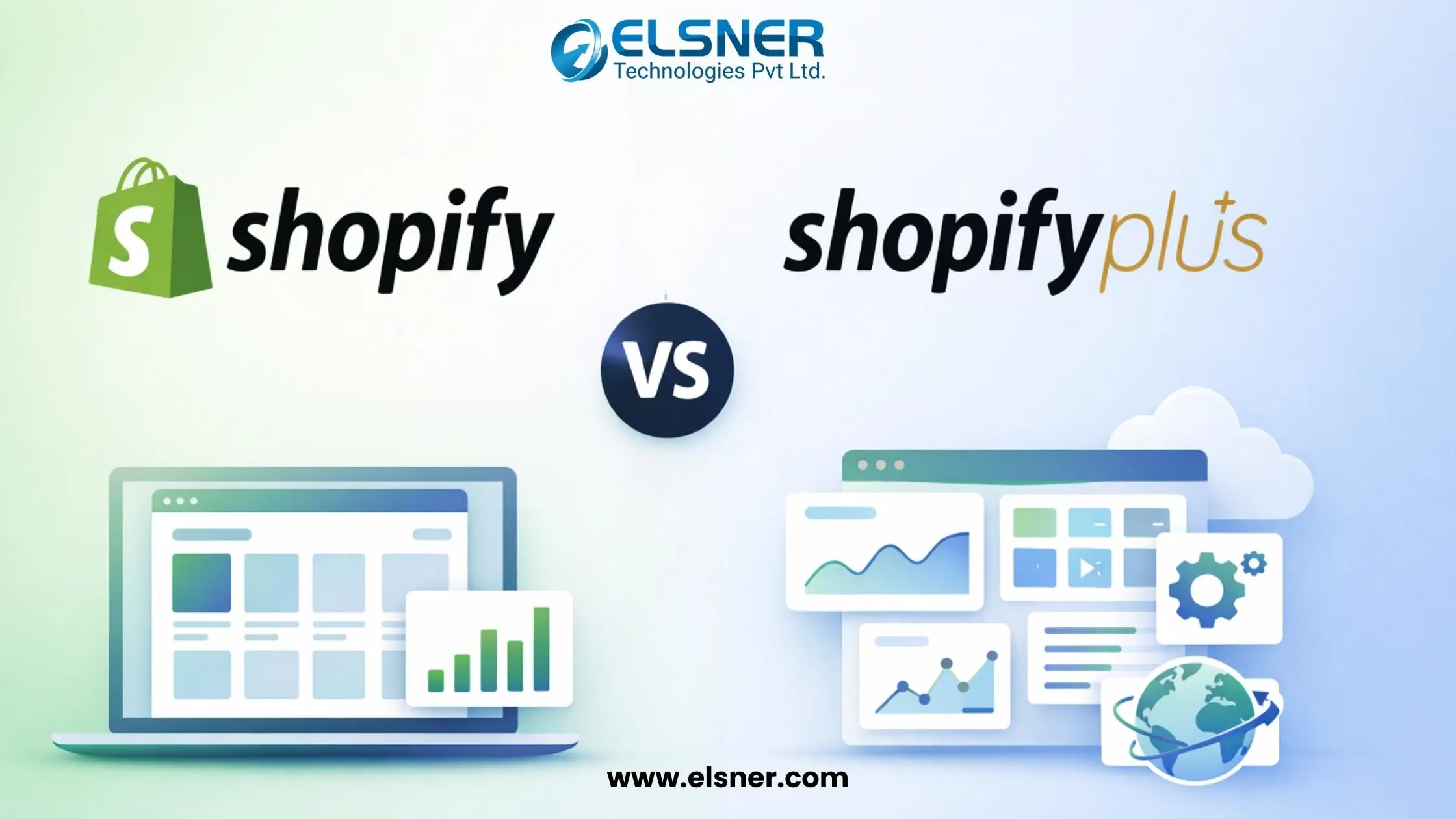
- Shopify vs Shopify Plus Comparison: Key Differences
- Shopify Plus Cost 2026: Does Shopify Plus Pay for Itself?
- When the upgrade makes financial sense
- Shopify Vs. Shopify Plus Performance and Scalability
- Flash sales and product drops
- API limits at scale
- Headless builds
- Checkout Control: Where the Real Gap Is
- When to Upgrade to Shopify Plus?
- Who Should Stay on Standard Shopify?
- Pros and Cons: Understanding Shopify vs Shopify Plus For Growing Brands
- Shopify (Standard)
- Shopify Plus
- Need Help Choosing Between Shopify and Shopify Plus?
- Final Verdict
- Frequently Asked Questions
- What is the main difference between Shopify and Shopify Plus?
- How much does Shopify Plus cost in 2026?
- Is Shopify Plus only for enterprise businesses?
- At what revenue should you upgrade to Shopify Plus?
- Does Shopify Plus reduce transaction fees?
- Shopify vs. Shopify Plus for high-traffic stores: Which is the right choice?
- Is Shopify Plus worth it for B2B?
- Can you migrate from Shopify to Shopify Plus easily?
Shopify powers roughly 30% of all US eCommerce businesses. Over 4.8 million merchants globally run their stores on it. In 2025, its merchants collectively processed more than $378 billion in GMV. That’s a 29.5% jump from the year before.
That kind of scale creates a genuine problem for growing brands. The platform is built wide enough to fit everyone. But “built for everyone” has a ceiling. And if you’re scaling fast, you’ll find it.
The conversation usually starts the same way. Sales are up. The team is bigger. Someone wants a custom checkout flow, or you’re running a product drop, and the manual coordination is exhausting. You Google “Shopify vs Shopify Plus”. And immediately, you find vendor content telling you it’s worth every penny.
It isn’t always. But sometimes the math is obvious.
Over 47,000 live websites now run on Shopify Plus, up from around 25,000 in 2022. That growth isn’t just big brands chasing enterprise features. A lot of it is mid-market stores that hit genuine operational limits on standard Shopify and needed more room.
This guide breaks down exactly what those limits are, where Shopify Plus for enterprise earns its cost, and where it doesn’t. Global ecommerce is forecast to hit $6.88 trillion in 2026. The wrong platform costs you conversion rate, developer hours, and the campaigns you couldn’t run cleanly.
So: Shopify or Shopify Plus? The answer depends entirely on where your business is right now and where you’re planning to be. This blog is for growing eCommerce brands, DTC businesses, and enterprise store owners evaluating whether upgrading from Shopify to Shopify Plus is the right strategic move in 2026.
What Is Shopify?
Shopify is a hosted eCommerce platform. It handles infrastructure hosting, security, payments, and storefront rendering, which is why many brands work with a shopify development company when building scalable online stores.
Core features
- Online store builder with theme library
- Shopify Payments plus 100+ third-party gateways
- Basic automation via Shopify Flow
- 8,000+ app integrations
- Built-in inventory, orders, and analytics
Shopify Enterprise Pricing Comparison (2026)
Basic |
Grow (mid-tier) |
Advanced |
Shopify Plus (Enterprise) |
|
|
Monthly price |
$39/month | $105/month | $399/month |
From $2,300/month |
|
Annual price |
~$29/month | ~$79/month | ~$299/month |
From $2,300/month (3-yr term) |
|
Staff accounts |
2 | 5 | 15 |
Unlimited |
|
Online credit card rate |
2.9% + 30¢ | 2.6% + 30¢ | 2.4% + 30¢ |
Negotiated per account |
|
In-person card rate |
2.6% + 10¢ | 2.5% + 10¢ | 2.4% + 10¢ |
Negotiated per account |
|
3rd-party transaction fee |
2% | 1% | 0.6% |
0.2% |
|
Shipping discount |
Up to 77% | Up to 88% | Up to 88% |
Up to 88% |
Where standard Shopify isn’t enough?
The checkout is mostly locked. You can change colors and swap fonts. That’s about it. Once you need custom payment logic, conditional discount rules, or branded checkout steps, standard Shopify can’t deliver them. API rate limits also become a real bottleneck when ERP integrations or high-volume order syncing are involved.
For stores doing under $1M/year, none of this matters much. Above that, the gaps start showing.
What Is Shopify Plus?
Shopify Plus is the enterprise tier. Same infrastructure, very different feature set. It’s built for stores that have outgrown the guardrails of standard Shopify.
Shopify Plus Features: What Shopify Plus actually add?
Checkout extensibility is the biggest unlock.
Checkout UI Extensions add custom components that render natively in the checkout flow. Many brands hire Shopify developer resources to build these custom checkout components and implement advanced logic.
Shopify Functions let you rewrite backend logic: custom discount calculations, shipping rate rules, and payment method filtering by customer tag or cart value.
Shopify Flow and Launchpad.
Flow is available on standard plans in a limited form. Plus unlocks the full version. Launchpad handles scheduled events such as product drops, flash sales, and promotional campaigns.
It helps you automate inventory publishing, discount activation, and pricing changes at a specific time.
B2B tools.
Shopify Plus for enterprises includes a native wholesale portal with company accounts, custom price lists, net payment terms, and draft order workflows. Standard Shopify has none of this natively.
Higher API limits.
Standard plans cap REST API calls at 40 requests/second. Plus doubles it to 80, with higher GraphQL quotas as well.
Dedicated support.
A Merchant Success Manager replaces the general support queue. Different tier of access entirely.
Unlimited staff accounts.
Standard plans cap out at 15. But with Shopify Plus, you can have unlimited staff accounts. Thishelps with better and more organized store management.
Shopify vs Shopify Plus Comparison: Key Differences
|
Feature |
Shopify Advanced |
Shopify Plus features |
|
Starting Price |
~$399/month |
~$2,300/month |
|
Transaction Fee |
0.5% |
0.15% |
|
Checkout Customization |
Theme-level only |
Full via Extensions + Functions |
|
Automation |
Basic Flow |
Full Flow + Launchpad |
|
REST API Limit |
40 req/sec |
80 req/sec |
|
Staff Accounts |
Up to 15 |
Unlimited |
|
Support |
Email/chat |
Dedicated Success Manager |
|
B2B Features |
None natively |
Full portal, net terms, price lists |
|
Headless Commerce |
Supported |
Better API support |
Shopify Plus Cost 2026: Does Shopify Plus Pay for Itself?
Shopify Plus pricing starts at $2,300/month for stores under $800K/month in revenue. Above that, it switches to 0.25% of monthly revenue.
The transaction fee comparison is where the math shifts. A store doing $2M/month through a third-party processor pays 0.5% on Advanced — that’s $10,000/month in fees. On Plus, it drops to 0.15%, or $3,000/month. The $7,000 difference covers the Shopify Plus pricing.
When the upgrade makes financial sense
- You’re processing $1.5M–$3M+ per year through a non-Shopify Payments gateway.
- You’re paying for multiple apps that replicate features. Plus includes natively.
- Developer time spent working around checkout limitations is ongoing and expensive.
The upgrade rarely makes sense below $1M/year unless specific operational needs are driving the decision.
Shopify Vs. Shopify Plus Performance and Scalability
Both tiers run on Shopify’s shared infrastructure. Raw uptime and storefront speed are roughly the same. The difference is operational capacity.
Flash sales and product drops
Without Launchpad, coordinating a major sale means manual work: updating prices, activating discount codes, and publishing products at the right time. Launchpad schedules all of it. One setup, automated execution.
API limits at scale
Standard Shopify’s 40 req/sec REST cap is fine for most stores. It becomes a problem during traffic spikes when ERPs, custom apps, and analytics tools all need data at once. Plus’s 80 req/sec limit and higher GraphQL quotas prevent that bottleneck.
Headless builds
Both plans support headless via the Storefront API. Plus handles it better in practice — higher API limits matter here, and the Merchant Success Manager speeds up troubleshooting when something in a decoupled frontend stack breaks.
Checkout Control: Where the Real Gap Is
Apart from the Shopify Plus cost 2026, this is the clearest dividing line between standard Shopify and Plus.
On standard Shopify, the checkout is Shopify’s checkout. You can apply branding. That’s the limit.
On Shopify Plus:
- Checkout UI Extensions add custom components that render natively in the checkout flow
- Shopify Functions modify the backend: discount logic, shipping rules, payment method visibility
- Subscription brands can capture product preferences at checkout
- B2B brands can show net terms only to approved wholesale accounts
- Loyalty integrations can display and redeem points without redirecting users
None of this is possible with apps on standard Shopify. The checkout is the highest-leverage page in any store. Losing control of it has measurable consequences.
When to Upgrade to Shopify Plus?
Many brands first try improving conversion rates, automation, and marketing performance through proven Shopify growth strategies before deciding whether upgrading to Shopify Plus is necessary.
Upgrade when:
- You’re running frequent drops or sales and managing them manually
- Checkout conversion is suffering, and app-based solutions have been exhausted
- API limits are causing sync failures or data delays with your ERP
- International expansion requires more control over pricing and storefronts
- A B2B channel is in play and needs more than workarounds
- The staff account cap is slowing down team growth
Most brands hit these friction points somewhere between $1.5M and $3M in annual revenue. Some hit them earlier due to operational complexity.
Who Should Stay on Standard Shopify?
Not every growing brand needs Plus. Standard Shopify handles the majority of eCommerce operations well, and the app ecosystem covers most gaps, which is why many founders still evaluate whether Shopify is worth it for growing businesses before deciding if they actually need enterprise features.
Stay on standard Shopify if:
- Annual revenue is under $1M
- Operations are straightforward — no complex automation, no wholesale channel.
- Flash sales and product drops aren’t part of the strategy
- The team is small, so staff account limits aren’t an issue
- Third-party apps are handling checkout needs without hitting hard walls
The savings are real. $2,300/month is $27,600/year. That money builds a lot of margin for a store that isn’t yet constrained by what standard Shopify can do.
Pros and Cons: Understanding Shopify vs Shopify Plus For Growing Brands
Shopify (Standard)
Pros
- Low entry cost, accessible at any stage
- Large app ecosystem
- Reliable infrastructure
- No developer required to manage day-to-day
Cons
- Checkout customization is almost entirely locked
- API limits create problems at scale
- Transaction fees add up on third-party gateways
- No native B2B or wholesale tools
Shopify Plus
Pros
- Full checkout control
- Launchpad makes complex events manageable
- Reduced transaction fees offset cost at higher volumes
- Dedicated support with faster resolution
- Native B2B portal included
Cons
- $2,300/month minimum — expensive if you’re not at scale
- Revenue-based pricing above $800K/month grows fast
- Some features need developer resources to set up properly
Need Help Choosing Between Shopify and Shopify Plus?
If you’re planning to build a Shopify store or considering upgrading to Shopify Plus, our Shopify experts can help you choose the right setup and implement it smoothly.
Final Verdict
Standard Shopify works well until it doesn’t. For most brands under $1M/year, it’s the right call.
Shopify Plus earns its cost when the limitations of standard Shopify are creating real friction. Many growing brands evaluate their platform options with the help of an experienced Ecommerce Development Company before deciding whether Shopify or Shopify Plus is the better long-term fit. For example, checkout constraints that hurt conversion, API bottlenecks slowing integrations, and manual processes that could be automated.
The Shopify Plus minimum revenue requirement is $2M+ annually. The transaction fee savings alone often cover the platform cost.
So, Shopify vs Shopify Plus for growing brands? The decision comes down to one question: Is standard Shopify currently blocking something your business needs to do? If the answer is yes, the upgrade math usually works. If the answer is no, there’s no reason to rush it.
Frequently Asked Questions
What is the main difference between Shopify and Shopify Plus?
Checkout control is the biggest functional difference. Plus unlocks Checkout UI Extensions and Shopify Functions, which let you customize the checkout experience in ways standard plans don’t allow. Beyond that: full automation tools, higher API limits, dedicated support, and native B2B capabilities are the benefits of Shopify Plus for scaling.
How much does Shopify Plus cost in 2026?
It starts at $2,300/month for stores doing under $800K in monthly revenue. Above that threshold, pricing moves to 0.25% of monthly revenue.
Is Shopify Plus only for enterprise businesses?
No. Many mid-market brands with $2–10M in annual revenue use Plus. The relevant factor is whether standard Shopify’s constraints are creating actual problems.
At what revenue should you upgrade to Shopify Plus?
Most brands find the economics work at $1.5M–$3M/year, where Shopify Plus transaction fees savings start offsetting the platform cost. Some brands upgrade earlier based on specific needs like B2B channels, frequent product drops, or complex integrations.
Does Shopify Plus reduce transaction fees?
Yes. If you’re not on Shopify Payments, Advanced charges 0.5% per transaction. Plus drops it to 0.15%. For a store processing $2M/month through a third-party gateway, that’s roughly $7,000/month in savings.
Shopify vs. Shopify Plus for high-traffic stores: Which is the right choice?
Both tiers use the same hosting infrastructure. The issue isn’t storefront delivery; it’s API limits. Standard Shopify caps REST calls at 40/second. For stores with complex integrations during peak traffic, that ceiling causes real sync problems.
Is Shopify Plus worth it for B2B?
If you’ve a wholesale channel, then yes!. The native B2B portal handles company accounts, custom pricing, net payment terms, and draft orders. Replicating that on standard Shopify typically requires multiple apps. And that still doesn’t cover everything.
Can you migrate from Shopify to Shopify Plus easily?
Yes, because it’s not migrating to another platform. You’re just upgrading. Your store, products, customers, and theme carry over. The work is in configuring Plus-specific features. You need to configure checkout Extensions. After that, you need to work on Flow automations and B2B setup. Most brands complete the transition in two to four weeks.