




- The Problem Elsner Is Solving
- What the Enterprise AI Strategy Consulting Practice Covers
- AI Roadmaps Anchored in Business Operations
- Production-Grade Engineering From Day One
- Unified Data Platforms for Executive Visibility
- Structured Rollout Frameworks That Scale
- Is Your AI Program Ready to Scale?
- What Enterprises Gain: Measurable Outcomes
- Industry Deployments: How Elsner Delivers in Practice
- Stabilizing Subscription Revenue Forecasting
- Consolidating Fragmented Operational Data
- Governing Machine Learning Across Production Lines
- A Word From Elsner’s Leadership
- About This Launch
- Ready to Build an AI Program That Actually Scales?
- About Elsner
- FAQs
Most enterprises today are not short on AI ambition. They are short on execution. Innovation teams launch pilot projects. Business units experiment with automation. Analytics dashboards get introduced across departments. But few of these initiatives ever connect to the systems, metrics, and governance structures that actually run the business.
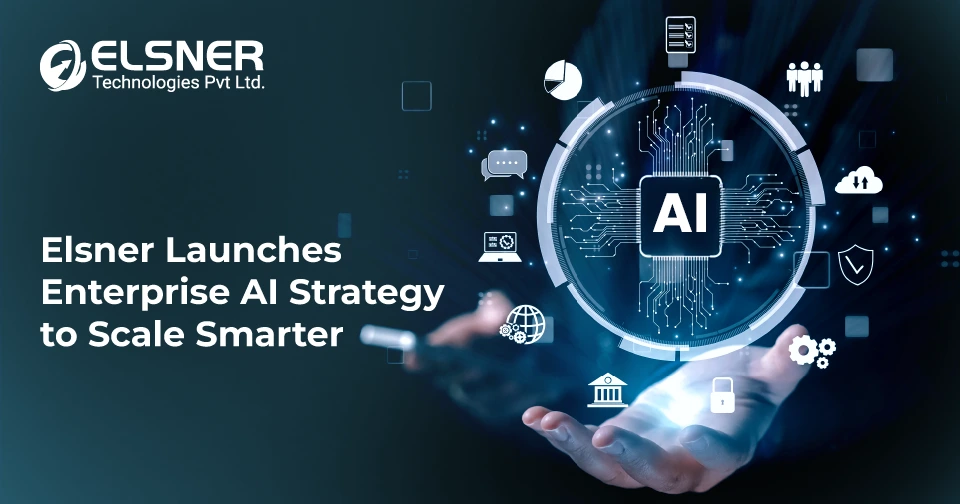
That gap is exactly what Elsner’s new Enterprise AI Strategy Consulting practice is built to close. Instead of treating AI as a standalone experiment, Elsner helps enterprise technology leaders connect every AI initiative to production infrastructure, business performance metrics, and long-term data governance, from the very beginning.
This announcement is intended for enterprise CTOs, CDOs, and technology leaders who are responsible for scaling AI programs inside large, complex organizations. If you are managing a multi-system architecture, a regulated environment, or a large data ecosystem, read on.
The Problem Elsner Is Solving
Across mid-to-large enterprises, AI investment has accelerated significantly over the past three years. Yet a large share of those investments have not delivered measurable returns. The reason is almost always the same.
Pilot models sit outside ERP and CRM platforms. Reporting structures do not align with executive KPIs. Governance oversight remains undefined or inconsistent. The result is stalled AI adoption, fragmented data pipelines, limited ROI transparency, and growing technical debt.
Boards now expect visibility. Regulators expect control. And enterprise leaders are under mounting pressure to justify AI spending with real performance outcomes. Elsner’s Enterprise AI Consulting practice addresses this directly, through structured planning, disciplined engineering, and accountable deployment.
What the Enterprise AI Strategy Consulting Practice Covers
The new practice expands Elsner’s existing AI Strategy Consulting Services into a formal enterprise model. Every engagement begins with a structured assessment of business workflows, system dependencies, data maturity, and compliance obligations.
From that foundation, Elsner delivers a phased enterprise roadmap covering technology priorities, ownership structures, model oversight mechanisms, and defined success criteria. The goal is to ensure AI programs are treated as enterprise systems, not experimental side projects.
AI Roadmaps Anchored in Business Operations
Engagement teams identify where AI can directly influence revenue, cost, or risk metrics. They assess how existing data architecture supports or restricts expansion. They define what governance controls must be in place before any scaling begins. The output is a roadmap built around operations, not technology for its own sake.
Production-Grade Engineering From Day One
Elsner integrates AI and ML development, Enterprise Ecommerce Development, SaaS Development, and Data Engineering and MLOps into a unified execution model. Model pipelines are built with version control and validation checkpoints. Deployment workflows integrate with existing CI/CD systems. Logging, audit trails, and performance tracking are embedded from the start, not added later.
Unified Data Platforms for Executive Visibility
AI programs require stable, unified data environments. Elsner modernizes enterprise data platforms to eliminate fragmentation across departments. Through Business Intelligence transformation and Predictive Analytics, organizations gain structured forecasting across demand planning, operational performance, supply chain, and financial modelling. Executive dashboards are connected to operational systems, not disconnected reporting tools.
Structured Rollout Frameworks That Scale
Many enterprises win early with AI pilots but struggle when scaling to the full organization. Elsner addresses this through structured MVP Development followed by disciplined Product Development cycles. Initial deployments are measured against defined benchmarks. Broader rollout occurs in staged phases, supported by performance monitoring and governance review, so the transition from pilot to production is stable, not chaotic.
Is Your AI Program Ready to Scale?
Connect your AI investments to real business outcomes. Elsner’s Enterprise AI Strategy Consulting practice helps technology leaders build governed, production-ready AI programs, without the architectural chaos.
Talk to our team and get a structured roadmap built around your enterprise systems.
What Enterprises Gain: Measurable Outcomes
Industry Deployments: How Elsner Delivers in Practice
Elsner supports enterprise organizations across SaaS, retail, manufacturing, healthcare technology, logistics, and industrial sectors. Below are three representative deployment scenarios that reflect the scope and outcomes of this practice.
SaaS Platform
Stabilizing Subscription Revenue Forecasting
A mid-market SaaS company with over 40,000 active subscriptions was relying on static dashboards and spreadsheet models to forecast renewals. Their data science team had built a churn prediction model, but it operated outside the billing system and was updated manually every two weeks.
Elsner redesigned the pipeline so product usage signals, customer support activity, and billing behaviour were ingested automatically into a governed data environment. A monitored MLOps framework was introduced with automated weekly model retraining, version control, performance tracking, and executive dashboards tied directly to revenue forecasts.
The result was a production-ready predictive analytics system embedded inside the subscription lifecycle. Forecast accuracy improved, leadership gained weekly visibility into churn risk, and renewal strategy shifted from reactive to proactive.
Retail Enterprise
Consolidating Fragmented Operational Data
A national retailer operating across 120 physical stores and an eCommerce platform was experiencing reporting delays of up to 10 days. Sales, inventory, and supply chain data were stored in separate systems managed by different teams. Executives lacked a single operational view.
Elsner redesigned the enterprise data architecture by integrating POS systems, warehouse management platforms, and online transaction data into a unified data warehouse, with structured ETL pipelines, centralized semantic data modelling, and standardized Business Intelligence dashboards at store, regional, and executive levels.
Within months, reporting cycles reduced from days to near real-time. Inventory planning became data-backed. Regional performance comparisons were standardized across all business units.
Manufacturing Enterprise
Governing Machine Learning Across Production Lines
A manufacturing organization operating multiple automated production lines had deployed anomaly detection models to monitor equipment performance. However, models were maintained separately by plant engineers without central oversight. When performance drift occurred, detection rates dropped without notice.
Elsner introduced a centralized model registry with defined ownership, automated sensor data ingestion pipelines with quality validation, real-time alert systems integrated into plant control dashboards, and model performance monitoring with defined retraining triggers.
The organization gained structured visibility into equipment risk across all facilities. Downtime prediction accuracy stabilized, and unplanned stoppages were significantly reduced.
A Word From Elsner’s Leadership
“Enterprise AI must operate within structured systems, not outside them. Technology leaders are looking for programs that align directly with operational metrics and regulatory standards. Our role is to create architectural clarity and execution discipline so AI delivers sustained business value.” Senior Executive, Elsner
About This Launch
The Enterprise AI Strategy Consulting practice represents a strategic expansion of Elsner’s advisory and execution capabilities at the enterprise level. The firm continues to support digital leaders through disciplined AI programs and SaaS Development Services aligned to operational metrics, data governance standards, and scalable architecture.
Ready to Build an AI Program That Actually Scales?
Elsner’s Enterprise AI Strategy Consulting practice is built for technology leaders who need more than a pilot, they need a governed, production-ready program tied to real business outcomes. Let us help you get there.
About Elsner
Founded in 2006, Elsner delivers enterprise-focused Digital Transformation Services across AI Strategy Consulting, Business Intelligence, Product Development, SaaS Development, and custom software engineering. With delivery centres in India and the United States, Elsner supports mid-to-large enterprises through strategy-to-execution programs built for operational stability, governed data platforms, and long-term enterprise resilience.
FAQs
What is Enterprise AI Strategy Consulting?
Enterprise AI Strategy Consulting is a structured advisory and execution service that helps large organizations connect AI initiatives to production systems, business metrics, and governance frameworks. Rather than treating AI as a standalone experiment, it ensures every program is built as a governed enterprise system from the start.
How is Elsner’s enterprise AI practice different from standard AI consulting?
Most AI consulting stops at strategy. Elsner covers the full journey, from roadmap design and data platform modernization to production-grade engineering, MLOps, and post-deployment governance. Every engagement is grounded in operational metrics, not just technical deliverables.
Which industries does Elsner’s Enterprise AI practice support?
Elsner works with enterprise organizations across SaaS, retail, manufacturing, healthcare technology, logistics, and industrial sectors. The practice is particularly suited to regulated environments, multi-system architectures, and organizations managing large or fragmented data ecosystems.
What does an Elsner Enterprise AI engagement look like?
Every engagement begins with a structured assessment of your business workflows, data maturity, system dependencies, and compliance obligations. From there, Elsner delivers a phased roadmap with defined technology priorities, governance controls, and success criteria, followed by hands-on execution across data engineering, AI development, and deployment.
How does Elsner handle AI governance and compliance?
Governance is embedded from the start, not added after deployment. Elsner implements model registries, audit trails, version control, performance monitoring, and defined retraining triggers as standard parts of every AI program. This ensures organizations maintain control and transparency at every stage of the AI lifecycle.
How do I get started with Elsner’s Enterprise AI Strategy Consulting?
You can reach Elsner directly at sales@elsner.com or call +1 (607) 524-4040. The team will schedule an initial consultation to understand your current AI landscape, identify the biggest gaps, and outline a structured path forward for your organization.