





- Here’s What We’ll Cover:
- What is Data Engineering?
- Key Responsibilities of Data Engineering
- Common Tools and Technologies
- What is MLOps?
- Key Responsibilities of MLOps
- Common Tools and Technologies
- How Data Engineering and MLOps Work Together?
- Turn Your Data Pipelines into Production-Ready ML Systems
- Data Engineering Use Cases
- Building Scalable Data Pipelines
- Real-Time Data Processing
- Data Warehousing and Analytics
- MLOps Use Cases
- Automating ML Model Deployment
- Monitoring Model Performance
- Continuous Model Improvement
- When Do You Need Data Engineering vs MLOps (or Both)?
- Common Challenges and How to Overcome Them
- Data Quality Issues
- Model Drift and Performance Drop
- Integration Complexity
- Struggling with Data Engineering or MLOps Challenges?
- Best Practices for Implementing Data Engineering and MLOps
- When to Consider Professional Implementation Support?
- Conclusion
- FAQs
- What is the difference between Data Engineering and MLOps?
- Can a business operate without MLOps?
- Do you need Data Engineering before MLOps?
- What tools are used in Data Engineering and MLOps?
- When should a company invest in MLOps?
Data is everywhere now. But just having data doesn’t mean much for your business. And when you’re working with data you’ll come across data engineering vs MLOps.
Data engineering and MLOps are distinct disciplines. Different goals, different tooling, different failure modes. And yet in any mature machine learning system, they’re deeply dependent on each other. You can’t really have one working well without the other being at least somewhat functional.
This blog will help you understand MLOps vs data engineering difference.
Here’s What We’ll Cover:
- What is Data Engineering & MLOps architecture?
- Data Engineering vs MLOps: Key Differences
- How Data Engineering and MLOps Work Together
- Data Engineering & MLOps Use Cases
- When Do You Need Data Engineering vs MLOps (or Both)?
- Common Challenges and How to Overcome Them
- Best Practices for Implementing Data Engineering and MLOps
- When to Consider Professional Implementation Support?
What is Data Engineering?
If machine learning is the “brain,” data engineering is everything that keeps it fed.
At a basic level, data engineering is about getting data into a usable state. Raw data rarely shows up clean. It’s scattered, inconsistent, sometimes incomplete. Someone has to make sense of it before anything meaningful can happen.
This is where our Data Engineering & MLOps Services expertise comes into play.It’s not just pipelines, it’s how those pipelines are designed to scale, adapt, and not break every time data volume spikes.
Key Responsibilities of Data Engineering
Data Ingestion
Data doesn’t come from one place. It trickles in from apps, databases, APIs, third-party tools. Sometimes in real time, sometimes in batches. Pulling all of that together—reliably—is step one.
Data Transformation (ETL/ELT)
Raw data is messy. Formats don’t match. Fields are missing. Some of it is just noise. This stage cleans things up, reshapes it, and gets it ready for actual use.
Data Storage and Management
Once it’s cleaned, it needs a home. Not just storage, but storage that makes retrieval fast and analysis possible. That’s where warehouses and lakes come in.
Common Tools and Technologies
The common stack includes:
- Apache Spark handles heavy-duty data processing
- Apache Airflow for pipeline orchestration and scheduling
- Apache Kafka deals with real-time event streaming
- Snowflake for cloud-based warehousing
Most teams don’t use all of these simultaneously. The combination depends on data volume, latency requirements, and what the team already knows how to operate.
Put simply, if you’re thinking in terms of data pipeline vs ML pipeline, this is the data pipeline side. No models yet. Just making sure the data is worth using.
What is MLOps?
Now, once you do have good data, you can build models. That’s where things usually get exciting and also where things start to break if there’s no structure.
MLOps steps in after the model is built. It’s less about creating models and more about making sure they actually survive in production.
Because a model is sitting in a notebook? That’s not useful. It needs to be deployed, monitored, updated and trusted.
That’s essentially the role of MLOps. It keeps the entire ML lifecycle running without constant manual intervention.
Key Responsibilities of MLOps
Model Deployment
Turning a trained model into something usable: an API, a service, something that can return predictions when needed.
Model Monitoring and Retraining
Data changes. User behavior shifts. What worked last month might quietly degrade today. MLOps keeps an eye on performance and triggers retraining when necessary.
Version Control and Experimentation
Models evolve. You tweak parameters, try different datasets, test variations. Keeping track of all that without chaos is a big part of MLOps.
Common Tools and Technologies
- MLflow is widely used for experiment tracking and model registry.
- Kubeflow handles ML workflows on Kubernetes.
- TensorFlow Serving and Triton Inference Server manage high-throughput model serving.
Our AI/ML Development team helps configure AWS SageMaker, Google Vertex AI, and Azure ML for production use.They’re a natural starting point for teams that don’t want to manage infrastructure from scratch. Our Cloud/Data Architecture Services can help configure your cloud infrastructure.
Data Engineering vs MLOps: Key Differences
One way to frame the data engineering vs MLOps difference: data engineering builds the foundation. MLOps makes everything work. They serve different stages, different people, and produce different outputs. But neither gets far without the other.
The two disciplines overlap at the data layer, where training data, feature stores, and retraining pipelines intersect. That MLOps vs data engineering difference overlap is exactly where miscommunication between teams tends to create silent failures that take weeks to diagnose.
How Data Engineering and MLOps Work Together?
Production ML systems don’t run in phases. They run in loops. Continuous, overlapping, interdependent loops.
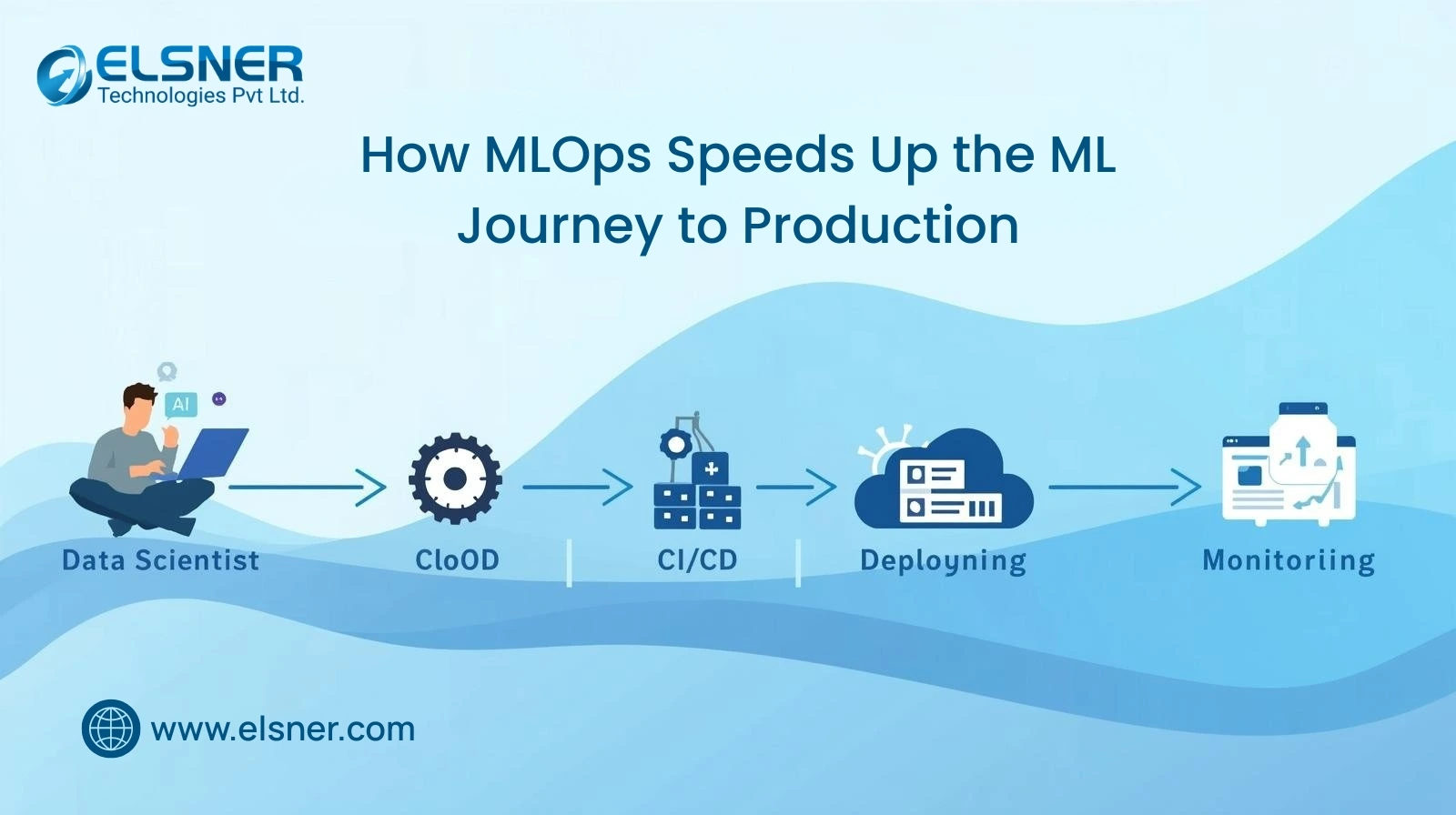
Data engineering architecture ingests and transforms raw data, then loads it into feature stores or training datasets. Data scientists train models on that data. MLOps handles deployment, watches performance in production, and when something degrades, feeds that signal back to trigger a new training cycle. Then it starts over.
Fraud detection makes this concrete. The data engineering side ingests transaction records from payment processors, normalizes inconsistent fields, runs validation checks, and loads everything into a feature store.
The MLOps layer deploys a classification model that scores transactions in near real time. When fraud patterns shift, and they always shift eventually, monitoring flags the accuracy drop and kicks off retraining.
Without the data pipeline, the model has nothing reliable to learn from. Without the MLOps layer, the model never makes it into the hands of the system that needs it.
Recommendation engines follow the same pattern. Behavior data flows through pipelines. A model trained on that behavior gets served via an MLOps layer. Patterns shift, the pipeline adapts, the model gets updated. The loop keeps running whether anyone is watching or not.
At Elsner we help you set up the perfect enterprise workflow with AI and machine learning. Know more about our AI/ML Development Services.
Turn Your Data Pipelines into Production-Ready ML Systems
Build a seamless loop between data engineering and MLOps. From reliable data pipelines to scalable model deployment, get the right architecture in place to keep your ML systems running, learning, and improving continuously.
Data Engineering Use Cases
Building Scalable Data Pipelines
This is the foundational use case. Any organization pulling data from multiple sources needs a system that handles all of it consistently. Data engineering architecture builds that system and keeps it running as volume grows and sources multiply.
Real-Time Data Processing
Not every use case can tolerate a nightly batch window. Streaming pipelines built on tools like Kafka let teams act on data as it arrives. In financial services, logistics, or any domain where delays have direct costs, that real-time capability isn’t optional.
Data Warehousing and Analytics
Clean data in a well-structured warehouse is what makes business intelligence actually useful. Someone has to build and maintain that structure. When it’s done well, analysts can answer questions quickly. When it’s not, every report becomes a negotiation over whose numbers are correct.
MLOps Use Cases
Automating ML Model Deployment
Every ML deployment involves the same set of tasks: containerization, versioning, testing, staged rollout. Without MLOps, each deployment is a slightly different process run by whoever happens to be available. With it, deployment becomes a repeatable workflow that doesn’t depend on institutional memory to function.
Monitoring Model Performance
Models don’t fail dramatically. They drift. Slowly, quietly, in ways that don’t trigger any alarms until a stakeholder notices the predictions look off. Automated monitoring with defined performance thresholds catches this early. It’s the difference between catching a problem in staging and explaining it in a client call.
Continuous Model Improvement
Quarterly retraining cycles were fine when ML was experimental. In production systems where the underlying data changes constantly, they’re not enough. MLOps pipelines can trigger retraining automatically based on drift detection or performance thresholds, keeping models current without anyone having to manually manage the schedule.
When Do You Need Data Engineering vs MLOps (or Both)?
Most teams overthink this. The honest answer is usually pretty clear once you know where the actual bottleneck is.
Unreliable or inconsistent data means data engineering needs work first. No amount of MLOps tooling compensates for a pipeline that produces bad training data. If the data is solid but models can’t make it into production reliably, that’s an MLOps architecture problem.
And if you’re building from the ground up, both need to be designed together, not treated as separate projects to be sequenced later.
The data pipeline vs ML pipeline distinction matters most when something breaks and you’re trying to figure out where to look first.
Common Challenges and How to Overcome Them
Data Quality Issues
Everyone knows the phrase “garbage in, garbage out.” Far fewer organizations actually build the validation checks that prevent it. Data quality problems are upstream problems, which means fixing them requires intervening at ingestion, not after the model has already learned from bad data for six months.
Schema enforcement, distribution monitoring, automated alerts when expected patterns break. None of it is interesting to build. All of it is expensive to skip.
Model Drift and Performance Drop
A model trained in January definitely needs an update in July. User behavior changes. Fraud patterns become more advanced. There may be a change in supply chains. The model’s accuracy drifts downward, because reality moved and the model didn’t. Catching this requires baselines, ongoing monitoring, and the discipline to act on what the metrics say.
Integration Complexity
Data engineering and MLOps tooling were built by different communities solving different problems. Getting them to communicate cleanly requires deliberate architecture choices. Feature stores need to serve both training pipelines and inference endpoints consistently. Retraining jobs need to trigger at the right time with the right data. Shared data contracts between teams, and restraint about tool proliferation, prevent most of the problems that show up here.
Struggling with Data Engineering or MLOps Challenges?
From unreliable data pipelines to production-ready ML systems, we help you fix what’s broken and build what scales. Get expert guidance to design, optimize, and deploy your data and ML infrastructure the right way.
Best Practices for Implementing Data Engineering and MLOps
- Design for scale before you need it. Retrofitting a pipeline that wasn’t built for scale is significantly more expensive than building it right the first time.
- Validation belongs at ingestion. If bad data enters the system, everything downstream inherits the problem. Catch it at the source.
- Automate what repeats. Manual processes are liabilities. Any task done by hand on a regular schedule is a future incident.
- Instrument production thoroughly. Pipelines, model accuracy, infrastructure health. If you can’t observe it, you can’t respond to it.
When to Consider Professional Implementation Support?
The organizations that struggle most with data engineering vs machine learning engineering aren’t usually short on intelligence or ambition. They’re short on bandwidth. They’re trying to build infrastructure, run existing systems, and ship new products simultaneously, with a team that has limits.
A few situations where external support changes the outcome:
- ML-ready team, but no production MLOps experience. The team knows ML but hasn’t operated MLOps architecture in production at scale before.
- Data volume outgrowing current pipelines. Data volume is growing faster than the current pipeline was designed to handle.
- ML delivery delays due to weak infrastructure. ML features keep slipping timelines not because the models are wrong, but because the infrastructure around them isn’t ready.
Elsner works with businesses at exactly these moments, whether that’s laying a proper data engineering foundation, getting trained models into production reliably, or designing the full AI Strategy & MLOps architecture for a system that hasn’t been built yet.
Conclusion
Data engineering vs MLOps don’t compete with each other. The data pipeline makes the model possible. The MLOps layer makes the model useful. Take either one out and what’s left is either infrastructure with nowhere to go, or a research artifact that never ships.
So the real question isn’t which one your team needs. It’s which one needs attention first. Shaky data? Start there. Models stuck in notebooks? That’s the MLOps gap. Starting from scratch? Plan both together from day one.
FAQs
What is the difference between Data Engineering and MLOps?
Data engineering builds the foundation. It is the process and profiles you use to prepare and manage data. MLOps helps you create machine learning models using that data and deploy them.
Can a business operate without MLOps?
Yes. But only up to a point. Without MLOps, it’ll become difficult for you to scale and maintain ML systems.
Do you need Data Engineering before MLOps?
In most cases, yes. You need clean and reliable data to make ML systems work. And data engineering helps you do that.
What tools are used in Data Engineering and MLOps?
Data engineering uses tools like Spark, Airflow, and Snowflake. MLOps relies on MLflow, Kubeflow, and TensorFlow Serving.
When should a company invest in MLOps?
Usually when ML moves beyond experimentation and starts impacting real users or business decisions.