- Why Is AI in SEO So Widely Used Today?
- Everyone Wants Faster Results
- Automation Reduces Mental Load
- Cost Looks Attractive at First
- What AI SEO Tools Can Do Well?
- Keyword Research and Content Ideas
- On Page SEO Automation
- Reporting and SEO Insights
- Where AI Falls Short in SEO?
- Lack of Business Context
- Strategy and Decision Making Gaps
- Search Intent and User Experience Limitations
- Get Expert SEO Strategy
- SEO Experts vs AI Tools: What Is the Real Difference?
- Can AI Replace SEO Experts Completely?
- When Businesses Should Combine AI With SEO Experts?
- Scaling Content Without Losing Quality
- Competing in Saturated Markets
- Planning for Sustainable Growth
- The Future of SEO: AI Assisted, Human Led
- Final Verdict
- FAQs
- Can AI replace SEO professionals?
- Should businesses rely on AI SEO tools?
- AI SEO tools vs human experts. What is the real difference?
- What are the limitations of AI in SEO?
- Is AI enough for SEO success?
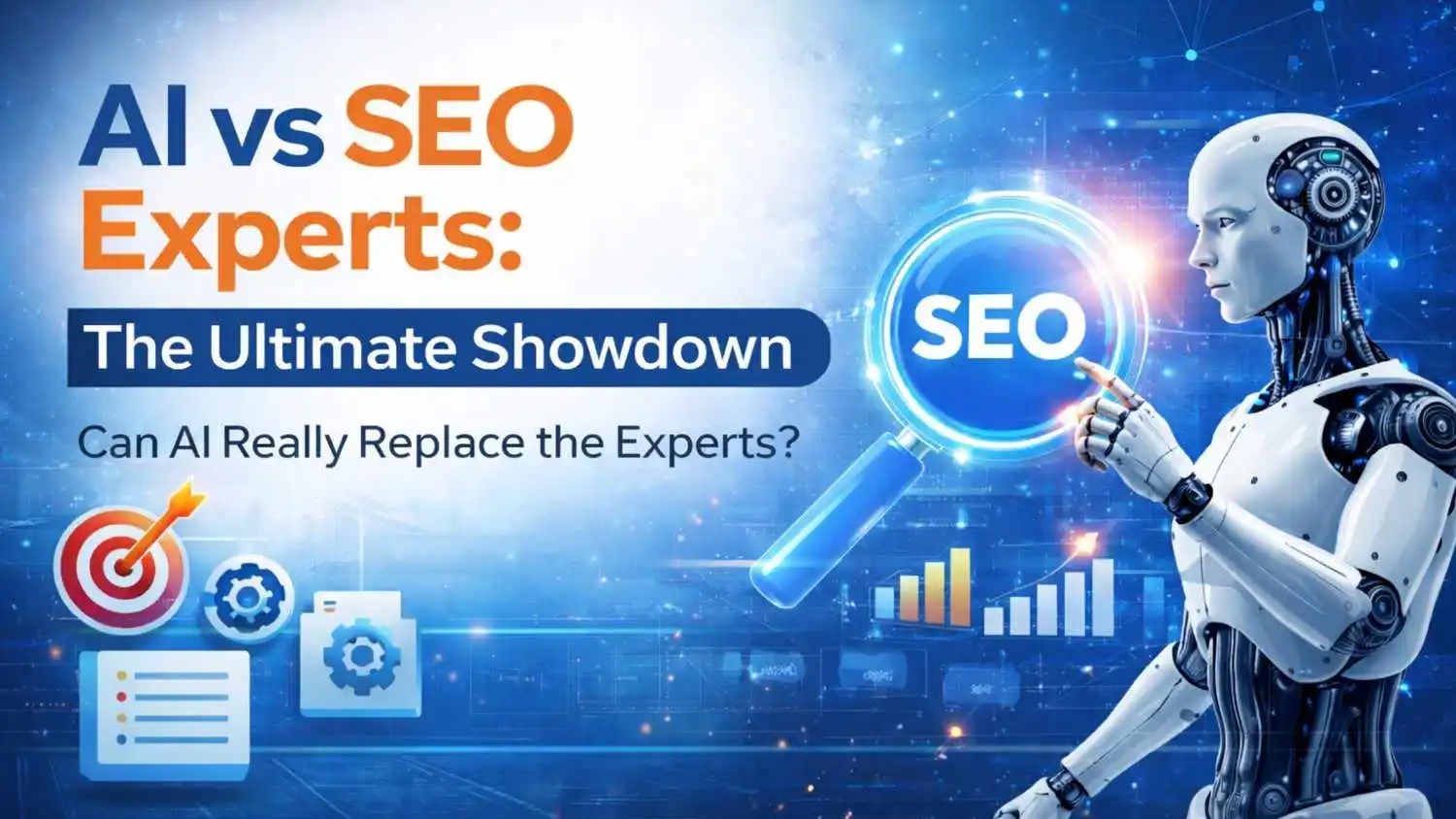
The impact of AI tools on SEO was loud and promising. These tools brought speed, scale, and shortcuts that weren’t possible with manual efforts. But as AI SEO tools matured, they claimed to handle everything. They could do better keyword research. Some tools were great at content optimization with little human input.
These features raised some operational questions. If AI can automate SEO tasks, do companies still need SEO experts? Can AI replace SEO experts completely?
If you are a founder or a marketing head actively exploring AI in SEO, this blog is for you. Because SEO mistakes rarely fail fast. They fail quietly, over time.
Why Is AI in SEO So Widely Used Today?
With the rise of AI-powered search and generative results, generative engine optimization is emerging as a key practice for brands that want to stay visible inside AI-generated search experiences, not just traditional search listings.
Everyone Wants Faster Results
AI powered SEO tools respond to one core demand. Speed.
They analyze data faster than humans ever could. Rankings. Keywords. Competitors. Trends. Everything at once. For teams juggling multiple priorities, that speed feels like relief.
Automation Reduces Mental Load
SEO automation tools remove repetitive work.
No one misses manually grouping keywords or compiling weekly reports. AI handles those tasks without complaints or coffee breaks. That alone makes it appealing, especially for lean marketing teams.
Cost Looks Attractive at First
Here is where many businesses pause.
AI SEO tools appear cheaper than SEO consulting services. A subscription feels safer than hiring experts. On paper, automation looks like a smart shortcut.
But SEO rarely rewards shortcuts.
What AI SEO Tools Can Do Well?
AI for search engine optimization performs best when it focuses on data driven execution rather than strategic leadership.
Keyword Research and Content Ideas
AI SEO tools excel at keyword research.
They quickly identify:
- Keyword variations and clusters
- Search volume patterns
- Related topics users explore
- Competitive keyword gaps
They also suggest content ideas based on trending queries. For early planning and brainstorming, AI adds momentum and direction.
On Page SEO Automation
AI handles on page SEO efficiently.
It assists with:
- Writing meta titles and descriptions
- Improving keyword placement
- Flagging missing headers
- Suggesting internal links
These optimizations help teams scale content without missing technical basics.
Along with traditional on page improvements, answer engine optimization is becoming increasingly important for helping content appear in featured answers, voice search, and AI-powered response platforms.
Reporting and SEO Insights
Performance tracking is another strong area.
AI analyzes traffic, rankings, and engagement to highlight patterns. It spots sudden drops or growth spikes faster than manual reviews. For large websites, this visibility matters.
Still, insight without interpretation rarely leads to smart decisions.
| SEO Task | Why Businesses Use AI |
| Keyword discovery | Faster access to search trends |
| Meta tag creation | Saves time on repetitive work |
| Content optimization | Improves structure and readability |
| Performance tracking | Continuous monitoring without manual effort |
| Technical alerts | Early detection of site issues |
Where AI Falls Short in SEO?
This is where the conversation shifts. AI delivers efficiency, but SEO success depends on context, intent, and experience.
Lack of Business Context
AI does not understand your business priorities.
It cannot:
- Align SEO goals with revenue targets
- Weigh brand positioning against traffic volume
- Understand internal politics or customer expectations
SEO experts make decisions based on conversations, not just data.
Strategy and Decision Making Gaps
AI follows historical patterns. It does not think ahead.
It struggles with:
- Choosing between competing SEO opportunities
- Knowing when not to pursue a keyword
- Balancing short term gains with long term growth
- Adapting strategy during search engine updates
This is where human vs AI SEO becomes obvious.
Search Intent and User Experience Limitations
Search intent rarely stays static. Content consumption patter changes very if People change how they search and what they expect, consume content.
AI SEO tools measure engagement metrics, but they do not feel friction. They do not sense confusion or frustration.
SEO experts read between the lines. They adjust content tone, layout, and flow based on real user behavior.
Get Expert SEO Strategy
Talk to our SEO experts and get a growth plan tailored to your business.
SEO Experts vs AI Tools: What Is the Real Difference?
When comparing SEO experts vs AI tools, the distinction is simple but important.
| Aspect | SEO Experts | AI SEO Tools |
| Core role | Build strategy and make judgment calls | Automate tasks and process data |
| Decision making | Based on experience and business goals | Based on patterns and historical data |
| Search intent | Interpreted with human understanding | Inferred through metrics |
| Adaptability | Adjusts quickly during algorithm shifts | Waits for new data signals |
| Risk handling | Anticipates and manages SEO risks | Cannot assess long term impact |
| Accountability | Owns outcomes and results | Executes without responsibility |
Businesses that rely entirely on automation often experience traffic growth without meaningful conversions. Strategy bridges that gap.
Can AI Replace SEO Experts Completely?
No. And the reasons are practical, not emotional.
AI cannot replace SEO professionals because SEO is not just optimization. It is decision making under uncertainty.
AI SEO tools work best as assistants. They speed up workflows and highlight opportunities. They do not own outcomes.
Businesses that rely only on AI often discover this too late. Rankings fluctuate. Traffic stalls. Content loses relevance. Someone still has to diagnose the problem.
That someone is human.
| Scenario | AI SEO Tools Are Enough | SEO Experts Are Needed |
| Small websites | Basic optimization tasks | Growth focused planning |
| Early SEO efforts | Keyword discovery and audits | Full SEO strategy with AI |
| Low competition niches | Simple ranking improvements | Conversion focused optimization |
| Stable rankings | Monitoring and reporting | Risk management and recovery |
| Long term growth | Limited impact | Sustainable SEO direction |
When Businesses Should Combine AI With SEO Experts?
The smartest companies do not ask whether AI SEO tools vs human experts is a choice. They ask how both can work together.
Scaling Content Without Losing Quality
AI helps generate ideas quickly. SEO experts ensure those ideas align with brand voice, search intent, and quality standards. This balance prevents thin content and ranking penalties.
Competing in Saturated Markets
In competitive industries, automation alone does not win. SEO consulting services bring differentiation, competitor insights, and creative positioning that AI cannot replicate.
Planning for Sustainable Growth
Long term SEO success requires foresight. SEO experts build strategies that account for market changes, product evolution, and algorithm updates.This is where professional SEO services add real value by combining AI powered SEO strategies with human oversight.
The Future of SEO: AI Assisted, Human Led
The future of SEO will not exclude AI. It will depend on it.AI will shape:
- AI powered SEO workflows
- Generative engine optimization
- Answer engine optimization
- Advanced automation tools
At the same time, human leadership will matter more. As automation increases, so does the risk of sameness. SEO experts ensure originality, relevance, and trust.The future of SEO with AI belongs to teams who guide technology instead of surrendering to it.
Final Verdict
AI improves efficiency. No argument there.
SEO experts drive outcomes.
The businesses that succeed will not ask if AI is enough for SEO success. They will ask how to combine tools, experience, and judgment intelligently.
Because the future of SEO with AI still needs humans at the wheel.
If you want growth that lasts, use AI thoughtfully. Combine automation with professional guidance from Elsner’s SEO consulting services. When SEO strategy meets intelligent execution, results follow.
FAQs
Can AI replace SEO professionals?
No. And not because AI lacks power. It lacks context. AI can spot patterns, but it does not understand why a business should ignore certain traffic or protect specific pages. When priorities clash or results stall, professionals step in. AI does not make those calls.
Should businesses rely on AI SEO tools?
Use them, yes. Rely on them, no. AI SEO tools are helpful for research and monitoring, but they do not tell you what matters most. Many teams learn this after months of activity with little impact. Automation without direction rarely ends well.
AI SEO tools vs human experts. What is the real difference?
AI moves fast. Humans think ahead. Tools process information. Experts decide what to do next and what to avoid. One handles tasks. The other manages risk. That difference shows up when competition increases or algorithms shift.
What are the limitations of AI in SEO?
Judgment. Timing. Intent. AI in SEO reacts to what already happened. It does not sense when user expectations change or when content feels off. Those gaps explain why AI driven SEO often plateaus.
Is AI enough for SEO success?
No. AI helps, but it does not lead. SEO success depends on choices made over time, not just outputs. Without human oversight, AI produces activity, not direction. Results may appear briefly, then fade.