- What “AI-Driven” Actually Means in a Magento 2 Development Context?
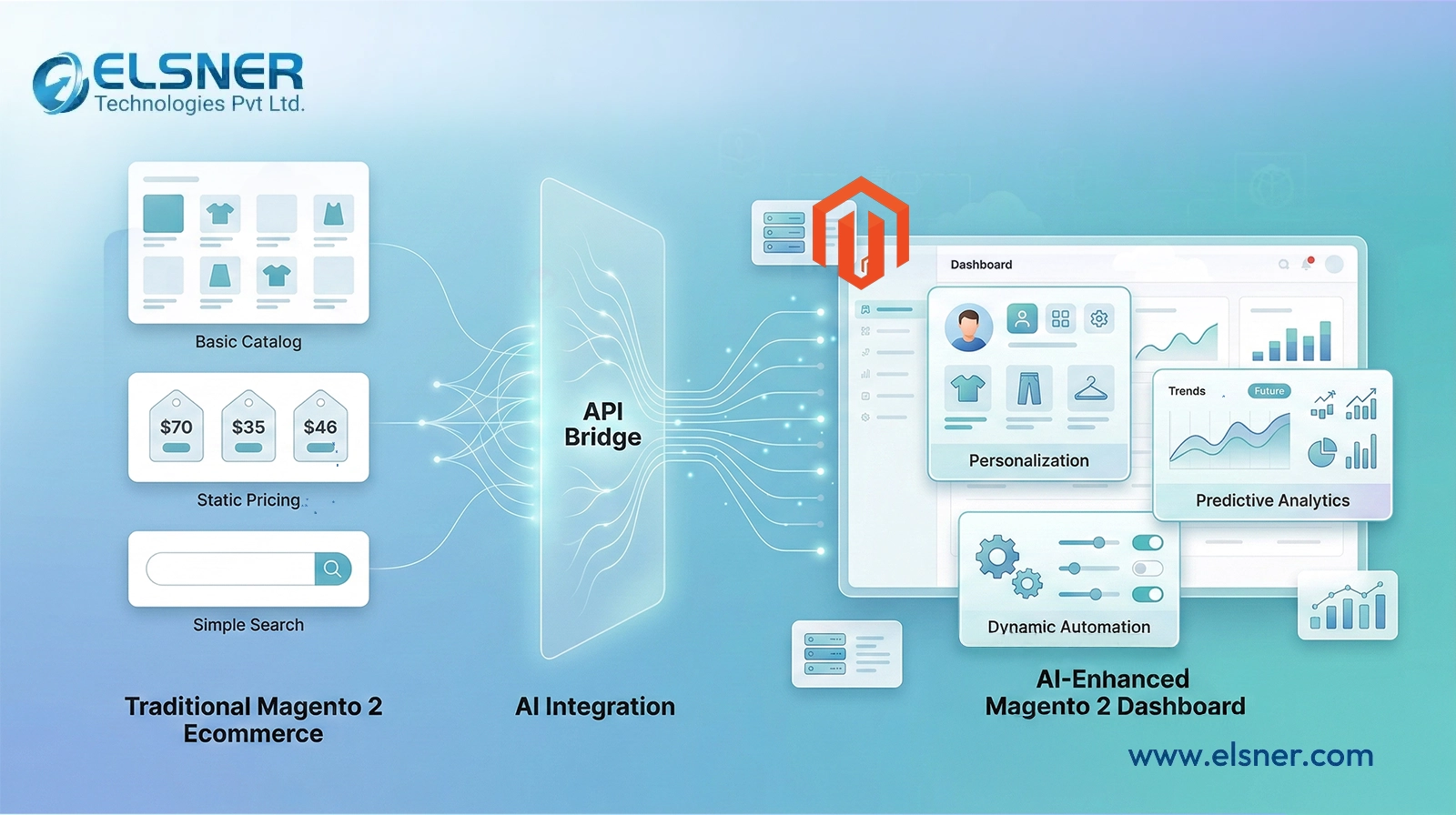
- Traditional Magento 2 vs. AI-Enhanced Magento 2
- Why Enterprise Teams Still Choose Magento 2?
- Full control over architecture.
- Multi-store management at scale.
- Integrations that go deep.
- Security and scalability are built in.
- The AI Strategies That Actually Make Enterprise Magento Development Smarter
- Personalization and Product Recommendations
- Demand Forecasting
- Intelligent Search
- Dynamic Pricing and Promotions
- Inventory and Order Automation
- Performance and Scalability: The Infrastructure Reality
- Performance Problems and What AI Does About Them
- SEO at Enterprise Scale Needs More Than Manual Work
- Where AI Directly Improves Conversions?
- Personalized journeys.
- Checkout friction.
- Cart recovery.
- Security and Compliance: What Enterprise Operations Require
- Knowing When to Make the Move
- Why Elsner for Enterprise Magento 2 Development?
- The Bottom Line
- Looking to Scale Your Enterprise Magento Store with AI?
- FAQs
- What is AI-driven Magento 2 development?
- How does AI improves Magento 2 performance?
- Can AI help improve Magento 2 SEO?
- How secure are AI-powered Magento stores?
- How long does enterprise Magento development take?
- What does AI-driven Magento development cost?
- What’s the difference between Magento Open Source and Adobe Commerce for enterprise use?
Running an enterprise ecommerce is nothing like running a regular online store. The catalog is massive. The traffic spikes are brutal. Customer expectations keep climbing. And every system, like inventory, pricing, fulfillment, and search, has to work together without breaking.
Traditional Magento 2 development handled this well enough for a while. Set it up, tweak it, fix it when it breaks. But that cycle gets expensive fast. And it doesn’t scale.
That’s where AI steps in. AI built into enterprise Magento development makes the platform genuinely smarter. This guide covers what that looks like, why it works, and where it makes the biggest difference.
What “AI-Driven” Actually Means in a Magento 2 Development Context?
The traditional Magento platform just responds to what’s happening. AI-driven development anticipates it. Machine learning models, behavioral analysis, and predictive algorithms get woven into the store’s core operations.
Over time, the system learns what works and what doesn’t. It adjusts. It improves. No manual push required.
Traditional Magento 2 vs. AI-Enhanced Magento 2
|
Capability |
Traditional Magento 2 |
AI-Enhanced Magento 2 |
|
Performance monitoring |
Manual checks after problems arise |
Continuous monitoring flags issues early |
|
Product recommendations |
Rule-based, manually curated lists |
Real-time, driven by actual user behavior |
|
Search |
Basic keyword matching |
Intent-based, learns from every query |
|
Pricing |
Static or manually updated |
Dynamic, responds to demand automatically |
|
Fraud detection |
Fixed rule filters |
Live anomaly detection |
|
Inventory management |
Manual reorder points |
Predictive restocking before stock runs out |
The difference isn’t subtle. One approach waits for problems. The other catches them before customers ever notice.
Why Enterprise Teams Still Choose Magento 2?
SaaS platforms have gotten better. The competition is real. But enterprise brands across the USA, UK, Australia, and Canada keep landing on Magento 2 for reasons that hold up under scrutiny.
Full control over architecture.
Magento handles complex business logic, custom workflows, and unusual UX requirements very well. Teams build what they need with the help of Magento development services. No vendor roadmap gets in the way.
Multi-store management at scale.
One Magento instance runs dozens of storefronts across different regions, currencies, and languages. All managed from a single admin panel.
Integrations that go deep.
You can easily integrate ERPs, CRMs, PIMs, logistics platforms, and payment gateways. Magento connects to virtually everything, natively or through its extension ecosystem.
Security and scalability are built in.
PCI compliance support, regular security patches, and horizontal scaling architecture come standard. These aren’t optional add-ons. And you can improve security through AI-driven Magento 2 development strategies.
No closed platform comes close to Magento 2 scalability for enterprise businesses.
The AI Strategies That Actually Make Enterprise Magento Development Smarter
Personalization and Product Recommendations
Manually merchandising a catalog of 100,000 SKUs is not possible. Not well, anyway.
AI enterprise ecommerce development with Magento can change this completely.
They pull from browsing behavior, purchase history, session context, and account-level data to surface the right product at the right moment.
A B2B buyer sees their contract-priced items. A returning retail customer sees accessories that match their last order. No manual curation needed. The result shows up in average order value and repeat purchase rates. Both go up.
Demand Forecasting
Inventory errors are painful at any scale. At enterprise scale, they affect quarterly numbers.
Too much stock ties up capital. Too little stock during a peak weekend means real, measurable revenue loss.
AI-driven forecasting models analyze historical sales, seasonality, promotional schedules, and external market signals to predict what’s needed before it’s needed. Purchasing decisions get smarter. Holding costs drop. The panic around peak periods goes away.
Intelligent Search
Search users convert two to three times better than browsers. That stat alone should drive priority.
AI-powered search inside Magento 2 ecommerce solutions handles natural language queries, forgives typos, learns from dead-end searches, and keeps refining relevance based on what users actually click and buy. For catalogs in the hundreds of thousands of SKUs, this is not a nice upgrade. It directly drives revenue.
Dynamic Pricing and Promotions
Dynamic pricing used to require a dedicated data science team. AI has changed that.
Prices now adjust automatically based on demand signals and competitor data. AI can even adjust it based on inventory levels and customer segments.
Intelligent promotions identify the smallest discount needed to convert a hesitating buyer. With AI, pricing becomes a precision tool. Margins stay protected. Conversion improves.
Inventory and Order Automation
Forecasting is only half the job. Acting on it automatically is the other half. AI handles reorder triggers, warehouse routing, and order exception management. And it doesn’t need constant human input.
For brands shipping thousands of orders daily, this cuts errors and speeds up fulfillment. AI frees your operations team to focus on what actually needs their attention.
Performance and Scalability: The Infrastructure Reality
Magento performance optimization at enterprise scale is an ongoing discipline.
Performance Problems and What AI Does About Them
|
Problem |
Old Approach |
AI-Driven Approach |
|
Slow page loads |
Manual profiling after complaints come in |
Continuous monitoring, automated alerts before customers notice |
|
Traffic spikes |
Statistically over-provisioned servers |
Predictive autoscaling tied to real demand signals |
|
Database overload |
Periodic manual audits |
Real-time anomaly detection |
|
Flash sale failures |
Pre-planned capacity increases require manual effort |
Fully automated dynamic load balancing |
Cloud infrastructure on AWS, Google Cloud, or Azure, paired with AI-driven autoscaling, handles a tenfold traffic spike without a single manual intervention. When the spike ends, the infrastructure scales back down. No wasted spend. No scrambling.
SEO at Enterprise Scale Needs More Than Manual Work
Enterprise Magento SEO is legitimately hard. Faceted navigation generates duplicate URLs across thousands of pages. Large catalogs produce thin content problems. Multi-region setups require precise hreflang handling. Managing this manually across a catalog of any real size isn’t realistic.
AI tools built into scalable Magento 2 platforms make it workable:
- Crawl audits run across thousands of pages at once
- Search intent gets mapped directly to the category and product page strategy
- Metadata generation happens automatically at catalog scale
- Duplicate and thin content gets flagged before rankings suffer
- Internal linking gets optimized without manual mapping
AI doesn’t replace SEO expertise here. It makes that expertise scale to the size of an enterprise operation.
Where AI Directly Improves Conversions?
Every UX decision in enterprise ecommerce ties back to one thing: conversion. AI answers the conversion question with behavioral data rather than gut feel. Three places AI has the most impact.
Personalized journeys.
Each visitor gets an experience shaped by their geography, device, purchase stage, and brand history. Not a template. Not a default layout. Something that reflects who they actually are.
Checkout friction.
Intelligent form completion, smart payment method surfacing, and predictive address validation reduce the number of people who get halfway through checkout and stop. Small friction reductions at this stage have an outsized revenue impact.
Cart recovery.
AI spots at-risk sessions before the customer leaves. It triggers personalized recovery — the right message, timed correctly, with the right offer. Revenue that would otherwise disappear gets recovered.
Security and Compliance: What Enterprise Operations Require
Security in AI-driven Magento development runs at two levels. Platform integrity. Customer data protection. Both matter equally.
At the infrastructure level, enterprise Magento stores need web application firewalls, DDoS protection, and tight extension vetting as baseline requirements. AI goes further. It detects bot activity, credential stuffing attempts, and abnormal traffic patterns that rule-based systems catch too late or miss entirely.
For fraud prevention, AI models trained on transaction data flag suspicious orders in real time. Chargebacks drop. Margin protection improves. Legitimate customers face no added friction.
Compliance is non-negotiable for brands operating across the USA, UK, Australia, and Canada.
PCI DSS covers payment data. GDPR and equivalent regional frameworks cover customer privacy. AI-assisted compliance monitoring keeps pace with platform changes and regulatory updates without requiring constant manual auditing.
Knowing When to Make the Move
Not every Magento store needs a full AI overhaul today. But there are signals that make the timing clear.
|
Signal |
What It Tells You |
|
Catalog too large to merchandise manually |
AI personalization and intelligent search are past due |
|
Flat conversion rates despite ongoing UX work |
Behavioral AI and checkout optimization are needed |
|
Performance issues keep coming back |
AI monitoring and autoscaling required |
|
Running across multiple regions or segments |
Personalization ROI becomes very compelling |
|
Competitors moving faster with smarter experiences |
Delay is actively costing market share |
The ROI case gets strongest when annual ecommerce revenue crosses $5 to 10M, SKU counts reach the tens of thousands, or operations span multiple markets. AI cuts costs through automation, lifts revenue through better personalization, and reduces risk through proactive monitoring. These gains compound. Earlier investment means greater long-term advantage.
Why Elsner for Enterprise Magento 2 Development?
Elsner has 19 years of ecommerce experience and a track record of delivering enterprise Magento projects across the USA, UK, Australia, and Canada.
The approach is AI-first by design, not as a selling point, but because it produces measurably better results. AI capabilities get designed into the platform architecture from the start, fully connected with existing data, workflows, and business goals.
Elsner’s team, recognized as a trusted Magento 2 Development Company, has delivered across high-traffic retail, complex B2B distribution, and multi-region ecommerce.
Businesses looking to scale faster can also Hire Magento Developers with enterprise AI and Magento experience to build, optimize, and maintain high-performance ecommerce platforms aligned with their growth goals.
Want to see what AI-driven Magento looks like for your specific operation? Talk to Elsner’s enterprise experts and get a clear picture of what’s possible.
The Bottom Line
Enterprise ecommerce doesn’t reward platforms that stay static. The brands gaining ground treat Magento as a system that continues to improve. AI integrated with Magento learns from data, adapts to demand, and gets sharper every month.
Magento 2 development lays the foundation. AI adds the intelligence that makes the platform work harder, scale better, and convert more consistently.
The compounding effect of AI is real. Start scaling smart with Elsner’s AI-driven Magento 2 development services.
Looking to Scale Your Enterprise Magento Store with AI?
From AI-powered personalization and automation to performance optimization and scalability, our Magento experts help enterprises build smarter, high-performing ecommerce platforms.
FAQs
What is AI-driven Magento 2 development?
It means building machine learning, predictive analytics, and intelligent automation directly into the Magento architecture. The store continuously learns and improves from real data. No need for constant manual configuration and reactive fixes.
How does AI improves Magento 2 performance?
AI monitors the platform continuously and catches bottlenecks before they affect customers. It also powers intelligent autoscaling, so infrastructure adjusts to real traffic demand. Flash sale spikes get handled automatically. Infrastructure scales back down just as fast when the spike ends.
Can AI help improve Magento 2 SEO?
Significantly. AI tools audit thousands of pages at once, map search intent to content strategy, automate metadata generation at scale, and optimize internal linking. Enterprise SEO becomes manageable without requiring a proportionally larger team.
How secure are AI-powered Magento stores?
More secure than conventionally managed deployments. AI threat detection picks up malicious traffic patterns, bot activity, and fraud signals. Standard rule-based systems miss these. You can combine AI with PCI DSS and GDPR compliance frameworks. This makes security posture is considerably stronger.
How long does enterprise Magento development take?
A core enterprise built with foundational AI integrations needs four to eight months. Complex projects involving multi-store setups or custom AI development can stretch to twelve months or more. A phased approach works well for most large teams. You can launch core functionality first and layer in AI capabilities as the platform matures.
What does AI-driven Magento development cost?
Enterprise projects typically fall between $50,000 and $250,000 or more, depending on scope and complexity. The more useful frame is ROI: improved conversion rates, lower operational costs, and better inventory efficiency typically deliver payback within 12 to 18 months for mid-to-large operations.
What’s the difference between Magento Open Source and Adobe Commerce for enterprise use?
Adobe Commerce adds enterprise-specific features. It includes advanced B2B tools, native cloud hosting, and direct Adobe support. For most enterprise use cases, it is the stronger starting point. Experienced development partners can build comparable functionality on Open Source for businesses with specific architectural or budget requirements.