 Zoho
Solutions
 Ecommerce
Development
 Web
Development
 AI
Solutions




- What Kind of Adobe Commerce Development Agency Does Your Store Need?
- For a new B2B store
- For a migration or an upgrade
- For an existing store that needs support
- What Should You Send Agencies Before Asking for a Quote?
- How Do You Check an Agency’s Experience?
- A working session you can run in twenty minutes
- How Do Adobe Commerce Agency Costs Compare in Year One?
- What should “ERP integration included” cover?
- How a Tile Manufacturer Connected Magento and Zoho
- Which Agency Should Make the Final Cut?
- What happens the morning after launch?
- Before You Sign With an Adobe Commerce Development Agency
- Discuss your project with Elsner
- Frequently Asked Questions
- How many Adobe Commerce agencies should I get quotes from?
- How much should I budget for an Adobe Commerce implementation?
- Should I choose fixed pricing or time and materials?
- Can a new agency take over an existing Adobe Commerce store?
- What can I share before an agency signs an NDA?
- How can I check an agency’s Adobe Commerce B2B experience?
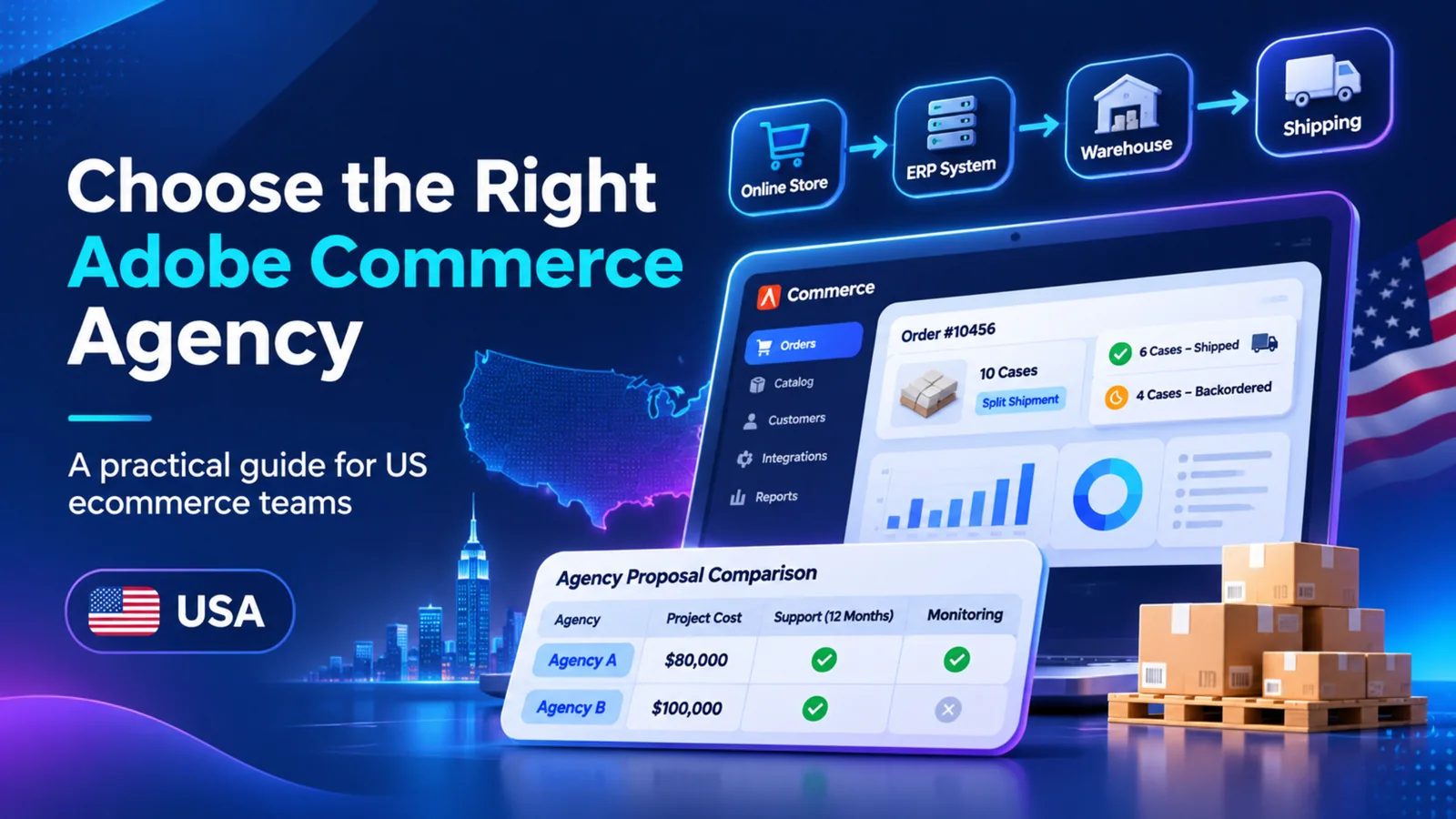
When you’re choosing an Adobe Commerce development agency, one team might quote $80,000 for your build. Another quotes $100,000. Both proposals include a warehouse integration. You ask what happens if a customer pays and the order never reaches the warehouse. One team can show you how your staff would catch it. Meanwhile, the other says monitoring costs extra.
That’s why it pays to give each agency the same order to walk through. Meet the people who’ll build it, compare what their quotes cover through the first twelve months after launch, and find out who can help during your busiest US trading hours. The sample brief and scorecard below give you a way to do all three. The prices in the worked example are illustrative.
What Kind of Adobe Commerce Development Agency Does Your Store Need?
Start with the reason you’re hiring. For example, a team that’s right for a new wholesale site may be a poor fit for taking over an established retail store a week before a busy shopping weekend.
For a new B2B store
Bring a real purchasing rule to the first call. For instance, a dealer might buy tile by the case at a negotiated price and need a manager to approve some orders. Then ask the agency to show where the price comes from, who can see it, and what happens while the buyer waits for approval. Adobe documents how shared catalogs work for company buyers. Have the team explain which of your requirements fit your licensed setup and which need extra work.
For a migration or an upgrade
Ask what the team will rehearse before launch. For example, finance might need to reconcile open orders and outstanding balances against the old system during a migration. For an upgrade, customer service might instead need to test the returns extension it uses every day. Give that person a place in the test plan. They’re often the first to spot a detail a storefront demo misses.
For an existing store that needs support
Bring the last incident that interrupted trade. If checkout slowed down at 4 p.m. Pacific, ask who on the proposed team would have been available then. Get a name, the hours covered, and the rate for work outside those hours. That tells you more about fit than a US mailing address.
What Should You Send Agencies Before Asking for a Quote?
A page is enough to get the conversation going. First, list your platform and edition, the systems it connects to, your launch window, and one order your staff finds awkward to process. Ask your operations lead which order still requires a spreadsheet. Then use that order in your brief.
Here’s what a brief could look like for a US distributor.
| What to include | Example from a fictional US distributor |
|---|---|
| Business outcome | Let dealers reorder at their contracted price without calling sales. Measure the share of eligible reorders completed online. |
| Store and systems | Record your current platform and edition, deployment model, ERP, payment provider, warehouse systems, and who owns each. Identify the source of truth for price and stock. |
| One acceptance test | A dealer orders ten cases. Six ship today and four are backordered. Show the agreed price, both shipment statuses, and the order total in Commerce and the ERP. |
| Constraints and people | State the launch window, blackout dates, working time zone, budget range if available, and who can approve a pricing exception. |
| What you want back | Ask for named leads, milestones, assumptions, exclusions, estimated third-party fees, a test plan, and support terms. Request prices in the same currency and for the same period. |
The split shipment in this brief gives you a simple way to check the finished work. First, can the dealer see that six cases shipped and four are still due? Then, can finance match the total to the accounting system? Next, send both questions to every finalist. If the answer changes the price, you want to know while the bids are still open.
How Do You Check an Agency’s Experience?
Use the Adobe Solution Partner Directory to check a partner claim. Filter by Commerce and the location served. Next, ask to meet the architect or lead developer assigned to your project. They’re the person you want answering the difficult questions.
Four things to settle on the shortlist call:
A working session you can run in twenty minutes
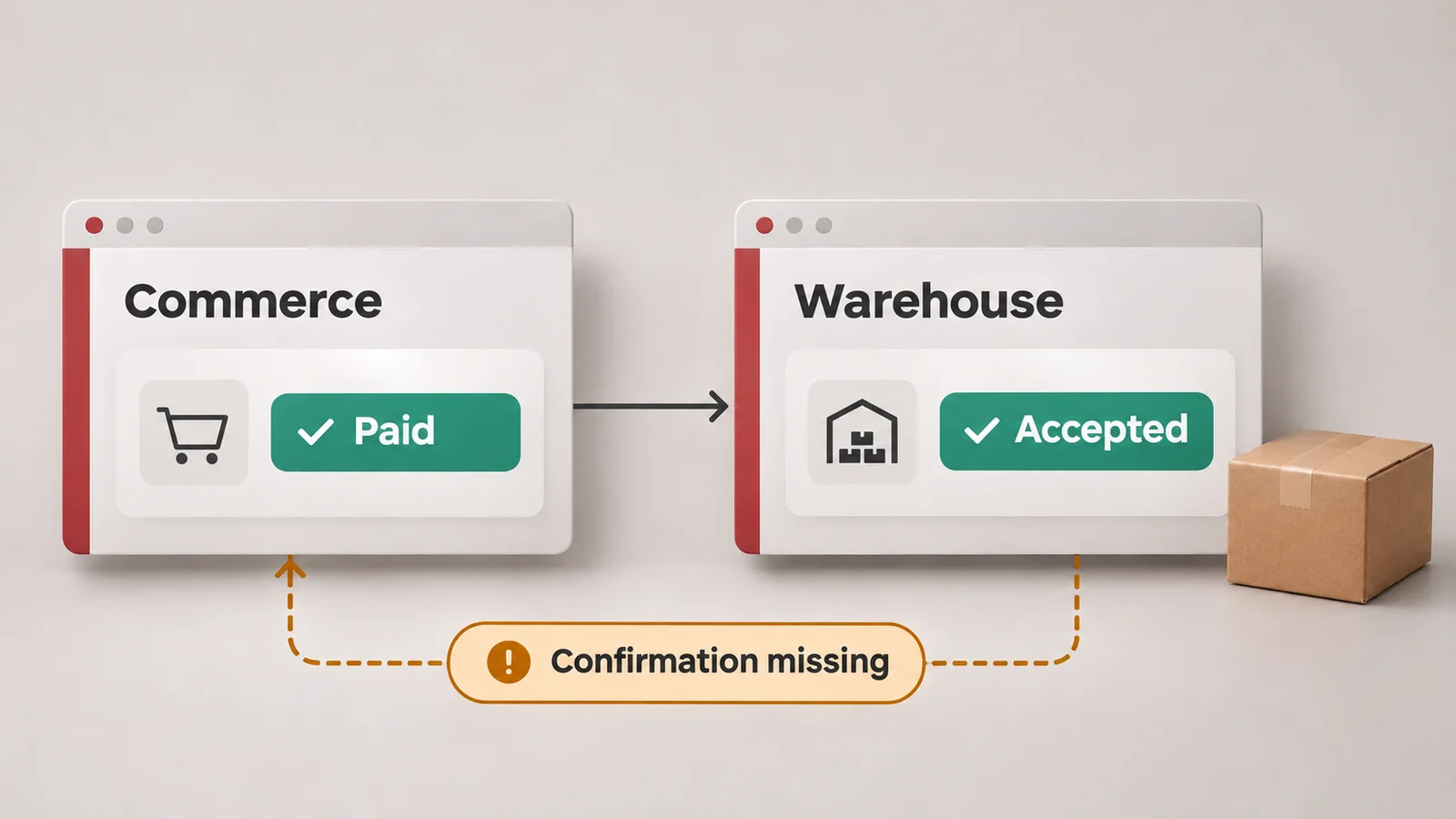
Take the distributor’s order from the brief. First, the dealer pays. Next, the warehouse system accepts the order, but the confirmation never gets back to Adobe Commerce. Your support rep now sees a paid order with no shipping update. Should they resend it?
Let the architect draw what the rep would see, which order number they’d search for in each system, and how they’d establish whether a second shipment was already on its way. If the architect needs an answer from your warehouse vendor, write down who’ll get it and whether it changes the estimate.
How Do Adobe Commerce Agency Costs Compare in Year One?
Start by matching the build price with the first 12 months of support. Then separate migration rehearsals, testing, and third-party costs. If a quote says “included,” ask what you’ll receive. For any item the quote leaves blank, confirm who will pay.
Take these two fictional bids for the same project. All figures are in US dollars.
| Comparable cost | Proposal A | Proposal B |
|---|---|---|
| Quoted implementation | $80,000 | $100,000 |
| ERP reconciliation and migration rehearsal | $18,000 add-on | Included |
| Twelve months of required support | $24,000 | $18,000 |
| Comparable total | $122,000 | $118,000 |
The $80,000 bid looks attractive until you add the $18,000 of integration and rehearsal work that the other agency included. With support added, the totals are $122,000 and $118,000. As a result, the bid that opened $20,000 higher ends up $4,000 lower.
Those figures illustrate the calculation. For your own budget, add any licensing, hosting, and internal staff time your business will pay. Mark uncertain figures as ranges and ask what would move you to the high end. For instance, give an old, undocumented extension its own estimate.
What should “ERP integration included” cover?
An ERP is the system your business may use for orders, inventory, and finance. A proposal can promise to connect that system to Commerce and still leave your team responsible for checking every failed order. Ask for a sentence both your warehouse lead and the agency can sign off on.
Example acceptance test. “When a paid order reaches the ERP but its confirmation is lost, support can look up the order in both systems, see whether the warehouse accepted it, and retry safely. The test passes when the ERP has one order and the customer sees one confirmation.”
Use your own order and systems in the final wording. Then price the monitoring, testing, and ongoing support needed to make that sentence true.
How a Tile Manufacturer Connected Magento and Zoho
For example, Elsner connected a tile manufacturer’s Magento storefront with Zoho CRM, Inventory, Books, and Campaigns. If stock, sales, and finance live in separate systems at your business, that project gives you a concrete starting point for a conversation about how orders move between them.
Which Agency Should Make the Final Cut?
Have finance, ecommerce, and operations score the finalists separately. Agree on the weights first. A distributor with a complicated warehouse connection might use the ones below. A retailer hiring for round-the-clock coverage may want to give support a bigger share.
| Criterion | Weight | Evidence to record | Agency A / B (0–5) |
|---|---|---|---|
| Order and integration design | 30% | Named systems, recovery test, and reconciliation owner. | |
| Comparable delivery team | 20% | Named personnel, relevant project, client reference. | |
| Scope and first-year cost | 20% | Comparable totals, exclusions, assumptions, and change approval. | |
| Launch and handover | 15% | Rehearsal, go/no-go owner, rollback conditions, and documentation. | |
| US-hours support | 15% | Coverage hours, incident owner, escalation, and handoff. |
Score each row from 0 to 5. Use 0 if the agency gave you no evidence, 1 for a claim, 2 for partial evidence, 3 when it meets your brief, 4 when the team demonstrates it, and 5 when a comparable client backs up the demonstration. Then multiply the score by the weight and divide by five. For example, a 4 on integration earns 24 of its 30 points.
Pay attention to where your reviewers disagree. For example, if finance gives a proposal a 4 for scope and operations gives it a 1, ask what operations thinks is missing. One conversation about who checks failed orders is worth having before you settle on a winner.
What happens the morning after launch?
Try one last question. It’s 8:15 a.m. Eastern. Customers can pay, but the warehouse hasn’t received an order for forty minutes. Ask each agency to talk you through four decisions.
- Who receives the alert and checks which orders are affected?
- Whose call is it to keep checkout open?
- Who tells customer service what to say to buyers waiting for confirmation?
- Once the connection returns, who matches paid orders to warehouse records?
Finally, put the answers in the support agreement. A thirty-minute response target tells you when someone will acknowledge the incident. Also confirm the recovery time and who can approve urgent work.
Before You Sign With an Adobe Commerce Development Agency
Share your preferred Adobe Commerce development agency’s proposal with the people who will have to fill the order. Will the warehouse lead know how a bad order makes it to their line? Can finance give you the first-year total? Does customer service know who to call at 8 a. m. Eastern? If anyone has to make an educated guess, have the agency include that answer as part of the scope of work.
Sometimes both finalists still have a fair question. For instance, the warehouse software may be old and its retry behavior may be unclear. In that case, ask for a small paid discovery phase. Before work starts, agree on the fee, the test, and what you’ll receive at the end. A test order that reaches the warehouse exactly once gives both sides a sounder basis for quoting the build.
Discuss your project with Elsner
Share your current platform, one order your team still has to fix by hand, and your target launch date. Those details help us discuss what belongs in your Adobe Commerce proposal.
Frequently Asked Questions
How many Adobe Commerce agencies should I get quotes from?
Two or three finalists are usually enough to compare scope, delivery teams, and cost. Give them the same brief. Add another bidder if none can meet a requirement you can’t change, such as launch-week coverage.
How much should I budget for an Adobe Commerce implementation?
Start with the build, data migration, integrations, and twelve months of support. Add any licenses and hosting you pay directly. Ask bidders to identify the biggest unknown and show how much it could change the estimate.
Should I choose fixed pricing or time and materials?
Fixed pricing suits work you can test against a clear finish line, such as importing an agreed product catalog. For an undocumented integration, a capped discovery phase gives the team time to investigate and gives you a decision point before more money is spent.
Can a new agency take over an existing Adobe Commerce store?
Yes. Ask for a handover covering code access, environments, extensions, deployment steps, and open issues. Have the incoming team rehearse a small release in staging while the outgoing team is still available.
What can I share before an agency signs an NDA?
Start with your platform, approximate catalog size, storefront count, systems involved, and a fictional order that illustrates the workflow. Your team can agree on access to more detailed material when the agency needs it.
How can I check an agency’s Adobe Commerce B2B experience?
Give its team a wholesale order with a contract price, an approval step, and a partial shipment. Ask them to follow it from sign-in to invoice. Invite someone from sales or finance who knows what the customer should actually be charged.