





- What a digital transformation roadmap actually is, and what it is not
- Why a formal roadmap matters more in 2026 than it did five years ago
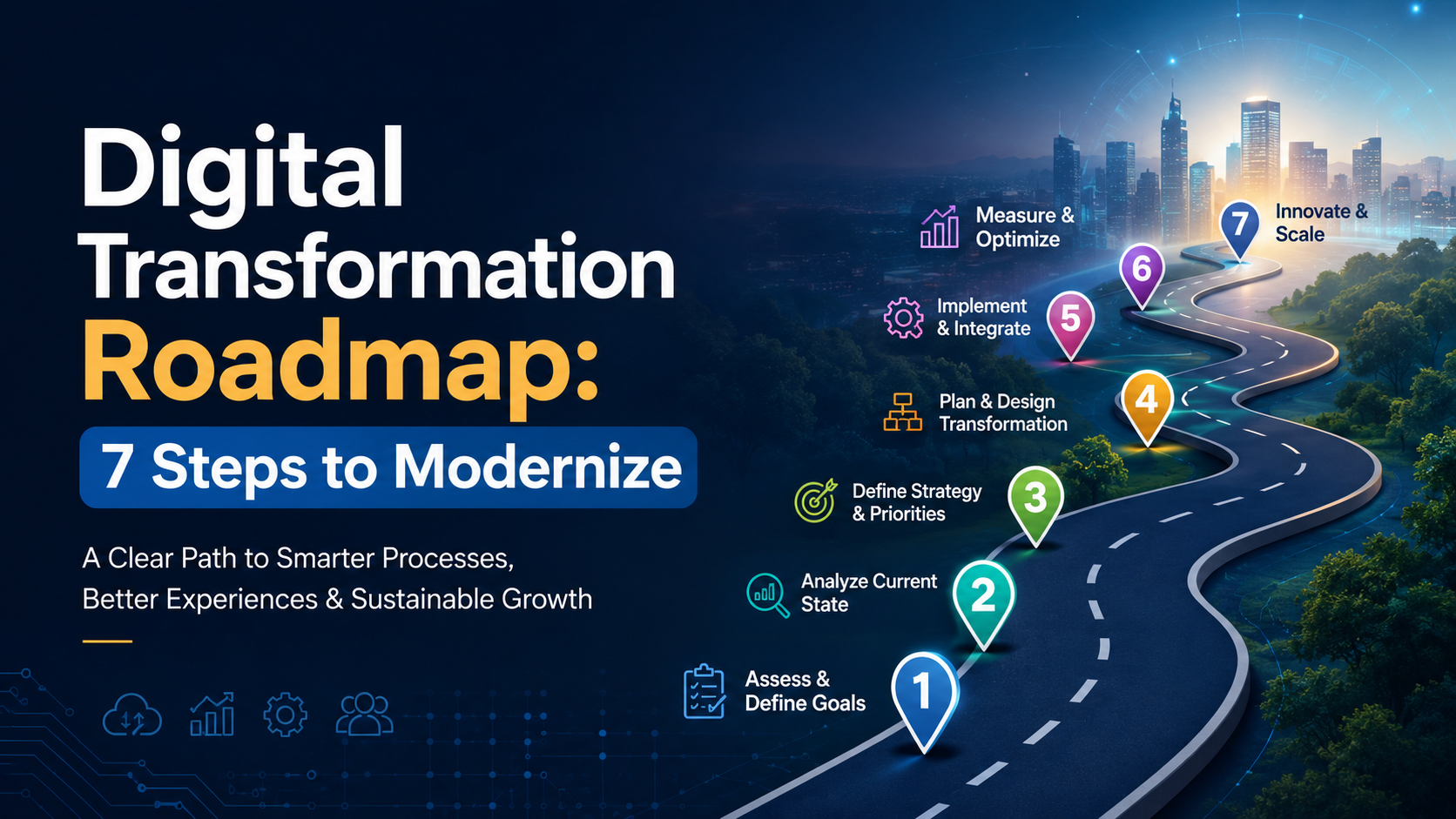
- The seven-step digital transformation roadmap at a glance
- Step 1: Assess digital maturity honestly, before picking any technology
- Step 2: Align transformation goals with actual business strategy
- Step 3: Build the data and cloud foundation everything else depends on
- Step 4: Modernize the core systems that justify the investment
- Step 5: Embed AI and agentic process automation into real workflows
- Not sure which workflows are actually ready for AI agents?
- Step 6: Drive change management like it is part of the architecture
- Step 7: Govern and scale the roadmap continuously after go-live
- What a realistic roadmap costs and how long it takes
- Common mistakes that stall a digital transformation roadmap
- Where a technology partner fits into the roadmap
- Frequently Asked Questions
- What is a digital transformation roadmap?
- What are the main steps in a digital transformation strategy?
- Why do most digital transformation initiatives fail?
- How long does a digital transformation roadmap take to implement?
- How much does digital transformation cost?
- What role does AI play in a digital transformation roadmap?
- What is the difference between digital transformation and digitization?
- Who should own a digital transformation roadmap?
- How do you measure the success of a digital transformation initiative?
- The bottom line
- Ready to build your digital transformation roadmap?
Most executives already agree that their business needs to modernize. Fewer agree on what that actually means in practice, and that gap is exactly where most digital transformation programs stall. A roadmap that lives only in a slide deck rarely survives contact with budget season, legacy systems, or a skeptical department head who has watched three previous “transformation” initiatives quietly disappear.
The organizations that get this right treat digital transformation as a sequence of decisions, not a single announcement. They know which systems to modernize first, how to fund the work without freezing product delivery, and how to keep the effort accountable to business outcomes rather than technology for its own sake. This guide lays out a practical, seven-step digital transformation roadmap built for how businesses are actually modernizing in 2026, from data and cloud foundations through AI and agentic process automation, along with the costs, timelines, and mistakes that determine whether a roadmap becomes real change or another shelved strategy document.
Quick Answer
A digital transformation roadmap is a phased, business-outcome-driven plan for modernizing how an organization operates, using technologies like cloud, data platforms, automation, and AI. The seven steps that consistently separate successful programs from stalled ones are: assess digital maturity, align transformation goals with business strategy, build the data and cloud foundation, modernize core systems and applications, embed AI and agentic process automation, drive change management and adoption, and govern and scale continuously. Global spending on digital transformation technologies and services is forecast to reach $3.4 trillion in 2026, growing at a five-year compound annual growth rate of 16.3 percent, according to IDC’s Worldwide Digital Transformation Spending Guide.
What a digital transformation roadmap actually is, and what it is not
A digital transformation roadmap is not an IT project plan with a longer name. It is a sequenced set of business decisions about which processes, systems, and customer touchpoints get rebuilt around modern technology first, in what order, and against which measurable outcomes. A project plan tells engineering what to build. A roadmap tells the whole organization why the work matters, who owns each phase, and what changes for the business once it ships. Digital Transformation Consulting can help organizations translate this roadmap into practical business priorities and measurable initiatives.
This distinction matters because of how often digital transformation efforts fail to produce results that leadership can actually point to. Research from McKinsey has repeatedly found that fewer than 30 percent of transformation efforts fully meet their stated objectives, and Boston Consulting Group’s research lands on a similar figure, with roughly 30 percent of transformations meeting or exceeding their target value. The pattern shows up again in newer technology waves too: MIT research cited by Forbes found that 95 percent of generative AI pilots failed to deliver measurable business impact, which suggests the problem is rarely the technology itself.
What separates the minority that succeeds is not a bigger budget or a flashier vendor. It is a roadmap built around business outcomes from the start, sequenced realistically, and governed with the same discipline applied to any other capital investment. That is the model this guide walks through.
Why a formal roadmap matters more in 2026 than it did five years ago
Digital transformation used to mean moving a handful of processes online and calling it modernization. That bar has moved considerably. Global spending on information and communications technology is forecast to reach $4 trillion in 2026, with software now absorbing more than a third of that total as enterprises invest in resource management, security, and operations applications, according to IDC’s Worldwide ICT Spending Guide reported by Channel Impact. Businesses are not just digitizing individual tasks anymore; they are rebuilding the operating model those tasks run on.
Artificial intelligence is the biggest reason the pace has changed. A roadmap written two years ago likely treated AI as an experimental line item. In 2026, it has to treat AI as core infrastructure, because the applications customers and employees expect are increasingly built with AI agents baked in rather than bolted on. Gartner predicts that 40 percent of enterprise applications will be integrated with task-specific AI agents by the end of 2026, up from less than 5 percent at the start of 2025, a shift that reshapes almost every workflow a transformation roadmap would normally sequence in later.
The second reason is accountability. Cloud bills, AI spend, and modernization budgets are now reviewed at the board level rather than buried in an IT line item, which means a roadmap without measurable milestones does not survive its first budget review. Digitally mature organizations consistently outperform on the metrics that matter to a board: research cited by StartUs Insights found that mature firms report 26 percent higher profitability and 9 percent greater revenue growth than digital laggards, which is the kind of evidence a roadmap needs to defend continued funding past year one.
The seven-step digital transformation roadmap at a glance
Every business’s specific sequence will vary by industry and starting point, but the underlying seven-step structure holds up across most successful programs, whether the organization is modernizing fifty processes or five hundred. The table below gives the shape of the roadmap before the detailed breakdown that follows.
| Step | Core question it answers | Primary owner |
|---|---|---|
| 1. Assess digital maturity | Where does the business actually stand today, honestly | Leadership team, with IT and operations |
| 2. Align goals with strategy | What business outcome justifies this investment | Executive sponsor |
| 3. Build the data and cloud foundation | Is the infrastructure ready to support everything after it | CIO or cloud architecture lead |
| 4. Modernize core systems | Which legacy applications actually deserve rebuild investment | Engineering and product leadership |
| 5. Embed AI and agentic automation | Which workflows benefit from agents acting, not just assisting | Operations and AI strategy leads |
| 6. Drive change management | Will the people running these systems actually use them | HR, department heads, and program lead |
| 7. Govern and scale continuously | How does the business keep this accountable after go-live | Transformation office or center of excellence |
Step 1: Assess digital maturity honestly, before picking any technology
Every roadmap that goes off the rails in year two usually skipped this step in year zero. Before a business chooses a cloud provider, an AI platform, or a systems integrator, it needs an honest inventory of where it actually stands: which processes are still manual, which systems are so brittle that nobody wants to touch them, where data lives and how trustworthy it is, and how ready the workforce is for a different way of working.
This assessment should span four dimensions, not just technology. Leadership alignment on priorities, the actual condition of core systems, the quality and accessibility of data, and the organization’s appetite and capacity for change all shape what a realistic roadmap can achieve in year one. A retailer with clean transaction data but a resistant frontline workforce needs a very different starting sequence than a manufacturer with strong operational buy-in but two decades of undocumented system dependencies.
What a credible maturity assessment covers
- Process inventory: which core workflows are manual, semi-digital, or already automated, and how much revenue or cost each one touches
- System health: which applications are supportable long-term versus running on unsupported infrastructure or undocumented custom code
- Data readiness: whether the data needed to power analytics and AI actually exists, is accessible, and can be trusted
- Organizational readiness: whether leadership, middle management, and frontline teams are genuinely prepared for new ways of working
- Competitive baseline: where the business stands relative to peers on digital capability, not just relative to its own past
The output of this step is not a technology shopping list. It is a clear-eyed statement of the gap between where the business is and where it needs to be, ranked by business impact rather than by which fix looks easiest.
Step 2: Align transformation goals with actual business strategy
A digital transformation strategy that exists apart from the company’s business strategy is the single most common reason boards lose patience with these programs. If the business is trying to win on speed to market, the roadmap should prioritize things like faster deployment pipelines and modular product architecture. If it is trying to win on cost discipline, the priorities look completely different, favoring automation and process consolidation over customer-facing innovation.
This is also the point where executive sponsorship gets locked in, and it matters more than most technology decisions that follow. A transformation with a genuinely engaged executive sponsor, someone accountable for the business outcome and not just the technology rollout, moves through budget approvals and cross-department friction in a fraction of the time one without that sponsorship does. This step should produce a small number of clear, board-legible objectives, not a long list of aspirational statements that nobody can be held accountable to a year later.
A useful test at this stage: if a proposed initiative cannot be tied to a specific line on the income statement, a specific customer metric, or a specific operational risk the business is trying to reduce, it probably does not belong in this version of the roadmap.
Step 3: Build the data and cloud foundation everything else depends on
Nearly every later step in a digital transformation roadmap, from application modernization to AI-driven automation, depends on infrastructure that most legacy environments were never built to support. This step is where the business decides its cloud model, public, private, hybrid, or a deliberate mix, and establishes the data architecture that will feed analytics, reporting, and AI initiatives for years to come.
Getting this foundation wrong is expensive in a way that shows up months later, not immediately. A business that rushes into application modernization on top of fragmented, low-quality data ends up rebuilding twice, once for the application and once for the data underneath it. Establishing consistent data governance, a defined cloud target state, and integration standards before core systems move is what prevents that second, more expensive rebuild.
A useful way to sequence this step: get the data platform and integration layer stable first, even if it means a slightly slower start, rather than modernizing customer-facing applications on top of a data foundation that will need to be rebuilt within eighteen months.
Step 4: Modernize the core systems that justify the investment
Not every legacy application deserves a full rebuild, and treating every system the same is one of the more common ways a modernization budget quietly doubles. Some applications need only a lift-and-shift into the cloud to buy time. Others need targeted replatforming, moving a database to a managed service without touching the rest of the application. A smaller set of core, revenue-generating systems deserve a genuine rebuild into cloud-native, API-first architecture because the business expects to keep evolving them for years.
The discipline here is ranking applications by business value against modernization complexity, not by which system is technically easiest to touch first. A customer-facing platform that drives revenue justifies a deeper rebuild than an internal reporting tool used by a dozen people, even if the reporting tool happens to be simpler to migrate. Enterprises working through this decision often bring in a partner for product modernization specifically for the systems that carry the most business risk if they are done badly.
A quick way to triage the application portfolio
- Rebuild: core, revenue-generating systems the business will keep investing in for years
- Replatform: important systems that need better performance and lower operational overhead, not a full rewrite
- Rehost: systems under time pressure, such as an expiring data center lease, that need to move quickly
- Retire: systems whose function has been absorbed elsewhere or that no longer justify their maintenance cost
Step 5: Embed AI and agentic process automation into real workflows
This step has changed more than any other part of the roadmap over the last two years. Earlier digital transformation frameworks treated automation as robotic process automation bolted onto existing workflows, and treated AI as a chatbot layered on top of a support queue. Agentic process automation is a different category: AI agents that can plan, take multi-step action across systems, and complete a workflow rather than simply assisting a person working through it manually.
The adoption curve backs up why this step now sits mid-roadmap rather than as a later-stage add-on. Gartner projects that 40 percent of enterprise applications will include task-specific AI agents by the end of 2026, up from under 5 percent at the start of 2025. At the same time, Gartner’s 2026 CIO and Technology Executive Survey found that only 17 percent of organizations have actually deployed AI agents to date, even though more than 60 percent expect to do so within two years, which is the widest ambition-to-execution gap Gartner measured across any emerging technology in that survey.
That gap is exactly why this step belongs in a sequenced roadmap rather than a company-wide rollout. The businesses closing the gap successfully start with a small number of well-scoped, high-friction workflows, invoice matching, claims triage, tier-one customer support, order exception handling, where an agent acting autonomously has a clear, measurable payoff. They put a human in the loop for judgment calls, measure time-to-value in weeks, and only then expand agent scope into adjacent workflows. Businesses that skip the scoped pilot and attempt to embed agents everywhere at once are the ones most likely to end up part of the roughly 40 percent of agentic AI projects Gartner expects to be cancelled by 2027. This is also where a dedicated AI and machine learning development partner earns its place, building the governance and human-oversight layer around agents rather than deploying them unsupervised into production processes.
Not sure which workflows are actually ready for AI agents?
Elsner can review your current processes and give you an honest read on where agentic automation will pay off first, and where it will just add risk.
Step 6: Drive change management like it is part of the architecture
Technology decisions get the attention in most transformation roadmaps, but the people running the resulting systems are usually the reason a program succeeds or quietly fails to stick. A new platform that nobody trusts, or a workflow change nobody was trained on, produces the same outcome as no transformation at all, except the business has now spent the budget.
Effective change management in a digital transformation context does three things well. It communicates why a change is happening in terms that connect to a person’s actual job, not just to a company-wide strategy slide. It builds training and support directly into the rollout timeline instead of treating it as an afterthought once a system is already live. And it identifies champions within each affected team early, people who can answer day-to-day questions faster than a formal support ticket ever will.
This step is also where a business decides how much of the transformation capacity to build internally versus bring in through an outside team. Closing a skills gap through hiring alone can take longer than the business can afford to wait, which is why many organizations run a phase of the work through a dedicated engagement model, pairing an external team with internal staff so the knowledge transfers rather than walking out the door when the contract ends.
Step 7: Govern and scale the roadmap continuously after go-live
A digital transformation roadmap does not end when the first wave of systems goes live. It shifts into a different mode: measuring whether the changes are actually delivering the business outcomes defined back in step two, and adjusting the next phase based on what the data shows rather than what the original plan assumed two years earlier.
This is where a small, cross-functional transformation office or center of excellence earns its keep, with representation from IT, finance, and the business units most affected by the changes. Its job is to track a short list of outcome metrics on a regular cadence, flag initiatives that are not producing value so they can be redirected or shut down, and keep the roadmap’s next phase grounded in evidence instead of momentum. Programs that only ever add new initiatives without ever retiring underperforming ones are the ones that plateau, technically still transforming but no longer moving the numbers that matter.
What a realistic roadmap costs and how long it takes
Be wary of any source offering one universal number for what digital transformation costs. It depends heavily on how many processes and systems are in scope, how much legacy debt the business is carrying, and whether the work is a targeted initiative or an enterprise-wide operating model shift. What is more useful than a single figure is understanding where the money and time typically go, and how the two approaches compare.
Build your budget around these line items
- Cloud, data platform, and integration infrastructure, benchmarked against current run-rate spend
- Application modernization work, scoped separately for rehost, replatform, and rebuild candidates
- AI and automation tooling, including the governance layer that keeps agents accountable
- Change management, training, and internal communications, not just the technology rollout
- Cloud architecture, data engineering, and AI talent, whether hired or engaged through a partner
- A contingency buffer for the first two to three months after each phase goes live
The most common budgeting mistake is funding the build and stopping there. Adoption, training, and the first quarter of post-launch optimization are where a transformation either compounds into real value or quietly reverts to old habits, and that phase needs its own dedicated budget line rather than whatever is left over.
Common mistakes that stall a digital transformation roadmap
Starting with technology instead of outcomes: Choosing a platform before defining what business result it needs to produce leads to expensive tools nobody can prove the value of a year later.
Treating every system the same: Applying a full rebuild to applications that only needed a rehost, or a quick lift-and-shift to systems that were always going to need a genuine rebuild, wastes budget in both directions.
Underfunding change management: A roadmap that spends ninety percent of its budget on technology and ten percent on the people using it tends to produce systems that are technically live and practically ignored.
Deploying AI agents without governance: Handing agents broad autonomy before establishing oversight, audit trails, and clear escalation paths is how a promising pilot turns into a costly rollback.
A mistake worth avoiding
Treating the roadmap as a fixed document instead of a living plan is one of the more common reasons transformations stall after an early win. The market, the technology, and the business’s own priorities shift over a two-year program. Roadmaps built with quarterly checkpoints, and the authority to actually change course at each one, consistently outperform roadmaps locked in at the start and revisited only when something breaks.
Where a technology partner fits into the roadmap
Few internal teams can staff every discipline a digital transformation roadmap needs at once: cloud architecture, data engineering, application modernization, AI development, and change management, all while continuing to ship the product work the business already depends on. This is the gap a technology partner is built to close, taking ownership of a defined phase rather than an open-ended overhaul, establishing the patterns the rest of the program will follow, and handing off documented, repeatable work the internal team can build on.
Elsner works within this model, helping businesses translate a transformation roadmap into a working AI and digital strategy before locking in architecture decisions, and then carrying that strategy through custom software development for the systems the business needs built or rebuilt around it. Getting the strategy right before the first system moves is what keeps a multi-year roadmap from turning into a second, more expensive round of rework eighteen months in.
Key takeaways
- Global digital transformation spending is forecast to reach $3.4 trillion in 2026 at a 16.3 percent CAGR, with the United States accounting for roughly 35 percent of the worldwide total.
- Fewer than 30 percent of digital transformation efforts fully meet their stated objectives, a pattern that shows up consistently across McKinsey, BCG, and even newer generative AI pilot data from MIT.
- A working roadmap runs on seven sequenced steps: assess maturity, align with strategy, build the data and cloud foundation, modernize core systems, embed AI and agentic automation, drive change management, and govern and scale continuously.
- Gartner projects 40 percent of enterprise applications will include task-specific AI agents by the end of 2026, yet only 17 percent of organizations have deployed agents so far, the widest ambition-to-execution gap in Gartner’s 2026 CIO survey.
- Digitally mature organizations report meaningfully higher profitability and revenue growth than digital laggards, which is the evidence a roadmap needs to defend continued funding past its first year.
- The most common failure points are starting with technology instead of outcomes, underfunding change management, and treating the roadmap as fixed rather than reviewed on a regular cadence.
Frequently Asked Questions
What is a digital transformation roadmap?
A digital transformation roadmap is a phased, business-outcome-driven plan for modernizing how an organization operates using technology such as cloud infrastructure, data platforms, application modernization, and AI. Unlike a technology project plan, it sequences initiatives by business value and includes ownership, timelines, and measurable outcomes for each phase.
What are the main steps in a digital transformation strategy?
The seven steps that consistently appear in successful programs are assessing digital maturity, aligning transformation goals with business strategy, building the data and cloud foundation, modernizing core systems and applications, embedding AI and agentic process automation, driving change management and adoption, and governing and scaling the roadmap continuously after go-live.
Why do most digital transformation initiatives fail?
Research from McKinsey and Boston Consulting Group consistently finds fewer than 30 percent of transformation efforts fully meet their objectives, most often because the initiative was not tied to a clear business outcome, change management was underfunded, or every system was treated the same regardless of how much rebuild investment it actually justified.
How long does a digital transformation roadmap take to implement?
A targeted, single-department initiative can take weeks to a few months. A full enterprise-wide roadmap covering data, cloud, application modernization, and AI is typically planned in phases over twelve to thirty-six months, with the maturity assessment and foundation-building stages usually taking longer than most organizations initially expect.
How much does digital transformation cost?
There is no single figure that applies to every business. Cost depends on the number of processes and systems in scope, the condition of existing infrastructure, and how much of the work involves full application rebuilds versus lighter modernization. A realistic budget should include infrastructure, application modernization, AI and automation tooling, change management, talent, and a buffer for post-launch optimization.
What role does AI play in a digital transformation roadmap?
AI, and increasingly agentic process automation, now sits in the middle of the roadmap rather than as a later add-on. Gartner projects that 40 percent of enterprise applications will include task-specific AI agents by the end of 2026. Successful roadmaps start agentic automation with a small number of well-scoped, high-friction workflows, backed by human oversight, before expanding scope.
What is the difference between digital transformation and digitization?
Digitization is converting analog information or processes into digital formats, such as scanning paper records. Digital transformation is broader: it is rebuilding how a business operates, makes decisions, and delivers value around digital technology and data, which usually includes digitization as an early step but goes well beyond it.
Who should own a digital transformation roadmap?
Ownership should sit with an executive sponsor accountable for the business outcome, not solely with IT. Day-to-day execution typically runs through a cross-functional transformation office or center of excellence with representation from IT, finance, and the business units most affected, so the roadmap stays tied to outcomes rather than becoming a purely technical initiative.
How do you measure the success of a digital transformation initiative?
Success should be measured against the specific business outcomes defined at the start of the roadmap, such as revenue growth, cost reduction, cycle time, or customer satisfaction, rather than technical milestones like a system going live. Digitally mature organizations report meaningfully higher profitability and revenue growth than digital laggards, which is the kind of outcome-level metric a roadmap should track.
The bottom line
A digital transformation roadmap that works is not defined by how much technology it deploys. It is defined by how tightly each step ties back to a business outcome, how honestly the organization assesses its starting point, and how much discipline it applies to change management and governance once the first systems go live. Businesses that sequence these seven steps deliberately, rather than chasing whichever technology is getting the most attention that quarter, are the ones building an operating model that can actually keep up with what comes next, AI included.
Ready to build your digital transformation roadmap?
Elsner helps businesses turn a transformation strategy into a sequenced, fundable roadmap, from data and cloud foundations through AI and agentic automation, without the guesswork of solving strategy, architecture, and adoption on your own.