



- What enterprise cloud solutions actually mean today
- Why enterprise cloud strategy is a boardroom topic now, not just an IT one
- Types of enterprise cloud solutions
- Benefits of enterprise cloud solutions
- Public, private, hybrid, or multi-cloud: what actually separates them
- Choosing the right migration approach
- What you actually need before migrating to enterprise cloud
- The practical path from strategy to a live cloud environment
- What enterprise cloud solutions actually cost
- Not sure whether your workloads need a rehost, a replatform, or a full rebuild?
- Enterprise cloud security: the part that cannot be an afterthought
- Governance and FinOps: keeping cloud accountable after go-live
- Common challenges enterprises run into, and how to handle them
- From lift-and-shift to a genuinely cloud-native, AI-ready enterprise
- Where a technology partner fits into an enterprise cloud strategy
- Frequently Asked Questions
- What are enterprise cloud solutions?
- What are the main types of enterprise cloud solutions?
- What are the benefits of enterprise cloud solutions?
- What is the difference between public and private cloud for enterprises?
- What is the difference between enterprise cloud and traditional cloud hosting?
- How do enterprises choose the right cloud solution?
- How much does enterprise cloud migration cost?
- How long does an enterprise cloud migration take?
- Which cloud provider is best for enterprises?
- The bottom line
- Planning your next move to the cloud?
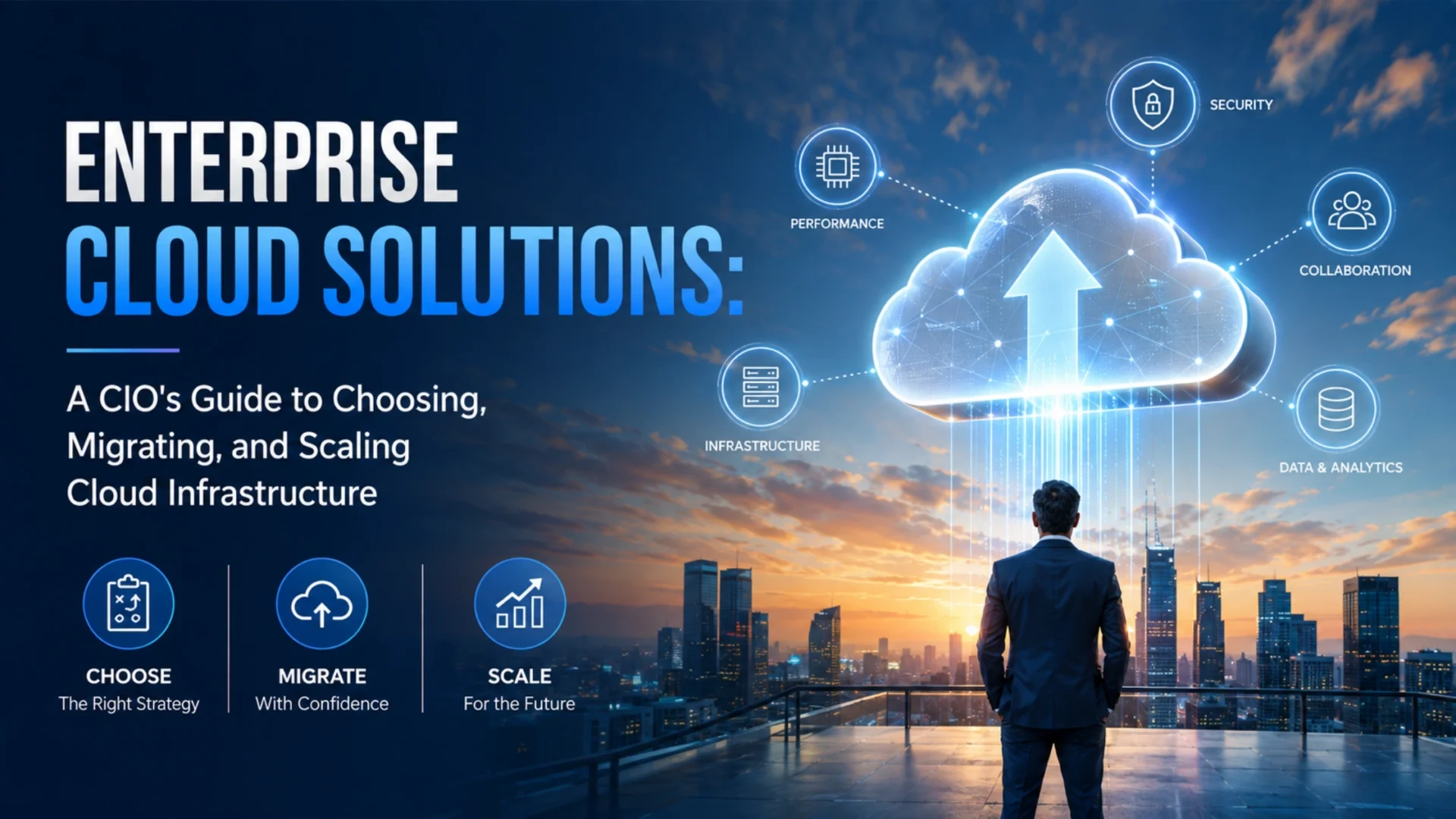
Every enterprise cloud conversation used to start and end with a single question: which provider is cheapest. That question is still on the table, but it is no longer the one that decides whether a cloud investment pays off. The organizations getting real value from cloud infrastructure in 2026 are the ones that stopped treating cloud as a hosting decision and started treating it as the operating model for how the business actually runs, from AI workloads to customer-facing applications to the data pipelines connecting both.
The gap between those two approaches shows up fast. Companies that migrated to the cloud purely to cut infrastructure costs are now the ones fighting unpredictable bills, fragmented security postures, and platforms that cannot keep pace with AI-driven demand. This guide walks through what enterprise cloud solutions actually mean today, the different types available, how to choose between public, private, hybrid, and multi-cloud models, what a realistic migration and cost picture looks like, and how to build the security and governance foundation that determines whether cloud becomes a genuine growth lever or an expensive rerun of the same problems on someone else’s servers.
Quick Answer
Enterprise cloud solutions are the infrastructure, platforms, and managed services large organizations use to run applications, store data, and scale computing resources without owning and operating the underlying hardware themselves. Unlike consumer or small-business cloud tools, enterprise cloud solutions are built around the demands of scale: strict security and compliance controls, multi-region availability, integration with legacy systems, and increasingly, the compute power needed to run AI workloads. Worldwide IT spending is projected to reach $6.37 trillion in 2026, a 14.2 percent increase from 2025, with data center systems and infrastructure as a service named as the two fastest-growing categories, according to Gartner’s July 2026 worldwide IT spending forecast.
What enterprise cloud solutions actually mean today
A decade ago, an enterprise cloud strategy mostly meant deciding whether to rent servers from Amazon or Microsoft instead of buying your own. That framing has not aged well. Enterprise cloud today spans infrastructure as a service, platform as a service, software as a service, and an expanding category of AI-ready infrastructure, GPUs, high-performance networking, and inference capacity purpose-built to support machine learning and generative AI workloads rather than traditional web applications.
It also helps to be precise about the vocabulary, since it gets used loosely. Public cloud means shared infrastructure operated by a third-party provider such as AWS, Microsoft Azure, or Google Cloud. Private cloud means dedicated infrastructure, either on-premises or hosted, used by a single organization. Hybrid cloud connects the two, letting workloads move between private and public environments based on cost, compliance, or performance needs. Multi-cloud means using more than one public cloud provider, often to avoid vendor lock-in or to match specific workloads to the provider best suited for them. Most enterprise cloud strategies in 2026 are not choosing one of these models. They are combining two or three of them deliberately, which is exactly why the strategy decision matters more than the vendor decision.
Why enterprise cloud strategy is a boardroom topic now, not just an IT one
Three forces are pushing cloud decisions up the org chart. The first is AI. Building and running machine learning models at production scale requires compute, storage, and networking that most on-premises environments were never designed to provide, which is why organizations are rebuilding their technology foundations around platform-as-a-service and AI-ready cloud infrastructure rather than treating AI as a bolt-on project.
The second is data sovereignty and regulation. As more countries introduce data residency and localization requirements, enterprises operating across borders are being forced to think about where their data physically sits, not just how it is secured. Worldwide sovereign cloud infrastructure-as-a-service spending is forecast to total $80 billion in 2026, a 35.6 percent increase from 2025, as regulated industries and multinational companies invest in keeping sensitive workloads within specific jurisdictions, according to a February 2026 Gartner forecast. This is no longer a niche concern limited to government contractors. It shapes architecture decisions for any enterprise handling customer data across multiple regions.
The third is cost accountability. Cloud bills that once lived quietly inside an IT budget line are now routinely reviewed at the CFO and board level, because the numbers have gotten too large to ignore. Total data center spending alone is expected to surpass $788 billion in 2026 as hyperscale demand for AI-optimized infrastructure accelerates, and that pressure trickles directly down to how enterprises plan, govern, and justify their own cloud consumption.
Types of enterprise cloud solutions
“Enterprise cloud solutions” is often used as a single catch-all term, but in practice it covers several distinct categories of work, and most enterprises need more than one of them running together.
- Cloud infrastructure solutions: The compute, storage, and networking foundation, delivered as IaaS, that everything else runs on
- Cloud migration solutions: The assessment, planning, and execution work involved in moving existing applications and data into the cloud
- Cloud modernization and application development: Rebuilding or replatforming applications to be cloud-native, typically using containers, microservices, and managed services
- Managed cloud services: Ongoing operation, monitoring, and support of a cloud environment, often handled by a partner rather than an internal team alone
- Cloud security solutions: Identity and access management, threat detection, encryption, and compliance tooling built specifically for cloud environments
- Data and analytics cloud platforms: Cloud-based data warehousing, pipelines, and business intelligence infrastructure that feeds both reporting and AI initiatives
- AI and machine learning cloud infrastructure: GPU-backed compute, model training environments, and inference infrastructure purpose-built for AI workloads
- Disaster recovery and business continuity solutions: Backup, failover, and recovery architecture designed for cloud and hybrid environments specifically
- Cloud governance and FinOps solutions: The tooling and processes that keep spend, access, and architecture standards accountable once workloads are live
Enterprises rarely need all nine categories from day one. What tends to work better is sequencing them against actual business priorities, migration and infrastructure first, then modernization and cloud-native application development for the systems that will keep evolving, with security and governance built in throughout rather than added at the end.
Benefits of enterprise cloud solutions
The case for enterprise cloud is well established at this point, but it is worth being specific about where the value actually shows up, since not every benefit applies equally to every workload.
- Elastic scalability: Resources scale up or down with demand instead of sitting idle or running short during peak load
- Faster time to market: Managed services and pre-built infrastructure reduce the time between an idea and a shipped feature
- Business continuity: Multi-region availability and cloud-native disaster recovery reduce downtime risk compared with a single physical data center
- Global availability: Enterprises can deploy closer to customers and users across regions without building physical infrastructure everywhere
- Infrastructure flexibility: Teams can mix public, private, hybrid, and multi-cloud resources to match each workload’s actual requirements
- AI readiness: Access to GPU-backed compute and managed AI services without the capital cost of building that infrastructure in-house
- Operational efficiency: Automated provisioning, patching, and monitoring reduce the manual overhead of running infrastructure
- Better data accessibility: Centralized, cloud-based data platforms make it easier for teams across the business to access consistent, current data
- Stronger security and compliance capability: Enterprise cloud providers invest in security tooling and certifications that would be costly for most organizations to replicate independently
These benefits are real, but they are not automatic. Scalability only helps if the architecture is actually built to scale, and security capability only helps if it is configured correctly. This is why the benefits of enterprise cloud solutions tend to show up fully only when migration, modernization, and governance are planned together rather than treated as separate initiatives.
Public, private, hybrid, or multi-cloud: what actually separates them
Most enterprises do not pick a single cloud model and stay there. They land on a combination shaped by workload type, compliance requirements, and existing infrastructure investments. Understanding what each model actually trades off makes that combination a deliberate choice instead of an accident of history.
| Model | Control and customization | Cost profile | Best suited for |
|---|---|---|---|
| Public cloud | Lower, shared infrastructure managed by the provider | Pay-as-you-go, lowest upfront cost, variable at scale | Variable workloads, fast scaling, customer-facing applications |
| Private cloud | Highest, dedicated environment fully owned or ring-fenced | Higher fixed investment; exact economics depend on whether it’s on-prem, hosted, or managed private cloud | Regulated data, legacy systems, strict compliance mandates |
| Hybrid cloud | Balanced, workload-dependent placement | Mixed, optimized per workload if governed well | Enterprises modernizing gradually, keeping some systems on-prem |
| Multi-cloud | High, but adds real operational complexity | Can reduce lock-in risk, but harder to optimize without FinOps | Large enterprises avoiding vendor dependency, global footprints |
None of these models is inherently superior. A financial services company with strict data residency rules and a consumer app with unpredictable traffic spikes have almost nothing in common in terms of what “the right cloud” looks like, even if both call themselves cloud-native. A mistake enterprises make often is copying a competitor’s cloud architecture instead of mapping their own workloads against their own compliance, latency, and cost constraints first.
How to choose: four questions worth answering before the model decision
- What compliance or data residency rules actually apply to this workload, and where
- How predictable or spiky is the traffic and compute demand for this workload
- How tightly is this workload dependent on legacy systems that are not moving anytime soon
- Does the internal team have the skills to manage this model, or does that gap need to be closed first
Choosing the right migration approach
Once the model question is settled, the harder decision is how existing applications actually get there. Not every workload deserves the same migration approach, and treating them all the same is one of the more common ways enterprise cloud programs run over budget and over schedule.
Rehost, or lift-and-shift
Moving an application to the cloud with minimal changes to its architecture. It is the fastest and cheapest way to exit a data center, and it is a reasonable starting point for workloads under time pressure, such as a lease expiring. Its downside is that it rarely delivers the deeper benefits of cloud, elastic scaling, managed services, cost efficiency, since the application is still architected the way it was on-premises.
Replatform
Making targeted optimizations during migration, moving a database to a managed cloud service, for example, without rewriting the whole application. This captures some real cloud-native benefits, better performance, lower operational overhead, without the cost and risk of a full rebuild. It is often the practical middle ground for enterprises balancing speed with long-term efficiency, and it is where a large share of realistic enterprise cloud migration work actually happens.
Refactor or rebuild
Redesigning the application to be cloud-native, often moving to microservices, containers, and serverless components. This delivers the biggest long-term payoff in scalability, resilience, and development speed, and it is usually the right call for core, revenue-generating systems that the business expects to keep evolving for years. It is also the slowest and most resource-intensive path, and attempting it for every application at once is how modernization budgets quietly double.
A mistake worth avoiding
Enterprises frequently commit to refactoring every application before they have ranked which systems actually justify the investment. A customer-facing platform that drives revenue deserves a cloud-native rebuild. An internal reporting tool used by twelve people probably does not. Sequencing migration by business value, not by what looks impressive in a roadmap slide, is what keeps a multi-year cloud program funded past year one.
What you actually need before migrating to enterprise cloud
Before selecting a cloud provider or setting a migration date, enterprises benefit from having a clear readiness checklist. Skipping this step is one of the more common reasons a migration ends up running long and over budget.
- A full application inventory, including dependencies, data flows, and current infrastructure costs
- A workload-by-workload migration strategy, not a single approach applied to everything
- A defined cloud governance model, covering access control, tagging standards, and spend accountability
- Security and compliance requirements mapped early, especially for regulated data and cross-border transfers
- A realistic cost model that accounts for migration, run-rate, and the first twelve months of optimization
- Skilled cloud architecture and DevOps capacity, whether built in-house or brought in through a partner
- A rollback and business continuity plan for every workload being migrated
- Executive sponsorship that treats this as a business transformation, not an infrastructure project
The governance piece deserves particular attention, since it is the one enterprises most often defer until after migration is underway. Organizations that establish tagging, access, and cost-allocation standards before the first workload moves generally spend less time untangling ownership and spend visibility later. Getting the underlying cloud and AI strategy right before locking in architecture decisions tends to prevent a second, more expensive round of re-platforming eighteen months in.
The practical path from strategy to a live cloud environment
A cloud migration that goes well tends to follow the same rough sequence, whether the enterprise is moving fifty applications or five hundred. What changes is the timeline and the depth of work at each stage.
1. Assess and prioritize the application portfolio
Catalog every application, its dependencies, its current cost, and its business criticality. Rank candidates by expected value versus migration complexity, rather than by which system is easiest to move first.
2. Design the target architecture and cloud model
Decide, workload by workload, between public, private, hybrid, and multi-cloud placement, and choose the migration approach, rehost, replatform, or refactor, for each. This is also the point to lock in security and compliance architecture, not retrofit it later.
3. Run a pilot before committing to the full program
Migrate a small number of representative, lower-risk workloads first. This surfaces real cost, performance, and integration issues while the blast radius of a mistake is still small, and it builds internal confidence in the approach before the harder, higher-stakes systems move.
4. Execute migration in waves, not all at once
Group applications into migration waves based on dependency chains and business risk tolerance. A dedicated engineering team can run this in parallel with ongoing product work, so the business does not have to choose between migrating and shipping features.
5. Optimize continuously after go-live
Migration is the start of cost and performance management, not the end of the project. Rightsizing instances, adjusting reserved capacity, and reviewing architecture against actual usage patterns should be a standing quarterly practice, not a one-time cleanup.
What we typically see in enterprise cloud migrations
- Legacy dependencies are almost always more tangled than the initial application inventory suggests
- Cost visibility works best when it is established before migration, not reconstructed afterward from a confusing bill
- Not every workload benefits from a full refactor, and forcing one rarely pays for itself on internal or low-traffic systems
- Security architecture decided upfront is consistently easier to defend later than security retrofitted after workloads are already live
What enterprise cloud solutions actually cost
Be skeptical of any source offering a single number for what enterprise cloud costs. It genuinely depends on workload volume, migration approach, compliance requirements, and how disciplined the organization is about ongoing cost management. What is consistent across enterprises is that managing cloud spend, not security, has been the most commonly cited cloud challenge for two consecutive years according to Flexera’s State of the Cloud research, which points to a governance problem more than a pricing problem.
Build your cost model around these line items
- Compute, storage, and networking costs, benchmarked against current on-premises spend
- Data migration and transfer costs, often underestimated for large datasets
- Licensing changes for software moving to cloud-native or managed versions
- Security tooling and compliance certification costs
- Cloud architecture and DevOps talent, whether hired or engaged through a partner
- Training and change management for internal teams
- FinOps tooling and processes for ongoing cost visibility
- A contingency buffer for the first two to three months of live operation, when usage patterns are still being tuned
The most common budgeting mistake is planning for the migration cost and stopping there. The real financial story plays out over the following year, as usage patterns settle, reserved capacity gets negotiated, and teams either build cost discipline into their workflow or let spend drift upward unnoticed. Enterprises that build FinOps practices in from month one consistently outperform those that treat cost optimization as a cleanup project.
Not sure whether your workloads need a rehost, a replatform, or a full rebuild?
Elsner can walk through your application portfolio and give you an honest read on what actually needs to move first, and what can wait.
Enterprise cloud security: the part that cannot be an afterthought
Cloud security has changed shape as fast as cloud adoption itself. Threats that barely registered a decade ago are now leading attack vectors, and the financial stakes of getting security wrong keep climbing. In 2015, cloud misconfiguration was not even a formally categorized breach vector in industry research. Today it is a leading target, a shift that tracks closely with how much more enterprise infrastructure now lives in the cloud.
The financial numbers back up why this matters at the board level. The global average cost of a data breach was $4.44 million in 2025, the first year-over-year decline in five years, while the average cost of a breach in the United States reached a record $10.22 million, according to IBM’s 2025 Cost of a Data Breach Report. The gap between those two figures reflects both the scale of US enterprise environments and the regulatory and legal exposure that comes with them.
A few practices consistently separate enterprises that handle cloud security well from those that treat it as a checklist item completed once and revisited only after an incident.
Identity and access management first: A large share of cloud breaches trace back to overly broad permissions or credentials that were never revoked after a role change. Least-privilege access, enforced continuously rather than audited annually, closes one of the most common gaps.
Configuration management as a continuous process: Automated scanning for misconfigured storage buckets, open ports, and overly permissive network rules catches the mistakes that manual review misses, especially as environments scale across multiple accounts and regions.
Data residency and sovereignty built into architecture: With sovereign cloud infrastructure spending accelerating sharply worldwide, enterprises operating across borders need data placement decisions baked into their architecture from day one, not addressed after a regulator asks where customer data physically lives.
Disaster recovery planned for the cloud, not copied from on-premises: A recovery plan built for a physical data center rarely maps cleanly onto a multi-cloud or hybrid environment. Enterprises evaluating data engineering and MLOps practices as part of their cloud build should treat backup, failover, and recovery testing as core architecture decisions, not a separate project bolted on afterward.
Governance and FinOps: keeping cloud accountable after go-live
Governance gets treated as the least exciting part of a cloud strategy, which is exactly why it is where many enterprise cloud programs quietly lose control. Without clear ownership of spend, access, and architecture standards, a cloud environment that started clean six months ago drifts into duplicated resources, orphaned instances, and access nobody can fully account for.
FinOps, the discipline of bringing financial accountability to cloud spend, has moved from a nice-to-have to a standard enterprise function precisely because cloud cost management has consistently outranked security as the top challenge organizations report. A functioning FinOps practice does three things well: it gives engineering, finance, and leadership a shared, real-time view of spend, it ties cost to business value rather than treating every dollar the same, and it builds a habit of continuous optimization instead of an annual scramble when the bill spikes.
Cloud governance and FinOps work best when they are cross-functional from the start, not something IT builds in isolation and hands to finance after the fact. Enterprises that get this right typically have a small, dedicated cloud center of excellence with representation from engineering, security, and finance, meeting on a regular cadence rather than only when a problem forces the conversation.
Common challenges enterprises run into, and how to handle them
Uncontrolled cost growth: Without tagging discipline and regular rightsizing, cloud spend tends to grow faster than the business value it produces. Building FinOps practices in from the first migration wave, rather than after costs become a visible problem, is one of the highest-leverage fixes available.
Skills gaps in cloud architecture and security: Enterprise cloud environments increasingly require specialized skills, in Kubernetes, in multi-cloud networking, in FinOps tooling, that internal teams built around legacy infrastructure may not have. Closing this gap through hiring alone can take longer than the business can wait, which is why many enterprises bring in a dedicated engagement model to run alongside internal teams during the transition.
Legacy application dependencies: Older applications built with tight, undocumented dependencies on specific hardware or network configurations are consistently among the hardest to migrate cleanly. Discovering these dependencies during the assessment phase, rather than mid-migration, prevents the kind of surprise that derails a project timeline.
Multi-cloud complexity outpacing the team’s ability to manage it: Using multiple providers to avoid lock-in is a reasonable strategy, but only if the organization has the tooling and processes to manage identity, cost, and security consistently across all of them. Multi-cloud without strong governance tends to multiply the challenges of a single cloud rather than solving them.
Underestimating change management: A cloud migration changes how engineering teams build, deploy, and troubleshoot software. Enterprises that treat this as a purely technical project, without investing in training and workflow changes for the people running the systems, tend to see slower adoption and more resistance than the technology itself would predict.
From lift-and-shift to a genuinely cloud-native, AI-ready enterprise
It helps to think about enterprise cloud maturity as a curve rather than a single migration event. Two enterprises can both describe themselves as cloud-first while sitting at very different points on that curve, and the difference shows up directly in cost efficiency, deployment speed, and how ready the organization actually is to run AI workloads.
- Migrated: Workloads run in the cloud but largely mirror their on-premises architecture
- Optimized: Cost and performance are actively managed through FinOps and rightsizing
- Cloud-native: Applications are rebuilt around microservices, containers, and managed services
- Data-driven: Cloud infrastructure supports real-time analytics and machine learning at scale
- AI-ready: The platform can support production AI workloads without a separate infrastructure buildout
Progression through these stages requires deliberate investment, not just time. It means building real AI and machine learning capability into the cloud platform rather than treating AI as a separate project running on separate infrastructure, and it means giving governance and FinOps practices the authority to actually change how teams provision resources, not just report on what they already spent. Enterprises that only ever add more workloads to the cloud, without maturing how those workloads are managed, tend to plateau at the optimized stage regardless of how large their cloud footprint grows.
Where a technology partner fits into an enterprise cloud strategy
Not every enterprise wants to build cloud architecture, migration execution, and ongoing FinOps capability entirely with an internal team, especially while that team is also expected to keep shipping product. This is the gap a technology partner is built to close, handling the technical scaffolding while internal teams stay focused on what the business actually needs the cloud environment to do.
In practice, the most effective partner engagements start with a defined workload or platform, not an open-ended infrastructure overhaul. A dedicated engineering team can take ownership of one migration wave, establish the architecture and security standards the rest of the program will follow, and hand off a working, documented pattern the internal team can repeat. This is the model Elsner works within, helping enterprises modernize legacy platforms into cloud-native environments through product modernization engagements.
The same applies to building new products on top of that cloud foundation. Rather than treating migration and product development as separate tracks that hand off awkwardly to each other, Elsner runs them as connected work through dedicated product development, so the cloud environment being built is shaped by what the applications running on it actually need.
Key takeaways
- Enterprise cloud solutions now span infrastructure, platform, and AI-ready compute, not just hosting, with worldwide IT spending projected at $6.37 trillion in 2026, a 14.2 percent increase from 2025.
- The category covers at least nine distinct solution types, from infrastructure and migration to governance and FinOps, and most enterprises need several of them working together rather than just one.
- Most enterprises run a deliberate mix of public, private, hybrid, and multi-cloud models, matched to each workload rather than applied uniformly.
- Public cloud services growth is accelerating to 21.3 percent in 2026, with the market on track to reach $1.48 trillion by 2029, driven largely by AI and modernization demand.
- Managing cloud spend, not security, has been enterprises’ most commonly cited cloud challenge for two consecutive years, which points squarely at the need for FinOps discipline.
- The global average data breach cost was $4.44 million in 2025, while the US average hit a record $10.22 million, underscoring why cloud security architecture cannot be an afterthought.
- Cloud maturity is a curve, not a single migration event. Enterprises that only add workloads without maturing governance and optimization tend to plateau well short of being genuinely AI-ready.
Frequently Asked Questions
What are enterprise cloud solutions?
Enterprise cloud solutions are the infrastructure, platforms, and managed services large organizations use to run applications, store data, and scale computing resources without owning the underlying hardware. They typically include public, private, hybrid, and multi-cloud configurations, along with the security, compliance, and cost management practices needed to operate them at enterprise scale.
What are the main types of enterprise cloud solutions?
The main categories include cloud infrastructure, migration solutions, cloud modernization and application development, managed cloud services, cloud security solutions, data and analytics platforms, AI and machine learning infrastructure, disaster recovery and business continuity, and cloud governance or FinOps solutions. Most enterprises combine several of these rather than relying on just one.
What are the benefits of enterprise cloud solutions?
The main benefits are elastic scalability, faster time to market, stronger business continuity, global availability, infrastructure flexibility, AI readiness, operational efficiency, better data accessibility, and improved security and compliance capability. These benefits depend on the underlying architecture being built and governed correctly, not just on moving to the cloud itself.
What is the difference between public and private cloud for enterprises?
Public cloud runs on shared infrastructure managed by a third-party provider such as AWS, Azure, or Google Cloud, offering lower upfront cost and fast scalability. Private cloud is dedicated infrastructure used by a single organization, offering more control and is often preferred for regulated data or strict compliance requirements. Most enterprises use a hybrid combination of both rather than choosing one exclusively.
What is the difference between enterprise cloud and traditional cloud hosting?
Traditional cloud hosting usually refers to renting server space to run a website or application, with limited customization and support. Enterprise cloud solutions are built for organizational scale: multi-region availability, dedicated security and compliance controls, integration with existing legacy systems, and infrastructure sized for AI and large-scale data workloads rather than a single application.
How do enterprises choose the right cloud solution?
The decision generally comes down to four factors: which compliance and data residency rules apply to a given workload, how predictable or variable the traffic and compute demand is, how tightly the workload depends on legacy systems, and whether the internal team has the skills to manage the chosen model. These factors are evaluated per workload, not once for the entire organization.
How much does enterprise cloud migration cost?
There is no single figure that applies universally. Cost depends on the number and complexity of applications being migrated, the migration approach chosen for each, data transfer volume, and how much re-architecture is involved. A realistic cost model should include migration execution, licensing changes, security tooling, talent, and a buffer for the first few months of live operation while usage patterns are tuned.
How long does an enterprise cloud migration take?
Timelines vary widely based on the number of applications and their complexity. A rehost of a single, well-understood application can take weeks. A full enterprise migration involving hundreds of applications, several of them legacy and interdependent, is typically planned in phases over twelve to twenty-four months, with the assessment and pilot stages taking longer than most organizations initially expect.
Which cloud provider is best for enterprises?
There is no single best provider for every enterprise. AWS, Microsoft Azure, and Google Cloud each have distinct strengths in specific services, pricing models, and existing integrations, and many enterprises use more than one deliberately through a multi-cloud strategy. The right choice depends on existing technology investments, compliance needs, and which provider’s managed services best match the workloads being migrated.
The bottom line
A successful enterprise cloud strategy is not a single migration project with a start and end date. It is a deliberate combination of the right model and solution type for each workload, a security and governance foundation built in from the beginning, and a FinOps discipline that keeps cost tied to business value long after the migration itself is finished. Enterprises that treat these as sequential afterthoughts, solved one at a time after workloads are already running, are the ones that end up managing cloud sprawl instead of a cloud advantage. Enterprises that plan them together, before the first workload moves, are the ones building infrastructure that can genuinely support what comes next, including AI at production scale.
Planning your next move to the cloud?
Elsner helps enterprises design, migrate, and manage cloud environments that are built for what the business actually needs next, without the guesswork of solving architecture, security, and cost all on your own. Let’s talk through what your cloud roadmap should actually look like.