



- What SaaS Lead Generation Means Now
- Why SaaS is a different animal
- The modern SaaS funnel, stage by stage
- How AI Rewrote SaaS Lead Generation
- Buyers research without ever landing on you
- Why a ranking alone stopped being enough
- A SaaS Lead Generation Framework That Holds Up in 2026
- Stage 1: Build topical authority
- Stage 2: Capture high-intent demand
- Stage 3: Convert visitors into leads
- Stage 4: Nurture and qualify
- 7 SaaS Lead Generation Strategies That Deliver in 2026
- Which Lead Generation Channels Are Worth It
- The Metrics That Actually Tell You Something
- Should You Hire a SaaS Lead Generation Agency?
- Where SaaS Lead Generation Goes Next
- The Short Version
- Ready to Build a SaaS Pipeline That Compounds?
- Frequently Asked Questions
- What is SaaS lead generation?
- What are the best SaaS lead generation strategies in 2026?
- How does AI search impact SaaS lead generation?
- What is the difference between demand generation and lead generation?
- Is outbound lead generation still effective for SaaS companies?
- Should SaaS companies focus on SEO or paid advertising?
- When should a business hire a SaaS lead generation agency?
- How long does SaaS lead generation take to show results?
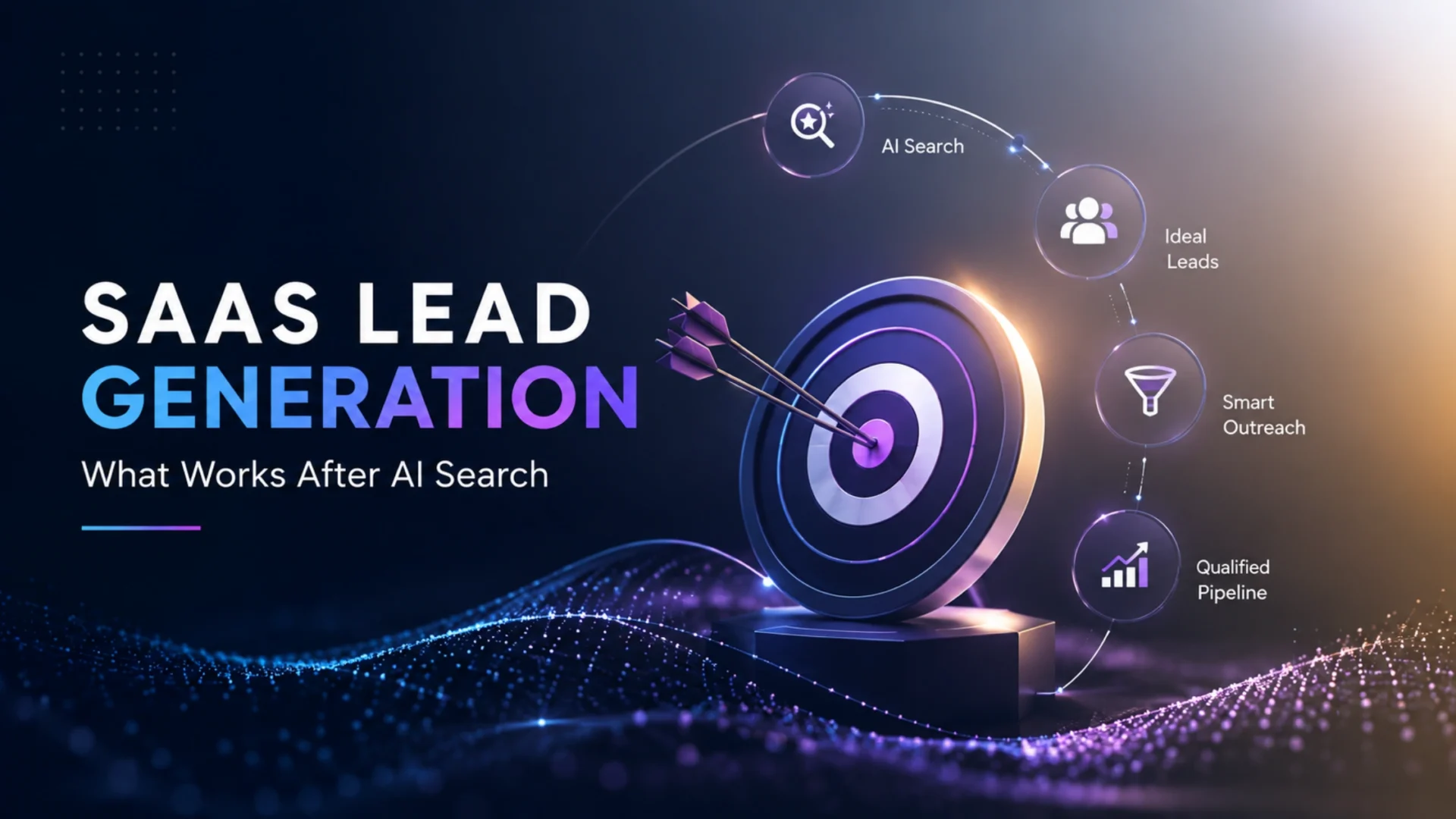
By the time a B2B software buyer fills out your demo form, they’ve usually made up their mind. They compared you against three competitors, read a Reddit thread, asked ChatGPT which tool fits their stack, and skimmed a couple of review sites. None of that happened on your website. That’s the part of SaaS lead generation that quietly broke over the last two years, and most playbooks haven’t caught up.
The old model assumed you could catch a buyer early and walk them through a funnel you controlled. AI search ended that. Buyers now do the bulk of their research inside answer engines and AI Overviews, surfacing only when they’re already close to a decision. Most of the purchase is finished before a vendor ever hears from them, a shift HubSpot’s marketing research has tracked steadily across recent years. Rank on Google alone and you’re showing up to a conversation that’s already half over.
What you’ll get from this guide:
A clear definition of modern SaaS lead generation, how AI search rewrote buyer behavior, a four-stage framework that holds up in 2026, the seven strategies actually pulling pipeline today, the channels worth your budget, the metrics that matter, and a straight answer on whether to hire an agency or build in-house.
What SaaS Lead Generation Means Now
SaaS lead generation is the work of turning strangers into qualified prospects for a subscription software product. Attract the right people, earn enough trust that they raise a hand, and route them to sales or a self-serve trial. Simple to say. Harder than it looks, because software buyers behave nothing like other buyers.
Why SaaS is a different animal
Sell a one-time product and the job ends at the sale. Sell software on a recurring contract and the relationship is the whole point. That changes everything upstream. Deals involve more people, run longer, and hinge on whether the buyer believes the tool will still fit their workflow a year from now. Gartner’s buying-journey research puts a typical B2B purchase in the hands of a group of six to ten decision makers, each arriving with their own questions and their own short list. You aren’t convincing one person. You’re convincing a committee that mostly never talks to you directly.
So the lead that matters isn’t just an email address. It’s a contact with budget, fit, and intent, attached to an account where several stakeholders already trust your brand. That bar is higher than traditional lead gen ever set.
The modern SaaS funnel, stage by stage
The funnel hasn’t disappeared. It’s just gotten less linear and more self-directed. Here’s the shape most SaaS teams work with today.
Read it top to bottom and notice how much of the work sits at the wide end. Awareness and consideration are where AI search now intervenes most, and where the biggest shift has happened. That’s where the next section starts.
How AI Rewrote SaaS Lead Generation
Two years ago, the goal was a number-one ranking. Get to the top of the results page, capture the click, and the lead was yours to nurture. Then answer engines started giving buyers the answer directly, no click required, and the ground moved.
Buyers research without ever landing on you
A SaaS buyer in 2026 might type “best project management tool for remote agencies” into ChatGPT, get a ranked rundown with reasoning, ask a follow-up about pricing, and walk away with a short list, all without visiting a single vendor site. Google’s AI Overviews do the same at the top of the results page. The research still happens. It just happens somewhere you can’t put a form.
Gartner research has long shown that B2B buyers spend only about 17 percent of their total purchase time meeting with potential suppliers, and even less with any single one. AI answer engines have pushed that number further in the buyer’s favor. By the time you’re in the room, the comparison is mostly done.
of B2B buying time spent meeting suppliers, per Gartner
decision makers in a typical software buying group
surfaces to win now: Google, AI Overviews, ChatGPT, Gemini
Why a ranking alone stopped being enough
Visibility used to mean one thing: position on Google. Now it means being the answer an AI engine cites, the brand a model recommends, and the source it pulls a definition from. Those are different jobs. A page can rank well and still get skipped by the AI summary sitting above it. Worse, the summary might recommend a competitor and never link you at all.
The practical response is to stop optimizing for a single results page and start optimizing for citation across engines. That means clear, extractable answers, real expertise an algorithm can trust, and structured content a model can quote without mangling. Teams that have already retooled their approach to AI search and answer engine strategies are the ones still capturing demand while everyone else watches their click-through rates erode.
A SaaS Lead Generation Framework That Holds Up in 2026
Tactics change every quarter. A framework gives you something stable to hang them on. This one runs in four stages, and each stage feeds the next. Skip a stage and the ones after it underperform, no matter how good your tactics are.
Stage 1: Build topical authority
Authority is what makes an AI engine willing to cite you and a buyer willing to trust you. You build it by covering a topic deeply enough that you become the obvious source, not by publishing one post and hoping. That means clusters of connected content, consistent expertise, and a clear point of view. This is slow work, and it compounds. A focused approach to content marketing built around topic clusters does more for long-term lead gen than any single viral post ever will.
Stage 2: Capture high-intent demand
Authority brings reach. Demand capture brings buyers. The difference matters. Someone searching “what is workflow automation” is curious. Someone searching “workflow automation tool pricing” is shopping. Your content needs to meet both, but the second group is where pipeline lives. Strong, intent-matched SEO services aimed at bottom-funnel queries usually return faster than top-funnel reach, even if the volume is smaller.
Stage 3: Convert visitors into leads
Traffic that doesn’t convert is just expensive applause. Conversion is about reducing friction at the moment of intent: a clear offer, a short form, a trial that starts in one click, a demo booking that takes thirty seconds. Most SaaS sites lose leads here not because the offer is wrong but because the path is clumsy.
Stage 4: Nurture and qualify
Not every lead is ready to buy, and chasing the ones that aren’t burns your sales team out. Nurturing keeps warm prospects engaged while qualification sorts them by readiness, so sales spends time on the accounts that will actually close. Done right, this stage quietly raises every downstream number.
7 SaaS Lead Generation Strategies That Deliver in 2026
This is the part to bookmark. The framework above tells you where to aim. These seven strategies are what actually moves pipeline this year, ordered roughly from foundation to acceleration. You don’t need all seven on day one. You need the first two working before the rest matter.
|
1
|
Optimize content for AI searchIf buyers research inside answer engines, your content has to be quotable by them. That means direct answers near the top of every page, structured formatting a model can extract, schema markup, and genuine expertise the engine can verify. The brands getting cited in AI Overviews and ChatGPT answers aren’t lucky. They built for it. This is the foundation, which is why a deliberate generative engine optimization approach now sits at the center of serious SaaS lead programs rather than off to the side. Foundation, start here |
|
2
|
Create high-intent SEO contentTop-funnel content builds reach. Bottom-funnel content builds pipeline. The queries that convert sound like a buyer with a wallet open:
These rarely have huge volume. They convert anyway. Prioritize them over chasing a viral top-funnel piece. |
|
3
|
Build comparison and alternative pagesWhen a buyer searches “Asana vs Monday” or “alternatives to Salesforce,” they are deep in evaluation and ready to act. Comparison and alternative pages capture that intent directly, and AI engines love them because the format answers the question cleanly. The catch: be honest. A rigged comparison that pretends competitors have no strengths reads as marketing and gets ignored by readers and models alike. |
|
4
|
Use LinkedIn for demand generationFor B2B SaaS, LinkedIn is where decision makers actually pay attention. The shift worth understanding is from lead generation to demand generation: instead of gating everything behind a form, you give value openly, build recognition with the buying committee, and capture the demand when it converts. Notion is a textbook case of this beyond LinkedIn too, growing largely through an open template gallery and a community that shares setups freely, which builds preference long before anyone signs up. LinkedIn’s B2B Institute research points to the same idea: brand familiarity built before the buyer is in-market is what tips the short list later. Brand now, capture later |
|
5
|
Create interactive lead magnetsThe gated PDF is tired. Buyers know a generic ebook isn’t worth their email. What still works is interactive: an ROI calculator, a readiness assessment, a benchmarking tool, a free audit that returns a real result. HubSpot built much of its inbound engine on exactly this, with free tools like its Website Grader and a free CRM tier that pull people in by delivering value first and asking for the relationship later. A calculator that shows a prospect they’re overspending by a specific amount earns the demo on its own. |
|
6
|
Run intent-based outboundCold outbound to a random list is mostly noise. Intent-based outbound is different. You reach out to accounts already showing signals, a competitor page visit, a pricing view, a relevant trigger event, with a message that references their actual situation. Lower volume, far higher response. The skill is in the targeting and the timing, not the send count. |
|
7
|
Lead with customer success storiesBuyers trust other buyers more than they trust you. A specific case study with a named outcome does more to convert a skeptical committee than a page of feature claims. The best ones read like a story: here was the problem, here’s what changed, here’s the number. Place them at the evaluation stage where trust is the deciding factor, not buried on a page nobody finds. |
Notice the progression. Strategies one through three build a base that works while you sleep. Four through seven accelerate it. Pour budget into acceleration before the base exists and you’re amplifying a signal that isn’t there yet.
Which Lead Generation Channels Are Worth It
Every channel claims to be the best. None of them is best for everyone. The right mix depends on your price point, sales motion, and how long your buyers take to decide. Here’s an honest read on the common ones.
The honest read: organic and AI search win on the long game because the cost per lead drops over time while paid stays flat or climbs. Paid search buys speed when you need pipeline this quarter, but the moment you stop paying, the leads stop. A healthy mix usually pairs a compounding channel with a fast one, then tightens the conversion path between them with disciplined conversion rate optimization so none of that hard-won traffic leaks.
The Metrics That Actually Tell You Something
Lead volume is a vanity metric. A thousand bad leads is worse than fifty good ones, because someone has to work them. These are the numbers worth watching, and HubSpot’s B2B benchmarks are a reasonable place to sanity-check your own against the market.
The one ratio to internalize is LTV to CAC. If a customer is worth far more than it costs to win them, spend more to win them. If that gap is thin, no amount of lead volume fixes the business. Watch that ratio before you watch anything else.
Should You Hire a SaaS Lead Generation Agency?
There’s no universal answer, only a fit. The real question isn’t agency or in-house. It’s where your team is strong, where it’s stretched, and how fast you need to move.
In-house makes sense when
You have deep product knowledge that’s hard to transfer, a long-term content engine you want to own, and the headcount to run it consistently. Owning the function builds an asset that stays with you.
An agency makes sense when
You need specialized skills fast, want to scale without hiring, or lack in-house depth in technical SEO and AI search. The right partner brings a playbook you’d spend a year building alone.
Before you sign anything, ask the hard questions. How do they measure success, and is it pipeline or just leads? Can they show results in your category, not a generic case study? How are they adapting to AI search specifically? A partner who can’t answer the last one cleanly is selling last year’s playbook. It’s worth studying how a strong lead generation strategy is structured before you evaluate anyone, so you know what good looks like.
The verdict: for most growth-stage SaaS teams, a hybrid wins. Keep product-led content and positioning in-house where the knowledge lives, and bring in a partner for the technical and AI-search heavy lifting your team can’t staff fast enough.
Where SaaS Lead Generation Goes Next
The direction is clear even if the timing isn’t. A few shifts are already visible and worth preparing for now rather than reacting to later.
AI agents are starting to do buyer research autonomously, which means your content increasingly has to satisfy a machine evaluating you on a human’s behalf. First-party data is becoming the backbone of targeting as third-party signals fade, so the brands collecting their own intent data win. Buyer intent intelligence is getting sharper, letting teams reach accounts at the exact moment they enter the market. And the whole function is tilting toward revenue, not leads, as the metric that earns budget. Salesforce’s State of Marketing research has tracked this move toward AI-assisted, revenue-accountable marketing across recent editions.
The teams that win the next two years won’t be the ones with the biggest budgets. They’ll be the ones who treated AI search as a foundation rather than a feature, and built the data and content assets that compound. A clear AI strategy applied to demand generation, not just product, is what separates them.
The Short Version
AI didn’t kill SaaS lead generation. It moved it. Buyers research in answer engines now, decide before they ever reach you, and arrive as a committee with a short list already formed. The response isn’t to abandon what worked. It’s to build for visibility across every engine a buyer might ask, capture the high-intent demand that signals real purchase intent, and earn trust before you ask for anything.
Start with the foundation. Get found by AI search, win the high-intent queries, and tighten your conversion path. Layer the acceleration once that base holds. Measure pipeline and the LTV to CAC ratio, not raw lead counts. Do that consistently and the leads compound while your competitors keep paying for clicks that dry up the moment the budget does.
Ready to Build a SaaS Pipeline That Compounds?
We help SaaS teams build lead generation systems engineered for AI search, high-intent demand, and revenue, not just lead counts. From topical authority to conversion-ready SaaS product and growth support, let’s map where your pipeline is leaking and what to fix first.
Frequently Asked Questions
What is SaaS lead generation?
SaaS lead generation is the process of attracting and qualifying potential buyers for a subscription software product, then routing them to sales or a self-serve trial. Because SaaS deals involve recurring revenue and multiple decision makers, a qualified lead means a contact with budget, fit, and intent inside an account, not just an email address.
What are the best SaaS lead generation strategies in 2026?
The strategies delivering results now are optimizing content for AI search, creating high-intent SEO content, building honest comparison and alternative pages, running LinkedIn demand generation, offering interactive lead magnets, using intent-based outbound, and leading with customer success stories. Start with AI search and high-intent SEO before layering the rest.
How does AI search impact SaaS lead generation?
AI search lets buyers research and compare software inside answer engines like ChatGPT, Gemini, and Google’s AI Overviews without visiting vendor sites. Most of the buying decision now happens before a prospect contacts you, so the goal shifts from earning a click to becoming the answer those engines cite and recommend.
What is the difference between demand generation and lead generation?
Lead generation captures contact details from people who raise a hand. Demand generation builds awareness and trust earlier, often without gating content, so buyers already know and prefer your brand by the time they’re in-market. Most strong SaaS programs run both: demand generation feeds the pipeline that lead generation later captures.
Is outbound lead generation still effective for SaaS companies?
Yes, when it’s intent-based rather than spray-and-pray. Reaching accounts that show buying signals, such as a competitor page visit or pricing view, with a message tied to their actual situation produces far better response rates than mass cold outreach. The value is in the targeting and timing, not the volume.
Should SaaS companies focus on SEO or paid advertising?
It depends on your timeline. Paid search buys pipeline fast but stops the moment you stop spending. SEO and AI search compound, lowering cost per lead over time. Most teams pair the two: paid for immediate pipeline, organic and AI search for the long-term engine that keeps producing without ongoing spend.
When should a business hire a SaaS lead generation agency?
Consider an agency when you need specialized skills quickly, want to scale without adding headcount, or lack in-house depth in technical SEO and AI search. Keep product-led content and positioning in-house where your knowledge lives. A hybrid model works well for most growth-stage SaaS teams.
How long does SaaS lead generation take to show results?
Paid channels can produce leads within days. Organic and AI search typically take a few months to gain traction and longer to compound, since authority builds gradually. Results vary with your market, competition, and how consistently you publish, so baseline your numbers early and measure the trend rather than expecting an overnight lift.