




- What is Product Development Strategy?
- Why Product Development Strategy is Critical for Business Growth
- Key Components of a Successful Product Development Strategy
- Product Development Strategy Process (Step-by-Step)
- Popular Product Development Strategy Frameworks
- Product Development Strategy for Startups vs Enterprises
- Digital Product Development Strategy in 2026
- Common Product Development Strategy Mistakes to Avoid
- Real-World Product Development Strategy Examples
- Slack
- Airbnb
- How to Measure the Success of Your Product Development Strategy?
- How to Build a Winning Product Development Strategy (Actionable Tips)
- Conclusion
- Ready to Build a Product Development Strategy That Actually Gets Used?
- Frequently Asked Questions
- What is a product development strategy?
- How do you create a product development strategy step by step?
- What are the key stages of product development?
- What is the difference between product strategy and product development strategy?
- Which framework is best for a product development strategy?
- How do startups approach product development strategy differently?
You have built an amazing SaaS platform. But it failed to capture the market. Sounds familiar?
The team was capable. The budget was there. The product had great features. But the planning went sideways between the first brainstorm and the actual launch.
When you dig into why, it comes back to the same thing. There was no clear product development strategy that would serve as a roadmap.
That’s what this guide is about.
Quick context: A product development strategy isn’t just a planning document. It’s the framework that decides how fast you move, how well you spend, and whether you actually build something the market wants. This guide covers the full picture — from components and frameworks to step-by-step process and real-world examples.
What is Product Development Strategy?
A product development strategy is the structured plan that takes your idea from concept to a market-ready product. It answers the questions your team will end up arguing about at some point anyway: Who are we building this for? What problem does it solve? How do we actually get it built? And how do we know when we’ve gotten it right?
Now, here’s a distinction worth making. A lot of people use “product strategy” and “product development strategy” interchangeably, but they’re not the same thing. Product strategy is about what to build and why. Product development strategy is about how to build it. The process, the sequencing, the resources, the decisions at each stage.
In 2026, this matters more than it probably did five years ago. AI is shortening development cycles. Competition arrives faster and from more directions. Businesses that move quickly without direction tend to end up building things the market didn’t ask for. A clear strategy is what keeps speed from becoming a liability.
Definition at a Glance
Product strategy defines what to build and why. Product development strategy defines how to build it — the process, sequencing, resources, and decisions at every stage from idea to market.
Why Product Development Strategy is Critical for Business Growth
Here’s what a well-built product development strategy actually does, practically speaking. And if your team needs more structured direction on aligning strategy with business goals, exploring product strategy consulting is a smart starting point before you begin building.
And yes, this list looks obvious when it’s laid out like this. But you’d be surprised how many businesses skip the strategy entirely and go straight to building. They figure they’ll adapt as they go. Sometimes that works. More often, it doesn’t, and the cost of course-correcting halfway through is significant.
Good product development strategies don’t slow teams down. They save teams from the kind of rework that really slows them down.
Key Components of a Successful Product Development Strategy
No two strategies look the same. But successful product strategies have similar building blocks. Get these right, and everything else becomes easier to figure out.
|
1
|
Market Research and Customer InsightsYou cannot build a good product for people you don’t understand. It’s not just about collecting data — it’s about building a real picture of who your customer actually is (not who you assume they are), what’s genuinely frustrating them right now, what they’re already using to solve the problem, and why those existing solutions aren’t quite cutting it. Surveys give you patterns across a large group. One-on-one conversations give you the why behind those patterns. Both matter. But if you only have time for one, talk to people. |
|
2
|
Product Vision and GoalsHere’s the thing about teams without a clear product vision: every decision becomes a debate. A well-defined vision cuts through that confusion. It gives your team a reference point. So when a new idea comes up, your teams know the end goal and make the correct choice. Less confusion. More confidence and better productivity. Your goals should be specific and measurable. “Build something people love” is not a goal. “Reach 500 active users within 90 days of launch” is. |
|
3
|
Competitive AnalysisIt’s more about understanding what your competitors aren’t doing. Where are they falling short? Which customer segments are they ignoring? What complaints keep showing up in their reviews? That’s where the real opportunity tends to live. Not in building a slightly better version of what already exists. But in finding the gap the market hasn’t filled yet. |
|
4
|
Technology and Innovation PlanningThe tools you choose shape the product you can build. So this isn’t a decision to make casually or default to whatever the team already knows. In 2026, this also means being deliberate about AI. Most teams are using it in some form now. But the ones getting real value from it aren’t using it to replace judgment. They’re using it to handle the repetitive, time-consuming work so that attention can go toward the decisions that actually require a human. |
|
5
|
Go-To-Market AlignmentThis is the component that gets underestimated most often. And it’s also the one that tends to sink otherwise good products. Go-to-market alignment means product and marketing are not operating in separate lanes. They’re working from the same customer understanding, launch timeline, core messaging, and definition of what success looks like. When these aren’t aligned, you end up with a ready product but a market that wasn’t prepared for it. Both are avoidable — but only if alignment is treated as part of the strategy, not an afterthought. |
Get these five components in place before you start building, and you’ll spend a lot less time untangling problems that could have been avoided.
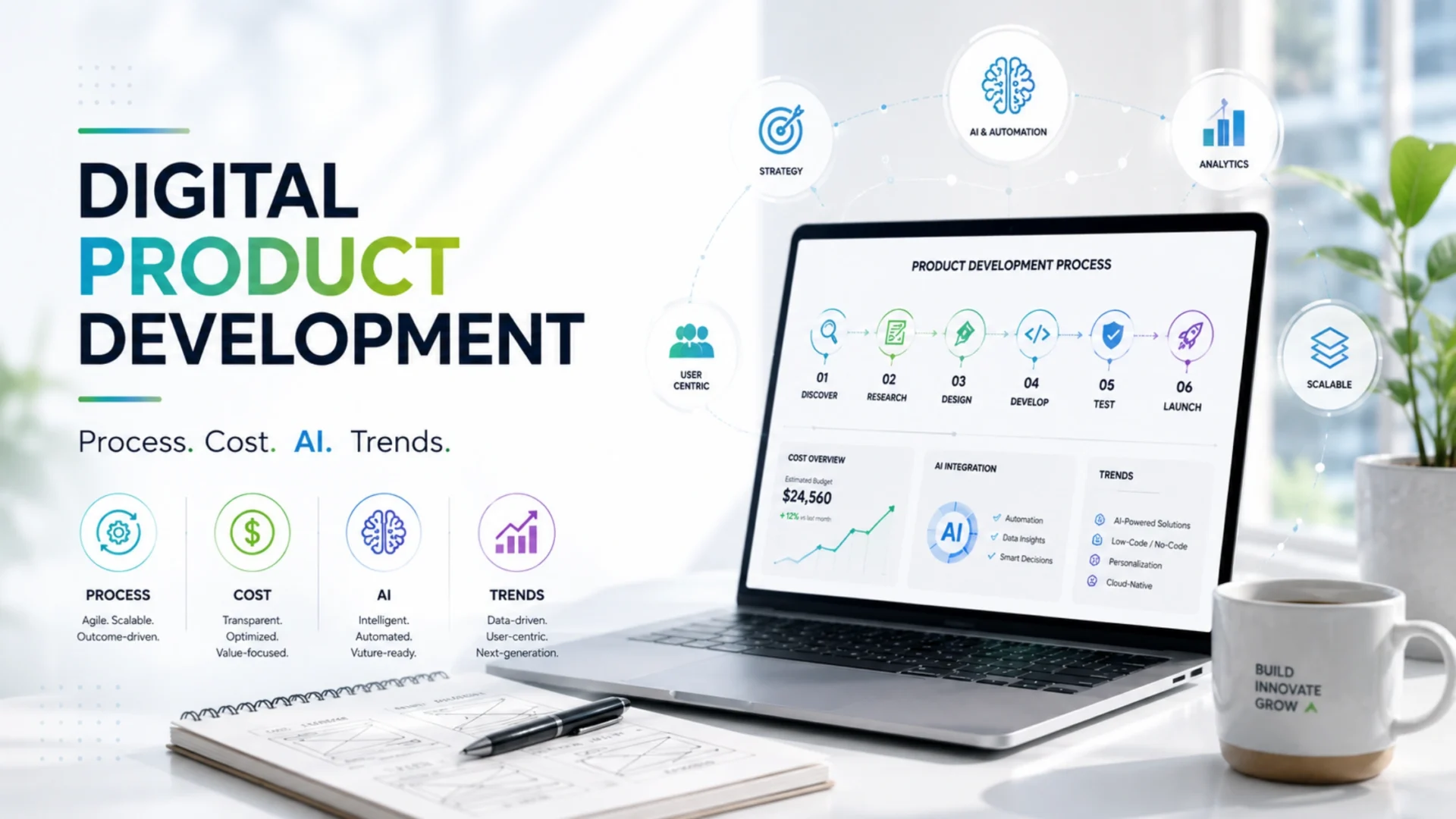
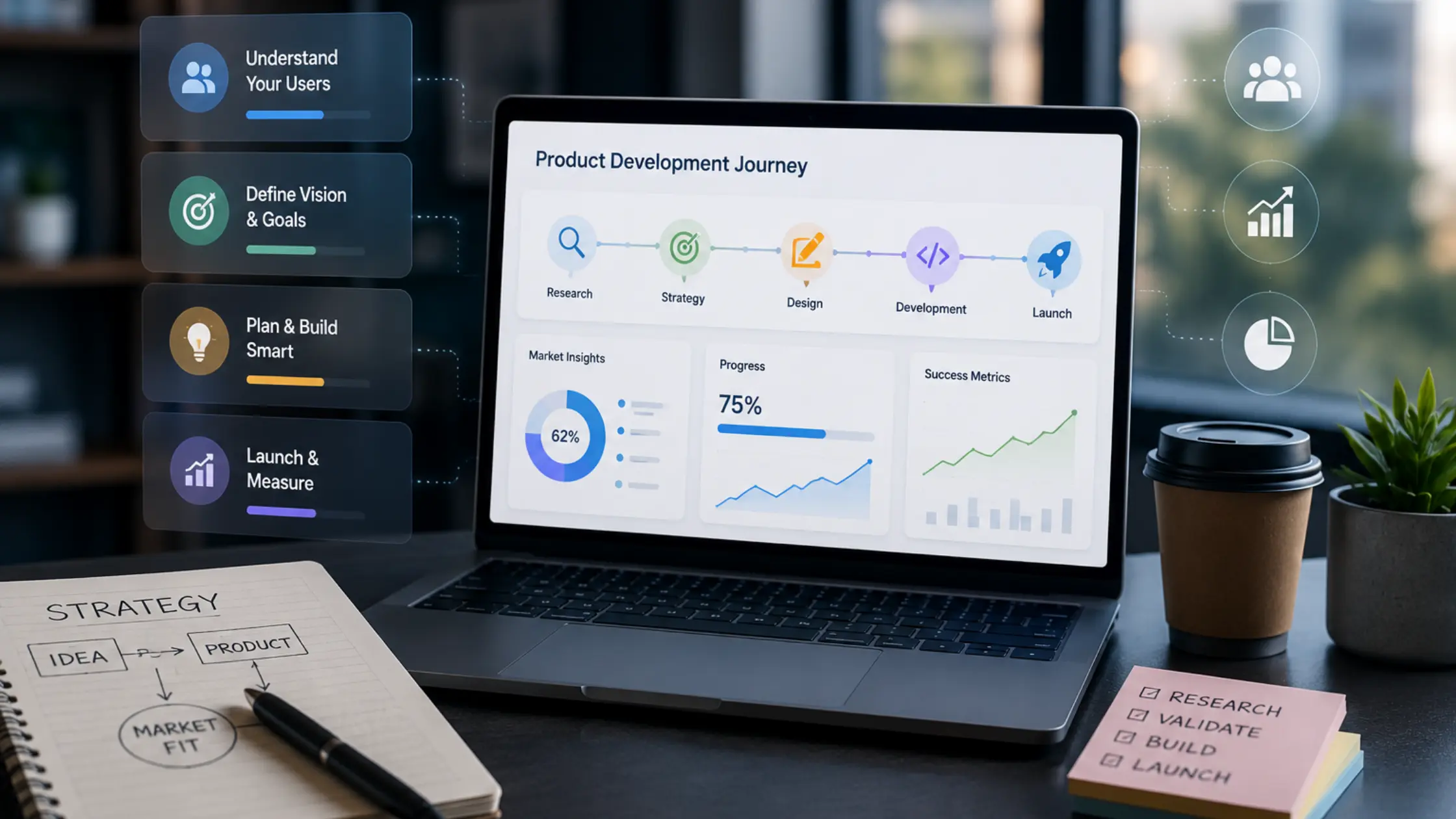
Product Development Strategy Process (Step-by-Step)
This is probably why you’re here, so let’s walk through how to create a product development strategy.
|
1
|
Step 1: Idea Generation and ValidationEvery product starts with an assumption. The question is whether you test that assumption before or after spending months building. Validation doesn’t need to be a big, formal process. Talk to potential customers. Run a simple landing page. Look for real evidence that the problem exists and that people would actually pay to solve it. Understanding the core principles of MVP software development can help you structure validation the right way from day one. A founder who spends three months building a project management tool before discovering her target audience already uses five project management tools and isn’t looking for another one could have learned that in two weeks of conversations. Validation is cheap. Building the wrong thing is not. |
|
2
|
Step 2: Market Research and FeasibilityOnce an idea shows real promise, you pressure-test the opportunity. How large is the market, realistically? What does it cost to acquire a customer? Are there technical, regulatory, or competitive factors that haven’t been accounted for yet? This is also where you stress-test the business model. Product-market fit without a viable path to revenue is just an expensive proof of concept. |
|
3
|
Step 3: Product Design and PrototypingA prototype exists to answer questions, not to impress people. Build the smallest version that actually tests your core assumption. Then get it in front of real users. And watch what they do with it, not just what they say about it. Behavior tends to be more honest than feedback. |
|
4
|
Step 4: Development and TestingThis is where the build happens in earnest. Testing isn’t a final phase that happens before launch. It runs alongside development the whole way through. Unit tests, user acceptance testing, QA reviews. The teams that treat testing as optional tend to be the ones explaining bugs to frustrated customers six weeks after launch. |
|
5
|
Step 5: Product Launch StrategyA release date is not a product launch strategy. A real new product launch strategy defines the audience you’re reaching, the channels you’re using, the messaging you’re leading with, and the metrics you’re tracking. It also defines what success looks like at 30, 60, and 90 days. So before launch, ask yourself: if the numbers are good, which numbers are those? If you can’t answer that, the strategy isn’t finished yet. |
|
6
|
Step 6: Post-Launch OptimizationThe launch isn’t the finish line. It’s more like the start of the next phase. The feedback that comes in after launch is often the most honest data you’ll collect, because it’s based on real behavior, not anticipated behavior. Build a feedback loop in from day one, and plan for iteration from the start. |
Popular Product Development Strategy Frameworks
Different product strategy frameworks work better in different situations. Here’s an honest look at three that come up most often:
Agile in particular benefits from a disciplined quality process — learning more about agile testing methodology can help teams avoid the most common pitfalls of fast-paced development cycles. Most experienced product teams borrow from all three depending on where they are in the cycle. That’s not inconsistency. That’s good judgment.
Product Development Strategy for Startups vs Enterprises
The truth is that there’s no single “correct” way to approach product development strategy. What works for a 10-person startup will create bottlenecks in a 500-person enterprise, and vice versa. The context shapes the approach.
So instead of prescribing one method, here’s how the two actually differ across the dimensions that matter most:
Digital Product Development Strategy in 2026
AI has genuinely changed what’s possible here, and also what customers expect.
Development cycles are faster. Personalization is more precise. Data is more abundant than most teams know what to do with. But here’s the observation worth sitting with: the businesses getting the most out of this shift aren’t necessarily the ones with the most AI tools. They’re the ones using data to make decisions that used to rely entirely on gut instinct.
Which features to prioritize? Which customer segments to focus on first? Where users are dropping off and why. A strong digital product strategy in 2026 treats that data as an ongoing feedback mechanism, not just something to include in a quarterly report.
The shift worth noting: The businesses getting the most from AI-powered development aren’t using it to replace judgment. They’re using it to handle repetitive, time-consuming work so that human attention can go toward decisions that actually require it.
Common Product Development Strategy Mistakes to Avoid
These show up across industries and company sizes. Avoid these mistakes for successful product launch strategies 2026:
Skipping Market Research
Because the team is already confident in the idea. Confidence and correctness are not the same thing, and the market doesn’t care which one you had.
Ignoring Customer Feedback
Because it complicates the roadmap. The complicated feedback is usually the most useful. It’s pointing at something real.
Weak Product Positioning
Even a genuinely good product gets overlooked when positioning is weak. If customers can’t quickly understand what it does and why they need it, they move on. That’s just how it works.
Poor Launch Strategy
A good product that reaches the wrong audience with unclear messaging doesn’t get a fair chance, regardless of how much work went into building it. Reviewing the biggest MVP launch mistakes before go-live can save you from the most costly ones.
Worth remembering: Most of these mistakes aren’t a result of bad teams. They’re a result of teams moving without a strategy. The fix isn’t talent — it’s structure.
Real-World Product Development Strategy Examples
Slack
Slack didn’t start as a messaging product. The team was building a game. The internal communication tool they created for themselves turned out to be far more valuable than the game ever was. They validated that other teams had the same problem, made the pivot, and built a product development strategy around that insight. The original product was rough. The strategy behind it was clear.
Airbnb
In the early days, the founders didn’t immediately try to scale. They went to New York, met their hosts in person, and photographed listings themselves. That direct, on-the-ground validation shaped their entire product development strategy. They understood the user experience at the granular level before trying to build systems around it.
You’ll notice the same thread running through both: the strategy came from genuine customer understanding, not from assumptions made at a whiteboard.
How to Measure the Success of Your Product Development Strategy?
A strategy without measurement is just a plan you hope works out. Track these — and set your benchmarks before launch:
How to Build a Winning Product Development Strategy (Actionable Tips)
- Keep it data-driven. Opinions are a starting point. Data is what you make decisions from.
- Align with business goals. A product that succeeds on its own terms but doesn’t support broader business growth isn’t actually a success. The two have to connect.
- Focus on user experience. Features get copied. A well-built user experience is much harder to replicate quickly.
- Iterate continuously. Markets shift. Customer needs shift. Build in regular reviews so the strategy stays current, and treat every version as a step rather than a destination.
And honestly, the teams that execute this well aren’t always the ones with the biggest budgets. They’re the ones who stay close to their customers, stay honest about what the data is telling them, and resist the temptation to fall in love with their own assumptions.
Conclusion
A product development strategy isn’t a formality you complete before the real work starts. It is the real work. It’s the difference between building something and building the right thing, for the right people, in a way that’s actually sustainable.
The following product strategy framework step-by-step isn’t complicated.
If you’re launching something new or scaling something that’s already working, a clear product development strategy — supported by the right product development services — is the highest-leverage investment you can make before writing a line of code or spending a dollar on marketing.
The right measure isn’t what strategy costs — it’s what it returns. A well-defined strategy that prevents a wrong-direction build saves more than the time it takes to write it down. A poorly scoped one that gets ignored costs far more than the meeting hours that went into it.
Ready to Build a Product Development Strategy That Actually Gets Used?
Get in touch. We work with startups and established businesses to build practical, structured roadmaps that are grounded in reality — and actually move the needle.
Frequently Asked Questions
What is a product development strategy?
It’s a structured plan for taking a product from initial idea to market. It covers research, design, development, launch, and what happens after launch, including how you iterate based on real feedback.
How do you create a product development strategy step by step?
Start with idea validation. Move through market research, feasibility analysis, product design, development, and launch planning. Then build in a post-launch feedback loop so you can improve based on actual user behavior.
What are the key stages of product development?
Ideation, validation, design, development, testing, launch, and ongoing optimization. Each stage feeds into the next.
What is the difference between product strategy and product development strategy?
Product strategy defines what to build and why. Product development strategy defines how to build it: the process, the sequencing, and the decisions involved in getting from idea to market.
Which framework is best for a product development strategy?
It depends on your situation. Agile suits teams that need flexibility and fast iteration. Lean works well when minimizing waste is the priority. Design thinking is valuable when the problem itself isn’t fully defined yet. Most teams end up using elements of all three.
How do startups approach product development strategy differently?
They move faster, build MVPs to test assumptions quickly, and operate with a higher tolerance for uncertainty. The goal for the marketing strategy for a new product launch is to learn fast.