- The Present and Future of AI
- AI Changed Work When Nobody Was Looking
- AI Got Smarter by Getting Smaller
- Software Development Got Supercharged
- Get AI-Powered Development Support
- AI breakthroughs 2026: Industries Are Getting Rebuilt
- Finance Runs on Algorithms Now
- Healthcare Gets Precise
- Climate Tech Gets AI Boost
- The Problems Everyone Ignores Until They Can’t
- Energy Consumption Is Enormous
- Bias Gets Automated at Scale
- The Out-of-the-Box Ideas That Might Actually Become AI Industry Trends 2026
- Quantum Computing Could Accelerate Everything
- Neuromorphic Chips Mimic Brains
- Federated Learning Preserves Privacy
- AGI Question Gets More Urgent
- What Real People Need to Do With Latest AI Advancements 2026?
- Companies Need Strategy, Not Experiments
- Entrepreneurs Face Lower Barriers
- Everyone Needs Basic AI Literacy
- Wrapping Up
- FAQs
- 1. What makes the decade from 2026 to 2036 so important for AI?
- 2. What are the biggest AI breakthroughs expected in 2026?
- 3. How will AI change the way people work?
- 4. Why are companies moving toward smaller, domain-specific AI models?
- 5. How is AI transforming industries like healthcare and finance?
- 6. What are the biggest risks related to AI’s rapid growth?
- 7. Will AI replace developers, or make them more productive?
- 8. How can businesses prepare for the future of artificial intelligence?
Artificial intelligence stopped being futuristic sometime last year. Now it’s everywhere. Coffee shops. Law firms. Hospitals. Construction sites. Even farming operations. AI tools show up in places nobody expected them.
The pace? Honestly, it’s getting hard to keep up.
These latest AI advancements 2026 aren’t small improvements to existing tech. They’re wholesale changes to how businesses run, how professionals work, and how entire sectors operate.
Between 2026 and 2036, something fundamental shifts. Experts call it a “transformative decade.” That might sound like hype. But talk to anyone running a business. They’ll tell you—something’s different now. The future of artificial intelligence reaches into every profession.
So what’s the real story? What are these AI breakthroughs 2026 actually delivering? And more importantly, what does someone running a company or trying to advance their career need to know?
Let’s get into it.
The Present and Future of AI
AI Changed Work When Nobody Was Looking
AI assistants embedded themselves into Microsoft 365. Google Workspace. Slack. Generative AI trends just make things work better.
Tasks AI handles without human involvement:
- Email drafting that matches personal writing style
- Real-time meeting transcription with speaker identification
- Report generation, including data visualization
- Smart scheduling that actually understands priorities
- Document formatting to exact specifications
Companies measuring productivity see gains between 30-40% in knowledge work. That’s massive. An eight-hour workday compresses to five hours of actual necessary work.
But the story isn’t about job elimination. The latest AI developments 2026 are about eliminating the parts of jobs people hate anyway. What’s left? Strategic thinking. Creative problem-solving. Relationship building. Human judgment in ambiguous situations.
The future of AI at work looks straightforward: machines handle the predictable parts, humans handle the complex parts. Division of labor based on actual capability.
AI Got Smarter by Getting Smaller
The AI industry figured something out. Bigger models aren’t necessarily better models.
Companies kept increasing parameters, pushing models to massive sizes. They poured in more training data. They scaled computational power to extremes. All of it was meant to create “smarter” systems, but the industry eventually realized size alone wasn’t the answer.
Then reality intervened.
Most businesses don’t need an AI that knows everything about everything. They need AI that excels at their specific problems. Financial modeling. Medical diagnostics. Legal document analysis. Customer service for their particular industry.
How the AI industry trends 2026 pivoted:
|
Old Thinking |
New Reality |
|
Maximize model size |
Optimize for specific domains |
|
Centralized development |
Distributed open source collaboration |
|
Expensive training runs |
Cost-effective specialized systems |
|
General knowledge, frequent mistakes |
Focused expertise, reliable outputs |
Specialized models run faster. Costs significantly less. Deploy more easily. And in their domain? They outperform massive general models consistently.
Open source changed the game. Developers worldwide contribute improvements. Share discoveries. Build on each other’s work. Progress that used to take quarters now happens in weeks.
The latest AI trends May 2026 point clearly toward efficiency and specialization. Raw power takes a backseat to targeted intelligence.
Software Development Got Supercharged
Coding without AI assistance now feels archaic. GitHub Copilot appeared. Then competitors multiplied. CodeWhisperer. Cursor. Replit. Dozens more. Each one making developers faster, code cleaner, and bugs rarer.
These tools don’t just autocomplete. They understand context across entire codebases. Suggest complete functions. Spot security vulnerabilities. Generate comprehensive test coverage. Explain legacy code that the original developers don’t even remember writing.
What AI coding assistants actually do:
- Convert plain language into working code
- Generate complex algorithms from descriptions
- Identify bugs before code reaches production
- Write test suites automatically
- Refactor messy code into clean patterns
- Document functions and classes
Development teams report 40-50% faster delivery cycles. Features that required a month now take two weeks. Projects that seemed too ambitious become manageable.
Junior developers contribute meaningfully on day one. Senior developers tackle projects they previously considered too time-consuming. Everyone spends less time on syntax and more time on architecture.
The future of artificial intelligence in software extends beyond assistance though. Autonomous AI systems now handle workflows end-to-end. Describe a feature in normal language. The AI designs it. Implement it. Test it. Deploy it. All while following organizational conventions.
Not perfectly yet. But well enough to ship production code.
Five years from now? Autonomous AI will handle most routine development work. Humans will focus on product vision, user experience, and strategic technical architecture. The grunt work disappears.
Get AI-Powered Development Support
Let our team integrate intelligent coding assistants and automation tools to speed up your product delivery.
AI breakthroughs 2026: Industries Are Getting Rebuilt
Finance Runs on Algorithms Now
Banks adopted AI aggressively. Survival demanded it. Competitors moving faster meant losing market share. Every aspect of financial services transformed:
- Trading algorithms making microsecond decisions
- Fraud detection analyzing millions of transactions instantly
- Credit assessments outperforming human underwriters
- Portfolio optimization personalized at scale
- 24/7 customer service with intelligent conversation
The AI breakthroughs 2026 brought to finance focus on prediction accuracy. Models forecast market behavior, assess risk, and detect fraud with unprecedented precision.
Here’s what changed for regular people. Investment advice previously requiring $1 million in assets? Now available for $50 monthly subscriptions.
Healthcare Gets Precise
Medical AI carries the highest stakes. Mistakes kill people. But the technology proved itself.
Diagnostic AI outperforms doctors in specific, well-defined tasks. Not everything. But enough critical areas to save thousands of lives annually.
Healthcare AI achievements:
- Earlier cancer detection by 6-18 months (dramatically improving survival)
- Personalized treatment based on genetic markers
- Drug discovery 10x faster than traditional methods
- Administrative automation freeing doctors for patient care
- Continuous monitoring through wearable sensors
Precision medicine became standard practice. Treatments customized to individual patients. Based on genetics, lifestyle, environment, complete medical history. The future with AI in healthcare extends lifespans and improves quality of life. Starting now, not someday.
Climate Tech Gets AI Boost
Climate change demands solutions at scale. AI delivers tools that actually work. Energy optimization in buildings cuts consumption 20-30%. Industrial processes run radically more efficiently. Renewable energy systems coordinate through predictive modeling.
Agriculture transformed through precision farming:
- Water usage reduced 40% through optimized irrigation
- Pesticide application targeted precisely where needed
- Crop yields predicted months in advance
- Soil health monitored continuously
Environmental monitoring reached global scale. Satellites capture imagery. AI analyzes it for deforestation, ocean temperature changes, wildlife populations, ice sheet degradation.
The latest AI developments 2026 make environmental action measurable and adjustable. Organizations track impact. Modify approaches. See actual results.
Technology won’t solve climate change alone. But AI provides better tools for the fight ahead.
The Problems Everyone Ignores Until They Can’t
Progress always creates new problems. AI follows this pattern perfectly.
Energy Consumption Is Enormous
Training large AI models consumes staggering electricity. GPT-4’s training reportedly used more power than 1,000 homes use annually. Companies train larger models constantly.
Data centers multiply globally. Energy demand explodes. Carbon emissions rise despite efficiency improvements.
The uncomfortable reality:
- AI optimizes energy systems
- AI training burns massive energy
- Both statements stay true
- Nobody has solved this yet
Renewable energy helps some. Efficiency improvements matter. But scaling AI while reducing environmental impact? That’s the real challenge.
Bias Gets Automated at Scale
AI systems learn from historical data. Historical data reflects historical biases. Those biases get encoded into algorithms. Then automated across millions of decisions.
Hiring systems rejecting qualified candidates from certain demographics. Criminal justice tools perpetuating inequities.
The bias doesn’t come from malice. It comes from data reflecting an unfair world.
Hallucinations create different issues. AI generates false information confidently. Invents citations. Fabricates statistics. Sounds authoritative while being completely wrong.
Casual conversation? Annoying. Medical diagnosis or legal advice? Potentially catastrophic.
Regulations Are Coming
The European Union moved first and hardest. The AI Act establishes comprehensive rules for high-risk applications. Transparency requirements. Testing mandates. Human oversight obligations. These aren’t suggestions—they’re law with serious penalties.
The United States takes a messier approach. Federal guidelines. State regulations. Industry self-regulation. Sector-specific rules. The result? Complexity and confusion.
Regulatory landscape:
|
Region |
Strategy |
Key Requirements |
|
EU |
Unified comprehensive law |
Risk tiers, mandatory testing, transparency |
|
US |
Fragmented approach |
State-by-state variation, industry guidelines |
|
China |
Government control |
Content oversight, data sovereignty |
|
Others |
Adaptation |
Following EU or US frameworks |
Common themes emerge globally:
- Transparency in decision-making processes
- Accountability when systems fail
- Bias testing before deployment
- Data privacy in model training
- Extra scrutiny for high-risk uses
Nations operate with their own values, prioritize different outcomes, and follow distinct legal traditions, which makes global alignment on AI regulation challenging.
But the direction seems clear. The future of artificial intelligence includes serious governance. Not optional. Required.
The Out-of-the-Box Ideas That Might Actually Become AI Industry Trends 2026
Some AI industry trends 2026 point toward breakthroughs that sound impossible. Except the science checks out.
Quantum Computing Could Accelerate Everything
Quantum computers process information differently than classical computers. Fundamentally differently. Problems requiring centuries on supercomputers might solve in minutes.
For AI, this means potentially exponential training acceleration. Optimization problems taking weeks might complete in hours. Entirely new algorithm categories become computationally feasible.
Still mostly in labs. But progress accelerates quickly.
Neuromorphic Chips Mimic Brains
Current AI runs on standard processors. Works fine. But inefficient compared to biological brains.
Neuromorphic systems take a radically different approach. Mimic brain structure at the hardware level.
Advantages:
- Energy efficiency is 100x-1000x better than current chips
- Continuous learning without retraining cycles
- Better uncertainty handling
- More resilient to imperfect data
Commercial applications are years away. But research results look promising.
Federated Learning Preserves Privacy
Traditional AI requires centralized data. Collect everything in one place. Train the model. Deploy everywhere.
Privacy nightmare. Security risk. Regulatory headache.
Federated learning offers an alternative. Models train across distributed datasets. Data never leaves its source. Only model updates get shared.
Hospitals collaborate without sharing patient records. Banks improve fraud detection without exposing transactions. Phones contribute to AI training without compromising user privacy.
Technically complex. Increasingly practical.
AGI Question Gets More Urgent
Artificial General Intelligence remains theoretical. But the discussion intensified dramatically.
AGI would match human cognitive flexibility. Reason across completely different domains. Learn new tasks without specific training. Transfer knowledge between unrelated fields.
Current AI excels at narrow tasks. AGI would handle anything humans can handle. Maybe more.
Timeline estimates vary wildly. Some researchers say decades. Some say never. A few say within ten years.
Progress toward generalized intelligence continues. Each advance raises deeper questions about human-machine relationships.
What Real People Need to Do With Latest AI Advancements 2026?
Companies Need Strategy, Not Experiments
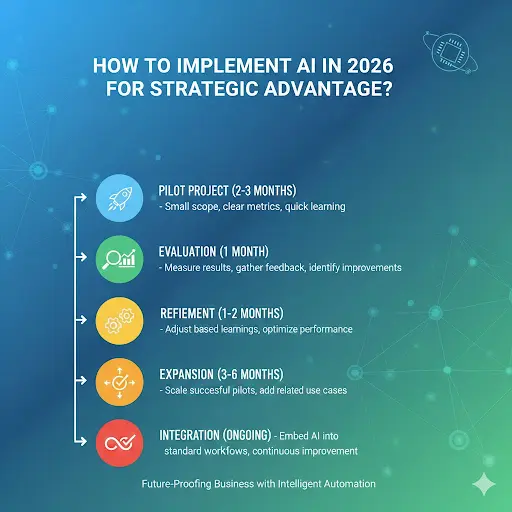
Random AI projects waste money and accomplish nothing. Strategic adoption follows clear patterns.
What actually works:
- Identify high-impact opportunities – Where does AI deliver measurable value quickly?
- Fix data quality problems first – Bad data produces bad AI
- Build necessary infrastructure – Cloud access, APIs, integration tools
- Train entire organization – Not just technical teams
- Scale successful projects – Pilots become organization-wide implementations
The latest AI advancements 2026 removed traditional barriers. Small companies compete with enterprises. Cloud services eliminate infrastructure costs. Pre-trained models reduce development time. Companies waiting are taking enormous risks.
Entrepreneurs Face Lower Barriers
Startups build sophisticated apps with tiny teams now. No massive infrastructure needed. No years of R&D. No specialized hardware.
Generative AI trends enable previously impossible capabilities:
- No-code platforms for complex applications
- AI-assisted design and development
- Automated marketing at scale
- Intelligent customer service from launch
- Rapid prototyping and testing
New business categories emerged:
- Specialized content creation services
- Personalized education platforms
- Industry-specific automation
- Niche analytics tools
Entry barriers dropped dramatically. The potential ceiling rose proportionally.
Everyone Needs Basic AI Literacy
Not everyone becomes a machine learning engineer. But understanding AI capabilities and limitations? That’s the baseline now. Essential skills by role:
| Profession | Core AI Competencies |
| Developers | AI-assisted coding, prompt engineering, API integration |
| Marketing | Content generation, analytics platforms, campaign optimization |
| Analysts | AI-powered data analysis, predictive modeling, visualization |
| Healthcare | Diagnostic tools, patient data interpretation, clinical AI |
| Education | Personalized platforms, content creation, assessment automation |
| Finance | Algorithmic analysis, risk modeling, automated reporting |
The future of AI transforms jobs more than eliminating them. People who adapt find opportunities. People are resisting and finding shrinking options. That’s observation, not judgment.
Wrapping Up
The upcoming decade will be defined by AI integration depth. Not as a separate technology. As fundamental infrastructure, like electricity or connectivity. Opportunities look substantial and real:
- Productivity gains that seemed impossible
- Solutions to previously unsolvable problems
- Democratized capabilities once requiring huge resources
- Tools amplifying human creativity and intelligence
Challenges look equally real:
- Environmental costs of infrastructure scaling
- Ethical deployment requires constant attention
- Equitable access across populations
- Workforce transitions and displacement
- Governance without innovation stifling
What happens depends on the choices made now. This week. This month. This year.
Organizations adopting AI thoughtfully while maintaining ethics will lead the way. Individuals developing complementary skills will thrive. Societies establishing balanced frameworks will capture benefits while minimizing harms.
The future of artificial intelligence isn’t predetermined by technology. It’s shaped by decisions from developers, executives, policymakers, researchers, and regular people using tools daily.
The future with AI started yesterday. Accelerated today. Tomorrow brings changes nobody fully predicts. Standing still stopped being an option.
Ready to navigate AI transformation? Start with tools in your field. Connect with others facing similar changes. Build capabilities that matter for what’s coming.
FAQs
1. What makes the decade from 2026 to 2036 so important for AI?
This decade is considered a turning point because AI is shifting from experimental tools to everyday infrastructure. Businesses, governments, and industries are adopting AI at scale. Models are getting cheaper, smarter, and more specialized, which means AI will touch everything from productivity tools to medicine, finance, and sustainability. The next ten years are about real-world impact, not just innovation.
2. What are the biggest AI breakthroughs expected in 2026?
AI breakthroughs in 2026 revolve around smarter small models, better reasoning, fewer hallucinations, stronger open-source ecosystems, and widespread integration in workplaces. Companies will rely on domain-specific AI rather than one giant model for everything. This makes AI faster, more reliable, and more affordable for everyday business use.
3. How will AI change the way people work?
AI will take over repetitive tasks like drafting emails, writing reports, analyzing meeting notes, and formatting documents. This doesn’t replace jobs — it removes the boring parts. People will spend more time on strategy, creativity, and decision-making. Productivity tools like Microsoft 365, Google Workspace, and industry-specific platforms will have AI built in by default.
4. Why are companies moving toward smaller, domain-specific AI models?
Because these models perform better for specific tasks. They’re faster, cheaper, easier to deploy, and often more accurate than massive general models. They can be trained on industry data, follow strict compliance rules, and avoid unnecessary complexity. This shift is one of the most important AI industry trends of 2026.
5. How is AI transforming industries like healthcare and finance?
In healthcare, AI helps detect diseases earlier, personalize treatments, automate administrative work, and monitor patient health in real time. In finance, AI strengthens fraud detection, improves forecasting, enhances customer service, and enables personalized investment insights. These sectors will see some of the fastest AI adoption between 2026 and 2036.
6. What are the biggest risks related to AI’s rapid growth?
AI still faces issues like hallucinated answers, biased decision-making, and heavy energy consumption. There’s also a global debate about safe deployment, transparency, and accountability. Regulations like the EU AI Act and U.S. policy initiatives will shape how AI is used in high-risk sectors such as healthcare, hiring, security, and finance.
7. Will AI replace developers, or make them more productive?
AI won’t replace developers — it will accelerate them. Tools like GitHub Copilot, Replit, Cursor, and agentic AI systems help with writing code, reviewing logic, fixing bugs, and generating tests. Developers spend less time on routine coding and more time on architecture and problem-solving. Future systems may even build features end-to-end, but human oversight will always be needed.
8. How can businesses prepare for the future of artificial intelligence?
Businesses should start by identifying high-value use cases, building clean datasets, training teams on AI tools, and running pilot projects. Once results are proven, they can scale AI across departments. Companies that adopt early will gain a major competitive edge, while those who wait may fall behind as AI becomes essential to everyday operations.