
 Zoho
Solutions
 Ecommerce
Development
 Web
Development
 AI
Solutions





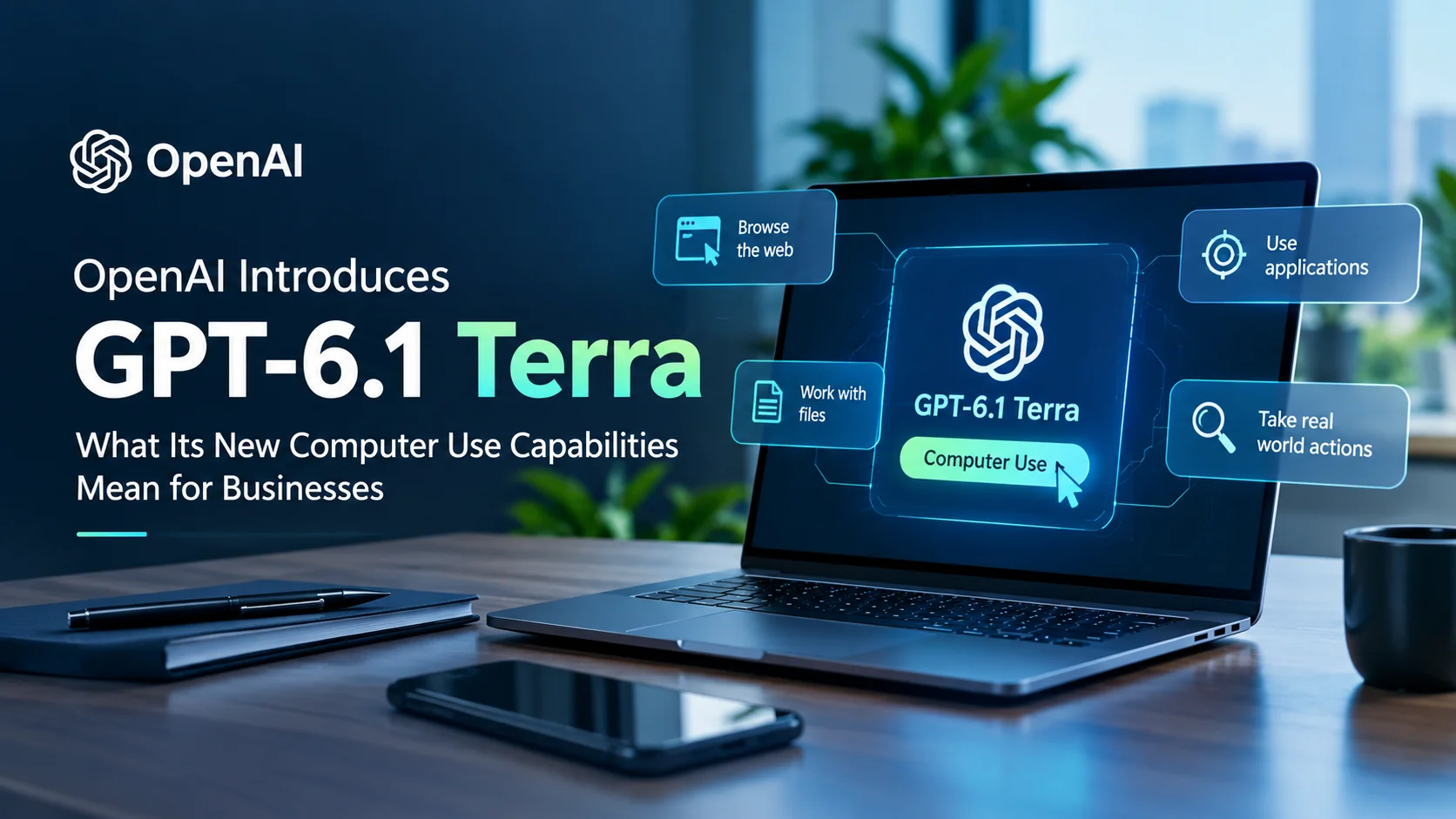
- GPT-6.1 Terra Pairs Visual Reasoning With Computer Use at a Much Lower Price
- What Is GPT-6.1 Terra?
- Why GPT-6.1 Terra’s Computer Use Capabilities Matter
- GPT-6.1 Terra Performance: What the Benchmarks Reveal
- 1. Improved Computer Use Performance
- 2. Stronger Visual Reasoning
- 3. Better Desktop Application Interaction
- 4. Improvements in Software Engineering
- 5. Reduced Factual Errors
- These Are OpenAI’s Own Evaluation Results
- How GPT-6.1 Terra Could Transform Business Operations
- Ecommerce Operations and Product Management
- Finance and Invoice Processing
- Customer Relationship Management
- Software Development and Maintenance
- Enterprise Data Management
- GPT-6.1 Terra API Pricing and Availability
- What to Consider Before Adopting Computer-Use AI
- What GPT-6.1 Terra Means for Enterprise Software Development
- Final Thoughts
- Key Takeaways
- Ready to Put AI to Work in Your Business Software?
- Frequently Asked Questions
OpenAI has introduced GPT-6.1 Terra, a new AI model designed to combine visual reasoning, computer use, and natural language capabilities for professional workflows. Announced on October 26, 2026, the model represents another step toward AI systems that can do more than generate text. It can interpret information displayed on screens and perform computer-based tasks through supported tools and environments.
The release focuses on making AI-powered computer interaction faster, more capable, and more cost-efficient. OpenAI says GPT-6.1 Terra improves on its predecessor, GPT-5.6 Terra, across visual understanding, software engineering, factual accuracy, and multi-step computer tasks.
For businesses, the announcement raises an important question: how can AI models interact with existing software applications to reduce repetitive work, improve operational efficiency, and support more connected digital workflows? It is especially relevant to organizations investing in enterprise automation, custom software, SaaS platforms, and AI-powered business applications.
GPT-6.1 Terra Pairs Visual Reasoning With Computer Use at a Much Lower Price
The model can read what is on a screen and act on supported applications, while standard API pricing is 50% lower than GPT-5.6 Terra. For businesses, the question is no longer whether AI can write text. It is whether AI can handle the repetitive, multi-app work your team does every day.
What Is GPT-6.1 Terra?
GPT-6.1 Terra is OpenAI’s latest model in its Terra series, built for visual reasoning, computer use, and professional productivity tasks. Unlike conventional AI interactions that mostly involve a text prompt and a text response, computer-use capabilities let an AI system interpret visual information and interact with supported computer interfaces.
A business may need to review invoices, extract relevant details, update records in accounting software, or organize information across several applications. An AI-powered workflow can assist with these activities by understanding what is on the screen and taking supported actions.
Model: GPT-6.1 Terra (API identifier: gpt-6.1-terra)
Announced: October 26, 2026
Available in: OpenAI API, ChatGPT Work, Codex, and Amazon Bedrock
Core strengths: visual reasoning, computer interaction, multi-step tasks, coding, factual accuracy, clearer writing
OpenAI positions the model as a fast and efficient option for everyday professional work. That mix of performance and cost makes it relevant to developers building AI-powered applications and to organizations exploring automation at scale.
Why GPT-6.1 Terra’s Computer Use Capabilities Matter
The most significant part of this release is the ability to combine visual understanding with computer interaction. Businesses rely on many platforms to run daily operations. Employees may switch between CRMs, spreadsheets, accounting tools, inventory platforms, and internal dashboards to finish a single task. Moving information between them still involves a lot of manual work.
Computer-use AI takes a different approach. Instead of depending only on hand-written instructions or conventional API integrations, a model can interpret supported interfaces and interact with them through an appropriate computer-use environment.
1. Open an invoice received from a supplier.
2. Identify the invoice number, date, vendor, and total amount.
3. Review the extracted information.
4. Open the accounting application.
5. Enter the relevant details.
6. Save the record for further processing.
An AI-powered workflow can assist with several of these steps, which cuts the repetitive interaction required from employees. OpenAI specifically names reading incoming invoices and entering their details into accounting software as a high-volume automation example.
One caution applies. Computer-use capabilities are not unrestricted or fully autonomous access to business systems. Actual execution depends on the available tools, application permissions, environment configuration, and appropriate human oversight.
GPT-6.1 Terra Performance: What the Benchmarks Reveal
OpenAI highlighted improvements across professional computer tasks, visual reasoning, software engineering, and factual accuracy. Here are the key results it reported.
1. Improved Computer Use Performance
OpenAI tested the model on Agents’ Last Exam, a benchmark of professional tasks that require reasoning and computer-based work. At medium reasoning effort, GPT-6.1 Terra scored 15 percentage points higher than GPT-5.6 Terra. OpenAI also reported comparable performance to GPT-6 Astra at roughly one-tenth of the price per token.
The benchmark includes tasks like interpreting architectural drawings and reviewing visual material to create detailed time-coded records. Professional computer tasks need more than understanding a written instruction. They involve reading visual information, spotting relevant details, and completing a sequence of actions.
2. Stronger Visual Reasoning
On MMMU-Pro, a benchmark for multimodal understanding and visual reasoning, OpenAI says the model outperformed GPT-5.6 Terra across every tested reasoning setting.
That could help workflows involving product photographs, technical diagrams, and design references. An ecommerce company could explore AI-assisted product image matching, and an engineering team could extract details from technical drawings. Practical value still depends on input quality, task complexity, and the tools available to the application.
3. Better Desktop Application Interaction
OSWorld 2.1 measures how AI agents use desktop applications to complete multi-step tasks. OpenAI reports that GPT-6.1 Terra at medium reasoning effort beat the best previous GPT-5.6 Terra score while lowering the cost per task.
This matters for organizations that depend on desktop software and complex application workflows. Developers can build AI-assisted processes around existing software instead of replacing established systems right away.
4. Improvements in Software Engineering
On Terminal-Bench 4.0, which evaluates coding agents on command-line engineering challenges, OpenAI reports a 50.3% success rate at maximum reasoning effort. The previously published score for GPT-5.6 Terra was 21.5%.
The results suggest usefulness for development assistance, debugging, and certain maintenance work. OpenAI notes that GPT-6.1 Sol and GPT-6 Astra remain better choices for the most complex software engineering tasks.
5. Reduced Factual Errors
On OpenAI’s internal benchmark of error-inducing prompts, the error rate at low reasoning effort fell from 53.6% with GPT-5.6 Terra to 16.7% with GPT-6.1 Terra. At maximum reasoning effort it dropped to 4.3%.
These Are OpenAI’s Own Evaluation Results
They are not a guarantee that the model will always produce accurate outputs. For business use, human review, validation rules, and reliable data sources remain important, especially when AI touches financial records, customer information, or operational systems.
How GPT-6.1 Terra Could Transform Business Operations
More capable computer-use models open opportunities across business functions. Instead of treating AI as a standalone chatbot, organizations can look at how it fits into their existing software infrastructure.
Ecommerce Operations and Product Management
Ecommerce companies manage large volumes of product information, images, pricing records, and inventory data, often from multiple suppliers and systems. Visual reasoning and computer use could support workflows such as:
- Matching supplier product images with existing catalog entries.
- Reviewing product information displayed in business applications.
- Identifying missing or inconsistent catalog details.
- Assisting with repetitive product data entry.
- Reviewing marketing assets for text placement and cropping.
For stores selling across multiple channels, AI-assisted workflows could reduce repetitive tasks and improve operational consistency.
Finance and Invoice Processing
Finance teams handle invoices, expense records, payment details, and supporting documents. Extracting that information and entering it into accounting applications consumes considerable time. GPT-6.1 Terra could interpret document information and help enter details into supported accounting software.
A more complete implementation would combine AI reasoning with document extraction, business rules, accounting integrations, and human approval. That lets organizations automate suitable administrative work while keeping control over financial decisions.
Customer Relationship Management
CRM platforms hold valuable data about customers, opportunities, conversations, and sales activity, but keeping records current is a repetitive job for sales teams. Computer-use AI could help review customer information, prepare record updates, and organize data. Combined with properly configured CRM APIs, AI agents could support more connected workflows across sales and customer management systems.
Software Development and Maintenance
Development involves more than writing code. Developers investigate bugs, inspect application behavior, review logs, update configurations, and test changes. Potential applications include:
- Assisting with debugging and issue investigation.
- Reviewing visual application behavior.
- Supporting repetitive development tasks.
- Organizing information from technical interfaces.
- Assisting with codebase investigation through connected tools.
The opportunity lies in combining AI with existing engineering processes, not treating AI-generated code as automatically production-ready.
Enterprise Data Management
Large organizations keep information across many enterprise applications, and moving it between systems creates bottlenecks and inconsistent records. AI-assisted computer workflows could help employees review information, identify relevant fields, and perform supported updates. For advanced implementations, developers can combine AI models with APIs, data pipelines, validation systems, and access controls to build intelligent business applications that connect previously disconnected workflows.
GPT-6.1 Terra API Pricing and Availability
Cost efficiency is a central part of this release. The model is available through the OpenAI API under the identifier gpt-6.1-terra. Here is the published standard pricing.
Source: OpenAI, Introducing GPT-6.1 Terra, October 26, 2026.
OpenAI states that this standard pricing is 50% lower than GPT-5.6 Terra and GPT-6.1 Sol. That makes the model attractive for developers building applications that process large volumes of routine business information.
It is also available to eligible Plus, Pro, Enterprise, and Edu users in ChatGPT Work and Codex. Amazon Web Services announced general availability of GPT-6.1 Terra on Amazon Bedrock on October 26, 2026, which gives teams building in the AWS ecosystem another deployment option.
Review the relevant platform documentation for regional availability, supported features, infrastructure requirements, and extra charges. Token pricing alone does not represent the full cost of deploying an AI-powered workflow.
What to Consider Before Adopting Computer-Use AI
The capabilities are promising, but practical requirements need checking before anything reaches production.
Security and access: set appropriate permissions, restrict unnecessary system access, and keep audit trails for important actions.
Human approval: add approval steps for payments, financial records, customer account changes, and other sensitive operations.
Integration method: where supported APIs exist, compare direct integrations against computer interaction for speed, reliability, and maintainability. A mix of APIs, AI reasoning, and computer-use tools often works best.
Reliability: plan for unexpected screens, incomplete information, application errors, and ambiguous instructions with validation, exception handling, monitoring, and recovery procedures.
Business value: measure outcomes, not just model benchmarks. Track task time, cost per completed workflow, error and correction rates, human intervention, processing volume, and overall efficiency.
A controlled pilot helps determine whether an AI-powered workflow delivers measurable value before it expands across departments.
What GPT-6.1 Terra Means for Enterprise Software Development
The release points to a broader shift: AI is increasingly used to interact with applications and support multi-step operational workflows. Enterprise automation has traditionally relied on predefined rules, API integrations, and robotic process automation. AI-powered computer interaction adds a layer that can interpret visual information and respond to changing interface conditions.
That does not make traditional automation or software integrations unnecessary. Businesses will likely combine conventional architecture with AI reasoning for workflows that mix structured data and visual information.
For software development companies, this creates room to build around specific business requirements. Examples include AI-powered internal tools, intelligent document-processing platforms, SaaS automation products, and enterprise applications that connect multiple systems. Purpose-built custom AI agent development tied to a company’s own software stack is where the strongest implementations will come from, because they pair a capable model with reliable architecture, secure integrations, and clearly defined business rules.
Final Thoughts
GPT-6.1 Terra is another step in the evolution of AI-powered business automation. Its gains in visual reasoning, computer use, coding, and factual accuracy give developers new ways to automate repetitive professional tasks.
For businesses, the bigger opportunity is not adopting another model. It is finding the workflows where AI delivers measurable improvement while security, reliability, and human oversight stay intact. The next phase of automation will depend not only on how capable the models become, but on how well organizations integrate them into their existing systems.
Key Takeaways
- OpenAI announced GPT-6.1 Terra on October 26, 2026, a model built for visual reasoning, computer use, and professional productivity tasks.
- Computer use scored 15 percentage points higher than GPT-5.6 Terra on Agents’ Last Exam at medium reasoning effort.
- Terminal-Bench 4.0 success reached 50.3% at maximum reasoning effort, up from 21.5% for GPT-5.6 Terra.
- Reported error rates fell sharply, from 53.6% to 16.7% at low reasoning effort and to 4.3% at maximum.
- API pricing is $1 input and $5 output per million tokens, 50% lower than GPT-5.6 Terra and GPT-6.1 Sol.
- The model is available in the OpenAI API, ChatGPT Work, Codex, and Amazon Bedrock.
- Human oversight still matters for any workflow touching financial records, customer data, or operational systems.
Ready to Put AI to Work in Your Business Software?
Our team builds custom software, SaaS platforms, and AI-powered business applications that connect your existing systems. Whether you want to automate invoice processing, streamline CRM updates, or pilot a custom AI agent, we can map a clear path forward.
Frequently Asked Questions
What is GPT-6.1 Terra?
GPT-6.1 Terra is OpenAI’s latest Terra series model, announced on October 26, 2026. It combines visual reasoning, computer use, and natural language capabilities for professional workflows such as invoice processing, product data review, and software engineering support.
How much does the GPT-6.1 Terra API cost?
Standard API pricing is $1 per million input tokens, $0.05 per million cached input tokens, and $5 per million output tokens. OpenAI states this is 50% lower than GPT-5.6 Terra and GPT-6.1 Sol.
Where is GPT-6.1 Terra available?
It is available through the OpenAI API as gpt-6.1-terra, in ChatGPT Work and Codex for eligible Plus, Pro, Enterprise, and Edu users, and on Amazon Bedrock, which reached general availability on October 26, 2026.
What does computer use mean in an AI model?
Computer use means the model can interpret what appears on a screen and interact with supported applications through an appropriate environment. Actual execution depends on available tools, application permissions, configuration, and human oversight.
Should GPT-6.1 Terra be used for the most complex coding tasks?
OpenAI notes that GPT-6.1 Sol and GPT-6 Astra remain better choices for the most complex software engineering tasks. GPT-6.1 Terra suits development assistance, debugging workflows, and certain maintenance activities.