
- What Actually Drives Magento Development Cost?
- Project complexity.
- Design.
- Features.
- Integrations.
- Who does the building.
- Location of the development team.
- Magento Pricing Breakdown
- Magento Open Source
- Adobe Commerce (Magento Enterprise)
- Development Cost by Project Type
- Not Sure of Your Magento Project Cost?
- Magento Development Services Cost Breakdown
- UI/UX Design
- Frontend Development
- Backend Development
- API Integrations
- Testing and QA
- Deployment and Launch
- Ongoing Magento Costs
- Magento vs. Shopify vs. WooCommerce: Quick Pricing Comparison
- Hidden Costs of Magento Development
- Custom feature development.
- Performance optimization.
- Third-party tool licensing.
- Scalability work.
- How to Reduce Magento Development Cost?
- Ship an MVP first.
- Check the extension marketplace before building custom.
- Hire teams who already know Magento.
- Resist the temptation to over-customize early.
- When Should You Invest in Magento?
- Why Choose a Magento Development Company?
- Get Your Magento Cost Estimate
- Conclusion
- FAQs
- How much does Magento development cost in 2026?
- Is Magento more expensive than Shopify?
- What is the cost of an Adobe Commerce license?
- How long does Magento development take?
- Is Magento good for small businesses?
- What is the monthly cost of running Magento?
- Can I reduce Magento development cost without cutting quality?
Nobody budgets for Magento development blindly and comes out fine. The cost question comes up early, and it should, but the answer is genuinely complicated. What you end up paying is shaped by project scope and team geography,
Magento development cost also depends on how many systems need to integrate This guide works through all of it:
- what drives the Magento pricing,
- what each service actually costs,
- what keeps costing money after launch, and
- when the whole investment actually makes sense for a business like yours.
What Actually Drives Magento Development Cost?
Some of this is obvious. Some of Magento website development costs only become obvious after you’ve already signed.
Project complexity.
A B2C store with a manageable catalog and standard checkout is not the same project as a B2B platform. B2B businesses have tiered pricing, multi-location inventory, and company-level account management.
They might both be called “a Magento build,” but the gap between them can be $40,000 to $80,000 in Magento website development costs. Context matters a lot here.
Design.
Off-the-shelf themes from the Magento marketplace run $100 to $500. They’re fine for many stores. But if your brand requires custom UI/UX built from the ground up, you’re looking at $3,000 to $15,000 before a single line of backend code gets written. Most enterprise builds go custom. Most basic stores don’t need to.
Features.
Configurable product rules, custom pricing logic, loyalty programs. Every one of these is a development task with real hours behind it. Some take days. Some take weeks. And this is the part of the scope that tends to quietly grow between the first planning call and the third one.
Integrations.
ERP systems, CRMs, payment gateways, 3PL shipping APIs. Each integration typically adds $1,500 to $8,000 to your Magento development cost.
A project carrying four or five integrations can easily accumulate $25,000 in integration work that wasn’t prominent in the original estimate. This is the line item that surprises people most.
Who does the building.
Freelancers are cheaper per hour. On simpler projects, they work well. On complex builds, the risk profile shifts considerably. A Magento Development Company costs more and comes with process, accountability, and usually a deeper bench. In-house teams mean year-round salary overhead whether or not there’s active project work. No single answer fits every situation.
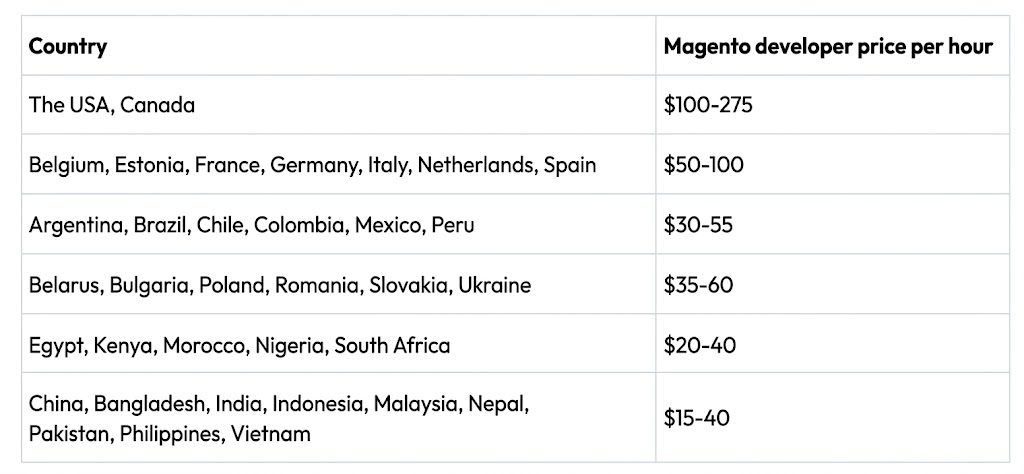
Location of the development team.
US-based Magento developers bill $100 to $200/hour. Eastern Europe is $40 to $80. South Asia typically runs $20 to $50. Worth noting: quality varies within these ranges too, sometimes dramatically, so hourly rate alone tells you less than you’d hope.
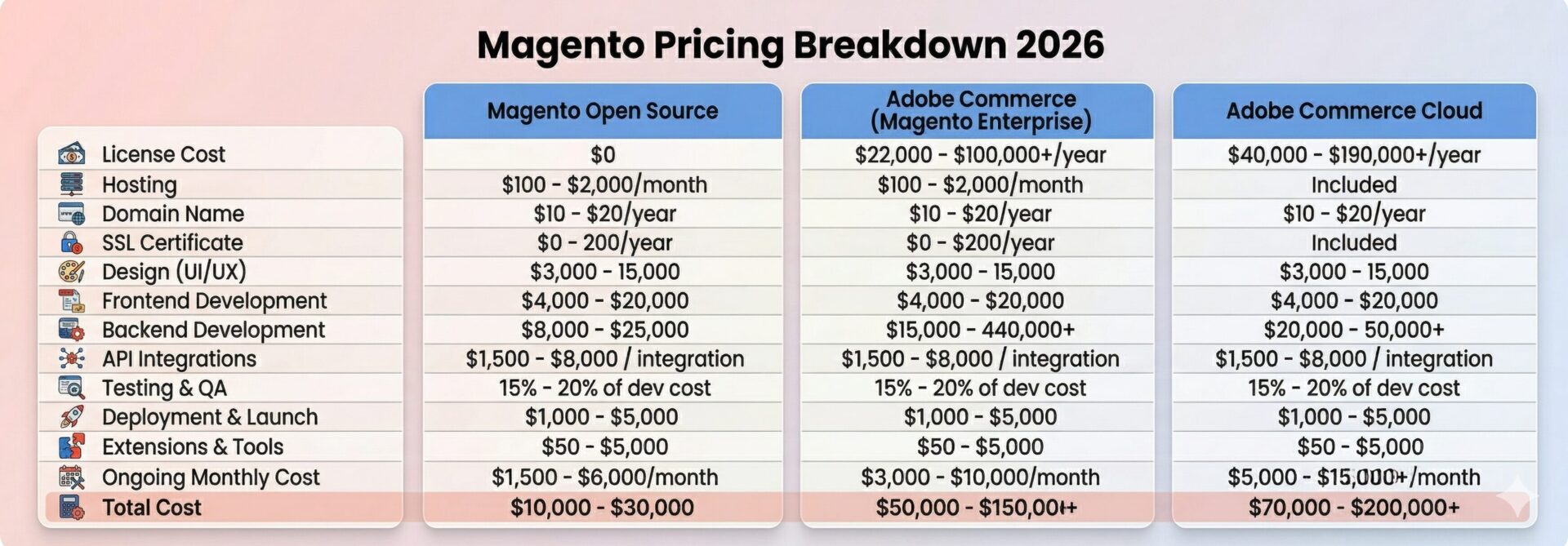
Magento Pricing Breakdown
Magento Open Source
Free platform. That’s genuinely attractive. But hosting ($50 to $500/month depending on traffic), SSL, CDN, extensions, and the development work that makes the store functional are all separate costs. A properly built Open Source store with a competent team runs $10,000 to $30,000 all-in. Cheaper quotes exist. You can usually tell where the shortcuts were made within six months of launch.
Adobe Commerce (Magento Enterprise)
This is where Magento ecommerce pricing makes people’s eyes widen. Licensing starts around $22,000/year for smaller merchants, climbs past $100,000/year at enterprise GMV levels, and Managed Cloud hosting is a separate cost on top of that, anywhere from $40,000 to $190,000 annually.
These figures aren’t meant for $2M stores. They’re built for operations where platform performance, multi-store management, and B2B functionality can directly move revenue numbers. At that scale, the math gets interesting.
Development Cost by Project Type
| Store Type | Estimated Cost |
| Basic Store | $3,000 to $10,000 |
| Mid-Level Store | $10,000 to $40,000 |
| Enterprise-Level | $50,000 and up |
These are development-only figures. Licensing, hosting, extensions, and maintenance all sit outside these numbers.
Not Sure of Your Magento Project Cost?
Unsure about your project budget? Talk to experts and get a free estimate based on your real scope.
Magento Development Services Cost Breakdown
The final invoice on a Magento project is essentially a stack of individual service costs. Understanding what each one covers, before you’re comparing proposals, saves a lot of confusion.
UI/UX Design
Custom design runs $3,000 to $15,000. Wireframes, prototypes, final handoff. It’s not the most exciting budget line, but it’s genuinely structural. Rushing it, or cutting it entirely, tends to produce a store that looks like it was designed during the build. Fixing design problems post-launch is consistently more expensive than doing it properly upfront.
Frontend Development
Taking finalized designs and turning them into a working Magento theme, responsive, accessible, compatible across browsers, adds $4,000 to $20,000. The range is wide because the number of page templates and custom interface components varies dramatically between projects.
Backend Development
Custom modules, business logic, catalog configuration, admin panel work. Almost always the largest single chunk of Magento 2 development cost. Mid-level builds land between $8,000 and $25,000. Enterprise builds with serious B2B functionality can push well past $40,000. This is where project scope does the most damage to budgets that weren’t built with enough buffer.
API Integrations
Each integration adds $1,500 to $8,000 in Magento development services cost. Four integrations is potentially $20,000 to $30,000 in work, before accounting for APIs that are poorly documented, inconsistently maintained, or that change behavior partway through a project. Budget a contingency here specifically.
Testing and QA
Typically 15% to 20% of total development cost. Functional testing, regression testing, payment flow verification, load testing. This is the part of the budget that gets trimmed when a project runs over, and it’s also the part whose absence shows up immediately after launch as checkout failures and payment errors.
Deployment and Launch
Server configuration, staging migration, go-live support: $1,000 to $5,000 depending on infrastructure complexity. Custom server environments push toward the top of that range.
Ongoing Magento Costs
Most blogs end at the build cost. Most budgets follow. That’s a problem.Here’s what a realistic monthly operating budget looks like:
- Hosting: $100 to $2,000/month based on traffic volume and infrastructure type
- Maintenance and bug fixes: $500 to $3,000/month under a retainer arrangement
- Security patches: Applied regularly, costs $500 to $2,000 per cycle in developer time. Skipping patches is how stores get compromised
- Extensions and plugins: $50 to $500 for quality marketplace extensions; $1,000 to $5,000 for advanced B2B or search tools
- Support retainer: $1,500 to $5,000/month for most mid-level stores
For a mid-level Magento store, $1,500 to $6,000/month is a realistic ongoing operating budget. Build it in from the start, not as an afterthought once the launch invoice has cleared.
Magento vs. Shopify vs. WooCommerce: Quick Pricing Comparison
| Platform | Typical Build Cost | Flexibility | Best For |
| Magento Open Source | $10,000 to $40,000 | High | Growing mid-market brands |
| Adobe Commerce | $50,000+ | Very High | Enterprise, B2B, multi-store |
| Shopify | $3,000 to $20,000 | Medium | Direct-to-consumer brands |
| WooCommerce | $2,000 to $15,000 | Medium | Small to mid-size stores |
Shopify launches faster and costs less to start. WooCommerce suits teams already running WordPress who don’t want to switch ecosystems. But Magento pricing buys something neither platform can fully replicate past a certain scale. The entry cost is higher. So is the ceiling. For the right business, that trade makes complete sense.
Hidden Costs of Magento Development
These don’t usually appear in the initial proposal. But they show up eventually.
Custom feature development.
Anything outside standard Magento behavior has development cost behind it. Custom approval workflows, complex product configurators, dynamic B2B pricing engines. Common in enterprise builds, almost always underestimated early, because the spec isn’t locked down tightly enough at the point when the quote gets written.
Performance optimization.
Page speed, full-page cache configuration, database query optimization, CDN setup. Teams treat this as optional until the store is live and slow. Budget $3,000 to $10,000 here on any store expecting real traffic, and expect the conversation to happen regardless of whether it was in the original scope.
Third-party tool licensing.
Marketing automation, advanced analytics, review platforms, AI-powered search. Every tool in your tech stack carries its own annual licensing cost, and none of it sits inside the Magento development cost. It adds up faster than most pre-launch budgets account for.
Scalability work.
Traffic growth, catalog expansion, multi-store rollout all eventually require infrastructure and code changes. Building for scale from day one costs more initially. Not building for it costs more eventually, usually twice as much, at a moment when the store is already under pressure.
How to Reduce Magento Development Cost?
Real options, not generic advice.
Ship an MVP first.
Launch the core store. Watch what users actually do. Add features based on observed behavior rather than pre-launch assumptions. This one approach eliminates more wasted development spend than anything else. It’s not the most exciting strategy, but the outcomes are consistent.
Check the extension marketplace before building custom.
The Magento marketplace has solid extensions for most standard functionality: B2B quoting, subscriptions, layered navigation, review systems. A $300 extension often does the job of $8,000 in custom development. Not always, but often enough to check before assuming a custom build is necessary.
Hire teams who already know Magento.
A generalist agency learning the platform on your project is the most expensive development arrangement possible. Their learning curve is real, and it costs money from your budget, not theirs. Teams with genuine Magento 2 development cost experience have already worked through the hard problems. That’s worth paying a slightly higher rate to access.
Resist the temptation to over-customize early.
Custom code is expensive to build and more expensive to maintain over time. Every non-standard layer makes future upgrades harder. If Magento has a native way to do something, use it even when the custom version demos better. The demo goes away. The maintenance cost doesn’t.
When Should You Invest in Magento?
Not every store should be on Magento. But some absolutely should be, and the signals are fairly clear.
- High and growing traffic volumes where server-side performance control produces measurable business outcomes
- B2B requirements that go beyond basic: tiered pricing, company accounts, purchase approval workflows, quote management, customer-specific catalogs
- Multi-store operations needing unified admin control with shared inventory across regions, brands, or business units
- Large or highly configurable product catalogs that require deep attribute management
- Custom checkout or fulfillment workflows that SaaS platforms can’t support without significant compromises
For smaller stores with simple catalogs and standard checkout, the Magento 2 development cost is difficult to justify on paper. But for a business past $5M in annual revenue that’s hitting the real limits of its current platform, Magento often becomes the cheaper long-term decision.
Why Choose a Magento Development Company?
Building Magento without people who know it well is where most budget overruns actually begin. Not from scope creep, not from the platform itself, but from teams working through problems in real time that experienced developers have already solved.
A proper Magento Development Company brings architectural knowledge that prevents rework, faster timelines because the patterns are familiar, QA processes built around Magento’s specific failure modes, and ongoing support that doesn’t require a full re-briefing every time something needs attention. These things have real dollar value over the life of a project.
If you’re looking to Hire Magento Developers, Adobe Commerce certification is a reasonable filter to start with. Live project references in your industry are what actually tells you something useful.
For larger implementations, Magento enterprise development requires teams who understand Adobe Commerce’s B2B module, cloud infrastructure configuration, and what performance architecture looks like at scale. Getting this wrong doesn’t just slow delivery. It creates compounding technical debt that surfaces under the worst possible circumstances, usually during peak traffic or a critical integration failure.
Get Your Magento Cost Estimate
Get a free Magento estimate with real numbers tailored to your project scope, business needs, and long-term goals.
Conclusion
Magento development cost in 2026 doesn’t compress into a tidy number. A lean basic store might launch for $5,000. A full enterprise B2B platform with multi-store architecture can run $150,000 before ongoing costs enter the picture. Both numbers are accurate. They just describe different businesses.
What deserves more attention than the build cost is the platform cost of getting it wrong: migrating out of a platform that’s hit its ceiling, mid-growth, under pressure, is consistently more expensive and more disruptive than the Magento investment would have been.
Get specific about scope before finalizing any budget. Work with people who’ve done this before. And consider the ongoing operating costs from the beginning.
FAQs
How much does Magento development cost in 2026?
Ranges vary significantly by project type. A basic Open Source store runs $3,000 to $10,000. Mid-level builds with custom features and integrations land between $10,000 and $40,000. Enterprise Adobe Commerce deployments start at $50,000 and can exceed $150,000 for complex B2B or multi-store requirements.
Is Magento more expensive than Shopify?
At launch, yes. Shopify’s managed infrastructure and lower entry cost make it faster and cheaper to start. But Shopify charges transaction fees, hits a ceiling on custom logic, and becomes expensive to work around at scale. Magento ecommerce pricing is harder to absorb upfront. But for high-volume or complex operations, the total cost of ownership over three to five years often tells a different story.
What is the cost of an Adobe Commerce license?
Around $22,000/year for smaller merchants, climbing well past $100,000/year at enterprise GMV levels. Managed Cloud hosting is a separate and substantial cost on top of that, ranging from $40,000 to $190,000 annually depending on the plan tier selected.
How long does Magento development take?
- Basic stores: 4 to 8 weeks.
- Mid-level builds: 3 to 5 months.
- Enterprise projects with heavy integrations and custom architecture: 6 to 12 months, sometimes longer.
Timeline tracks almost directly to scope.
Is Magento good for small businesses?
Rarely the right fit at that scale. Small businesses with manageable catalogs and standard checkout needs are better served by Shopify or WooCommerce. They cost less and launch faster. Magento’s real strengths emerge at mid-market and enterprise scale, where the control and flexibility actually justify the Magento development services cost.
What is the monthly cost of running Magento?
For mid-level stores, budget $1,500 to $6,000/month covering hosting, maintenance, security patches, and support. Adobe Commerce Cloud customers at enterprise scale often spend $5,000 to $15,000/month or more. These aren’t optional costs. They’re what responsible platform operation actually requires.
Can I reduce Magento development cost without cutting quality?
Yes, practically. Start with MVP scope and expand post-launch. Use marketplace extensions before assuming a custom build is necessary. Hire a team with genuine Magento experience. And keep the codebase as clean as possible from the start, because the cost of untangling it later, when you need to upgrade or scale, is usually far higher than doing it right the first time.