
- Why Standard Magento SEO Advice Falls Short
- Basic vs. Advanced Magento 2 SEO Strategy:
- Managing Faceted Navigation Without Destroying Your Magento SEO
- How to Handle Faceted Navigation Properly:
- Core Web Vitals and Performance Optimization for Magento 2
- Optimizing Largest Contentful Paint (LCP):
- Improving First Input Delay (FID):
- Structured Data Strategy for Magento Ecommerce SEO
- Essential Schema Types for Magento Stores:
- Internal Linking Architecture for Large Catalogs
- Core Internal Linking Principles:
- Internal Linking Distribution Framework:
- Advanced Magento SEO Best Practices for 2026
- Technical Optimization Tactics:
- Content and UGC Optimization:
- Technical SEO Checkpoints Every Magento Store Should Audit
- Critical Audit Points:
- Common Issues Diagnostic Framework:
- Content Strategy Beyond Product Descriptions
- Building a Complete Content Ecosystem:
- International and Multi Store Magento SEO
- Multi Market Optimization Considerations:
- Looking Ahead: What Matters Most in 2026
- Key SEO priorities for Magento stores:
- Frequently Asked Questions (FAQs)
- Is Magento 2 still good for SEO in 2026?
- What are the biggest SEO challenges Magento 2 stores face today?
- How important is page speed for Magento 2 SEO?
- Do Magento 2 extensions affect SEO performance?
- How long does it take to see SEO results for a Magento 2 store?
If you’ve been running a Magento store for a while, you already know the basics. Meta tags, alt text, XML sitemaps, sure, those matter. But if your organic traffic has plateaued or you’re watching competitors climb past you in search rankings, it’s time to go deeper.
I’ve spent years working on Magento SEO optimization across catalogs ranging from a few hundred products to enterprises with 50,000+ SKUs, and the difference between decent results and truly effective SEO often comes down to the technical decisions most people overlook. The Magento SEO best practices that actually move the needle in 2026 aren’t the ones you’ll find in basic setup guides. They’re the ones that address how search engines actually interact with large ecommerce catalogs, how users behave on category pages, and how to structure your site so Google doesn’t waste crawl budget on faceted navigation hell.
Let’s talk about what actually works when you’re trying to scale organic visibility for a serious Magento 2 operation.
Why Standard Magento SEO Advice Falls Short
Most Magento SEO guides focus on configuration settings and extensions. Install this module, tick these boxes, add your keywords here. That’s fine for getting started, but it doesn’t address the core challenges of Magento ecommerce SEO at scale.
The real issues start appearing when you scale into thousands of products, complex category structures, and layered navigation that creates hundreds of thousands of possible URL combinations. This is where architectural and development decisions made by an experienced Magento Development Company start to matter far more than most store owners realize. Your homepage might be perfectly optimized, but if Google is wasting crawl budget on faceted navigation pages or duplicate URL variations, your most important pages never get indexed properly. I’ve seen this exact problem surface during audits where nearly 80% of the crawl budget was consumed by filter combinations that should never have been crawlable in the first place.
Basic vs. Advanced Magento 2 SEO Strategy:
|
Basic SEO Approach |
Advanced Magento SEO Strategy |
|
Focus on product meta descriptions |
Optimize entire information architecture and internal linking flow |
|
Enable XML sitemap |
Strategic sitemap segmentation with priority signals |
|
Add schema markup via extension |
Custom structured data aligned with specific product types and business model |
|
Optimize images with alt text |
Implement lazy loading, WebP conversion, and CDN strategy for Core Web Vitals |
|
Submit URLs to Google |
Control crawl budget through strategic robots.txt and canonical management |
The difference is thinking systematically rather than tactically. Every change you make should consider how it affects crawl efficiency, user experience, and your ability to rank for commercial intent keywords.
Managing Faceted Navigation Without Destroying Your Magento SEO

This is where most Magento stores get into trouble. Layered navigation is essential for user experience, but every filter combination creates a new URL. Color, size, price range, material, suddenly you have tens of thousands of indexed pages that are basically duplicates.
Google doesn’t want to index all of those variations. More importantly, you don’t want them to. Each crawl is an opportunity cost. If Google spends time on filter pages, it’s not crawling your new products or updated category content.
How to Handle Faceted Navigation Properly:
-
Use canonical tags strategically
Your filtered pages should canonical back to the main category URL. Magento 2 gives you some control here, but you often need custom logic. A page filtered by “red” and “large” should canonical to the main category, not create a unique indexable page.
-
Configure robots meta tags for parameter combinations
In your Magento SEO configuration, you can set rules for which URL parameters should trigger noindex tags. Price filters, multiple attribute combinations, and sorting parameters should typically be noindexed.
-
Leverage the X-Robots-Tag header
For dynamic filter combinations, you can set noindex directives at the server level. This is cleaner than relying on meta tags for every possible variation and gives you more precise control.
-
Strategic robots.txt blocking
Be careful here, because blocking in robots.txt prevents crawling but doesn’t prevent indexing if the URLs get linked from elsewhere. But for certain parameter patterns, it’s an additional layer of protection.
-
The goal is simple
make sure Google only indexes the pages that represent unique value. Your main category pages, your product pages, your content pages. Everything else should either canonical to one of those or be excluded from the index entirely.
Core Web Vitals and Performance Optimization for Magento 2
Page speed has always mattered for ecommerce, but Core Web Vitals made it an explicit ranking factor. For Magento stores, this is challenging because the platform is powerful but resource-intensive. In enterprise environments, this is often where technical debt surfaces the fastest.
You can’t just throw a caching plugin at this problem and call it done. Real performance optimization for Magento requires architectural thinking, and it plays a crucial role not only in Magento SEO, but also in Answer Engine Optimization Services, where fast, reliable pages are more likely to be surfaced as direct answers.
Optimizing Largest Contentful Paint (LCP):
Start with Largest Contentful Paint (LCP): This measures when your main content loads. For category pages, this is usually your product grid. For product pages, it’s typically the product image and title area.
-
Image optimization that actually works
WebP format with proper fallbacks. Lazy loading for below the fold images. Responsive images using srcset so mobile users aren’t downloading desktop sized files. Most importantly, defining explicit width and height attributes to prevent layout shift. On stores with large catalogs, I’ve seen LCP improvements of 40% just from proper image handling.
-
Critical CSS extraction
Load only the CSS needed for above the fold content initially, then load the rest asynchronously. Magento’s default CSS bundle is huge, and users don’t need it all upfront.
-
Database query optimization
Slow database queries kill performance. Profile your queries, add appropriate indexes, and consider query result caching for frequently accessed data. This becomes critical once you’re dealing with complex product configurations or catalogs above 10,000 products.
-
Fixing Cumulative Layout Shift (CLS)
For Cumulative Layout Shift (CLS), the biggest culprits in Magento stores are usually dynamic content blocks, improperly sized images, and web fonts loading without proper fallbacks. Reserve space for every element that loads asynchronously.
Improving First Input Delay (FID):
-
First Input Delay (FID) is about JavaScript execution time
Magento uses a lot of JavaScript, especially for checkout and dynamic product options. Defer non-critical JavaScript, minimize main thread work, and consider lazy loading some interactive features that aren’t immediately needed.
-
Here’s the reality
You might need to make hard choices about features versus performance. That fancy product image zoom or real time inventory display might be hurting your rankings more than it helps conversions. Test everything. I’ve had clients reluctant to disable certain features until we A/B tested and found they weren’t impacting conversion anyway.
Structured Data Strategy for Magento Ecommerce SEO
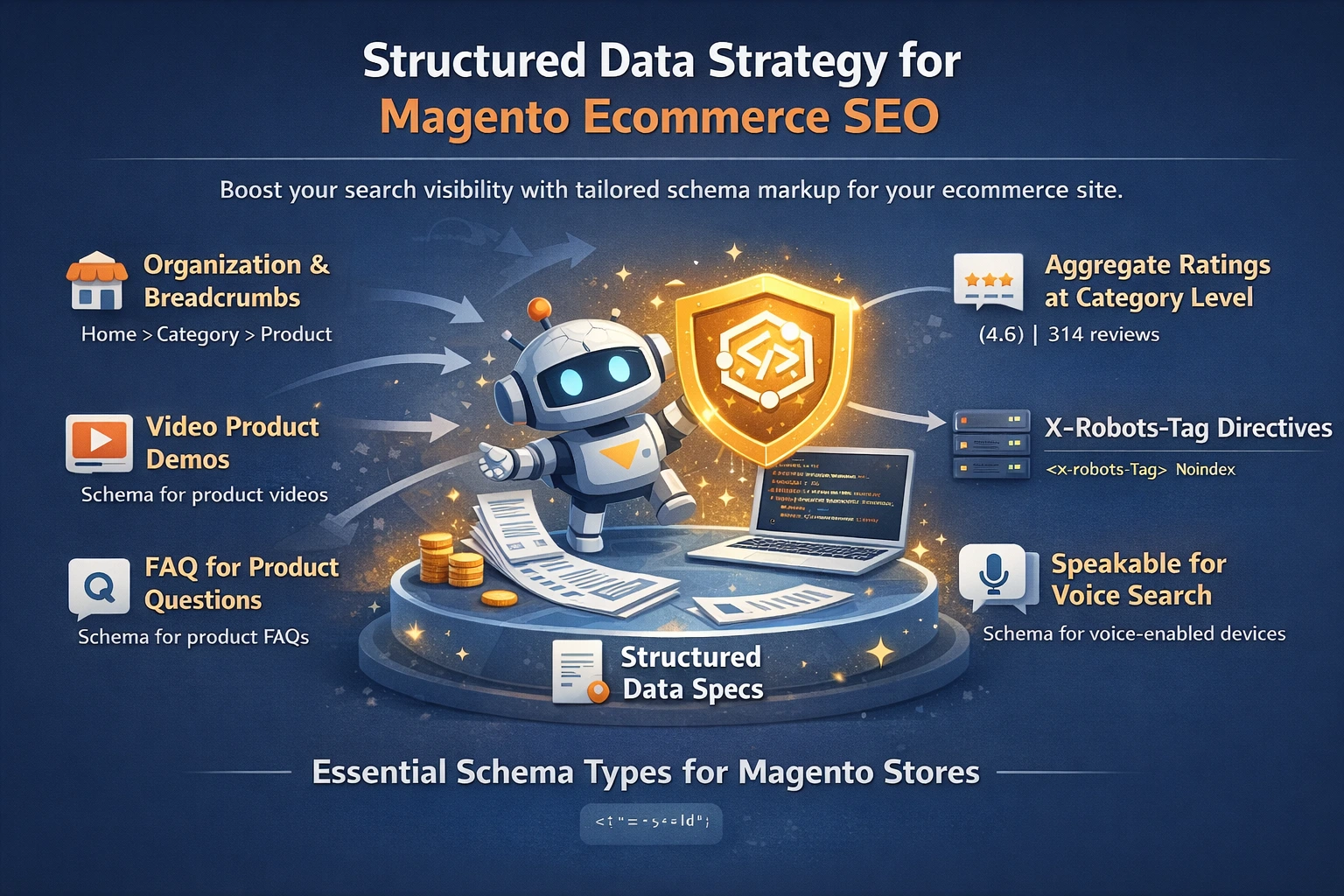
Basic schema markup is table stakes. Product schema with price, availability, and reviews, everyone does that. Advanced Magento SEO optimization means thinking about structured data as a competitive advantage.
Essential Schema Types for Magento Stores:
-
Organization and breadcrumb schema
These help Google understand your site structure and can enhance your search appearance with breadcrumb trails in results.
-
Aggregate rating schema at the category level
If you have reviews, showing aggregate ratings for product categories can improve click through rates on category page results. This is particularly effective for stores with strong review volume.
-
Video schema for product demos
If you’re using video content, proper schema markup makes you eligible for video rich results, which take up more SERP real estate.
-
FAQ schema for product questions
If you have a Q&A section on product pages, mark it up with FAQ schema. This can trigger featured snippets and FAQ rich results.
-
Speakable schema for voice search
Looking ahead to 2026 and beyond, marking up the most important content as speakable helps with voice search optimization.
-
The key is customization
Generic schema markup extensions give you the basics, but custom implementation lets you highlight your specific competitive advantages. If you offer same day shipping, warranty information, or size guides, that can all be structured data that helps your listings stand out.
Internal Linking Architecture for Large Catalogs
When you’re managing thousands of products across dozens or hundreds of categories, internal linking becomes complex. But it’s also one of your most powerful Magento SEO tools.
Google discovers and understands your site through links. How you structure those links determines which pages get crawled most frequently, which pages accumulate the most authority, and which pages rank.
Core Internal Linking Principles:
-
Shallow site architecture matters
Every product should be reachable within three clicks from your homepage. This isn’t always easy with large catalogs, but it’s essential for crawlability. In practice, this often means rethinking your category hierarchy or adding strategic featured product sections.
-
Related product links should be strategic
Don’t just show random related products. Link to items that represent logical user paths and help distribute PageRank to important products.
-
Category descriptions with contextual links
Your category pages should have unique content, and within that content, you should link to subcategories and featured products. This creates a semantic relationship that helps Google understand topic relevance.
-
Breadcrumbs as a linking signal
Proper breadcrumb implementation is both a user experience feature and an internal linking strategy. Make sure your breadcrumbs reflect your information architecture accurately.
Internal Linking Distribution Framework:
|
Page Type |
Link Priority |
Linking Strategy |
|
Homepage |
Highest |
Link to top categories, featured products, and key content pages |
|
Main category pages |
High |
Link to subcategories, top products, and related content |
|
Subcategory pages |
Medium high |
Link to products, sibling categories, and parent category |
|
Product pages |
Medium |
Link to category, related products, and cross sell items |
|
Content pages |
Medium |
Link to relevant categories and products contextually |
|
Filtered pages |
Low (canonical to main category) |
Minimal internal links, focused on main navigation |
The pattern you’re creating is a hub and spoke model with your most important pages acting as hubs that distribute authority to deeper pages.
Advanced Magento SEO Best Practices for 2026
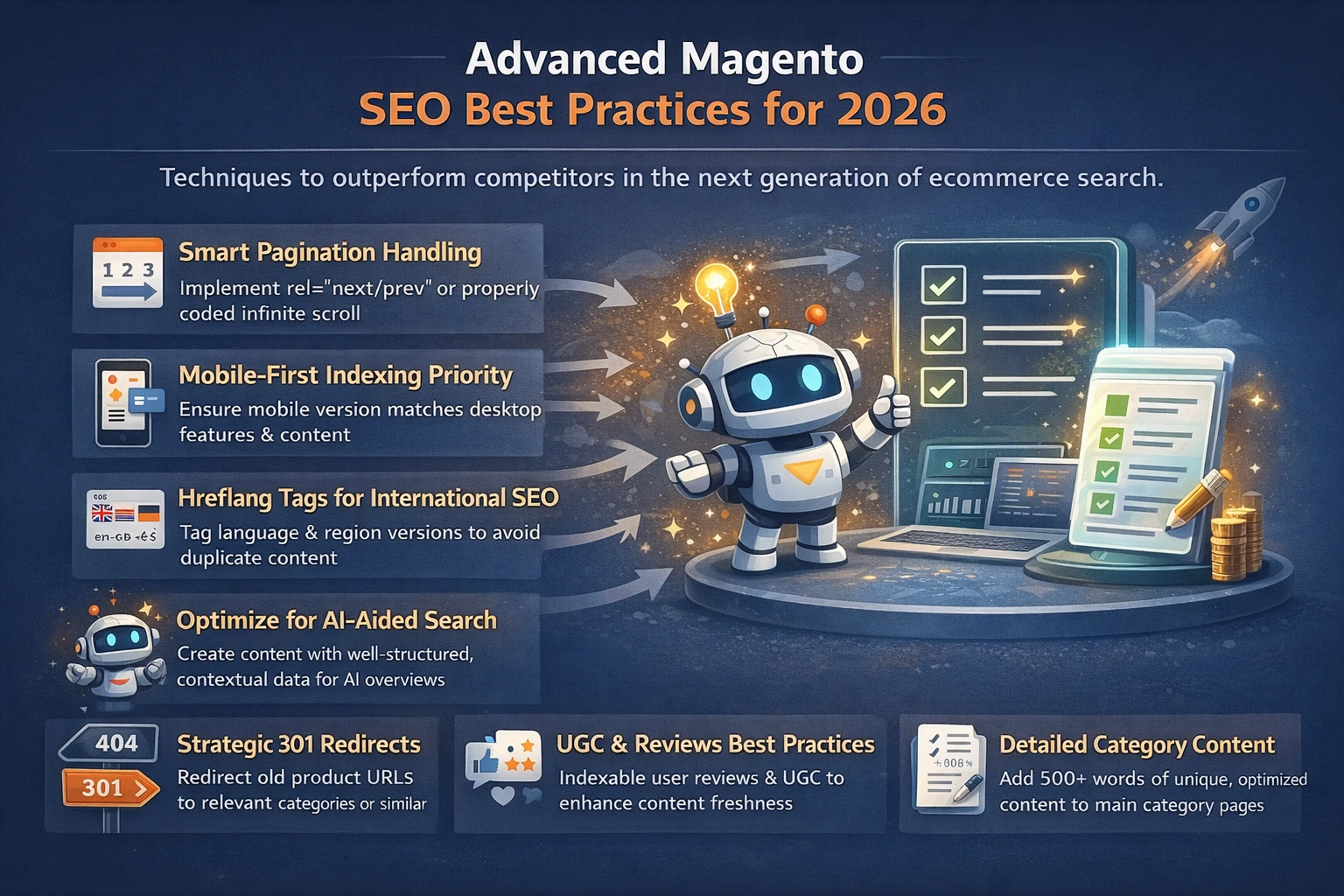
Let me break down the Magento SEO tips that make the biggest difference when you’re competing in serious ecommerce niches:
Technical Optimization Tactics:
-
Pagination handling
For large category pages, implement rel=”next” and rel=”prev” tags. Better yet, consider infinite scroll with proper implementation that maintains crawlability. Make sure your paginated content is accessible to both users and search engines.
-
Parameter handling in Google Search Console
Explicitly tell Google how to treat URL parameters through Search Console settings. This supplements your canonical and robots meta tag strategy.
-
Mobile first indexing optimization
Google uses your mobile version for indexing. Make sure your mobile experience isn’t a stripped down version of desktop. All content, structured data, and links should be present on mobile. I still see stores in 2026 that hide critical content on mobile, and they’re paying for it in rankings.
-
International SEO with hreflang
If you run multiple store views for different countries or languages, implement hreflang tags correctly. This prevents duplicate content issues across regions and ensures users see the right version.
-
Strategic 301 redirect management
When products go out of stock permanently, don’t just 404 the page. Redirect to the category or a similar product. Maintain redirect chains carefully, and audit redirects regularly to ensure they’re still pointing somewhere relevant.
Content and UGC Optimization:
-
Category page content strategy
Your category pages should have substantial unique content beyond just product listings. At least 300 to 500 words of relevant, helpful content. This gives Google more signals about what the page is about and provides value to users. This is a fundamental part of effective Magento ecommerce SEO.
-
Blog content integration
Your blog shouldn’t be isolated from your catalog. Write content that supports commercial intent keywords and links strategically to categories and products. Think “buying guides” and “how to choose” content, not just generic industry news.
-
Reviews and UGC optimization
User generated content is fresh content, and Google values it. Implement a review system that generates unique content on product pages. Make sure reviews are indexable but implement pagination or “load more” functionality so you’re not creating infinitely long pages.
Technical SEO Checkpoints Every Magento Store Should Audit
Even if you think your Magento 2 SEO is solid, these issues creep in over time. Schedule regular audits for:
Critical Audit Points:
-
Duplicate content across store views
Multi store setups often create duplicate content problems. Make sure canonical tags are pointing correctly and hreflang implementation is accurate.
-
Orphaned products
Products that aren’t linked from any category page are effectively invisible to search engines. Run reports to find products with no category assignment or no internal links. In catalogs with frequent product updates, this happens more than you’d think.
-
Slow category pages
Category pages with hundreds of products can have performance issues. Implement pagination limits, optimize queries, and consider lazy loading for images.
-
Redirect chains and loops
As your catalog evolves, redirects pile up. Clean them up regularly and make sure you’re not creating chains where URL A redirects to URL B which redirects to URL C.
-
XML sitemap issues
Your sitemap should only include indexable URLs. Make sure filtered pages, out of stock products you’ve redirected, and noindexed pages aren’t in your sitemap.
-
Crawl budget waste
Use your server logs and Google Search Console data to see where Google is spending crawl budget. If it’s crawling useless pages, you have a configuration problem.
Common Issues Diagnostic Framework:
|
Common Magento SEO Issue |
Impact on Performance |
Recommended Fix |
|
Duplicate product descriptions across multiple URLs |
Diluted ranking signals, potential penalties |
Canonical tags to primary version, unique content for variants |
|
Layered navigation creating thousands of indexed pages |
Wasted crawl budget, thin content issues |
Noindex + canonical strategy for filtered pages |
|
Out of stock products returning 404s |
Lost link equity, poor user experience |
301 redirect to category or similar product |
|
Slow server response time on category pages |
Poor Core Web Vitals, higher bounce rate |
Database optimization, full page caching, CDN implementation |
|
Missing or generic category descriptions |
Weak topical relevance signals |
Unique 300 to 500 word content for each major category |
|
Image files not optimized |
Slow LCP, poor mobile performance |
WebP conversion, compression, lazy loading, responsive images |
Content Strategy Beyond Product Descriptions
This is where a lot of Magento stores miss opportunities. You’re competing with Amazon, big box retailers, and specialty shops. Product descriptions alone won’t differentiate you.
Building a Complete Content Ecosystem:
-
Think about the entire customer journey
Someone who searches “best running shoes for plantar fasciitis” isn’t ready to buy immediately. They’re researching. If you can answer their questions, you build trust and they remember your brand.
-
Create content clusters around your product categories
If you sell kitchen equipment, you need content about cooking techniques, equipment comparisons, buying guides, and maintenance tips. All of that content should link strategically back to your catalog. This approach to Magento SEO optimization creates long term value that compounds over time.
-
The content should live on your domain, integrated with your site structure
A separate blog subdomain doesn’t pass authority as effectively as content on your main domain.
-
Focus on commercial intent keywords that indicate buying readiness:
“Best X for Y” and “X vs Y” and “how to choose X” are all high value content opportunities that naturally lead to product pages.
International and Multi Store Magento SEO
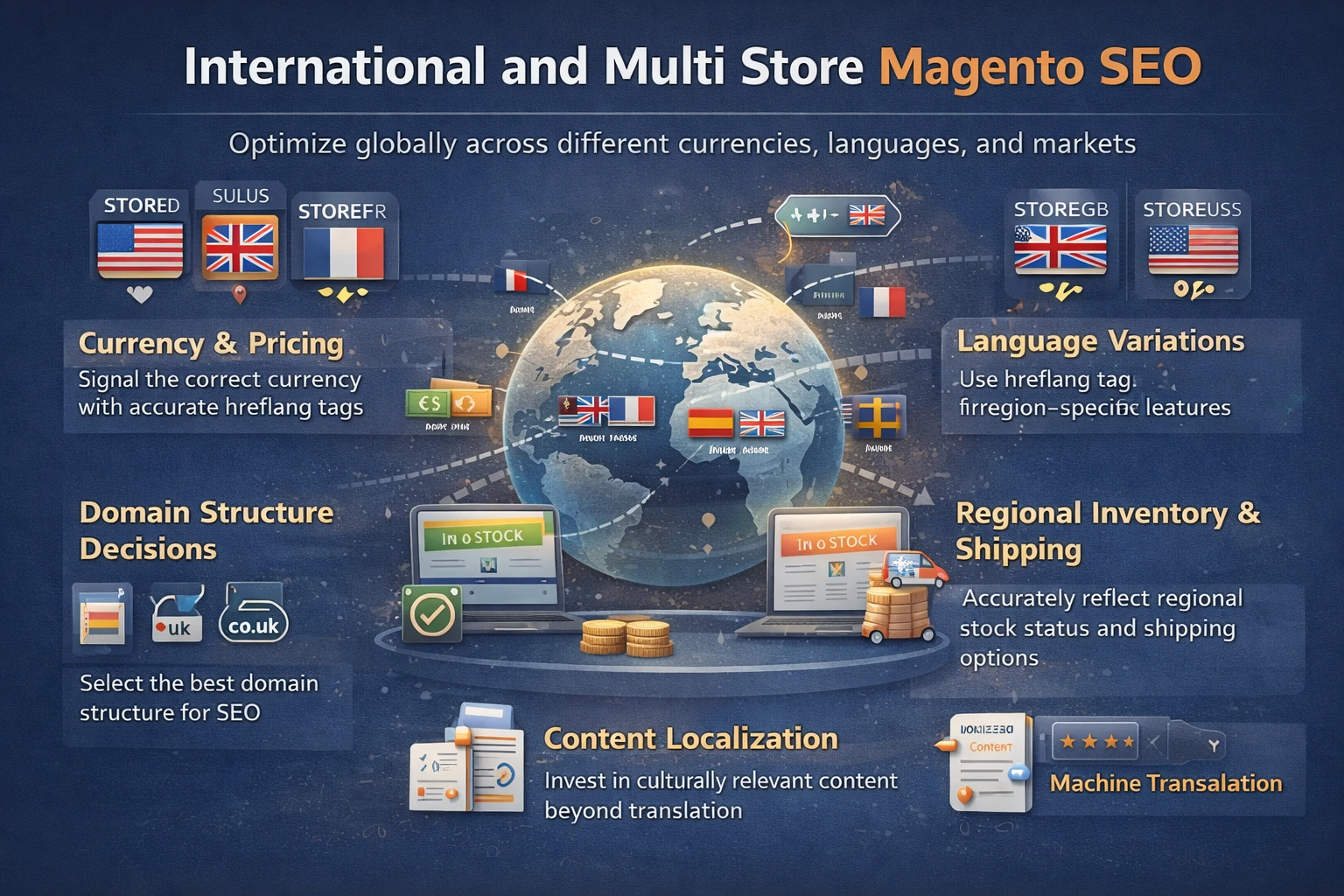
If you’re running multiple store views for different markets, you’re dealing with complexity most single store operations don’t face.
Multi Market Optimization Considerations:
-
Currency and pricing considerations
Different store views showing different prices for the same product can confuse search engines. Make sure your hreflang implementation clearly signals which version is for which market.
-
Language variations
UK English and US English are technically the same language, but they should have separate hreflang tags (en-GB vs en-US) to ensure proper targeting.
-
Content localization beyond translation
Machine translated product descriptions are obvious to native speakers and don’t perform well. Invest in proper localization that considers cultural context. This matters more than most people realize.
-
Regional domain structure decisions
Subdirectories (site.com/uk/) versus subdomains (uk.site.com) versus country code TLDs (site.co.uk) each have SEO implications. Subdirectories generally consolidate authority better, but geographic TLDs can build trust in local markets.
-
International shipping and inventory
Make sure your structured data accurately reflects availability and shipping for each region. Don’t show a product as available in your UK store if you can’t actually ship there.
Looking Ahead: What Matters Most in 2026
Key SEO priorities for Magento stores:
-
Search is evolving rapidly
AI overviews, conversational search, and changing user behavior patterns mean you can’t just optimize once and forget about it.
-
The fundamentals still matter most
Fast sites with clear information architecture, high quality content, and proper technical implementation will outperform sites that chase the latest gimmick. These core Magento SEO best practices remain unchanged because they’re based on how search engines fundamentally work.
-
Focus your energy on what actually drives ecommerce results
Getting your best products in front of people who are ready to buy, making sure your site is fast enough that people don’t bounce before seeing your value, and building content that answers real customer questions.
-
Magento gives you the tools to scale. But scaling requires discipline
Every new product, every category restructure, every site update is an opportunity to reinforce good SEO practices or undermine them. Make Magento 2 SEO part of your operational process, not something you do once a year when traffic drops.
The stores that dominate organic search in 2026 aren’t the ones with the biggest budgets for link building or flashy extensions. They’re the ones that understand how search engines evaluate ecommerce sites and build their entire technical foundation around those principles. That’s where get in touch with Elsner becomes important if you want to move from short-term tactics to sustainable, long-term organic growth.
Frequently Asked Questions (FAQs)
-
Is Magento 2 still good for SEO in 2026?
Yes, Magento 2 remains one of the strongest ecommerce platforms for SEO in 2026 when it is configured correctly. It offers advanced control over technical SEO elements like URL structure, metadata, canonical tags, and schema support. However, performance optimization and proper handling of large catalogs are critical to achieve consistent rankings.
-
What are the biggest SEO challenges Magento 2 stores face today?
The most common challenges include crawl budget waste due to layered navigation, duplicate content from filters and store views, slow page speed caused by heavy extensions, and improper indexing of category and product pages. These issues usually come from poor initial setup rather than platform limitations.
-
How important is page speed for Magento 2 SEO?
Page speed is extremely important for Magento SEO in 2026. Search engines prioritize fast, stable ecommerce experiences, especially on mobile devices. Optimizing Core Web Vitals through caching, image optimization, lightweight themes, and clean code directly impacts both rankings and conversion rates.
-
Do Magento 2 extensions affect SEO performance?
Yes, Magento 2 extensions can significantly impact SEO performance. Well built extensions can improve structured data, indexing control, and internal linking. Poorly optimized extensions can slow down the store, create duplicate URLs, or inject unnecessary scripts. Every extension should be evaluated for performance and SEO impact before installation.
-
How long does it take to see SEO results for a Magento 2 store?
Magento SEO results usually take three to six months to become visible, depending on competition, site health, and content quality. Stores with strong technical foundations and optimized category structures tend to see improvements faster, while large catalogs may require more time for crawl stabilization and ranking growth.