- What Does CRO Actually Involve Today?
- In-House CRO Team: Cost & Profit Breakdown
- Typical In-House CRO Team Structure
- In-House CRO Cost Structure
- In-House CRO Advantages
- In-House CRO Limitations
- CRO Agency Model: Cost & Profit Breakdown
- What a CRO Agency Typically Provides?
- CRO Agency Cost Structure
- CRO Agency Advantages
- CRO Agency Limitations
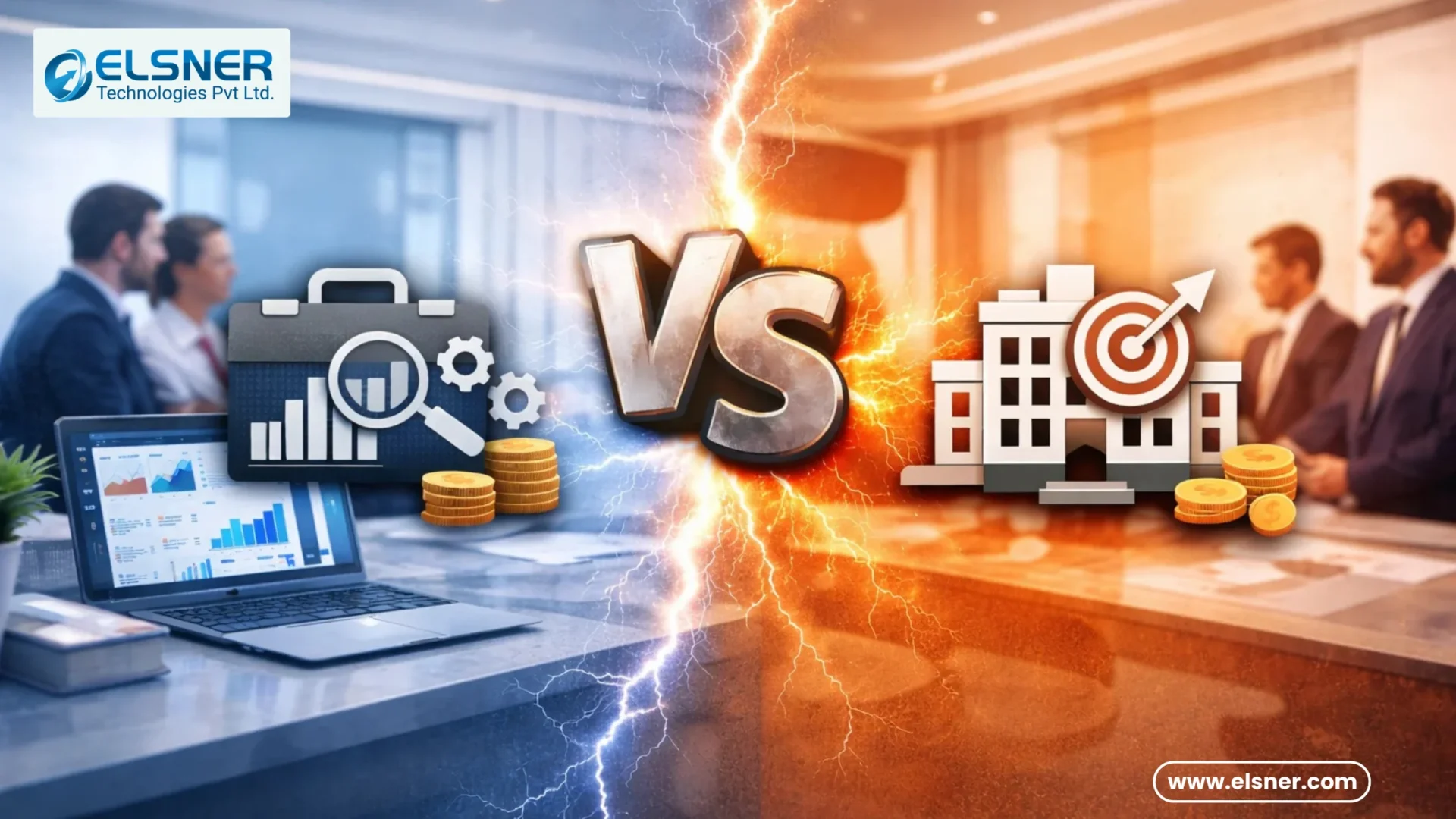
- In-House vs Agency CRO: Profitability Comparison
- When In-House CRO Is More Profitable?
- When a CRO Agency Is More Profitable?
- Hybrid CRO Model: The Best of Both Worlds?
- How to Decide the Right CRO Model for Your Business?
- Conclusion: The Right Model Is a Revenue Decision, Not a Preference
- Need Help Choosing the Right CRO Strategy?
- FAQs
- Is in-house CRO cheaper than hiring an agency?
- Which CRO model delivers better ROI?
- When should businesses switch from agency to in-house CRO?
- How much does CRO cost in 2026?
- Can small businesses afford CRO agencies?
- What skills are required for an in-house CRO team?
- How long does it take to see CRO results?
- Is a hybrid CRO model effective?
- Do CRO agencies guarantee conversion improvements?
- About Elsner Technologies
Here is a number worth pausing on – companies lose over $1.6 trillion in annual revenue because of poor website experiences, according to Accenture. Traffic is no longer the bottleneck. Conversion rate optimization – or CRO – is now the lever that separates fast-growing businesses from ones that burn ad budgets with nothing to show.
In 2026, the debate has shifted. Marketers are no longer asking, “Should we invest in CRO?” That question is settled. The real conversation happening in boardrooms and growth meetings right now is: should CRO live in-house, or should you hand it to a CRO agency? Each path has a different cost structure, a different speed of execution, and – critically – a different ROI profile.
According to recent data, businesses that run structured CRO programs see an average uplift of 223% in ROI. Not only that, but the average conversion rate optimization program costs between $3,000 to $30,000+ per month depending on the model you choose. That gap is enormous – and choosing wrong can cost you far more than you save.
This guide breaks down the real numbers. We will look at the cost structure of both models, compare profitability side by side, and give you a clear decision framework. That way, you can stop guessing and start choosing the model that actually fits your business. Now, let’s dig in:
What Does CRO Actually Involve Today?
A lot of people still picture CRO as swapping a red button for a green one and running an A/B test. That picture is about ten years out of date. Modern CRO services are a multi-disciplinary practice that touches UX, data science, psychology, copywriting, and front-end development – often all at once.
Today, a serious CRO program covers user research and session recording, behavioral analytics and heatmaps, funnel analysis and drop-off mapping, hypothesis building and prioritization, A/B and multivariate experimentation, and technical implementation of winning variants. Each of these areas demands a different skill set. That is the core reason staffing a full in-house CRO team is expensive – and why many businesses find that model harder than it looks on paper.
In-House CRO Team: Cost & Profit Breakdown
Typical In-House CRO Team Structure
To run a credible in-house CRO program, you need at minimum four roles: a CRO manager to own strategy and prioritization, a UX designer to turn insights into testable designs, a data analyst to interpret results and surface opportunities, and a front-end developer to build and deploy experiments. In larger organizations, you might add a copywriter, a product manager, and a QA specialist on top of that.
In-House CRO Cost Structure
The numbers add up quickly. In the US market in 2026, here is a realistic salary range for each core role.
| Role | Annual Salary (USD) | Notes |
| CRO Manager | $85,000 – $120,000 | Strategy + roadmap ownership |
| UX Designer | $70,000 – $100,000 | Research + wireframing + testing |
| Data Analyst | $75,000 – $110,000 | Analytics, stats, reporting |
| Front-End Developer | $90,000 – $130,000 | Experiment builds + deployment |
| Total (est.) | $320,000 – $460,000/yr | Before benefits, tools, training |
Add 30-40% for benefits, 20-30% for recruitment costs, $10,000-$30,000 annually for tooling (Hotjar, Optimizely, VWO, etc.), and ongoing training – and you are looking at $420,000 to $650,000 per year for a functional in-house team. The key issue here is that these are fixed costs. They do not scale down during slow periods. Whether your conversion program is firing on all cylinders or stalling mid-quarter, the payroll runs regardless.
In-House CRO Advantages
There are real reasons enterprises choose the in-house path. Your team builds deep brand knowledge over time – they understand your product, your customers, and your internal processes in a way that no external partner can replicate quickly. Internal alignment is also faster; there is no lag time in briefing an outside team or waiting for weekly calls to get a decision made.
Not only that, but long-term ownership is a genuine advantage. When institutional knowledge lives inside your company, your conversion optimization strategy keeps compounding. Each test result, each customer insight, each failed hypothesis adds to a body of knowledge that stays with you.
In-House CRO Limitations
The biggest challenge is skill gaps. CRO is broad – and finding one person who is equally strong in data, UX, and development is rare. Most in-house teams end up with pockets of excellence and blind spots elsewhere. Testing velocity is another bottleneck; a small internal team can typically run two to four experiments per month, compared to eight to twelve that a well-resourced CRO agency might manage.
Knowledge silos form over time too. When your CRO team only ever works on your product, they lose exposure to cross-industry patterns and emerging experimentation methods. That insular view can limit how creatively – and how profitably – they test.
CRO Agency Model: Cost & Profit Breakdown
What a CRO Agency Typically Provides?
A good CRO agency brings a full bench to every engagement. You get strategists, UX researchers, designers, statisticians, developers, and copywriters – without hiring any of them individually. Agencies also operate from proven frameworks built across dozens of clients and industries. That cross-pollination of experience means your business benefits from patterns and benchmarks that your in-house team simply has not seen yet.
Dedicated experimentation velocity is another core asset. Agencies run experiments in parallel across their client base, which means they have fine-tuned workflows, testing templates, and QA processes already in place. You skip the setup phase – and get to results faster.
CRO Agency Cost Structure
Pricing for conversion rate optimization services through an agency typically falls into three models:
|
Pricing Model |
Typical Range (USD/month) |
Best For |
|
Monthly Retainer |
$3,000 – $15,000/mo |
Ongoing optimization programs |
|
Project-Based |
$8,000 – $50,000/project |
Audits, redesigns, single sprints |
|
Performance-Based |
% of revenue uplift |
High-growth Ecommerce brands |
The annual cost of a mid-tier agency retainer runs roughly $36,000 to $120,000 per year. That is 50-80% less than the cost of a fully staffed in-house team – with a comparable or higher testing output. The cost model is also variable; you scale up or down based on business needs without severance, recruitment, or re-training costs.
CRO Agency Advantages
Speed to impact is the headline benefit. Since agencies have existing workflows, tools, and team structures, your program can go live in two to four weeks rather than the three to six months it typically takes to hire, onboard, and align an in-house team. CRO experts at agencies are also regularly exposed to industry benchmarks across verticals – Ecommerce, SaaS, fintech, healthcare – which informs smarter hypotheses and faster wins.
Lower hiring risk is a practical advantage worth naming. You do not have to bet your CRO program on a single hire. If the engagement is not working, you can switch agencies far faster – and with less organizational damage – than restructuring an internal team.
CRO Agency Limitations
To be fair, agencies have real limitations too. The first few weeks of an engagement involve a ramp-up period where the agency learns your brand, your product, and your customer base. That learning curve can slow early momentum. There is also a dependency risk – if you do not actively manage the relationship and document learnings internally, you can end up in a situation where all the knowledge lives with the agency, not with you.
In-House vs Agency CRO: Profitability Comparison
|
Factor |
In-House CRO |
CRO Agency |
|
Fixed Cost |
High ($320K–$650K/yr) |
Low-to-Medium ($36K–$120K/yr) |
|
Speed to Impact |
3–6 months to ramp |
2–4 weeks to first test |
|
Testing Velocity |
2–4 experiments/month |
6–12 experiments/month |
|
Tooling Access |
Must purchase separately |
Included in retainer |
|
Scalability |
Slow (requires hiring) |
Fast (adjust scope instantly) |
|
ROI Predictability |
Harder to forecast |
Structured reporting + benchmarks |
|
Brand Knowledge |
Deep over time |
Builds over engagement period |
|
Risk |
High if team underperforms |
Lower – easier to switch models |
When In-House CRO Is More Profitable?
The in-house model starts to win on profitability at scale. If you are a large enterprise running 20+ experiments per month with dedicated product lines, the economics shift. The fixed cost of a team gets absorbed across a higher volume of testing – and the ROI per test compounds over years of accumulated brand knowledge.
This model also works when your conversion optimization strategy is tightly integrated with product development. If every test feeds directly into engineering sprints, having the CRO function in-house removes coordination friction that an agency relationship would create. Likewise, enterprises with mature growth teams, high experimentation maturity, and long-term optimization programs often find the in-house path more financially logical at the three-to-five year mark.
When a CRO Agency Is More Profitable?
For the majority of businesses reading this – Ecommerce brands, mid-sized companies, SaaS teams in growth mode – the agency model delivers faster ROI with lower financial risk. Here is why: you do not pay for the learning curve. You get a team with existing frameworks, proven testing methodologies, and immediate execution capacity from day one.
If you are in a rapid growth phase, speed matters more than anything. Every week without a structured testing program is revenue left on the table. A CRO agency shortens that timeline dramatically. The same applies if your internal CRO maturity is low – an agency can run your program while simultaneously building internal capability through knowledge transfer.
At Elsner, we see this pattern consistently across our clients. The businesses that see the fastest lifts from conversion rate optimization consulting are those that bring in external expertise during high-stakes growth phases – and then evolve the model once internal capability matures.
Explore our conversion rate optimization services to see how we structure engagements for maximum ROI.
Hybrid CRO Model: The Best of Both Worlds?
There is a third path – and it is the one that often delivers the highest ROI in practice. The hybrid model pairs internal ownership with agency execution. Your in-house team owns strategy, brand direction, and stakeholder alignment. The agency handles research, experiment builds, and testing velocity. That way, you get the speed and scale of an agency without losing the brand context and institutional ownership that only an internal team can hold.
The split works particularly well for companies with one or two internal CRO resources who cannot realistically cover the full execution breadth alone. The agency fills the gaps – not by replacing the internal team, but by extending it. This hybrid path also reduces dependency risk; when the agency relationship ends, your internal team retains the strategy, the learnings, and the roadmap.
At Elsner, we have helped clients build hybrid models that deliver 3-5x the testing velocity of a standalone in-house team – at a fraction of the cost of fully outsourcing. The Ecommerce conversion optimization gains compound quickly when both sides are pulling in the same direction.
How to Decide the Right CRO Model for Your Business?
Use this checklist before you make a decision. It will not make the choice for you – but it will tell you where the data points are.
| Decision Factor | Points to In-House | Points to Agency | Points to Hybrid |
| Annual Revenue | $50M+ | Under $20M | $20M–$50M |
| Monthly Traffic | 1M+ sessions | Under 200K sessions | 200K–1M sessions |
| Current CRO Maturity | High (2+ yrs of testing) | Low (just starting) | Medium (some experience) |
| Budget Flexibility | Fixed, high budget | Variable, lean budget | Mixed structure |
| Internal Skills Available | Full team exists | No internal CRO skills | Partial team in place |
| Speed Requirements | Long-term program | Fast wins needed now | Both short and long term |
| Growth Phase | Mature, stable growth | Rapid scaling phase | Transitioning between phases |
If your answers fall mostly in the agency column, the math strongly favors outsourcing – at least for now. If you are mostly in-house territory, build that team with intention. And if your answers are split – the hybrid model deserves serious consideration. At Elsner, our CRO consulting engagements often start with a structured audit that helps businesses identify exactly where they sit on this matrix.
Conclusion: The Right Model Is a Revenue Decision, Not a Preference
There is a common misconception that in-house always means cheaper – and that agency always means short-term. Neither is true. The real question is: which model delivers profitable growth at your current stage, with your current resources, at the speed your business actually needs?
In-house CRO wins at scale – when you have the volume, the maturity, and the budget to sustain a full team. A CRO agency wins on speed, cost efficiency, and expertise breadth – especially for Ecommerce brands, SaaS companies, and growth-phase businesses that cannot afford a slow ramp. The hybrid model offers a practical middle ground that often outperforms both on ROI.
What matters most is not the label on the model. What matters is the quality of execution, the rigor of your testing program, and the speed at which your business can act on what the data tells you. Website conversion optimization done well – regardless of the model – is one of the highest-leverage investments any business can make in 2026.
At Elsner, we have spent 19+ years helping global businesses build CRO services programs that align with their actual growth stage – not a one-size-fits-all template. Our team of 250+ developers and digital growth specialists has delivered across 6,200+ clients worldwide.
Not sure whether in-house or agency CRO makes more financial sense for your business? Our CRO experts at Elsner can help you evaluate the right model – and build the program that fits. Reach out today.
Need Help Choosing the Right CRO Strategy?
Whether you’re building an in-house team or partnering with an agency, our CRO experts help you maximize conversions, improve ROI, and drive sustainable business growth.
FAQs
Is in-house CRO cheaper than hiring an agency?
Not always – and often the opposite is true. When evaluating a proper CRO cost comparison, a full in-house team can cost $420,000 to $650,000 per year when you factor in salaries, benefits, tooling, and training. A mid-tier agency retainer runs $36,000 to $120,000 annually. For most businesses, the agency route is significantly more cost-effective, at least until experimentation volume and revenue scale justify a full internal team.
Which CRO model delivers better ROI?
It depends on your stage and on which CRO model is more profitable for your growth trajectory. Agencies typically deliver faster ROI for growth-phase and mid-sized businesses because they remove the ramp-up delay and bring immediate execution capacity. In-house teams deliver stronger long-term conversion rate optimization ROI for large enterprises with sustained, high-volume testing programs. The hybrid model often outperforms both in the middle ground.
When should businesses switch from agency to in-house CRO?
The decision between a CRO agency vs in-house team becomes strategic when your business is running 15+ experiments per month consistently, you have senior internal talent ready to own the strategy, and the fixed cost of a team becomes proportionally smaller relative to the revenue you are generating from CRO. Most businesses hit this threshold between $50M and $100M in annual revenue.
How much does CRO cost in 2026?
A realistic CRO cost comparison shows agency-based conversion rate optimization services typically range from $3,000 to $15,000 per month for a retainer model. Project-based work runs $8,000 to $50,000+. In-house programs cost $320,000 to $650,000+ per year when fully staffed. Your actual number depends on the scope of testing, the tools required, and the markets you are targeting.
Can small businesses afford CRO agencies?
Yes – and in many cases, CRO outsourcing benefits make it the only realistic option for small businesses. Boutique CRO agency packages exist for as little as $1,500 to $3,000 per month, covering audits, basic A/B testing, and quarterly strategy reviews. That is far more accessible than hiring even one full-time CRO specialist. The key is to match the agency scope to your traffic volume and revenue stage.
What skills are required for an in-house CRO team?
A functional in-house CRO team needs expertise across UX research and design, statistical analysis and data interpretation, front-end development for experiment implementation, behavioral psychology and persuasion principles, and project management to keep the testing roadmap moving. These capabilities directly influence long-term conversion rate optimization ROI. The challenge is that strong CRO professionals with all these competencies are rare – and expensive.
How long does it take to see CRO results?
Timelines directly impact your expected conversion rate optimization ROI. With an agency, you can expect your first validated test results within four to eight weeks of engagement. With an in-house team starting from scratch, realistically expect three to six months before the program reaches consistent testing velocity. Statistical significance on individual tests usually requires two to four weeks of data collection depending on your traffic levels.
Is a hybrid CRO model effective?
Yes – especially when evaluating CRO outsourcing benefits alongside internal ownership. The hybrid model combines internal brand ownership with agency execution speed – which means you run more tests, retain more institutional knowledge, and reduce both cost and dependency risk simultaneously. At Elsner, our hybrid-structured clients consistently see 3-5x testing velocity compared to solo in-house programs.
Do CRO agencies guarantee conversion improvements?
When comparing a CRO agency vs in-house team, guarantee is not the metric to focus on. Reputable agencies do not offer guarantees on specific conversion lifts – and any agency that does should be treated with caution. What good conversion rate optimization consulting does guarantee is a structured, data-driven process with transparent reporting, clear hypotheses, and rigorous testing methodology. Results follow from that process – but the magnitude depends on your baseline, your traffic, and your product.
About Elsner Technologies
Elsner is a full-service IT company with 19+ years of experience delivering web development, mobile development, and digital growth services to 6,200+ clients worldwide. With 250+ developers and a track record of 9,500+ projects delivered, Elsner brings technical depth and commercial focus to every engagement.
Our CRO services are built on the same principles that drive everything we do: honest assessment, precise execution, and measurable outcomes. We work with Ecommerce brands, SaaS teams, and digital enterprises across the USA, UK, Australia, Canada, and Europe.
Founded by Harshal Shah, Elsner has grown into a multi-venture technology group with ventures including EcomVA, MyAppGurus, WeekMate, Link Publishers – each built to serve different aspects of the digital growth journey.