- What Is MLOps?
- Why Traditional ML Development Fails Without MLOps?
- The Machine Learning Lifecycle: From Dev to Production
- Data Ingestion and Data Engineering
- Model Development, Validation, and Deployment
- Monitoring and Continuous Improvement
- MLOps in Code: Experiment Tracking With MLflow
- How MLOps Accelerate ML Models Into Production?
- Before MLOps vs. After MLOps
- Key Benefits of MLOps for Businesses
- Common Challenges When Implementing MLOps
- MLOps Best Practices for 2026
- MLOps Maturity Model
- Build In-House vs. Partner With MLOps Experts
- Why Choose Data Engineering Services and MLOps Services From Elsner?
- Ready to Scale Your Machine Learning Models to Production?
- Conclusion: Operationalize or Fall Behind
- Frequently Asked Questions
- What is MLOps and why does it matters?
- MLOps vs DevOps for machine learning – what’s the difference?
- How does MLOps accelerate machine learning deployment?
- What are the key components of an MLOps pipeline?
- What challenges do companies face without MLOps?
- How long does it take to implement MLOps?
- What industries benefit most from MLOps?
- Can MLOps reduce AI operational costs?
- Should companies build MLOps in-house or outsource?
- About Elsner
Gartner research indicates that about 85 % of AI and machine learning projects never reach production or deliver measurable business value, underscoring just how many models remain unused after development .
Teams spend months building them. Data scientists run hundreds of experiments. Engineers stay up late tuning parameters. Then the model just sits there. Unused. Undeployed. Delivering zero business value.
That gap between dev and production is mainly where most AI investments quietly die. In 2026, the pressure to close it has never been higher. Boards want results. Operations teams want reliability. Customers want products that actually use the AI being promised.
“A model that never reaches production is not an asset – it is a cost.”
This is where MLOps – machine learning operations – enters the picture. At Elsner, we have worked with enterprise teams across the USA, UK, Australia, and Canada. The story is almost always the same: strong models, weak operational structure. This guide covers what MLOps is, how it accelerates the machine learning lifecycle, and what getting it right looks like in 2026. Now, let’s get started:
What Is MLOps?
MLOps is a set of practices, tools, and team principles designed to bring speed and structure to the full ML lifecycle. It borrows from DevOps – but extends it to cover what is unique about machine learning systems.
DevOps manages code pipelines. MLOps adds layers that code pipelines alone cannot handle. Data changes over time. Models drift. Training environments differ from production setups. None of that exists in standard software. Standard DevOps tooling cannot solve it either. That is exactly why machine learning operations exist as its own discipline.
The core components of a working MLOps system typically entails:
- Data pipelines: Automated flows that generally pull, clean, and version the data feeding every model.
- Model training infrastructure: Reproducible environments with experiment tracking built in from day one.
- Deployment pipelines: CI/CD-style processes that move validated models to production without manual steps.
- Inference serving: Batch scoring and real-time prediction endpoints – both managed and monitored.
- Drift detection and monitoring: Automated checks that catch degradation before the business feels it.
- Governance controls: Versioning, audit logs, as well as compliance tools for regulated environments.
In this regard, it is worth noting that MLOps is not purely a tooling exercise. It is just as much about how data scientists, ML engineers, and platform teams work together as it is about the platforms they use.
Why Traditional ML Development Fails Without MLOps?
Traditional ML development treats the model as the finish line. A data scientist trains it. Check the test set results. Then hands it off. Often as a script. Sometimes as a saved file. Usually with minimal documentation. That handoff is where everything starts to fall apart.
Without MLOps implementation in place, the following problems show up in AI ML pipelines almost every time:
- Manual deployments: Every release is a custom operation. No repeatable process exists. Small mistakes cause failures that take hours to trace.
- Environment mismatches: The model worked locally. It breaks in production because library versions or data types do not align.
- Undetected data drift: The real-world data feeding the model shifts over time. Nobody catches it until prediction quality has already dropped.
- No monitoring: Once deployed, there is no visibility into performance. Silent failures go undetected for weeks.
- Slow iteration: Retraining requires rebuilding from scratch. What should take hours takes weeks.
- Team silos: Data science and engineering teams operate separately with no shared standards. Handoffs fail repeatedly.
MLOps implementation replaces all of that with structured, automated processes. That shift from ad hoc to operational is exactly what separates organizations scaling AI from those stuck in pilot mode.
The Machine Learning Lifecycle: From Dev to Production
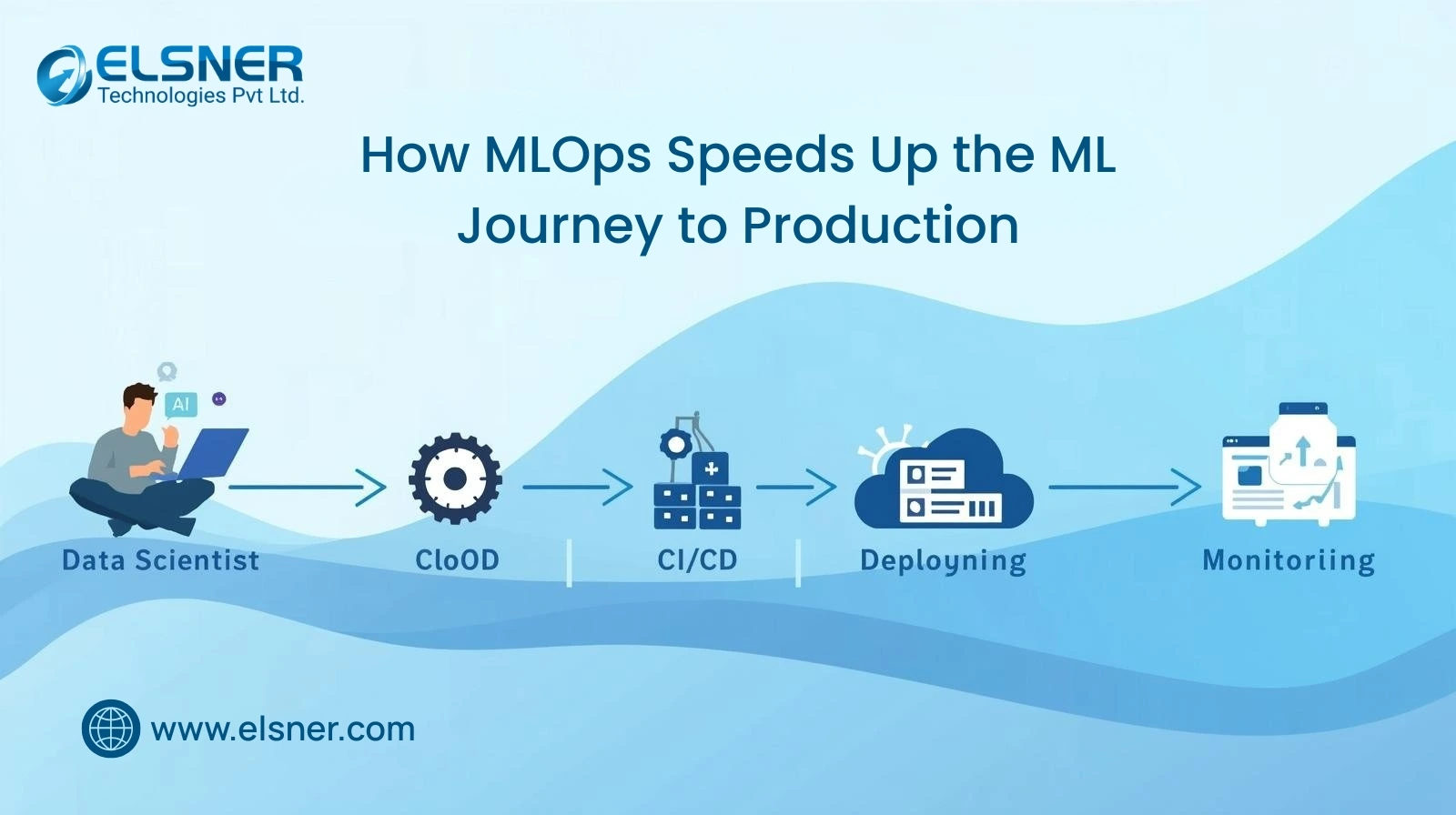
MLOps maps directly onto each phase of the ML lifecycle. Walking through the full cycle makes the value concrete and practical.
Data Ingestion and Data Engineering
Before a model can learn anything useful, it needs clean and versioned data. Data engineering and MLOps are deeply connected here. Poor data pipelines are the single biggest cause of model failure in production – not the model itself.
MLOps practices at this stage cover:
- Automated data ingestion from multiple sources – removing the manual steps that introduce errors.
- Feature engineering pipelines that transform raw inputs into model-ready formats.
- Data versioning via tools like DVC – so every model version traces back to the exact data that trained it.
This way, reproducibility is built in from the start. Teams are not left guessing. They know exactly why results from three months ago look different today.
Model Development, Validation, and Deployment
Experiment tracking tools like MLflow or Weights and Biases log every training run automatically. Parameters get captured. Metrics get recorded. Dataset versions get tagged. Model artifacts get stored. Not only that – model versioning sits alongside tracking to give teams a full audit trail. Rolling back to a previous version when a new deployment underperforms becomes a clean one-step action.
Validation in an MLOps context goes well beyond checking test set accuracy. Automated quality gates check:
- Performance benchmarks – the model must hit minimum thresholds before advancing.
- Bias and fairness checks – required for healthcare, finance, and insurance deployments.
- Data schema validation – confirming production inputs match the format the model expects.
Once a model clears those gates, the model deployment pipeline handles everything automatically. Containerized with Docker. Orchestrated with Kubernetes. The model moves to production without manual intervention. Rollback mechanisms are built in. If a deployed model behaves unexpectedly, the pipeline reverts to the previous version in minutes.
Monitoring and Continuous Improvement
Deployment is not the endpoint. That is where ML model monitoring begins – and where teams without MLOps fall apart fastest. A proper monitoring setup covers:
- Model drift detection – tracking how production data shifts relative to the training distribution.
- Performance monitoring – accuracy, latency, throughput, and error rates in real time.
- Automated retraining triggers – when drift crosses a set threshold, the pipeline kicks off retraining on its own.
Likewise, any business change that affects underlying data patterns feeds directly back into the retraining cycle. The model stays current. Manual coordination from the team is not required every time conditions shift.
MLOps in Code: Experiment Tracking With MLflow
Here is a simplified example of how experiment tracking works in practice. Every training run gets logged automatically – parameters, metrics, and the model artifact:
>import mlflow
import mlflow.sklearn
from sklearn.ensemble import RandomForestClassifier
from sklearn.metrics import accuracy_score
with mlflow.start_run():
    mlflow.log_param('n_estimators', 100)
    mlflow.log_param('max_depth', 5)
    model = RandomForestClassifier(n_estimators=100, max_depth=5)
    model.fit(X_train, y_train)
    acc = accuracy_score(y_test, model.predict(X_test))
    mlflow.log_metric('accuracy', acc)
    mlflow.sklearn.log_model(model, 'model', registered_model_name='prod_classifier')
Every run logged this way creates a versioned, reproducible record – paired with the dataset version from DVC. Therefore, any future audit, rollback, or result comparison has a precise reference point to work from.
How MLOps Accelerate ML Models Into Production?
Speed matters. Not just shipping speed though. What actually matters is how fast teams can safely iterate, deploy, and improve models without accumulating risk. MLOps delivers on multiple fronts at once.
Faster iteration cycles come from removing manual handoffs. A model that used to take three weeks to move from validation to production moves in hours when pipelines are automated. Data science teams spend less time on deployment mechanics and more time improving models.
Reduced deployment risk follows from MLOps automation. When every step from data ingestion to model serving is scripted and tested, environment mismatches and misconfigured inference setups get caught in the pipeline – not in production at 2am.
Better team collaboration is a structural result of shared pipelines and shared standards. Data scientists and ML engineers stop losing time at handoff boundaries. Clear ownership with documented processes means faster resolution when issues arise.
Scalable model management becomes real when MLOps is in place. Teams can oversee dozens of models across business units without losing visibility or control. Without it, managing even ten models starts to feel like a full-time job.
Before MLOps vs. After MLOps
| Area | Without MLOps | With MLOps |
| Deployment Time | Weeks to months | Hours to days |
| Environment Consistency | Frequent mismatches | Containerized, reproducible |
| Model Monitoring | Manual or none | Automated drift detection |
| Rollback Capability | Manual, slow, risky | Automated in minutes |
| Team Collaboration | Siloed handoffs | Shared pipelines and standards |
| Retraining Process | Ad hoc, from scratch | Triggered and automated |
| Compliance / Audit | Minimal or missing | Built-in versioning and logs |
Key Benefits of MLOps for Businesses
The business case for MLOps is real. It gets undersold though when framed in technical language. Here is what organizations actually gain:
- Reduced time-to-market: Automated pipelines mean AI capabilities reach customers faster. In competitive markets, weeks shaved off a release cycle matter.
- Improved model reliability: Monitoring catches degradation early. Retraining keeps models current. Rollbacks handle bad deployments before they become incidents.
- Cost savings: Automated operations handle larger model portfolios without proportional headcount growth. That is direct cost reduction.
- Regulatory compliance: MLOps provides the audit trails, model versioning, and bias monitoring that compliance teams in healthcare and finance need.
- Better ROI on ML investment: When models reach production and perform reliably, the investment in data science and infrastructure actually delivers returns.
Put simply – organizations that invest in data engineering and MLOps do not just build smarter models. They build the infrastructure to keep those models working as real business assets.
Common Challenges When Implementing MLOps
Even teams that understand the value of MLOps hit the same MLOps implementation challenges when getting started. Knowing these in advance is the most practical kind of preparation.
- Tool sprawl is the most common early trap. Dozens of MLOps platforms exist. MLflow. Kubeflow. SageMaker. Vertex AI. Azure ML. Teams often adopt several without a clear strategy. The result is a fragmented stack. Nobody fully owns it. Standardizing early is the only practical way out.
- Skill gaps create real friction. MLOps sits at the intersection of data science, software engineering, and DevOps. Most teams have strength in one or two areas. Rarely all three. Addressing this through hiring, training, or partnering externally is not optional.
- Legacy systems present integration challenges that are almost always underestimated. Connecting modern ML pipelines to older data infrastructure takes careful work. On-premise compute is the same story. Careful architectural work is required. Teams that treat integration as an afterthought pay twice. Once when they skip it. Again when they retrofit it.
- Organizational silos slow adoption even when the technical pieces are ready. Data science and engineering teams report separately. They use separate tools. Building shared MLOps workflows requires deliberate change management. Not just technical effort.
- Scaling beyond pilots is where many organizations stall. A proof-of-concept MLOps setup for one model looks very different from a system managing 50 models across the enterprise. Planning for that scale from the start saves significant rework later.
MLOps Best Practices for 2026
Getting MLOps right does not require perfection from day one. It requires a deliberate starting point and a clear path forward. Here is what works:
- Start with high-impact models. Identify the two or three models with the most direct business stakes. Build the pipeline around those first. Early wins prove value, and the pipeline gets tested on real workloads before scaling.
- Standardize pipelines early. Every team should use the same tools, naming conventions, and deployment stages. Standardization cuts cognitive overhead and makes onboarding dramatically faster.
- Automate monitoring from the start. Do not treat monitoring as something to configure post-deployment. Build it into the initial pipeline design. Set clear thresholds for retraining triggers and test them before going live.
- Align data engineering and ML teams. MLOps pipelines break at the data layer more often than anywhere else. Shared ownership of the data pipeline – with joint documentation – makes that layer reliable.
- Build governance early. Model registries, data versioning, bias monitoring, and access controls should be part of the initial architecture. For regulated industries, governance documentation is often required for model approval.
MLOps Maturity Model
| Level | Characteristics | Best For |
| Level 0 – Manual | Ad hoc deployments, no automation, no monitoring | Organizations just starting ML |
| Level 1 – ML Pipeline | Automated training, manual deployment, basic versioning | Teams with 1-5 models in production |
| Level 2 – CI/CD ML | Automated deployment, model registry, basic monitoring | Teams scaling to 10+ models |
| Level 3 – Full MLOps | End-to-end automation, drift detection, auto-retraining, governance | Enterprise AI at scale |
Build In-House vs. Partner With MLOps Experts
This question comes up in nearly every enterprise AI conversation at Elsner. There is no universal right answer. The decision depends on your team’s current capabilities, timelines, and how serious your AI roadmap is.
- Building internally gives you full control. Deep institutional knowledge follows. The trade-off is the timeline. Hiring experienced MLOps engineers is competitive. It is expensive too. Building the culture and tooling from scratch typically takes 12 to 18 months before the team operates productively at scale.
- Partnering externally gets you to production faster. Lower upfront risk too. External MLOps services teams bring established frameworks. They bring cross-industry experience. The best engagements include knowledge transfer. The internal team gradually takes ownership rather than staying dependent indefinitely.
- A hybrid approach often works best for mid-market and enterprise teams. An external partner builds the foundation. The internal team learns alongside them. Over time, the internal team takes primary ownership. The external partner shifts into advisory and support. Complex expansions draw on external expertise when needed.
From a cost perspective, a fully external model has predictable project costs. Fully internal carries higher fixed costs. It builds lasting capability though. The hybrid model tends to deliver the best return over a three-year horizon.
Why Choose Data Engineering Services and MLOps Services From Elsner?
End-to-end ML lifecycle support is rare. Most vendors specialize in either data infrastructure or model serving. Not both. At Elsner, our MLOps services teams cover the full stack:
- Data pipelines and feature stores – built for reliability and scale.
- Model training infrastructure – reproducible, versioned, and experiment-tracked.
- Deployment pipelines – CI/CD for ML with automated validation gates.
- Monitoring and drift detection – with configurable retraining triggers.
- Governance and compliance controls – for regulated industries and audit-ready programs.
Scalable architectures matter more than point solutions. Architectural decisions made early have outsized long-term impact. Cloud infrastructure. Container strategy. Model registry design. Getting them right the first time saves months of costly rework.
To see how our data engineering services support enterprise MLOps programs – explore what Elsner brings to AI engagements.
Ready to Scale Your Machine Learning Models to Production?
From building automated ML pipelines to deploying and monitoring models in production, our MLOps experts help you deliver reliable, scalable AI solutions faster.
Conclusion: Operationalize or Fall Behind
The organizations winning with AI in 2026 are not the ones with the most complex models. They are the ones with the strongest operational infrastructure around those models. That is the real edge right now.
Without that infrastructure, even a carefully built model is a liability. It might perform today. Fail silently next month. No visibility exists. No clear recovery path either. With MLOps in place, models become compounding assets. They grow more accurate with new data. They stay reliable as production conditions shift. They deliver measurable returns rather than impressive demos.
At Elsner, we treat ML success as an operational challenge as much as a technical one. That means building MLOps programs that match real-world complexity. Not generic pipelines from a tutorial. If your team is ready to stop running pilots and start scaling AI with confidence – the operational foundation is where it begins.
“Struggling to move ML models from development to production? Our MLOps experts can help you operationalize AI at scale. Reach out to Elsner today.”
Frequently Asked Questions
What is MLOps and why does it matters?
MLOps automates, standardizes, and monitors the full ML model lifecycle. It matters because most ML models never reach production. MLOps closes that gap by turning one-off builds into repeatable, auditable systems.
MLOps vs DevOps for machine learning – what’s the difference?
DevOps manages code pipelines. MLOps extends that to cover what is unique about ML. Data versioning. Experiment tracking. Model drift monitoring. Retraining automation. ML systems depend on data as much as on code. Data changes in ways that code does not.
How does MLOps accelerate machine learning deployment?
MLOps removes the manual steps that slow every pipeline stage. Automated CI/CD means a model that clears quality gates and reaches production in hours rather than weeks. That way, teams spend less time on deployment mechanics. More time improving models.
What are the key components of an MLOps pipeline?
A complete pipeline covers data ingestion and versioning, feature engineering, experiment tracking, model versioning, automated validation, CI/CD deployment, batch and real-time inference serving, performance monitoring, drift detection, retraining triggers, and governance controls.
What challenges do companies face without MLOps?
The most common problems are environment mismatches between dev and production, no ability to reproduce model results, no visibility into post-deployment performance, slow manual deployments, and undetected data drift. All of these reduce business value from AI investments significantly.
How long does it take to implement MLOps?
A basic pipeline for one high-priority model can be operational in four to eight weeks. A full enterprise platform covering multiple models and compliance requirements typically takes three to six months – depending on infrastructure complexity and team skills.
What industries benefit most from MLOps?
Financial services, healthcare, retail, manufacturing, and logistics benefit most – high model volumes, strict compliance needs, and direct revenue ties to model performance make MLOps essential. That said, any organization running more than two or three models in production gains meaningfully.
Can MLOps reduce AI operational costs?
Yes – and often significantly. Automated pipelines replace manual engineering hours. Retraining automation cuts the cost of keeping models current. Better reliability means fewer production failures and the remediation costs that come with them.
Should companies build MLOps in-house or outsource?
Building in-house creates lasting expertise. It takes 12 to 18 months to reach a productive scale though. Partnering externally is faster. Lower initial risk too. A hybrid approach works well – external team builds, internal team takes ownership over time. Tends to deliver the best balance of speed, cost, and long-term capability.
About Elsner
Elsner is a full-service IT company with 19+ years of experience, 250+ developers, 6,200+ global clients, and 9,500+ projects delivered across the USA, UK, Australia, Canada, and Europe. Technical depth and a client-first approach sit at the core of every engagement we take on.
Founded by CEO Harshal Shah and led operationally by COO Chirag Rawal, Elsner is built on customer happiness, mutual trust, and continuous improvement. We do not just deliver solutions. We build partnerships where clients actually reach their goals.