
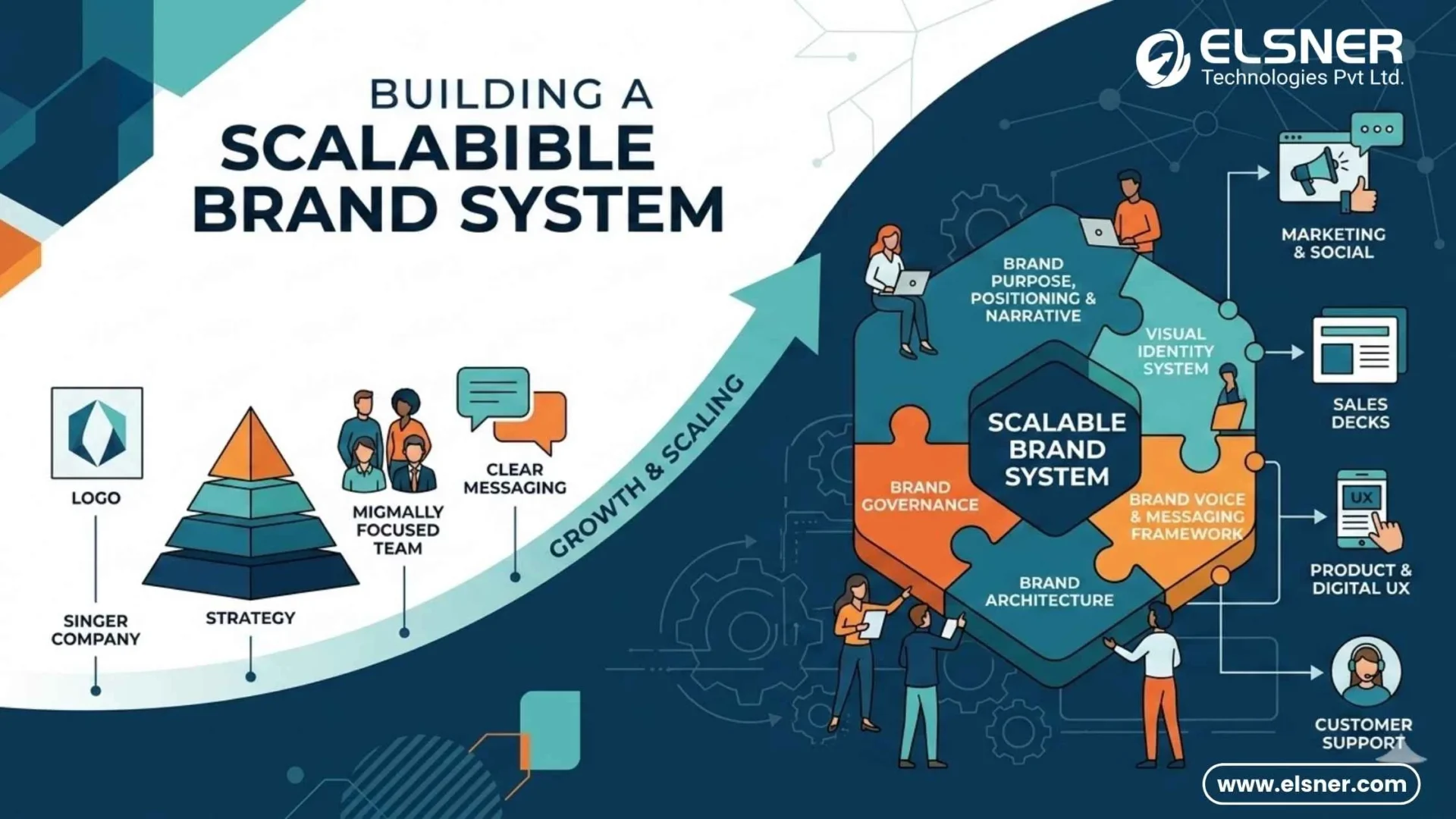
- What a Brand System Actually Is?
- What It Costs to Not Have a Brand Strategy?
- What Goes Into a Scalable Brand System?
- Brand Purpose, Positioning, and Narrative
- Visual Identity System
- Brand Voice and Messaging Framework
- Brand Architecture
- Brand Governance
- How To Build A Brand System? Step-by-Step Guide
- How To Maintain Brand Consistency At Scale?
- Mistakes That Break Brand Systems
- Where Brand Reputation Management Services Fit?
- Signs the Current System Needs Work
- Conclusion
- Need Help Building a Scalable Brand System?
- FAQs
- What is a brand system, and why is it important?
- How is a brand system different from brand guidelines?
- How do scalable brand systems help growing businesses?
- When should a company invest in brand reputation management services?
- How do you maintain brand consistency across teams?
- Can brand systems evolve over time?
- What are common brand management mistakes?
- How long does it take to build a brand system?
- Do small businesses need a brand system?
Most brands launch with real clarity. Sharp messaging. Tight visuals. A team that knows what the company stands for.
Then growth kicks in, and things start slipping.
New hires join who weren’t around for the original brand conversations. Different people brief agencies differently. Products multiply. Markets expand. And somewhere in the middle of all that movement, the brand starts showing cracks.
The brand strategy signs are painfully familiar:
- Sales decks that look nothing like the website
- Social posts that sound like three different companies wrote them
- Marketing assets rebuilt from scratch because nobody knows where the originals went
- Customer-facing teams giving slightly different answers about what the company actually does
None of this is one person’s fault. It happens because no structure existed to keep the brand strategy together as the business scaled.
Here’s the thing: a brand doesn’t scale on its own. The system behind it does. The frameworks, tools, governance structures, and rules that hold everything consistent regardless of how fast the organization grows. Strong branding also makes it easier for businesses to measure important eCommerce metrics tied to marketing performance and growth. That’s what this guide is about.
What a Brand System Actually Is?
Ask most people, and they’ll say a brand system is a logo, a color palette, maybe a PDF style guide. That’s brand identity. A brand system is a different thing altogether.
|
Term |
What It Covers |
|
Brand Identity |
Visual elements — logo, colors, typography |
|
Brand Guidelines |
Rules for applying those elements |
|
Brand System |
The full operational framework of corporate branding. It includes strategy, messaging, governance, and how brand decisions get made across the business |
Brand guidelines tell someone what the logo should look like. A brand system tells the whole organization how to think, communicate, and act as the brand — at any scale, in any market, through any channel.
That gap between the two is where most growing businesses get into trouble.
What It Costs to Not Have a Brand Strategy?
Growth adds complexity. A brand system handles that complexity before it handles the business.
Without one, the damage shows up in places that don’t always look like brand problems:
- Hours lost recreating assets that should already exist
- Customers are hitting different versions of the brand at every touchpoint
- Marketing spend absorbed by rework and campaigns that don’t align
- Brand distinctiveness slowly eroding — until recovery feels like starting over, which is why many companies eventually invest in online reputation management to rebuild trust and protect their brand perception.
Growth without a brand system leads to brand dilution. It doesn’t happen overnight. It happens steadily, quietly, until it’s hard to ignore.
A proper scalable brand management approach gives every team the guardrails to move fast without pulling the brand apart. It cuts onboarding time. It protects equity that took years to build.
What Goes Into a Scalable Brand System?
Brand Purpose, Positioning, and Narrative
Everything else in the system sits on top of this. Strategy first. Always.
| Element | What It Defines |
| Mission and Vision | Why the business exists and where it’s heading |
| Value Proposition | What makes it different, and why customers should actually care |
| Target Audience | Who it’s built for and what influences how they decide |
| Competitive Positioning | How it’s perceived differently from every real alternative |
Skip this layer, and the rest of the brand identity system has no anchor. Visuals look polished. Messaging still feels empty.
Visual Identity System
This goes beyond the logo. A visual identity system is the complete design language. It contains every element that makes the brand recognizable across any surface.
That means:
- Logo variations, spacing rules, and clear misuse examples.
- Full color system with primary, secondary, and functional palettes — exact values included.
- Typography hierarchy for headlines, body copy, and digital interfaces.
- Supporting elements — photography style, icon system, illustration direction, layout structure.
The target is recognizability with flexibility. Solid enough to stay consistent. Adaptable enough to work across different platforms, products, and markets without losing its shape.
Brand Voice and Messaging Framework
Every brand already has a voice. The real question is whether it’s intentional or just whatever comes out when different people write different things.
A messaging framework makes it consistent across every context:
- Tone of voice — The actual personality behind the words. Direct? Warm? Authoritative? It needs to be defined clearly, not left open to interpretation
- Messaging hierarchy — Core messages first, supporting claims second, proof points after that
- Channel adaptation — Tone shifts from a LinkedIn post to a support email to a product page. That’s normal — but the shifts should be intentional.
- Internal vs. external language — What the brand says publicly and how the team communicates internally aren’t always the same thing.
Without this, the voice changes every time a new hire writes a caption or a new agency takes over a campaign, which can also weaken content consistency and impact search engine optimisation efforts across different channels.
Brand Architecture
As businesses grow and diversify, brand architecture becomes one of the most consequential decisions in the system. It determines how the master brand, sub-brands, and product lines connect — or don’t.
| Architecture Model | How It Works | Brand System Examples |
| Single Brand | Everything under one master brand | Apple |
| Endorsed Brand | Sub-brands carry the parent’s credibility | Marriott Bonvoy |
| Multi-Brand | Independent brands with separate identities entirely | Procter & Gamble (P&G) |
Wrong architecture splits brand equity across too many directions. The right architecture keeps growth organized and the overall brand legible.
Brand Governance
Most companies build a decent identity system. Very few set up proper governance. That gap is usually what causes brand systems to eventually collapse.
Governance answers the questions that create operational chaos when left undefined:
- Who owns the brand and makes final decisions?
- What needs approval, and what can teams handle independently?
- How does the system stay current as the business changes?
Good governance isn’t a process for its own sake. It’s the structure that lets teams move with confidence.
How To Build A Brand System? Step-by-Step Guide
| Step | What Happens | Why It Matters |
| Audit existing assets | Map what currently exists — visuals, messaging, guidelines | Reveals actual gaps and inconsistencies |
| Lock in strategy | Define positioning, audience, and differentiation | Everything else depends on this being right |
| Build identity systems | Develop visual and verbal consistency frameworks | Creates tools that teams will genuinely use |
| Write usable guidelines | Make rules practical and easy to apply | Guidelines nobody reads don’t function |
| Define governance | Assign ownership, set approval structures | Prevents brand decisions from becoming anyone’s call |
| Equip teams | Roll out templates, asset libraries, and onboarding | Reduces reliance on individual judgment |
| Review and evolve | Audit regularly, update the system | Keeps everything relevant as the business moves |
The most common mistake is skipping straight to step three. Companies rush into design before the strategy underneath is solid. The result is a brand that looks sharp and says nothing distinctive.
How To Maintain Brand Consistency At Scale?
Consistency doesn’t come from constant oversight. It comes from building systems where the right action is also the easiest one.
When a brand system is genuinely embedded, teams don’t need sign-off for every move. They have the tools, templates, and clarity to act correctly without checking in.
That has to hold across every function:
- Marketing — Campaigns, content, and ads should feel like they come from the same source, since a consistent brand experience often plays a major role in improving conversion rate optimization across different customer touchpoints.
- Sales — Proposals and outreach need consistent messaging, not improvised versions
- Product and Digital — UX copy and interface design should reflect both voice and visual standards
- Customer Support — Every interaction is a brand experience, not just the marketing-facing ones
- Agencies and Partners — External teams need the same clarity as internal ones, or the system breaks at the edges
Brand consistency is operational infrastructure. The companies that get it right treat it the same way they treat any other business system.
Mistakes That Break Brand Systems
Most brand systems don’t fail at launch. They fail during rollout — or because they never got properly embedded into how work actually happens.
| Mistake | Why It Happens | What It Leads To |
| Guidelines too rigid | Fear of any deviation | Teams ignore them or route around them |
| No internal adoption | Weak rollout, no real training | The system lives in a document nobody opens |
| Design before strategy | Wrong starting point | Polished visuals, hollow messaging |
| No governance | Ownership never defined | Brand decisions made by whoever speaks loudest |
| Ignoring regional context | One-size-fits-all thinking | Brand feels tone-deaf in local markets |
Almost always the same pattern: strategy exists, operational embedding doesn’t. A brand system only works when real teams use it in real workflows.
Where Brand Reputation Management Services Fit?
Internal teams are built to execute. That’s their strength. But as brand complexity scales. You’ll get into newer markets and have more competing priorities. The strategic and governance demands tend to outgrow internal capacity.
Professional Brand Management Services fill that gap:
- Aligning leadership, marketing, and product teams on strategy — not just surface-level awareness of it
- Designing architecture and governance frameworks, the brand needs to actually function at scale
- Building systems that give teams clarity without slowing everything down in approvals
- Tracking brand health over time, not just at launch
For companies managing rapid expansion or already dealing with visible brand fragmentation, the difference between a system that holds and one that looks good in a deck often comes down to this kind of strategic support.
Signs the Current System Needs Work
Not every situation demands a full rebuild. But some signals are hard to rationalize away:
| Trigger | What It’s Telling You |
| Rapid headcount or revenue growth | Brand infrastructure hasn’t kept pace |
| Market or geographic expansion | The system wasn’t designed for where the company is now |
| Product line diversification | Brand architecture likely needs rethinking |
| Mergers or acquisitions | Brand integration requires real structural decisions |
| Visible inconsistency across touchpoints | The system has gaps or has already broken down |
| Declining brand perception | Equity is eroding. Waiting makes it harder to fix |
Two or more of these at once isn’t a coincidence. It’s a signal worth acting on before the problems stack up further, and many growing companies turn to brand management services to bring structure and consistency back into their brand systems.
Conclusion
Brands don’t break because companies grow too fast. They break because the infrastructure behind the brand stops keeping up.
Brand management best practices give every team what they need to represent the brand correctly and without constant direction. Less ambiguity. Less waste. Better protection for everything built over time.
Brand management isn’t a project with a delivery date. It’s a business function that needs ongoing attention.
Need Help Building a Scalable Brand System?
If your brand is growing but consistency is starting to slip, our brand management experts can help you design a structured brand system with clear strategy, messaging, and governance.
FAQs
What is a brand system, and why is it important?
A brand system is the complete framework defining how a brand looks, sounds, and behaves across every touchpoint. Without one, consistency breaks down as the business scales, and inconsistency erodes the trust that growth depends on.
How is a brand system different from brand guidelines?
Brand guidelines document the rules for visual and verbal identity. A brand system is the broader structure. It involves strategy, governance, architecture, and messaging. It’s the processes that hold everything together at scale.
How do scalable brand systems help growing businesses?
Brand system for growing companies cuts wasted effort and speeds up execution. It helps to create consistent customer experiences and protect brand equity. All these things get significantly harder to manage without a proper structure.
When should a company invest in brand reputation management services?
When internal capacity is stretched, inconsistency is showing up across channels, or the business is adding complexity that the current brand structure wasn’t built to handle.
How do you maintain brand consistency across teams?
Through shared guidelines, centralized asset libraries, defined governance, and onboarding that actually covers brand, so teams can work independently without going off-brand.
Can brand systems evolve over time?
They have to. A system that never updates becomes a constraint. Regular audits and reviews keep it relevant as the business and market shift.
What are common brand management mistakes?
Leading with design before strategy, skipping governance, building guidelines nobody uses, and treating brand as a one-time project rather than an ongoing business function.
How long does it take to build a brand system?
Most builds take 8 to 16 weeks, depending on size and complexity — covering strategy, identity, messaging, guidelines, and governance.
Do small businesses need a brand system?
Yes — scaled to where they are. Even a lean system covering positioning, visual identity, and tone gives smaller businesses something solid to grow from without the brand fragmenting later.