




- What is WooCommerce and What is PrestaShop?
- WooCommerce Overview
- PrestaShop Overview
- WooCommerce vs PrestaShop: Key Differences at a Glance
- Features Comparison – WooCommerce vs PrestaShop
- Product Management
- Payment Gateways
- Plugin and Module Ecosystem
- Multi-Store Capability
- SEO Features
- Pricing Comparison – Which Platform is More Cost-Effective?
- WooCommerce Costs?
- PrestaShop Costs
- Where Costs Sneak Up on You?
- Performance & Scalability Comparison
- WooCommerce vs PrestaShop Performance
- WooCommerce vs PrestaShop Scalability
- Pros and Cons of WooCommerce vs PrestaShop
- WooCommerce Pros & Cons
- PrestaShop Pros & Cons
- Which Platform is Better for Your Business?
- Choose WooCommerce if:
- Choose PrestaShop if:
- Quick Decision Matrix
- Real-World Use Cases
- Small Businesses
- Medium Enterprises
- International Ecommerce
- Content-Driven Ecommerce
- Migration Considerations
- When to Move from PrestaShop to WooCommerce?
- What to Plan For?
- Best Practices for Choosing the Right Platform
- Think long-term consequences
- Be honest about technical resources.
- Build a real cost model.
- Use the admin before you decide.
- Know where you’ll get support.
- Final Thoughts
- Frequently Asked Questions
Planning to build, migrate, or grow your online store? Picking a platform is harder than it looks.
Ask ten store owners what they use and why. You’ll get ten different answers. Most picked based on an old blog post or whatever their developer was comfortable with. Some are still quietly wondering if they chose right.
In 2026, WooCommerce vs PrestaShop is still one of the most Googled comparisons in ecommerce. Both platforms are widely used in modern Ecommerce Development Services, are open source, free to start, and come with tradeoffs that only become clear after long term use.
This blog provides a straight comparison so you can figure out which ecommerce platform is better for small business.
What is WooCommerce and What is PrestaShop?
You’d be surprised how many people jump straight into feature comparisons. But understanding what makes these two platforms different at a structural level matters more than any single feature.
WooCommerce Overview
WooCommerce is a free ecommerce plugin built on top of WordPress. It’s responsible for roughly 30% of all online stores globally.
The real appeal is the ecosystem.
Thousands of themes. Countless plugins. A developer community so large that help is almost always a few hours away.
If you mix content marketing with selling, WooCommerce fits that naturally.
But it’s still a plugin. Hosting, security, performance, updates everything is on you. More control means more responsibility. That’s the deal.
PrestaShop Overview
PrestaShop is a standalone open-source ecommerce platform. Unlike WordPress it wasn’t built on top of something else. It was designed from scratch with merchants in mind.
The platform comes with built-in product management, multi-language support, multi-currency handling and supplier tracking.
It tends to perform well for businesses with complicated catalogs or international ambitions. Non-technical users usually find it difficult at first. But developers tend to appreciate how structured and ecommerce-specific the codebase is.
The core difference between WooCommerce and PrestaShop really comes down to this: WooCommerce extends WordPress. PrestaShop stands on its own.
That single architectural fact drives almost every other comparison you’ll read below.
WooCommerce vs PrestaShop: Key Differences at a Glance
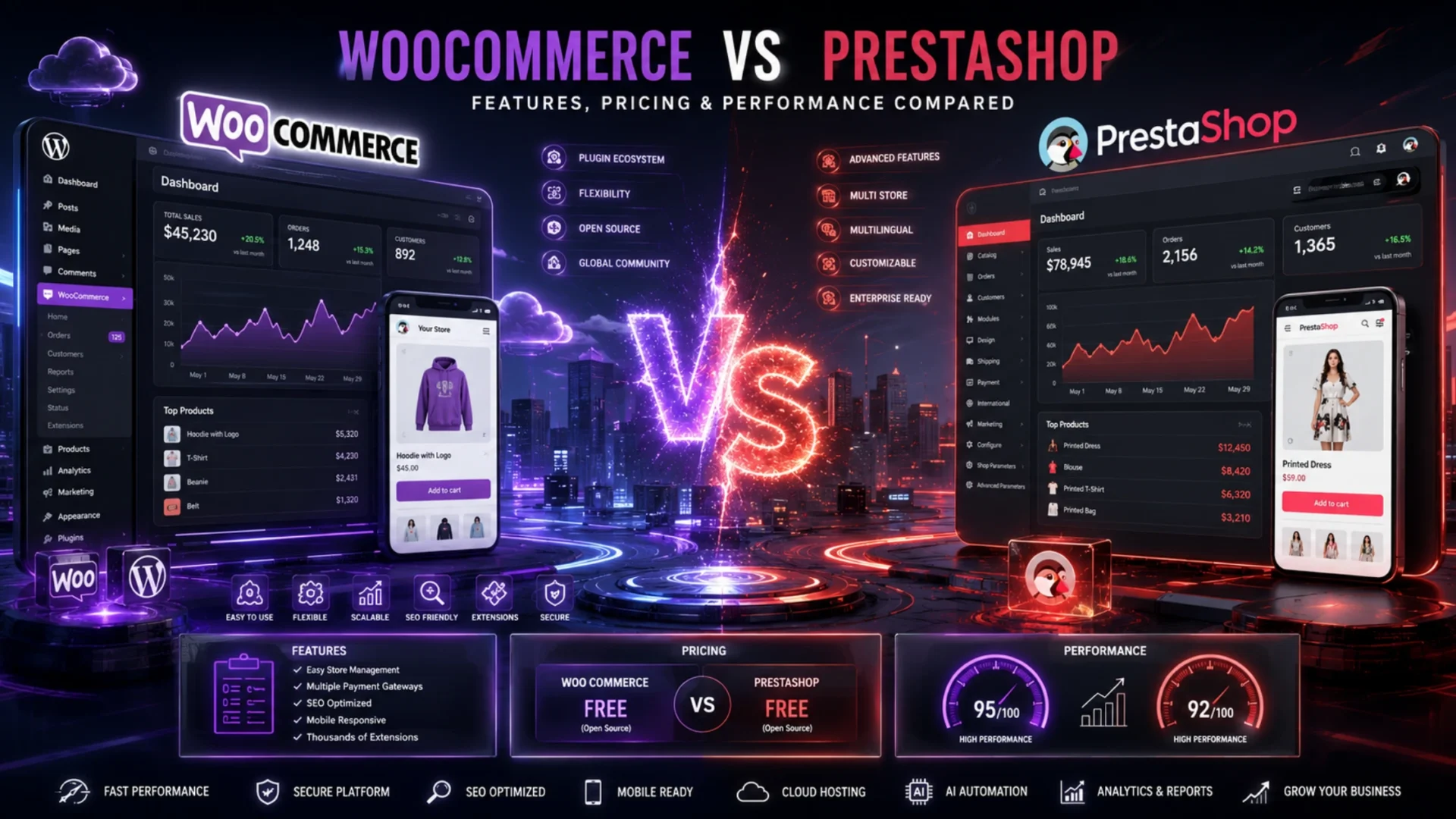
Here’s a quick WooCommerce vs PrestaShop comparison:
| Factor | WooCommerce | PrestaShop |
|---|---|---|
| Platform Type | WordPress plugin | Standalone ecommerce platform |
| Ease of Use | Familiar for WordPress users | Steeper learning curve |
| Customization | Extremely high (WordPress ecosystem) | High (ecommerce-focused modules) |
| Base Cost | Free (hosting + plugins add up) | Free (modules + development add up) |
| Performance | Depends on hosting and optimization | Generally leaner out of the box |
| Scalability | Scales well with proper hosting investment | Handles large catalogs natively |
| SEO | Excellent (Yoast, RankMath, etc.) | Good, fewer dedicated tools |
| Multi-language/Currency | Needs plugins | Built-in |
| Developer Availability | Large talent pool | Smaller but specialized |
| Best For | Content-driven stores, SMBs, US market | International, complex catalogs |
Features Comparison – WooCommerce vs PrestaShop
Product Management
WooCommerce product management runs through the WordPress admin. Simple products, variable products, digital downloads or subscriptions via extension. It handles the standard catalog types without much trouble.
Where it starts to show strain is high-volume, complex catalogs. The interface was designed for WordPress, not exclusively for merchants.
PrestaShop’s product management is more purpose-built. Standard features include:
- Combination attributes,
- Supplier management,
- Stock movement tracking.
If your catalog is complicated, PrestaShop handles it more cleanly.
Verdict: PrestaShop has the edge for catalog complexity. WooCommerce is more than enough for simpler setups.
Payment Gateways
Both platforms cover the major gateways like Stripe, PayPal, etc. WooCommerce has a wider selection of free and paid integrations because of the WordPress plugin library.
PrestaShop’s payment modules work well, but there are fewer of them.
WooCommerce Payments as a first-party option also simplifies managing payments, refunds, and disputes from a single dashboard. It is a convenience worth noting for smaller teams.
Plugin and Module Ecosystem
This is where the WooCommerce vs PrestaShop features gap becomes hard to ignore.
WooCommerce sits on top of WordPress. You get access to 59,000+ plugins in the official repository. Email automation, A/B testing, loyalty programs, affiliate management and more. Many WooCommerce plugins have free tiers.
There are usually multiple options at different price points for whatever you need.
PrestaShop’s module marketplace has around 5,000 options. Still solid, but smaller. A lot of PrestaShop modules carry licensing fees. They start adding up once you need five or six of them.
Multi-Store Capability
PrestaShop handles multiple storefronts natively. Different languages, currencies, or catalogs are managed from one dashboard. For international businesses, this is a genuine operational advantage.
WooCommerce can do multi-site through WordPress Multisite. But the setup is more involved and the management experience isn’t as clean. It’s possible, just not seamless.
SEO Features
WooCommerce has the edge here.
WordPress was built for content, so SEO runs deep. Plugins like Yoast and RankMath give you full control over metadata, schema, breadcrumbs, and canonical URLs. That level of tooling is hard to match.
PrestaShop handles the basics fine. But to get anywhere near WooCommerce’s SEO depth, you’ll need extra modules. And even then, the gap doesn’t fully close.
Pricing Comparison – Which Platform is More Cost-Effective?
Both platforms are free to download. That’s also roughly where the free part ends for most real-world stores.
Here’s what PrestaShop vs WooCommerce pricing actually looks like when you factor in everything you need to run a functional store:
WooCommerce Costs?
| Cost Category | Estimated Range (Annual) |
|---|---|
| Hosting (quality managed) | $200 – $1,200+ |
| Domain | $10 – $20 |
| Premium theme | $50 – $150 (one-time) |
| Essential plugins (SEO, security, backups) | $200 – $600 |
| WooCommerce extensions | $100 – $800+ |
| Developer / maintenance | Varies |
PrestaShop Costs
| Cost Category | Estimated Range (Annual) |
|---|---|
| Hosting | $200 – $1,200+ |
| Domain | $10 – $20 |
| Theme | $100 – $300 (one-time) |
| Modules (marketing, language, checkout) | $500 – $2,000+ |
| Developer setup and customization | Typically higher upfront |
Where Costs Sneak Up on You?
WooCommerce’s hidden costs usually come from plugin sprawl. Each plugin feels like a reasonable $99/year decision. Stack ten of them and you’re looking at a meaningful annual line item, plus the occasional conflict when one updates and breaks another.
PrestaShop’s costs tend to land upfront. Features that come with free WordPress plugins often require paid PrestaShop modules. A well-featured PrestaShop build can cost more to launch than an equivalent WooCommerce store.
WooCommerce is the lower-cost entry for small businesses with tight budgets. For stores that need complex functionality from day one, PrestaShop’s module costs can still compete when you account for development time saved.
Performance & Scalability Comparison
WooCommerce vs PrestaShop Performance
WooCommerce performance lives and dies by hosting quality and optimization. Out of the box, a WordPress install isn’t lean.
A bad plugin can slow your site down.
Good caching, a CDN, and managed hosting fix that. But you have to set it up yourself.
It won’t happen automatically.
PrestaShop runs leaner from the start. No CMS overhead means a faster baseline. For large catalogs, that difference is real.
WooCommerce vs PrestaShop Scalability
WooCommerce scales, but scaling costs money and effort. High-traffic stores need dedicated or cloud hosting, database tuning, and sometimes custom development to avoid hitting ceilings. None of that is beyond reach. It’s just not automatic.
PrestaShop handles large catalogs well natively. It’s been deployed in enterprise environments with hundreds of thousands of SKUs. The architecture was designed for ecommerce scale in ways that WooCommerce, as a plugin sitting on a CMS, has to work around.
If you’re launching with 10,000+ products or expecting serious traffic from the start, PrestaShop gives you a more stable foundation. If you’re scaling up gradually, WooCommerce with proper infrastructure gets you there too.
Pros and Cons of WooCommerce vs PrestaShop
WooCommerce Pros & Cons
Pros:
- Free core plugin, massive free extension library
- Seamless WordPress integration for content-heavy stores
- Largest ecommerce developer community available
- Unmatched SEO tooling via WordPress plugins
- Low barrier to entry for WordPress-familiar teams
- WooCommerce development services widely available at competitive rates
Cons:
- Performance needs active management: caching, hosting, optimization
- Plugin dependency creates update conflicts and security exposure
- Multi-language and multi-currency require plugins
- Plugin subscriptions stack up fast
- Scaling means real hosting investment
PrestaShop Pros & Cons
Pros:
- Purpose-built for ecommerce with a cleaner architecture
- Native multi-language, multi-currency, multi-store support
- Better baseline performance for large catalogs
- Strong international ecommerce capabilities
- Structured product and supplier management out of the box
Cons:
- Steeper learning curve for non-technical users
- Smaller module library than WooCommerce
- Many essential modules are paid
- Smaller developer pool, often higher hourly rates
- Content marketing workflows require extra effort
Which Platform is Better for Your Business?
The honest answer to “is PrestaShop better than WooCommerce” or vice versa? It depends on what you’re building, who’s building it, and what your store looks like in three years.
Choose WooCommerce if:
- You’re already on WordPress or building a content-plus-commerce site
- You’re a small business that wants to launch without heavy upfront costs
- Your team knows WordPress and doesn’t want a new learning curve
- You’re focused on a single market and don’t need multi-language from day one
- SEO and content are your primary traffic channels
- You want the broadest possible integration options
For most US-based SMBs, WooCommerce is the practical starting point. The ecosystem is mature, help is everywhere, and you can grow into complexity over time.
Choose PrestaShop if:
- You’re going international at launch: multiple languages, currencies, regions.
- Your catalog is large and complicated from the start.
- You want a standalone ecommerce platform without CMS overhead.
- Your team has PrestaShop experience or you’re working with a PrestaShop development services agency.
- Multi-store capability is a hard requirement.
PrestaShop fits mid-size businesses with international scope and catalog complexity. It’s not the easiest platform to run, but it handles the things it was designed for very well.
Quick Decision Matrix
| Your Situation | Better Fit |
|---|---|
| Small US-based store, tight budget | WooCommerce |
| Blog and store combined | WooCommerce |
| International store, multi-language | PrestaShop |
| 10,000+ SKUs from day one | PrestaShop |
| Existing WordPress team | WooCommerce |
| Complex product variants and suppliers | PrestaShop |
| Content-led ecommerce strategy | WooCommerce |
Real-World Use Cases
Small Businesses
For a boutique retailer, solo DTC brand, or a service business adding a shop, WooCommerce is usually the right call. Costs are manageable. WordPress is familiar. You can add functionality as your needs grow rather than paying for a full feature set on day one. Most realistic WooCommerce vs PrestaShop comparisons for small business land here.
Medium Enterprises
At this level, both platforms can handle the load. The decision comes down to team expertise and existing infrastructure more than anything inherent to the platforms. A business with a strong WordPress development bench should stay in that ecosystem. A business starting fresh with a more technical team might find PrestaShop’s structured architecture easier to manage at scale.
International Ecommerce
PrestaShop earns its reputation here. Native multi-language, multi-currency, and regional tax handling make it the cleaner solution for cross-border selling. Getting the same setup in WooCommerce is possible, but you’re stitching together plugins that don’t always coordinate well.
Content-Driven Ecommerce
WooCommerce wins this one without much debate. If your store depends on blog content, buying guides, and organic search to drive traffic, you want to be on WordPress. The connection between content and commerce is natural in ways PrestaShop can’t replicate without extra work.
Migration Considerations
When to Move from PrestaShop to WooCommerce?
Not every platform choice turns out to be the right one. Common reasons businesses decide to migrate from PrestaShop to WooCommerce include:
- The store has shifted toward content marketing and PrestaShop’s limitations are slowing things down
- Module costs have grown and the WooCommerce ecosystem looks more cost-effective at current scale
- The dev team has stronger WordPress expertise and PrestaShop maintenance is becoming friction
- US market focus makes WooCommerce integrations more practical
What to Plan For?
Data migration is where most migrations get complicated. Products, customer records, order history, URLs, and SEO data all need to transfer cleanly. URL structure changes in particular can hit search rankings if redirects aren’t handled correctly.
A proper migration covers:
- Products and categories. Consider attributes, variants, images, descriptions
- Customer and order history
- SEO continuity
- Integration resets (Email platforms, analytics, payment gateways)
Rushing the process costs more than doing it right. If you’re considering a move, get a technical audit first before locking in a timeline and then hire WooCommerce developers.
Best Practices for Choosing the Right Platform
Here’s how to approach the ecommerce platform comparison for business before committing:
Think long-term consequences
Pick the platform that handles your expected scale, not just where you are now.
Be honest about technical resources.
Both platforms need ongoing technical work. If you don’t have in-house developers, factor in agency availability and cost. WooCommerce developers are easier to find and generally less expensive than PrestaShop specialists.
Build a real cost model.
Add up hosting, plugins or modules, development, and maintenance over three years. The free label on both platforms can be misleading.
Use the admin before you decide.
Both platforms can be tested locally or on staging environments. Spend a few hours in each backend. The one that frustrates you less is worth something.
Know where you’ll get support.
Community size, documentation quality, and developer availability all affect how fast you can solve problems. WooCommerce’s community is bigger; PrestaShop’s is more specialized.
Final Thoughts
WooCommerce is the right starting point for most small and mid-size US-based businesses, especially if content and SEO are driving your growth. The ecosystem is larger, developers are easier to find, and getting started costs less.
PrestaShop is the better fit when you’re selling internationally from day one, managing a large or complex catalog, or working with a team that already knows the platform.
The WooCommerce vs PrestaShop comparison doesn’t produce a universal winner. It produces the right answer for your store, your team, and what you’re trying to build over the next few years.
If you’re still weighing the WooCommerce vs PrestaShop pros and cons, Elsner’s team has helped hundreds of businesses work through this exact decision. Whether you need WooCommerce development services, PrestaShop development services, or just a second opinion before committing, we’re worth a conversation.
Ready to build or migrate? Talk to Elsner’s ecommerce team and get platform guidance tailored to your business.
Frequently Asked Questions
What is the difference between WooCommerce and PrestaShop?
The difference between WooCommerce and PrestaShop is structural. WooCommerce is a plugin built on WordPress. It’s the part of a broader content management ecosystem. PrestaShop is a standalone ecommerce platform built for selling specifically. That shapes how you handle content, multi-language stores, development, and where you find help.
Which is better: WooCommerce or PrestaShop?
No platform wins across the board. WooCommerce is the stronger choice for content-led stores, US-focused businesses, and teams with WordPress experience. PrestaShop fits international ecommerce, complex catalogs, and businesses that want ecommerce-specific architecture. The right answer for “PrestaShop or WooCommerce which is better” depends entirely on your situation.
Is WooCommerce cheaper than PrestaShop?
WooCommerce usually costs less to start. The core plugin is free and basic stores can launch with minimal plugin spend. PrestaShop’s module costs tend to run higher upfront for comparable features. Over a three-year window, PrestaShop vs WooCommerce pricing looks more similar than the initial costs suggest. Both accumulate meaningful ongoing costs.
Which platform performs better for large stores?
For large catalogs and high traffic, PrestaShop typically handles the baseline load more efficiently. Its architecture was designed for ecommerce at scale. WooCommerce can absolutely reach the same level, but it takes deliberate infrastructure investment. On straight WooCommerce vs PrestaShop performance, PrestaShop has a structural edge out of the box.
Can I migrate from PrestaShop to WooCommerce?
Yes, and it’s a well-worn migration path. The areas that need the most care are data transfer, URL redirect mapping to protect search rankings, and reconfiguring integrations. A well-handled migrate from PrestaShop to WooCommerce project typically runs four to eight weeks depending on catalog size. Cutting corners on the SEO side tends to cost organic traffic for months afterward.