




- What is WordPress Custom Theme Development?
- When Do You Need a Custom WordPress Theme?
- WordPress Theme Development Cost Breakdown
- The Development Process: A Realistic Timeline
- Cost by Types of Business: US Market Estimates
- Hidden Costs in Custom Theme Development
- Red Flag Checklist for Evaluating Proposals
- Custom WordPress Theme Development vs Premium Theme
- Long-Term Value: What You Actually Pay For
- Conclusion
- FAQs
- What is a custom WordPress theme?
- How much does a custom WordPress theme cost in the USA?
- How long does it take to develop a custom WordPress theme?
- Do I need a custom theme or will a premium theme work for my business?
- What is the difference between a custom theme and a child theme?
- Who owns the WordPress theme code after the project is complete?
- What is the difference between custom WordPress theme development and WordPress theme customization?
- How much does it cost to hire a WordPress theme developer in the USA?
- How long does custom WordPress theme development take?
- Is custom WordPress theme development worth it for small businesses?
- What is the difference between a custom WordPress theme and a page builder like Elementor or Divi?
- Can I update my website content without a developer after custom theme development?
- What should I look for when hiring a custom WordPress theme development agency?
⚡ Quick Answer
How Much Does Custom WordPress Theme Development Cost in the USA?
A custom WordPress theme development in the US costs between $1,500 and $40,000+ depending on build type: child theme customization, semi-custom, or fully custom from scratch. Most US small businesses spend $5,000 to $15,000. Build time ranges from 4 to 16 weeks. Elsner Technologies has delivered 650+ WordPress projects across the US since 2006.
Custom WordPress theme development means building a theme coded specifically for your business, not modifying a $60 marketplace template. Done right, it gives you full design control, faster load speeds, and a codebase that scales with your business. Done wrong, it costs twice as much and delivers half the results.
At Elsner Technologies, we have built custom WordPress themes for 650+ clients across the US since 2006, from local service businesses spending $5,000 to enterprise SaaS platforms investing $50,000+. This guide breaks down exactly what custom theme development costs, what drives those costs up or down, and how to evaluate any proposal you receive.
Quick context: “Customizable” is a spectrum rather than a single product. The price difference between three main approaches can be $3,000 to $40,000. The right choice depends entirely on what your business actually needs, not on what sounds best in a proposal.
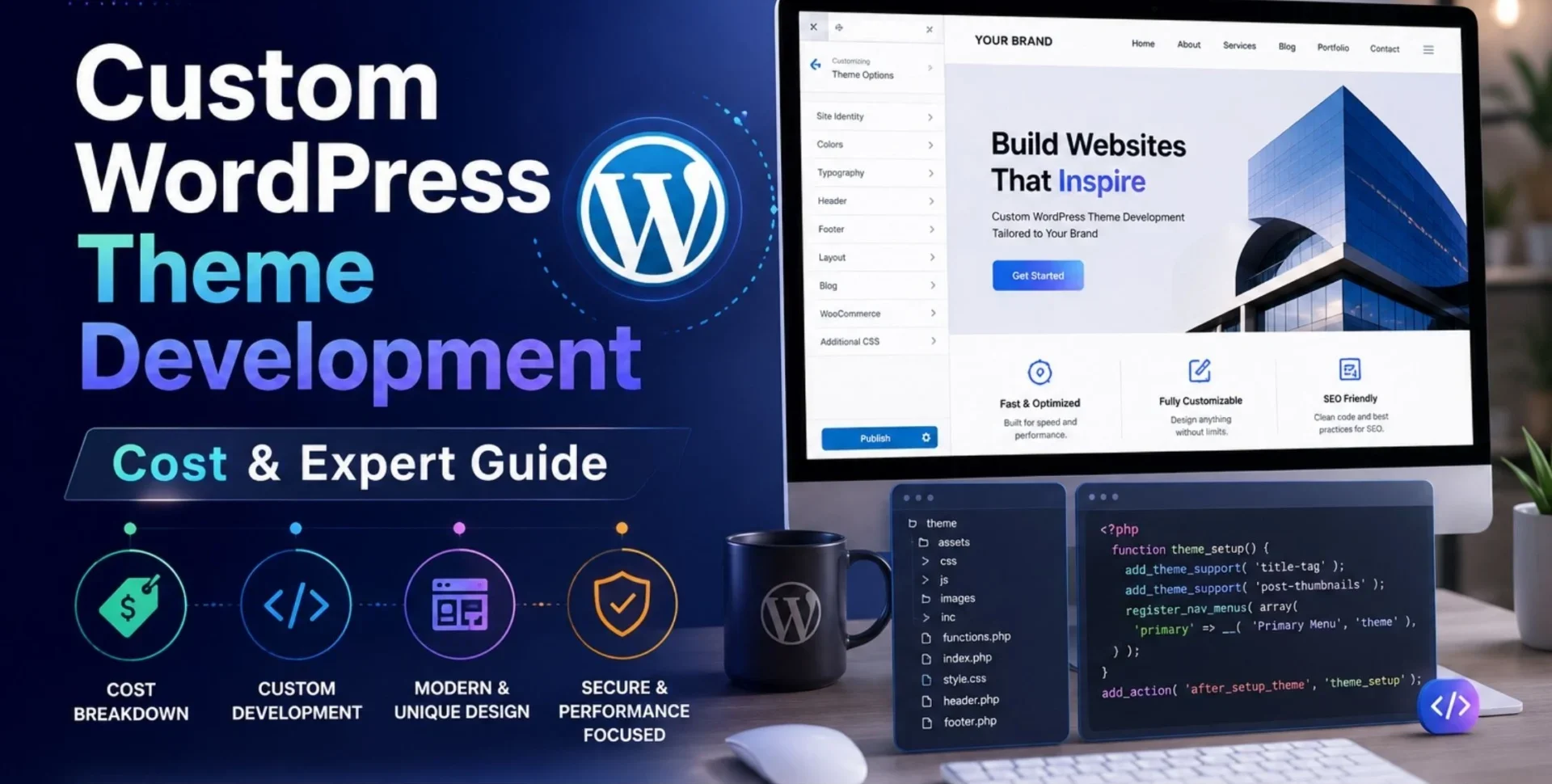
What is WordPress Custom Theme Development?
Before signing a contract, be aware that “customizable” is a spectrum rather than a single product. When it comes to WordPress custom theme development, three clear-cut levels exist:
|
1
|
The Truly Custom Theme (built from scratch)This is a completely custom-built theme, typically based on a starter theme such as Underscores or a custom boilerplate. There isn’t a pre-designed system, such as Divi or Elementor, in the background. Every design choice is purposeful, every pixel is tailored to your needs, and there’s not an ounce of bloat. |
|
2
|
Modified Premium ThemeThe agency purchases one commercial theme (such as GeneratePress, Astra, or Avada) and customizes it to your brand guidelines. This is quicker and much cheaper, but it creates long-term technical debt because you are reliant on the initial theme author for updates. |
|
3
|
Child Theme CustomizationThis means changing a few lines of CSS or functions in the existing theme, and it is a safe way to modify it. It’s the simplest level of development, good for small changes but not for a full rebrand or a big business site. |
When Do You Need a Custom WordPress Theme?
This is the question most agencies don’t answer, because it often results in a smaller project fee. However, being transparent yields stronger long-term results. Here is the honest decision framework.
When a Premium Theme with Customization is the Right Choice
For a whole lot of US-based businesses, custom WordPress website design does not mean starting from scratch. Go for a customized premium theme if:
- Your website is primarily informational with standard pages (Home, About, Services, Blog).
- You are a small business or start-up with an overall budget of less than $8,000.
- You don’t have custom content types (e.g., complex, searchable databases) or custom features.
- You need urgency and must get the site up within a 4- to 6-week window.
When WordPress Theme Development is Genuinely Justified
There are specific scenarios where a bespoke build is the only way to achieve your ROI. You need a custom WordPress theme if:
- Unique Content Architecture: Your business deals with custom content types that don’t work well in any off-the-shelf theme — for example, a real estate site with MLS filters, a job board with multiple filters, or a multi-vendor marketplace.
- Total Brand Control: You have an exquisite design language or a luxury brand look and feel that would be compromised by anything less than full customization.
- Performance as a Priority: You’re building a high-volume site where every millisecond counts. Truly custom themes can be 2–3x faster than premium themes, since they load only the code they need.
- Complex Integrations: You want a complex, bi-directional integration between your CRM (such as Salesforce), an ERP, or a proprietary data system that requires custom template logic.
The Honest Middle Ground
Here’s the reality: most US businesses fall somewhere in between. A hybrid approach — like a premium theme plus selective customization — often delivers 90% of the functionality at half the cost. This is especially true for growing businesses that need flexibility but aren’t yet at the scale where full customization makes financial sense. You can always transition to a fully custom solution later once your requirements become more complex.
From Our Experience
At Elsner Technologies, roughly 60% of US clients who come to us asking for a fully custom theme actually need a semi-custom build. A well-structured semi-custom theme built on a clean starter framework delivers 90% of the performance and design control at nearly half the cost. We always recommend the right solution for your budget, not the most expensive one.
WordPress Theme Development Cost Breakdown
Pricing for custom WordPress theme varies based on complexity, the developer’s seniority, and the specific needs of the American market. Before you hire WordPress theme developer talent, it’s important to align your business goals with the appropriate tier.
|
1
|
Tier 1: Child Theme / Premium Theme Customization $1,500 – $5,000What you get: Integrating your brand colors and font pair, some basic layout/styling adjustments, homepage customization, and mobile responsiveness fine-tuning. What you do not get: An original design system, custom post type templates, or performance-optimized code architecture. Who it is for: Local service agents, solopreneurs, and small early-stage startups. |
|
2
|
Tier 2: Semi-Custom Theme $5,000 – $15,000What you get: Custom design mockups in Figma, a theme developed using a starter framework, custom page templates, and Advanced Custom Fields (ACF) integration for flexible content management. What you do not get: Full custom architecture built from scratch, or complex dynamic features (like custom API endpoints). Who it is for: Growing SMBs and professional services firms wanting a distinct web presence. If you want to hire WordPress theme developer talent at this level, you should expect a portfolio of unique, non-templated sites. |
|
3
|
Tier 3: Fully Custom Theme $15,000 – $40,000+What you get: A theme built entirely from scratch, custom block development for the Gutenberg editor, a full design system, and a performance-optimized code base. This often includes custom WordPress development tasks, such as REST API integrations or headless capabilities. What you do not get: Speed. Fully custom builds take much longer and come with rigorous QA cycles. Who it is for: SaaS platforms, high-traffic publishers, and enterprises with complex UX needs. |
Who Should You Hire? Freelancer vs Small Agency vs Elsner Technologies
| Factor | Freelancer | Small Agency | Elsner Technologies |
|---|---|---|---|
| Typical Cost | $1,500 to $8,000 | $8,000 to $20,000 | $5,000 to $40,000+ |
| Timeline | 4 to 8 weeks | 6 to 12 weeks | 4 to 16 weeks |
| Design System | Rarely included | Sometimes included | Always included |
| Core Web Vitals Optimization | Rarely included | Sometimes included | Always included |
| Post-Launch Support | Limited or none | 30 to 60 days | Dedicated support plans |
| US Market Experience | Varies | Varies | 650+ US projects since 2006 |
| Code Ownership | Usually yours | Usually yours | 100% yours |
| Best For | Simple sites, tight budgets | Mid-size projects | SMBs to enterprise, US market |
The Development Process: A Realistic Timeline
WordPress theme development is a linear process. Any agency that gives you a quote of under 8 weeks for a full custom theme is either using a pre-made starter template or cutting corners on testing.
From Our Experience
In our 650+ WordPress projects delivered since 2006, the most common reason for missed deadlines is an under-scoped discovery phase. US clients who invest 1 to 2 weeks upfront on proper requirements gathering consistently see smoother builds and fewer costly revision rounds. We build this discovery phase into every project at Elsner Technologies as a non-negotiable first step.
A useful rule of thumb: Total Realistic Timeline: 10 to 16 weeks. Any agency promising delivery in under 8 weeks for a full custom build should be asked to clarify their process in detail.
Cost by Types of Business: US Market Estimates
Here’s the realistic range across the most common types of websites. Before you hire WordPress theme developer talent, it’s important to align your business goals with the appropriate tier.
Elsner Technologies
Not Sure Which Build Tier Fits Your Budget?
We have delivered 650+ custom WordPress projects for US businesses since 2006. Share your requirements and get an honest, no-pressure cost estimate within 24 hours.
Hidden Costs in Custom Theme Development
The initial quote rarely reflects reality. To plan your budget accordingly, take these additional costs into account:
|
1
|
Design Revision Rounds $75–$150 per hourMost proposals include two rounds of revisions. If your stakeholders cannot agree on a design, additional rounds are often billed hourly at $75 to $150 per hour. |
|
2
|
License Fees approx. $149/year per toolTools like Advanced Custom Fields (ACF) Pro are essential for custom themes but require annual licensing, which is often not included in the build cost. |
|
3
|
Gutenberg Block Development $2,000–$8,000 extraIf you want your team to drag and drop custom content, your developers will need to create custom blocks. This can add a significant cost to a project. |
|
4
|
Performance Optimization Often not included by defaultCore Web Vitals optimization is often not included by default. Many agencies deliver a functional theme but skip advanced performance tuning — proper asset loading, image optimization at scale, and caching strategies — leading to poor real-world speeds once the site goes live. |
|
5
|
Browser and Device QA Frequently under-scopedThorough cross-browser and real-device testing is frequently under-scoped. Proposals may mention “mobile responsive” but often don’t include exhaustive QA across older browsers, various Android devices, or iOS versions. Issues discovered post-launch usually result in additional support tickets and costs. |
|
6
|
Post-Launch Maintenance 15–20% of build cost annuallyCustom themes aren’t “set and forget.” You will need WordPress support packages for security updates and for ongoing issues with browser compatibility. Budget 15–20% of the initial build cost annually for maintenance. |
From Our Experience
Based on our project data, US businesses typically underestimate their total custom WordPress theme budget by 25% to 35% when they do not account for post-launch costs like performance optimization, content migration, and ongoing plugin licensing. At Elsner Technologies, we provide a full cost breakdown upfront so there are no surprises after go-live.
Red Flag Checklist for Evaluating Proposals
Before you hire any custom WordPress theme development services, run their proposal through this checklist to ensure you aren’t being overcharged for a glorified template.
- Code Ownership: Who gets the code at the end of the job? You should have the IP completely.
- Design Delivery: Do they provide Figma or Adobe XD design source files in the design handoff along with the code?
- The “Framework” Question: Does the proposal specify whether the theme is built from scratch or uses a builder like Elementor? If they use a builder, the price should be lower.
- Staging Environment: Are you provided with a staging (test) environment so you can view the work before making it live?
- Content Management: Will you be able to edit the site yourself using Gutenberg, or will you need to call a developer for every text change?
- Post-launch support clarity: Is ongoing support clearly defined in the contract (included hours or completely extra)?
- Gutenberg editing independence: Will your team be truly independent with custom blocks, or will even simple layout changes need developer intervention?
- Track Record: Has the agency previously delivered custom themes for sites with similar traffic and/or complexity?
Custom WordPress Theme Development vs Premium Theme
The choice between a custom WordPress theme development vs premium theme often comes down to the “Builder vs. Coder” debate.
For most mature U.S. businesses, a custom theme built with Gutenberg blocks is the best of both worlds: enough flexibility for your editorial needs without the performance degradation of a heavy page builder.
Read More: For a complete breakdown of overall WordPress project budgets, see our detailed WordPress website development cost guide for US businesses.
Long-Term Value: What You Actually Pay For
One aspect rarely discussed is long-term cost efficiency. A cheaper theme today can become expensive tomorrow due to limitations, performance issues, and frequent rebuilds. On the other hand, a well-structured semi-custom or custom theme can scale with your business.
Will Your Site Easily Support New Features?
A custom or semi-custom theme is built with extensibility in mind. Adding new content types, integrations, or functionality is straightforward rather than a workaround.
Can Your Team Manage Content Without Developers?
Properly built Gutenberg-based themes empower editors to create and manage content independently, removing the bottleneck of developer dependency for everyday updates.
Will Performance Hold Up as Traffic Grows?
Truly custom themes load only the code they need, making them 2–3x faster than bloated premium themes. This performance advantage compounds as your traffic scales and Google continues to weight Core Web Vitals in rankings.
Ready to Build a WordPress Theme That Fits Your Business?
Elsner Technologies has delivered 650+ WordPress builds since 2006, from local service businesses to high-traffic enterprise platforms. Get a transparent, honest recommendation on the right build tier for your goals — no padded quotes, no one-size-fits-all proposals.
| 650+ Projects Delivered | US Market Focused | Response Within 24 Hours |
Conclusion
For a typical US business, a semi-custom theme priced between $8,000 and $18,000 strikes a good balance between brand differentiation, development quality, and long-term maintainability. A fully custom WordPress theme development is the right decision if your content structure, UX complexity, or performance needs cannot be met with anything else.
If you’re evaluating custom WordPress development and want a clear, honest recommendation, explore our WordPress development services to get practical guidance tailored to your needs.
Our team at Elsner has delivered 650+ WordPress projects for US businesses since 2004. Match the build tier to the actual business goals — and treat your theme as the foundation for everything you’re trying to build online.
FAQs
What is a custom WordPress theme?
A custom WordPress theme is the process of creating a unique website skin and functional architecture from scratch or a minimal starter framework. Unlike using a pre-made premium theme, this approach ensures the code is written specifically for your business needs, resulting in better performance, a unique design, and superior security. It involves professional UI/UX design, PHP coding, and integration with the WordPress core.
How much does a custom WordPress theme cost in the USA?
In the USA, custom WordPress theme pricing generally starts at $5,000 for a semi-custom design and can exceed $40,000 for a fully custom enterprise design. Price-affecting elements include the complexity of the design, the number of unique page templates, custom Gutenberg block development, and third-party API integrations. Most mid-sized businesses spend between $10,000 and $20,000 for a high-quality build.
How long does it take to develop a custom WordPress theme?
The creation of a bespoke WordPress theme generally takes 10 to 16 weeks from start to finish. This includes discovery, wireframing, high-fidelity design, front-end and back-end development, and exhaustive QA testing. While small projects can be done in 8 weeks, complex enterprise sites with large-scale custom functionality can take 6+ months to ensure stability and performance.
Do I need a custom theme or will a premium theme work for my business?
A premium theme will do the job for a small business or a blog with a modest commercial purpose and a tight budget. Nevertheless, you should choose WordPress theme development if you want a distinct brand identity, high-speed performance, or special features that pre-built themes can’t offer. If your site needs to handle heavy traffic or complex data, custom development is the safer bet for the long term.
What is the difference between a custom theme and a child theme?
A custom theme is an independent set of files built specifically for a website, while a child theme is a layer that sits on top of an existing parent theme. Child themes are used to make minor CSS or functional tweaks without losing those changes when the parent theme updates. Custom themes offer full control over every line of code, whereas child themes are constrained by the parent theme’s structure.
Who owns the WordPress theme code after the project is complete?
The ownership of the theme source code is outlined in your contract, but the general rule of thumb is that the client owns the IP for any custom code for which a payment has been received in a professional engagement. Most US agencies provide the design source files and the theme repository to the client. It is essential to ensure you are not locked into a proprietary agency platform and that you have full admin access to your own code.What is the difference between custom WordPress theme development and WordPress theme customization?
What is the difference between custom WordPress theme development and WordPress theme customization?
Custom WordPress theme development means writing a theme from scratch in PHP, HTML, CSS, and JavaScript with no pre-built framework underneath. Theme customization means modifying an existing premium theme by changing colors, fonts, layouts, or adding CSS overrides. Custom development gives you full control and better performance. Customization is faster and cheaper but creates long-term dependency on the original theme author for updates and security patches.
How much does it cost to hire a WordPress theme developer in the USA?
Hiring a WordPress theme developer in the USA typically costs $75 to $150 per hour for a freelancer and $100 to $200 per hour for an established agency. For a fixed-price project, most US businesses pay $5,000 to $15,000 for a semi-custom theme and $15,000 to $40,000 for a fully custom build. Offshore agencies like Elsner Technologies offer US-quality work at significantly lower rates due to their India-based development teams with dedicated US client management.
How long does custom WordPress theme development take?
A custom WordPress theme typically takes 4 to 16 weeks depending on complexity. A simple semi-custom theme with 5 to 8 page templates takes 4 to 6 weeks. A fully custom theme with Gutenberg block development, complex integrations, and a complete design system takes 10 to 16 weeks. Any agency quoting under 4 weeks for a true custom build from scratch should be asked to clarify their process.
Is custom WordPress theme development worth it for small businesses?
For most small businesses in the US, a semi-custom WordPress theme is the better investment over a fully custom build. It delivers 90% of the performance and design control at roughly half the cost. A fully custom theme makes financial sense when your business has unique content architecture, complex integrations, or high traffic volumes where every millisecond of load time directly impacts revenue. If your annual revenue from the website exceeds $500,000, a custom build typically pays for itself within 12 months.
What is the difference between a custom WordPress theme and a page builder like Elementor or Divi?
A custom WordPress theme is hand-coded in PHP and does not rely on any page builder plugin. Page builders like Elementor and Divi generate bloated HTML and load multiple JavaScript frameworks that slow down your site. Custom themes regularly score 85 to 98 on Google PageSpeed mobile while page builder sites typically score 40 to 65. For businesses where SEO and Core Web Vitals matter, a custom theme gives a measurable ranking advantage over page builder sites.
Can I update my website content without a developer after custom theme development?
Yes. A properly built custom WordPress theme includes custom Gutenberg blocks or Advanced Custom Fields (ACF) that allow your team to update content without touching any code. At Elsner Technologies, every custom theme we deliver includes a content management training session and documentation so your team can manage pages, posts, images, and layouts independently after launch.
What should I look for when hiring a custom WordPress theme development agency?
When hiring a WordPress theme development agency, look for a portfolio of genuinely custom sites, not just premium theme modifications. Ask specifically whether they write themes from scratch or start from a marketplace theme. Verify they include Core Web Vitals optimization, cross-browser QA, and post-launch support in their base quote. Check whether they have delivered projects for US-based clients in your industry. Agencies with 5 or more years of WordPress-specific experience and verifiable client references are significantly lower risk than generalist web development shops.